The Paper Door · Grower · ages 6-8
Listen along
Loading audio…
Read by an AI-generated voice. The words on this page are the transcript.
1. The Print Shop
The hammer rang once. A spark jumped off the anvil and did not go out. It waited. They followed.
It bounced across the Green and into the print shop. It stopped on the long table, next to a square of paper.
"Fold me, I won't mind," said Kami.
"What shall we make?" asked Inkling.
"Start with something you know," said Kami. "Start with a little book."
They folded Kami in half, edge to edge, and pressed it like the cover of a book.
The last crease went flat, and the paper opened like a door.
2. A Garden With No Flowers
They stepped out onto a gravel path. There was a high wall, an apple tree, and rows of little flower beds.
The beds were empty. It was autumn, and the leaves were falling.
Under the apple tree, small children sat at a long table. Each child had squares of coloured paper. They were folding.
One leg of the table had been mended with a strip of tin. Beside it, someone had scratched a tiny hammer.
"Kuwana was a temple," whispered Lan. "This is a garden."
"A garden in Germany," said Kami softly. "Bad Blankenburg. The 1840s. They call this place a kindergarten. It means a children's garden."
An old teacher with grey hair sat at the end of the table. He was folding a paper star. He did not explain anything.
One boy sat apart from the others, beside an empty bed. He held one blue square.
"I'm Emil," he said. "My little sister Liese starts here tomorrow. She is scared. I wanted to give her a flower, but the flowers are all gone."
3. Torn Is Not a Flower
"I'll make her one!" said Lan. "I promise. Look, a flower is easy."
She took the blue square and began to tear a wavy edge with her fingers.
"Not all the way through, please!" said Kami, in a crackly voice. "A torn shape is just a flat scrap. Every fold makes me something new. Nothing has to be torn away."
Lan stopped. A tiny tear showed at one edge, no longer than a fingernail.
"I said easy before I checked," she said. "Sorry, Emil."
"It's only a little tear," said Emil. "It's still one square."
4. A Half
"Corners first, always," said Cornelia. "Make the corners meet exactly."
Emil turned the square into a diamond. He brought the bottom corner up to the top corner and held it there.
"Point to point, then hold," said Cornelia.
Now it was a triangle, two layers thick. Each layer was half of the square.
"It's a tulip!" said Inkling.
"It's a triangle," said Lan. "Tulips have petals."
Inkling laughed. She had named it too soon. "It is a half, though," she said. "I can name that."
5. The Same Line Twice
The teacher had left a folding card on the table. It showed a triangle with two dashed lines.
"Read the drawing before your hands move," said Mark. He traced the first dashed line. "This corner goes up, past the top point. That is one petal."
He traced the second line. "And here is the same line again, on the other side. Like a picture in a mirror."
"Every line on the drawing has a job," said Mark.
One line plus one line is two lines. Two petals.
6. The Crooked Petal
Emil lifted the left corner up past the top. It stood up like a little blue flame. One petal.
He lifted the right corner. It went up crooked. It leaned away from the first one.
"It doesn't match," said Emil. His mouth went wobbly.
"Crooked is just a first go," said Crinkle cheerfully. "Smooth it out and try again. The crease remembers."
Emil opened the crooked petal, gently. The old crease showed him where it had gone wrong. He folded it again, looking at the first petal this time.
Now the two petals matched, like the two sides of a butterfly.
7. A Flower That Stays
"Now press it flat," said Presso. "Run your thumbnail along the fold. A fold you press is a fold that stays."
Emil pressed each petal slowly and firmly.
He stood the tulip in the empty flower bed. It stood up.
Inkling looked at it for a long time. "It's three things," she said. "It's a flower. That's a thing you know. The petals match on both sides. That's beauty. And the triangle was a half. That's knowledge."
The old teacher looked up from his star and nodded, just once.
8. At the Gate
The next morning, Liese stood at the garden gate. She held her mother's hand very tightly.
Emil gave her the blue tulip. "It won't wilt," he said. "Not all winter."
Liese held it up. She let go of her mother's hand, just a little, and walked in.
Lan found a plain square in her pocket. They unfolded it flat, and the door closed behind them.
The spark dimmed to a warm dot and settled back on the anvil. The Green was just the Green again.
Back on the Green
In the print shop, Lan wanted to tear out a paper heart fast. She folded the paper in half first instead. Both sides came out the same.
Inkling held up a triangle. "It isn't a tulip yet," she said. "But it is a half."
Tell the story back to someone. What three things did one square become?
Saved. The next chapter will be here whenever you come back.
Who you met
-
 Kami Paper becomes a new shape with every fold, and it only cuts where it is told from CreaseTots
-
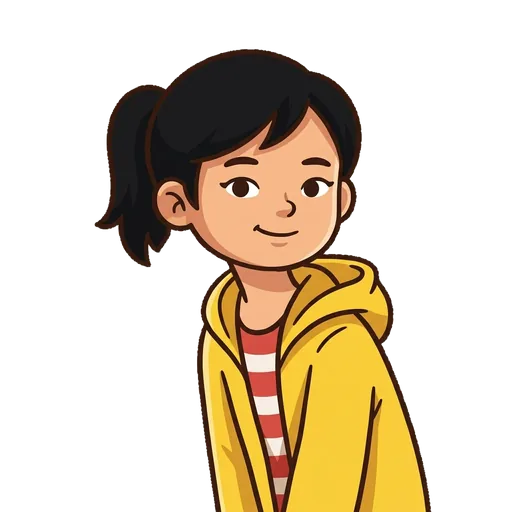 Lan a child of the Green Goes first; makes a friend in a minute
-
 Cornelia Bring one corner to meet the other corner, exactly from CreaseTots
-
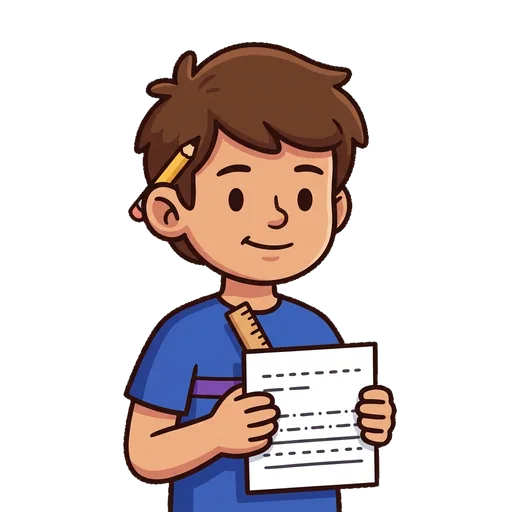 Mark The lines tell you what to do — dashes fold, solid lines cut from CreasePals
-
 Crinkle Smooth a crooked fold out and try again; the crease remembers from CreaseTots
-
 Presso Hold the paper still and press the fold flat so it stays from CreaseTots
-
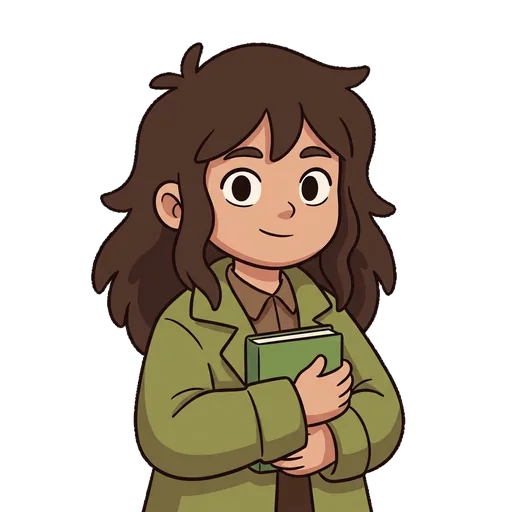 Inkling a child of the Green Names what she notices
Every recurring character has a short tune, so you can tell who is on stage before a word is said. The tunes play only when you tap, and the Reading Access sound switch turns them off.
The Honest Page
Which parts of this story are true, stretched or made up?
True
- Friedrich Fröbel opened a play school for small children in Bad Blankenburg, Germany, in 1837. In 1840 he gave it a new name: a kindergarten, a children's garden. Source
- Folding paper squares was one of the kindergarten's 'occupations', alongside weaving, cutting and clay. Source
- Kindergarten folding came in three kinds: folds of life (things you know, like boats and flowers), folds of beauty (patterns that match on both sides) and folds of knowledge, sometimes called folds of truth (halves, quarters and shapes). Source
- Historians are not sure how much of this folding Fröbel invented himself and how much came from his followers. Source
- Folding a square corner to corner once makes two layers, each half of the paper.
Stretched
- The teacher in our story folds a paper star and never says his name. What we simplified: Fröbel himself is kept in the background so the children and the cast solve the problem themselves; we do not know which teacher was in the garden on any one day.
- We put the tulip in Fröbel's garden. What we simplified: The tulip is a traditional fold often taught to young children; we have no record of this exact fold on a Blankenburg card.
Made up
- Emil, his sister Liese and the paper door are made up. Kami, Mark, Cornelia, Presso and Crinkle are our own characters.