The Paper Door · Reader · ages 6-8
Listen along
Loading audio…
Read by an AI-generated voice. The words on this page are the transcript.
1. A Spark and a Fortune Teller
The hammer rang once. A spark jumped off the anvil and did not go out. It waited. They followed.
It was a slow, sleepy afternoon on the Green. The baker had shut his shutters for an hour, and even the ducks on the pond were dozing with their heads under their wings. Lan had been lying on the grass complaining that nothing ever happened. Then the spark came, and she was on her feet before Inkling had finished closing her book.
The spark went where it always went. Past the mending shed. Past the bench with the loose plank. Right up to the door of the print shop, where it hung in the air, glowing orange, until they opened the door and let it in.
The print shop was cool and quiet and smelled of ink. The spark crossed the long table and settled next to a square of paper, orange on one side and cream on the other.
The square sat up.
"Fold me, I won't mind," said Kami.
"Somewhere exciting," said Lan. "Please. Somewhere with something really big happening. The Green is so boring today even the ducks are asleep."
"Every fold makes me something new," said Kami. "I can't promise big. Start with something you know. Start with something that moves. Start with a fortune teller."
Lan knew the fortune teller. Everybody at school made them. She brought one corner of Kami to the middle, then the next, then the next, then the last, until there was a smaller square with four triangles meeting in the centre. She turned it over and did it again. Then she folded it in half and pushed her thumbs and fingers into the four pockets underneath.
Open, close. Open, close. The little paper beak snapped at Inkling's nose.
"Stop it," said Inkling, laughing.
The last crease went flat, and the paper opened like a door.
2. The Hill by the Sea
The fortune teller opened wider and wider, until the inside of it was full of sunlight.
Lan stepped through first, of course. Inkling stepped through behind her, holding Kami by one corner.
It was warm. That was the first thing. Soft, bright, spring warm, with a breeze that smelled of grass and salt. Lan unbuttoned her raincoat at once.
They were standing on a green hill. All around them, families sat on picnic blankets. Some people had umbrellas to keep off the sun. Some had binoculars round their necks. A grandmother was handing out rice balls wrapped in seaweed from a plastic box. A baby was asleep in a pushchair. Everyone was looking the same way, over the tops of the palm trees, towards the sea.
Lan looked too.
Far away, beyond the trees and a long strip of beach, the sea was a deep, shining blue. And beside the sea stood a tall white tower. Next to the tower, very small because it was so far away, stood a white rocket, pointing straight up at the sky.
"A rocket," breathed Lan. "A real rocket."
"You said something big," said Inkling.
Kami crackled. "Japan," said Kami. "An island in the south, called Tanegashima. The date is the eighteenth of March, 1995."
"That's nearly now," said Inkling. "Well. Nearer than all the others."
"Every door opens somewhere," said Kami. "This one opened on a launch day."
A voice came over a loudspeaker somewhere, crackly and calm, saying something in Japanese. Lots of the people on the hill looked at their watches.
Lan shaded her eyes and stared at the rocket for a long time. From here it looked no bigger than a pencil standing on its end. But the tower beside it was tall, taller than any building on the Green, and the rocket was even taller than the tower. She tried to imagine standing at the bottom of it and looking up. Her neck hurt just thinking about it.
"How far up does it go?" she asked.
"All the way to space," said Kami. "Past the clouds. Past where the sky stops being blue."
"And then what?"
"Then it lets go of what it carried," said Kami. "And the rocket's job is done."
Inkling had found a little sign by the path, with a picture of a rocket on it and a lot of writing she could not read. She studied the picture carefully anyway. "There's a round thing at the top," she said. "Under the pointy part. I think that's where the cargo goes. It's not very big."
"Everything big has to fit in something small," said Kami, "if it wants to fly."
Nobody knew quite what Kami meant by that. Kami often said things like that, and then folded one corner in a pleased way and said no more.
3. Emi Is Worried
On the nearest picnic blanket sat a boy of about seven, in a T-shirt and shorts, with a cap pushed back on his head. Beside him sat a little girl, about four, in a floppy sun hat. She was not looking at the rocket. She was crying, quietly, into her knees.
Lan, who was never shy for long, sat down on the edge of their blanket.
"Hello," she said. "I'm Lan. This is Inkling. That's Kami."
The boy looked at Kami, who lifted one corner politely, and he decided he had too many other problems to ask about it.
"I'm Ken," he said. "This is my sister, Emi."
"Why is she sad?" asked Inkling.
Ken pointed at the rocket. "There's a satellite inside it," he said. "My dad works on it. Not the rocket, the satellite. It has a big flat panel that has to open out in space. When it's open it's huge. Bigger than our living room."
"How does it fit in the rocket?" asked Lan.
"That's the thing," said Ken. "It's folded up small. Really small. Dad showed us a picture."
"What did it look like?" asked Inkling.
Ken thought about it. "Like a big flat book," he said. "Lots of shiny squares, stacked on top of each other, very neat. Dad said that in space it will spread out like a blanket. He said it took them years to get the folding right."
"Years?" said Lan. "Just for folding?"
"He said folding is the hardest part," said Ken. "If one fold is in the wrong place, the whole thing jams. That's what he said, anyway. He said it at dinner, lots of times."
"He talks about it a lot," said Emi, from her knees, in a small voice.
"He's been working on it since before Emi was born," said Ken. "Today it goes up. He's down there somewhere." He waved vaguely towards the sea. "Not on the rocket. In a building, watching screens. Mum dropped us here with Granny to watch."
He pointed at the grandmother with the rice balls, who waved at them cheerfully and held up the box. Lan took one, because she was polite, and also because she was hungry.
Emi lifted her face out of her knees. It was red and wet.
"It will get squashed," she said. "It's all squashed up in there, and when it gets to space it will be all broken. And Daddy will be sad."
"It won't," said Ken. "Probably." He did not sound very sure. "I keep telling her. But she doesn't believe me. I want to show her that something folded small can still open properly. But I don't know how to show her."
They all looked at the rocket. It looked very small, and the sky looked very big.
4. Small as a Ball
Lan had an idea. Her ideas came out of her mouth before they had finished arriving.
"I'll do it!" said Lan. "I promise. Look, Emi. I'll show you paper can be small."
Ken had a drawing pad in his bag. Lan tore out a sheet. She held it up so Emi could see how big it was. Then she scrunched it in both hands, round and round, tighter and tighter, until it was a hard little paper ball, the size of a plum.
"There," said Lan. "Look how small! Now, open it up."
She gave the ball to Emi.
Emi picked at it with her fingers. The paper came open slowly, all crumpled and creased in a hundred directions, like a dry leaf. It would not lie flat. When she tried to smooth it on the blanket, it sprang back up into lumps. It did not open. It did not close. It just lay there, a sad, wrinkly mess.
"It's broken," said Emi. "See? Squashed things get broken." And she started crying all over again, harder than before.
"Scrunching is not folding," said someone behind them.
Lan turned round. In the shade of a palm tree stood Mark, who drew every fold line in the world and liked nothing better than a good drawing. He had a pencil behind one ear, as usual, and a look on his face that Lan knew very well.
"It's small," said Lan. "That's what we wanted."
"Small, but it can't open," said Mark. "A scrunch goes everywhere. It has no plan. Every crease fights every other crease." He knelt down and touched the crumpled sheet. "Read the drawing first."
Lan looked at the crumpled paper. Then at Emi, crying harder because of her. Her ears went hot.
"I promised before I checked," she said quietly. "Sorry, Emi. I made it worse."
Ken patted his sister's back. "It's all right," he said, though it did not look all right.
Inkling noticed that Lan sat very still for a while after that, with her hands folded in her lap, as if she had put them away.
5. One Pull
"Mark," said Inkling. "What drawing? There's nothing here but a rocket."
Mark nodded down the hill.
A little way off, apart from the families, a woman in a plain blue jacket stood watching the rocket. She had a badge on a ribbon round her neck. In her hands she held a small, neat, folded square of paper, about the size of a book.
She did not look at them. She did not explain anything. She only did one thing.
She took hold of two opposite ends of the folded square, and she pulled them gently apart.
The whole square opened in one pull. It did not unfold flap by flap, the way a letter does. It spread out all at once, every part moving together, until it was a wide flat sheet as big as a tea tray. Then she pushed the two ends towards each other, and the whole thing closed up again, every part at once, small and neat in her hands.
She did it again. Open. Close.
"Oh," said Inkling. "I noticed something. It knows how to open."
"It doesn't know anything," said Mark. "It's paper. But the folds know."
He walked a little closer, quietly, not too close, and looked at the open sheet in the woman's hands. It was covered in printed lines. There were dashed lines and lines of dashes with dots, in a careful zigzag pattern, like the scales of a fish or the bricks of a slanting wall.
Mark came back and knelt by the blanket.
"Read the drawing before your hands move," said Mark. "Every line on that sheet is in exactly the right place. Some fold towards you, some fold away. And because they're in the right places, the folds decide how the paper moves. When you pull, there's only one way it can go. Open."
"So it's like a machine," said Ken slowly.
"Fold where the lines say," said Mark, "and paper becomes a machine."
Ken looked at the rocket, and then at his sister.
"Is that how the panel is folded?" he asked. "Like that?"
"I think so," said Mark. "Something like it. Folded small on purpose, so it opens on purpose."
Emi had stopped crying. She was watching the woman's paper. Open. Close.
"I want one," said Emi.
6. Corners to the Middle
"That one is hard to fold," said Mark. "It's for grown-up hands with a lot of patience. But it's not the only paper machine."
"Corners first, always," said a cheerful voice.
It was Cornelia, who could make any two corners meet as if they had been made for each other. She took a fresh sheet from Ken's pad, folded it to make it square, and laid it on the blanket.
"Make the corners meet exactly," said Cornelia. "Not at the edge. In the middle. First we find the middle."
She folded the square corner to corner, and opened it, and corner to corner the other way, and opened it. Two faint creases crossed in the centre, like an X marking treasure.
"Now, one corner to the middle," said Cornelia. "Point to point, then hold."
She brought the bottom corner up to the centre of the X and pressed it. Then the next corner. Then the next. Then the last. Four triangles, their points meeting in the middle like four friends touching noses.
"Now turn it over," said Cornelia. "And do it again."
She turned the smaller square over and brought its four new corners to the middle, one, two, three, four.
"How many flaps now?" asked Ken.
Inkling did not say a number straight away. She had learned. She counted, touching each flap with one finger.
"Four on this side," she said. "And four on the other side. Eight."
"Eight," said Emi, who liked counting, and counted them again herself.
7. The Stuck Machine
Cornelia folded the little square in half, and Ken pushed his thumbs and fingers into the four pockets underneath, the way Lan had done in the print shop.
He pushed his fingers together.
Nothing happened. Something inside caught and held. He pushed a bit harder. The paper bent and creaked, but it would not open.
"It's stuck," said Ken. "Oh no. Now it's broken too."
Emi's face started to crumple again.
"It's stuck because of that corner," said Inkling, peering closely. "Look. That one goes past the middle. It pokes over the others, so they catch on it."
She was right. One of the corners had gone a little too far. It overlapped the corner next to it, and when Ken pushed, the two caught on each other like a zip that has jammed.
"Crooked is just a first go," said a gentle voice.
It was Crinkle, who was never upset by a mistake and only ever looked interested in them.
"Smooth it out and try again," said Crinkle. "The crease remembers."
Ken took his fingers out. He unfolded the machine carefully until he found the corner that had gone too far. He opened it. A faint line showed where it had been folded before.
"Now bring it back to the middle," said Crinkle. "Exactly to the middle. Not a hair past. The old crease will help you find the place."
Ken folded the corner again. This time its point landed exactly where the other points met. It did not poke over anything.
"Better," said Crinkle. "It's still the same paper. It just knows where to go now."
8. Pressed Like Hinges
Ken pushed his fingers in again. This time the machine moved a little, but floppily, as if it were tired.
"Hold it still," said a slow, calm voice. "Now press it flat."
It was Presso, who never hurried and whose folds never came undone.
"A soft fold flops," said Presso. "A soft fold doesn't know which way to go, so it goes any way at all. Run your thumbnail along every fold. Press slowly, press firmly."
Ken laid the machine on the drawing pad and pressed every fold, one by one. He ran his thumbnail along the edges until they were sharp and shiny.
"A fold you press is a fold that stays," said Presso. "And a fold that stays springs back the same way every time. Like a hinge on a door."
Down by the sea, the loudspeaker crackled again. The people on the hill went quiet. Some of them stood up.
9. Push and Pull
"Every fold makes me something new," said Kami, who had been sitting very still on the edge of the blanket. "Now work it. Emi, you do it."
Lan showed her how, because everybody at school made these and Lan had made a hundred. Two thumbs and two fingers, one in each pocket. Push them together, and pull them apart. Then Lan took her own hands away.
Emi put her small fingers in. They only just fitted. She pushed.
The paper opened, like a beak, one way. She pulled her fingers apart sideways. It closed, and opened the other way.
Open, close. Open, close.
Emi's mouth fell open, just like the machine.
"It's folded small," she said. "It's all folded up small. And it still opens!"
"Because the folds are in the right places," said Ken. "Like the panel."
"Like Daddy's panel," said Emi.
Open, close. Open, close. She giggled every time.
On the loudspeaker, the calm voice began to count. Ken counted with it, under his breath, in Japanese.
Then came the sound.
It started as a deep rumble that you felt in the ground before you heard it, a rumble that came across the trees and up the hill and into their tummies. Far away by the sea, a bright light flared at the bottom of the rocket, and a great cloud of white smoke rolled out sideways. Slowly, then faster, the rocket rose.
It climbed on a long white trail, up and up into the blue sky, getting smaller and smaller, until it was only a tiny bright dot at the top of a long white line.
Everyone on the hill was cheering. The grandmother with the rice balls was cheering. The baby woke up and joined in.
Emi stood up on the blanket and held her paper machine up high, as high as she could reach, towards the bright dot in the sky.
Open, close. Open, close.
"Good luck," she said to it. "Open properly."
10. Emi Folds Her Own
"I want to make one," said Emi. "Me. By myself."
Ken looked at Lan. Lan looked at the fresh sheet of paper on the drawing pad, and then at her own hands.
Every part of her wanted to grab the paper and do it fast. She knew how. She had made a hundred of them at school. She could have it finished before Emi had even found the middle.
But she remembered the crumpled ball.
"I'll go first," said Lan, out of habit, and then she stopped herself. "No. I mean, you go first. I'll just watch. I'll only help if you ask."
She sat on her hands.
Emi folded the paper corner to corner to find the middle, the way Cornelia had shown her. Her fold was a bit wonky. She opened it and tried again, and the second one was better. The crease remembered.
She brought one corner to the middle. It went a little past.
"Is that right?" she asked.
Lan looked carefully. She did not guess. She checked, the way Mark would. "It goes a tiny bit over," she said. "Can you see? Bring it back, just to where the lines cross."
Emi brought it back. Then the next corner, and the next, and the last, slowly, with her tongue poking out of the corner of her mouth. She turned it over, all by herself, and did four more.
"Press it," said Lan. "Hard. Like Presso said."
Emi pressed with both thumbs until her thumbs went white.
Then she folded it in half, and pushed her fingers into the pockets, and it worked. Open, close. It was a bit lopsided, and one flap stuck up, but it worked.
Now she had two paper machines, one in each hand, and she made them talk to each other.
"Hello," said one machine.
"Hello," said the other. "I was folded small, but I'm not broken."
Ken laughed so much he had to lie down on the blanket.
"You were good at not helping," Inkling told Lan quietly.
"It was the hardest thing I've done all day," said Lan. "Harder than the rocket."
11. Home
The white trail slowly bent and drifted in the wind. The families began packing up their blankets.
Ken picked up the crumpled ball that Lan had made, flattened it out as best he could, and folded it neatly in half to put in his bag.
"I'll keep it," he said. "To show Emi the difference. Scrunching and folding."
"I'm sorry I scrunched it," said Lan.
"I'm not," said Ken. "Now we know."
Down the hill, the woman in the blue jacket was looking up at the sky with her hand over her eyes. She had folded her square up small again and put it in her pocket. She did not look at them. She was smiling.
Lan found a plain square in her pocket. She looked at it, and then at Kami.
"Fold me, I won't mind," said Kami. "Or rather, unfold me."
They unfolded the paper flat, and the door closed behind them.
The spark dimmed to a warm dot and settled back on the anvil. The Green was just the Green again.
Back on the Green
The next morning, Lan's grandad gave her a big paper map of the hills for a walk. It was the kind of map that opens out bigger than a table.
At the end of the walk, it would not fit back in her bag. Lan did not scrunch it. She looked at its old creases, the way Mark would, and she followed them, one fold at a time. It closed up small and neat.
Tell the story back to someone. Why could the folded machine open, when the scrunched ball could not?
Saved. The next chapter will be here whenever you come back.
Who you met
-
 Kami Paper becomes a new shape with every fold, and it only cuts where it is told from CreaseTots
-
 Lan a child of the Green Goes first; makes a friend in a minute
-
 Mark The lines tell you what to do — dashes fold, solid lines cut from CreasePals
-
 Cornelia Bring one corner to meet the other corner, exactly from CreaseTots
-
 Crinkle Smooth a crooked fold out and try again; the crease remembers from CreaseTots
-
 Presso Hold the paper still and press the fold flat so it stays from CreaseTots
-
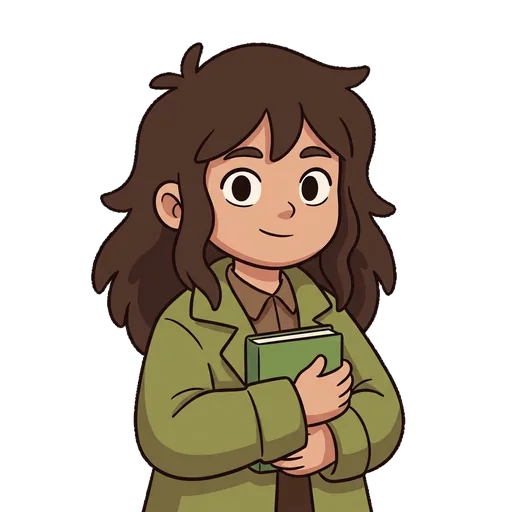 Inkling a child of the Green Names what she notices
Every recurring character has a short tune, so you can tell who is on stage before a word is said. The tunes play only when you tap, and the Reading Access sound switch turns them off.
The Honest Page
Which parts of this story are true, stretched or made up?
True
- On 18 March 1995, a Japanese H-II rocket launched a satellite called the Space Flyer Unit from Tanegashima Space Center, on an island in the south of Japan. Source
- The satellite carried a large flat panel, the 2D Array, folded with the Miura fold. In space it opened out to show that big structures can be built there. Source
- The Miura fold is named after the Japanese scientist Koryo Miura. A Miura-folded sheet opens in one movement when you pull its ends, and closes when you push them together. Source
- In January 1996 a space shuttle, Endeavour, caught the satellite and brought it back to Earth. Source
- A fortune teller takes four corners to the middle, then the paper is turned over and four more go to the middle: eight flaps.
Stretched
- The woman in the blue jacket in our story, and her folded square, are only there to show the idea. What we simplified: We do not know who watched the launch, or whether anyone on the hill had a folded model. The fold she shows is a real Miura fold.
- In our story the fortune teller is the paper machine, not the Miura fold itself. What we simplified: The Miura fold is hard for small hands, so the children fold a fortune teller, which shows the same idea: the folds decide how the paper moves.
Made up
- Ken, Emi and the paper door are made up. Kami, Mark, Cornelia, Presso and Crinkle are our own characters.