The Paper Door · Reader · ages 6-8
Listen along
Loading audio…
Read by an AI-generated voice. The words on this page are the transcript.
1. A Spark and a Paper Hat
The hammer rang once. A spark jumped off the anvil and did not go out. It waited. They followed.
It was raining on the Green, the fine kind of rain that you hardly notice until your hair is wet. Lan ran through it anyway, with her yellow hood bouncing on her back instead of over her head. Inkling put her hood up properly and walked, because she wanted to see where the spark went, not just get there.
The spark went where it always went. Past the mending shed, past the dripping bench, right up to the door of the print shop. It hovered there, glowing orange in the grey, until they opened the door and let it in.
The print shop was dry and smelled of ink. The spark crossed the long table and settled next to a square of paper, orange on one side, cream on the other.
The square sat up.
"Fold me, I won't mind," said Kami.
"Somewhere warm, please," said Lan, shaking the rain out of her hair. "Somewhere with sun."
"Every fold makes me something new," said Kami. "I can't promise sun. Start with something you know. Start with a hat."
The hat needed a rectangle, so Inkling folded Kami in half first, edge to edge, to make one. Then they folded it in half the other way and opened it again, to find the middle. They folded the two top corners down to meet in the middle, so there was a pointed roof. They folded the bottom strip up on the front, and turned it over, and folded the bottom strip up on the back. Inkling opened the bottom, and there it was, a little paper hat.
The last crease went flat, and the paper opened like a door.
2. A Garden in the Heat
The hat opened wider and wider, until the inside of it was full of light.
Lan stepped through. Inkling stepped through behind her, holding Kami by one corner.
It was hot. That was the first thing, before anything else. The heat came up from the ground and down from the sky at the same time, and Lan's raincoat suddenly felt like a duvet. She pulled it off and tied it round her waist.
"You got your sun," said Inkling.
They were standing in a garden behind a house. The house was white, with a deep shady porch that ran all along the front, held up by square pillars. A big tree with small, pointed leaves made a patch of cool shade in one corner. Large clay pots stood in a row by the steps, and in one of them grew a bush with tiny white flowers. The whole garden smelled sweet and warm.
The pot with the white flowers had cracked once, and somebody had bound the crack with a neat twist of wire so it would hold. Beside the wire, half hidden by a leaf, a tiny hammer had been scratched into the clay.
"That's jasmine," said Inkling, sniffing. "I think. It smells like the soap at Gran's house."
Somewhere over the wall, a cart went by, creaking, and a man called out something in a language they did not know, a long sing-song call that went up at the end. A crow on the wall answered him, rudely.
"Where are we?" asked Lan.
Kami crackled. "India," said Kami. "A city by the sea called Madras. The year is 1893."
"That's later than Kuwana," said Inkling, working it out. "And later than Emil's garden too. Almost fifty years later."
"Every door opens somewhere," said Kami. "This one opened here."
3. Meena and the Eight Plants
There was a flower bed along the side of the house, under the porch. It was freshly dug, dark and crumbly, with nothing growing in it yet. A girl was kneeling at the edge of it.
She was about seven, with a long plait down her back and a cotton skirt that came down to her ankles, tucked under her knees so it would not get muddy. Beside her stood a flat basket, and in the basket were tiny green plants, each in its own little ball of earth. Lan counted them. There were eight.
The girl was not planting them. She was just looking at the bed, with her chin on her fists.
Lan, who was never shy for long, went straight over.
"Hello," she said. "I'm Lan. This is Inkling. That's Kami."
The girl looked at Kami, and then at Lan's raincoat tied round her waist, and decided to ask about neither.
"I'm Meena," she said. "These are marigolds. My grandmother grew them from seeds. I'm supposed to plant them along the edge here, before she comes home from my aunt's house."
"That's easy," said Lan.
"She said all the same space apart," said Meena. "Exactly the same. So when they grow, they make a straight orange line all along the house, with no big gaps and no squashed bits. She says a row of flowers should look like a row of soldiers, all standing the same."
"So measure it," said Lan.
"I can't," said Meena. "The tape measure belongs to my uncle, and he took it to work this morning. There isn't a ruler anywhere. I looked."
She picked up something from the grass beside her. It was a long, thin strip of paper, as long as Lan was tall.
"Grandmother cut this to be exactly as long as the bed," said Meena. "Before she left. She said it would help. But I don't know how a piece of paper helps."
4. About Here, About There
Lan looked at the strip. She looked at the bed. Then she had an idea, and her ideas came out of her mouth before they had finished arriving.
"I'll do it!" said Lan. "I promise. You don't need a ruler. I'll just do it by eye."
She grabbed a stick from the path and held it over the soft earth, ready to poke.
"One here," she said, pointing. "One about here. One about there. And one, um, about there."
"Just guessing makes wobbly gaps," said someone behind her.
Lan turned round. In the shade of the porch stood Mark, who drew every fold line in the world and liked nothing better than a good drawing. Mark had a pencil behind one ear and a ruler in his hand, which Lan thought was very unfair, since nobody else had one.
"Can we use your ruler?" asked Lan.
"It's for drawing lines," said Mark. "It's too short for a whole bed. But that isn't the point." He came out into the sun and looked at the places Lan had pointed to. "Look. Your first gap is bigger than your second one. And the last two are nearly on top of each other."
Lan looked. He was right. In her head the gaps had been the same. On the ground, they were all different sizes.
"Lines don't lie, but eyes do," said Mark. "Read the line first, and let the paper draw it."
Lan put the stick down. Her ears went hot.
"I promised before I checked," she said quietly. "Sorry, Meena."
"You didn't poke any holes yet," said Meena. "That's what counts."
Inkling noticed that Lan stood with her hands behind her back for a while after that, as if she did not trust them.
5. The Man at the Desk
"Mark," said Inkling. "What did you mean, let the paper draw it?"
Mark did not answer straight away. He was looking up at the porch.
At the far end of it, in the shade, there was a wooden desk. A man sat at it in a plain white shirt, with his sleeves rolled up. He was not writing. He was folding a square of paper, slowly, the way you do something you have done a hundred times and still think is interesting.
On the desk beside him lay a few sheets of paper covered in drawings. They were not pictures of things. They were squares and triangles and lines, very neat, with little marks at the corners.
The man finished his fold. He opened the square again and looked at the crease. Then he folded it a different way. He did not look at the children. He did not explain anything.
"He's like the monk," whispered Lan. "And the old teacher in Emil's garden."
"He just folds," said Inkling. "And lets you look."
Mark walked quietly up the steps and stood beside the desk, the way you would stand beside someone's work in a museum. He looked at the top drawing for a long time. Then he came back down.
"Read the drawing before your hands move," said Mark. "Every line on the drawing has a job. That drawing shows a square. It's folded edge to edge, so one edge lands exactly on the other. And the crease is marked with dashes."
"What's the crease for?" asked Meena.
"That's the clever part," said Mark. "When one edge lands exactly on the other edge, the crease is exactly halfway between them. Not nearly halfway. Exactly. You didn't measure anything. The fold found the middle by itself."
Inkling's eyes went wide. "So the fold is a ruler."
"The fold is a ruler," said Mark. "And you can't fold it wrong without seeing. If the edges don't meet, you can see they don't meet."
"Can we try it?" asked Meena. "On something small first. Before Grandmother's strip."
Inkling held out Kami. "Kami is a square," she said. "Kami won't mind."
"Fold me, I won't mind," said Kami. "Every fold makes me something new."
Meena turned Kami so a corner pointed at her, like a kite. She brought the bottom corner up to the top corner, until they sat exactly on top of each other, and pressed. Then she opened it out again. A crease ran across Kami from one corner to the other.
"Now the other way," said Mark, watching. "The other two corners."
Meena brought the left corner over to the right corner, exactly, and pressed, and opened Kami out flat again. Now there were two creases. They made a big X across the square.
"Look where they cross," said Mark. He touched the middle of the X with the tip of his pencil, very lightly, without making a mark. "That's the centre of the square. The exact centre. You didn't measure. You didn't use a compass. Two folds found it."
Lan leaned so close her nose nearly touched the paper. The two creases crossed at one tiny point, right in the middle, with exactly the same space on every side.
"So a fold is a compass too," said Inkling. "It finds the middle of things."
"The middle of a line, if you fold end to end," said Mark. "The middle of a square, if you fold corner to corner both ways. That's what all his drawings are about." He nodded up at the man on the porch, who had just opened another square and was looking at its creases. "Finding the middle, and the shapes, with nothing but folds."
Kami gave a small, pleased crackle. "I'm still one piece of paper," said Kami. "Just one with a centre now."
Meena smoothed Kami flat and handed it back to Inkling very carefully. Then she looked at her grandmother's long strip, lying in the grass, and for the first time that afternoon she did not look worried.
"I think I know how a piece of paper helps," she said.
6. End to End
Meena laid the long paper strip on the grass at the edge of the bed, and they all knelt round it.
Someone very particular came hurrying across the garden.
"Corners first, always," said Cornelia. Then she looked at the strip and frowned. "Well. Ends, today. Ends first. Bring one end all the way over to meet the other end. Make them meet exactly."
Meena picked up one end of the strip and carried it over to the other end. The strip bent in the middle. The two ends met, nearly.
"Not near," said Cornelia. "Exactly. Look at both corners of each end. Four corners, all on top of each other."
Meena wiggled the top end a tiny bit, until all four corners sat perfectly on top of each other.
"Point to point, then hold," said Cornelia. "Now press the fold."
Meena pressed. The strip was half as long now, and two layers thick. When she opened it a little and looked, the crease sat exactly in the middle.
"That's the middle of Grandmother's bed," said Meena slowly. "Without any ruler."
"Bring it all the way over again," said Cornelia. "Same thing. End to end."
Meena folded the strip in half again. Now it was a quarter as long, and four layers thick.
"It's eight!" said Inkling. "Eight parts!"
Everybody looked at her.
Lan counted the edges at the end of the folded strip, carefully, with one finger. "One, two, three, four," she said. "It's four layers. Four parts. Not eight."
Inkling went pink, and then laughed. She had named it too soon. It was her habit, and she knew it was her habit, and it still jumped out before she could catch it.
"Four," she said. "Two halves, and each half in half again. Four quarters. I can name that properly."
"One more fold," said Cornelia, "and then it will be eight."
7. The Slippery Fold
The third fold was the hard one.
The strip was thick now, four layers of paper all folded together, and it did not want to bend. When Meena brought one end over to the other, the layers slid against each other. The ends did not meet. One stuck out past the other, by the width of a fingernail.
Meena pressed it anyway, because she was hot and tired and wanted to be finished.
Then she opened the whole strip out to look, and her face fell.
The first creases were fine. But the last ones were crooked. One of the parts was clearly bigger than the others, and the one next to it was clearly smaller.
"I've spoiled it," said Meena. "The last plant will be squashed. Grandmother will see."
Then someone very cheerful came bouncing out from behind the clay pots. It was Crinkle, who loved mistakes almost as much as other people love cake.
"Crooked is just a first go," said Crinkle. "We can fix this one. Open it up gently."
Meena had already opened it. She looked at the crooked creases miserably.
"Smooth it out and try again," said Crinkle. "Look. The crease remembers."
Meena looked closer. The good creases, the first ones, were still there, sharp and straight. They had not moved at all.
"Fold it back up on the good creases," said Crinkle. "They remember where they go. Then only the last fold is new. And this time, hold the ends with both hands so the layers can't slide."
Meena folded the strip in half on its good crease, and in half again on its good creases. Then she held both ends of the thick little strip firmly between her fingers and thumbs, so nothing could slip, and brought one end over to the other. Slowly. Slowly. Until all the corners sat exactly on top of each other.
This time they met.
Crinkle did a little bounce of joy. "See? First go, second go. That's all mistakes are."
The strip was a fat little packet now, eight layers thick. Each layer was an eighth of the whole strip.
8. Press It So It Shows
The packet was springy. When Meena let go, it started to puff open, like a book that does not want to stay shut.
Someone slow and calm came walking up the garden path. It was Presso, who never hurried, not even in the heat.
"Hold it still," said Presso. Presso's voice was low and patient, like a cello played softly. "Now press it flat. Run your thumbnail along the fold."
Meena held the packet still on the hot stone step and ran her thumbnail along the folded edge.
"Press slowly, press firmly," said Presso. "Every fold, not just the last one. When you open it, every crease must show. A fold you press is a fold that stays."
So Meena pressed every edge of the little packet, one at a time, slowly and firmly. It took a long time. Presso did not mind. Presso watched each one, and nodded at each one, and never said hurry.
When she had finished, the packet stayed flat by itself.
9. Seven Creases, Eight Parts
"Now," said Kami, from Inkling's hand. "Every fold makes me something new. Even unfolding. Open it along the bed, and see what you've made."
Meena carried the packet to one end of the flower bed. She held the first end of the strip at the corner of the bed and unfolded it, bit by bit, laying it along the edge of the dark earth.
When it was all open, it reached exactly from one end of the bed to the other, just as Grandmother had cut it.
And across it, sharp and clear, ran the creases. They looked like the lines on a ruler.
"Count them," said Kami.
Inkling counted the creases. "One, two, three, four, five, six, seven. Seven creases."
Lan counted the spaces between the creases, and the two at the ends. "One, two, three, four, five, six, seven, eight. Eight parts."
"Seven creases make eight parts," said Inkling slowly. "There's always one more part than creases. Because of the ends." She was naming it carefully this time, and she was right, and everybody could see she was right.
Mark laid his short ruler against the first part, and then against the second, and then against the last. "All the same," he said, pleased. "Exactly the same. And nobody measured anything."
"The paper drew it," said Lan.
Meena took the first marigold out of the basket. She dug a little hole with her fingers right in the middle of the first part, and planted it, and pressed the earth round it. Then she planted the second one in the middle of the second part. And the third, and the fourth, all the way to the eighth.
When she stood up and looked, there were eight small green plants in a perfectly straight row, with exactly the same space between every one, like eight soldiers standing to attention.
At the far end of the porch, the man at the desk had looked up from his folding. He looked at the row of plants for a moment. Then he nodded, just once, and went back to his square.
10. Grandmother Comes Home
Grandmother came home in the late afternoon, when the shadows were long and the heat had gone soft.
She was a small woman with grey hair pulled back in a knot and a sari the colour of turmeric. She came in through the gate with a bag on her arm, and stopped.
She looked at the flower bed. She looked at it for a long time, from one end to the other.
"Meena," she said. "Did you measure?"
"No," said Meena. "The tape measure went to work with Uncle. I folded the paper you gave me. In half, and in half, and in half again. And the creases showed me where."
Grandmother walked along the bed, slowly, looking at each plant. When she got to the end, she picked up the paper strip from the grass. She opened it out and ran her finger along the creases.
"I hoped you would think of that," she said. "That is why I cut it to the right length."
"You knew?" asked Meena.
"I hoped," said Grandmother. "Hoping is different."
She folded the strip up again along its creases, neatly, and put it in her bag. "We will keep this," she said. "It is a ruler now. It will tell us where the next row goes."
11. Home Through a Square
The sun was going down behind the neem tree, and somewhere a bird was making a noise like a squeaky gate.
"How do we get home?" asked Lan.
Kami crackled. "Fold me all the way, and the paper opens," said Kami. "Unfold me flat, and you are home."
Lan untied her raincoat from her waist and found a plain square in the pocket that she did not remember putting there. It had a little hat shape creased into it. She and Inkling unfolded it together, fold by fold, until it lay perfectly flat.
They unfolded the paper flat, and the door closed behind them.
They were standing at the long table in the print shop. It was still raining outside, very softly. The paper stacks were exactly where they had been. Kami lay on the table, a plain square again.
The spark dimmed to a warm dot and settled back on the anvil. The Green was just the Green again.
Back on the Green
At teatime there was a long cake on the print-shop table, a ginger one, and four people who wanted some. Somebody handed Lan the knife.
Lan held the knife over the cake. She was going to cut it by eye, about here and about there.
She stopped. She took a strip of paper from the stack, laid it along the top of the cake, and cut it to the same length. She folded the strip end to end, exactly, and then end to end again. When she opened it, three creases marked four equal parts. She laid it on the cake and cut along the creases.
Four pieces, all exactly the same. Nobody could say anybody else had the bigger bit.
"Three creases," said Inkling, with her mouth full. "Four parts. One more part than creases."
Tell the story back to someone. How did the paper find the middle, and how many creases made eight parts?
Saved. The next chapter will be here whenever you come back.
Who you met
-
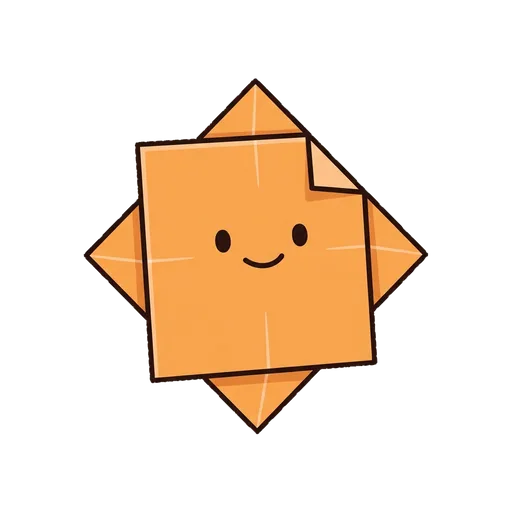 Kami Paper becomes a new shape with every fold, and it only cuts where it is told from CreaseTots
-
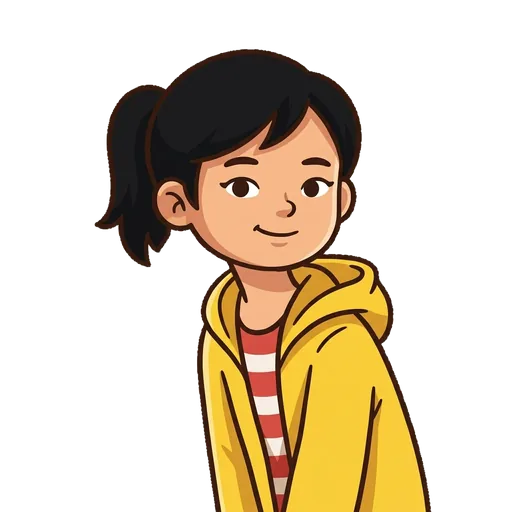 Lan a child of the Green Goes first; makes a friend in a minute
-
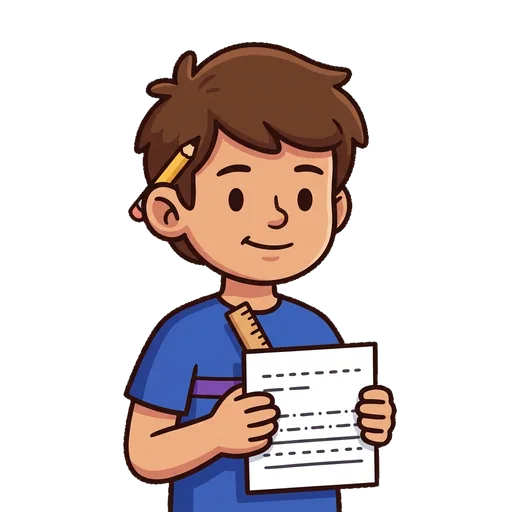 Mark The lines tell you what to do — dashes fold, solid lines cut from CreasePals
-
 Cornelia Bring one corner to meet the other corner, exactly from CreaseTots
-
 Crinkle Smooth a crooked fold out and try again; the crease remembers from CreaseTots
-
 Presso Hold the paper still and press the fold flat so it stays from CreaseTots
-
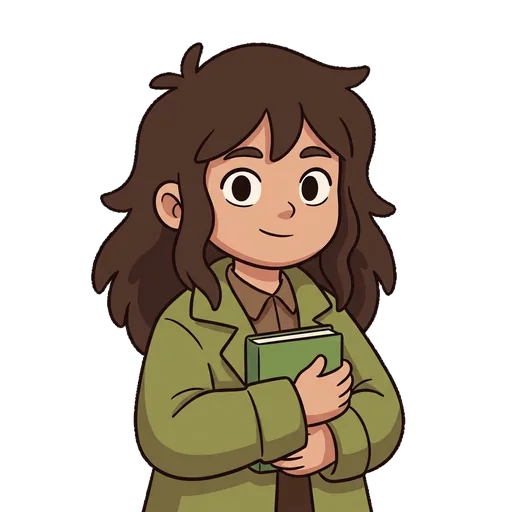 Inkling a child of the Green Names what she notices
Every recurring character has a short tune, so you can tell who is on stage before a word is said. The tunes play only when you tap, and the Reading Access sound switch turns them off.
The Honest Page
Which parts of this story are true, stretched or made up?
True
- T. Sundara Row's book Geometric Exercises in Paper Folding was printed in Madras in 1893. It showed how to fold shapes and find lines and middles without a ruler or a compass. Source
- Row wrote that his idea came from a kindergarten paper-folding gift, from the same kindergarten folding that Fröbel's garden used. Source
- A famous German mathematician, Felix Klein, wrote about the book in 1895, and it was later printed in America too. Source
- Folding a strip in half three times makes eight layers. Opened out, it has seven creases and eight equal parts.
Stretched
- The man folding on the verandah in our story never says his name. What we simplified: We kept the real author in the background so the children and the cast solve the problem themselves; nobody knows where Row sat to fold.
- In our story the folding drawing on the desk shows a square folded edge to edge to find its middle. What we simplified: That is one of the first exercises in Row's book, but we drew our own simple version, not his page.
Made up
- Meena, her grandmother, her uncle and the paper door are made up. Kami, Mark, Cornelia, Presso and Crinkle are our own characters.