The Day Before · Grower · ages 6-8
Listen along
Loading audio…
Read by an AI-generated voice. The words on this page are the transcript.
1. The Garden by the Canal
The hammer rang once. A spark jumped off the anvil and did not go out. It waited. They followed.
The spark led them to the sunniest corner of the Green. Then it simply waited there.
Warm wind blew the Green away, and the ground under their feet was somewhere else, the day before.
It was hot and very flat. The land went on for ever in every direction, with no hills at all. There was a garden of young date palms, onions and beans in neat rows. Below the garden, at the bottom of a steep bank, a canal of brown water ran straight as a ruler.
A girl about Lan's age was climbing the bank with a heavy water jar on her shoulder. The jar had been broken once and mended with dark pitch, and beside the crack was a tiny scratched hammer.
"The hot wind comes from the desert tomorrow," she said, puffing. "If the young plants are dry, they will burn. I have to water them all tonight."
2. Bzzz
"I know a machine for this!" said Lan. "I saw one in a museum. I promise, it's a long..."
The words came out as a buzz, like a bee in a jar. Bzzz, bzzz.
The girl looked at her, puzzled.
"The door," whispered Inkling. "You can only bring the question."
Lan went pink. Third time, she thought. Third time I've promised before counting.
3. Up the Bank
So they helped. They took jars down to the canal and filled them and carried them up the bank.
The bank came up to Lan's middle, and it was steep, and slippery with mud. A full jar was heavy. Half of every jar slopped out on the way up.
By noon, only one row of onions was watered.
4. What Is Heavy?
Inkling sat down on the bank and asked questions instead.
"What is heavy?" said Inkling. "The water. And where does it have to go? Not along. Only up. The height of the bank."
"So the hard part is lifting," said Lan.
"I think so," said Inkling. "I'm still looking."
5. The Pole
The girl's big brother came down from the house. He had a long wooden pole, and a forked post that he pushed into the top of the bank.
He laid the pole across the fork, like a seesaw. He tied a leather bucket to the end over the water.
"Push your end down," he said. "The bucket comes up."
It worked! The bucket swung up out of the canal, full and dripping. But you had to push as hard as the bucket was heavy. When Lan tried, the pole lifted her feet right off the ground.
6. Near and Far
Inkling tried pushing the pole in different places.
Near the fork, it was very hard. She could hardly move it. Right at the far end, it was much easier.
"I noticed something," said Inkling. "Near the post, it's heavy. At the very end, it's light. I can name it. The further from the post you push, the less push you need."
7. The Warm Wind
By late afternoon the air felt warmer. Half the garden was still dry. The brother had gone back to the house, and the pole was too heavy for the girl to push all evening.
Lan sat in the shade of a palm. "It's hopeless," she said.
8. The Question
Then Lan remembered the door. She could not bring the answer. But she could bring a question.
"Pushing far from the post is easier," said Lan. "So could the post stand nearer the bucket? Then the stick on our side would be really long."
The girl stared at the pole. Then she pulled the fork out of the ground and pushed it in again, much closer to the bucket end.
Now the bucket side was one step long. The pushing side was two steps long, and its end stuck up above their heads. They tied a rope to it.
Lan pulled the rope down. The full bucket rose up out of the canal. It felt half as heavy as before.
Then the girl had her own idea. She tied a lump of dried mud onto her end of the pole. Now the mud did the pushing, and she only had to steer.
9. By Moonrise
They worked until moonrise. Bucket after bucket swung up the bank. By the time the moon came up, every row in the garden was dark and wet.
The girl's grandmother came down with a lamp and laughed.
Nobody would ever write down the girl's name.
Warm wind blew the day before away, and the grass under their feet was the Green.
On the side of the anvil, beside the D and the O, there was another letter. A second O.
The spark dimmed to a warm dot and settled back on the anvil. The Green was just the Green again.
Back on the Green
At home, Lan's little brother Tí could not get the lid off the paint tin. Lan gave him a long spoon to push under the edge. Pop!
Tell the story back to someone. Why was pushing at the long end easier?
Saved. The next chapter will be here whenever you come back.
Who you met
-
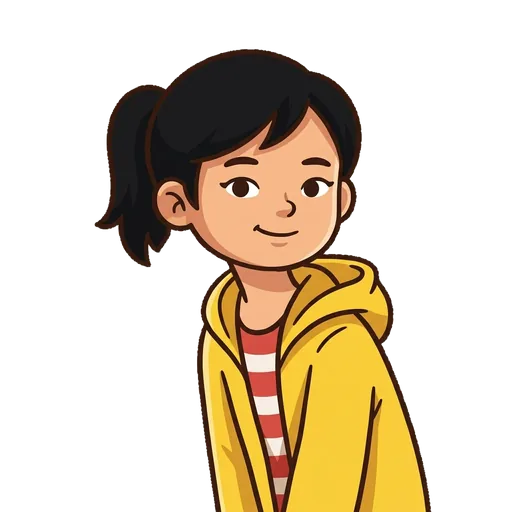 Lan a child of the Green Goes first; makes a friend in a minute
-
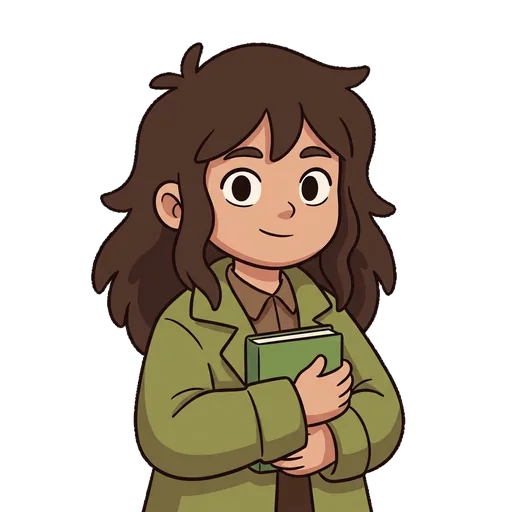 Inkling a child of the Green Names what she notices
Every recurring character has a short tune, so you can tell who is on stage before a word is said. The tunes play only when you tap, and the Reading Access sound switch turns them off.
The Honest Page
Which parts are true, stretched or made up — and what does nobody know?
True
- A shadoof is a long pole on a post, with a bucket at one end and a heavy weight at the other, for lifting water. The oldest known picture of one is on a cylinder seal from Mesopotamia, about four thousand two hundred years old. Source
- Shadoofs are still used in some places today. A painting in a tomb in Egypt from about 1250 BCE shows one too. Source
- A stick on a post balances when the weight times its distance on one side equals the push times its distance on the other. Twelve, one step away, balances six, two steps away. Twice as far, half the push.
Stretched
- In the story the bucket hangs on the short end of the pole. What we simplified: Real shadoofs usually hang the bucket on the long end and put a heavy lump of mud or stone on the short end, so the weight does the lifting and the bucket can rise higher. We kept the bucket on the short end to show the long stick most simply.
Made up
- Lan and Inkling, the spark, the buzzing words, the girl, her brother and her grandmother are made up. So is the hot wind that was coming tomorrow.
Nobody knows
- Nobody knows who made the first shadoof, or where. The oldest picture of one is on a seal; the seal does not say who thought of it. Source