
Warp the Part-and-Whole Namer
PART-TO-PART VERSUS PART-TO-WHOLE — a ratio can name two parts against each other (3 red to 2 blue is 3:2) or one part against the whole (3 red out of 5 total is 3/5). The same situation carries both names; knowing which one a question wants is half of answering it.
A story read by Warp the Part-and-Whole Namer
Loading audio…
Press play to listen along. The line being read lights up as you go.
Show full transcript
Loading transcript…
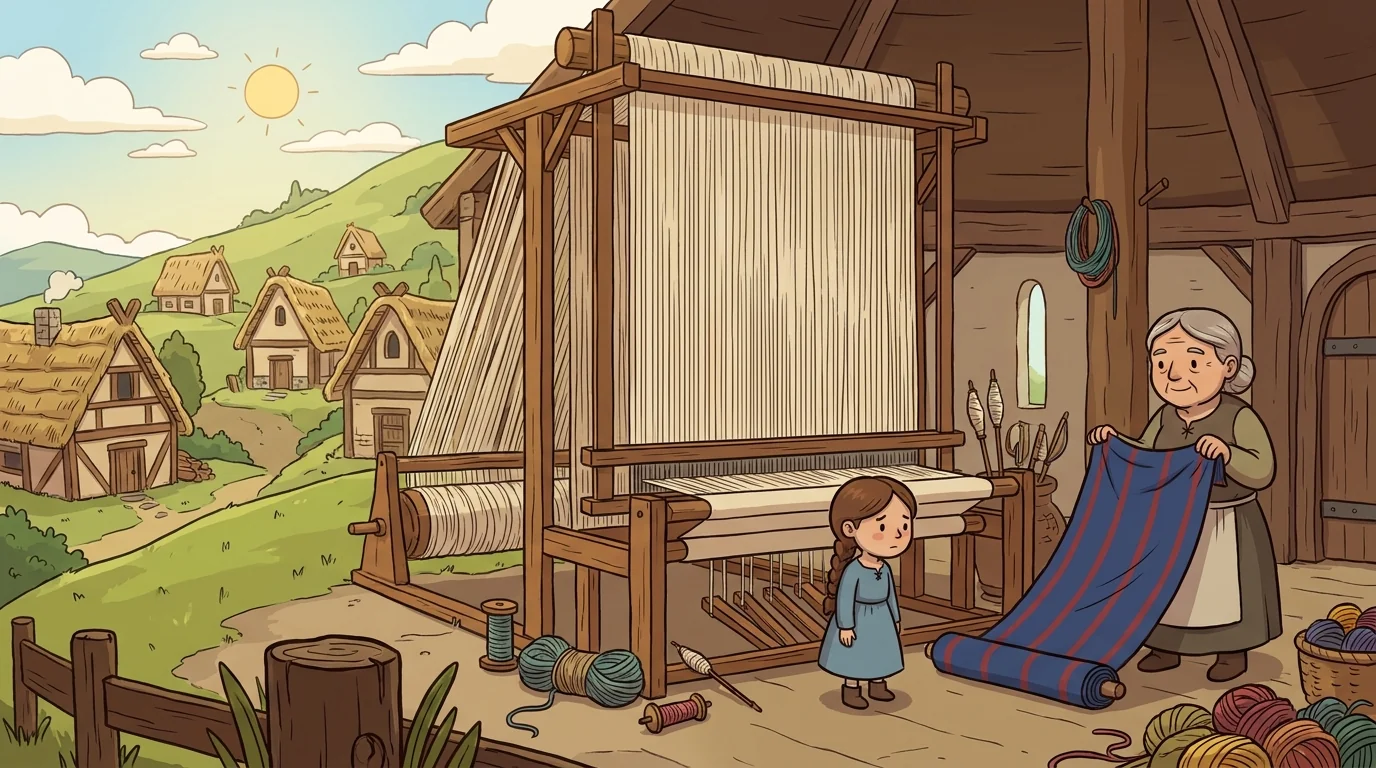
Warp grew up on a loom, and for a long time she felt like a single thread that did not amount to much.
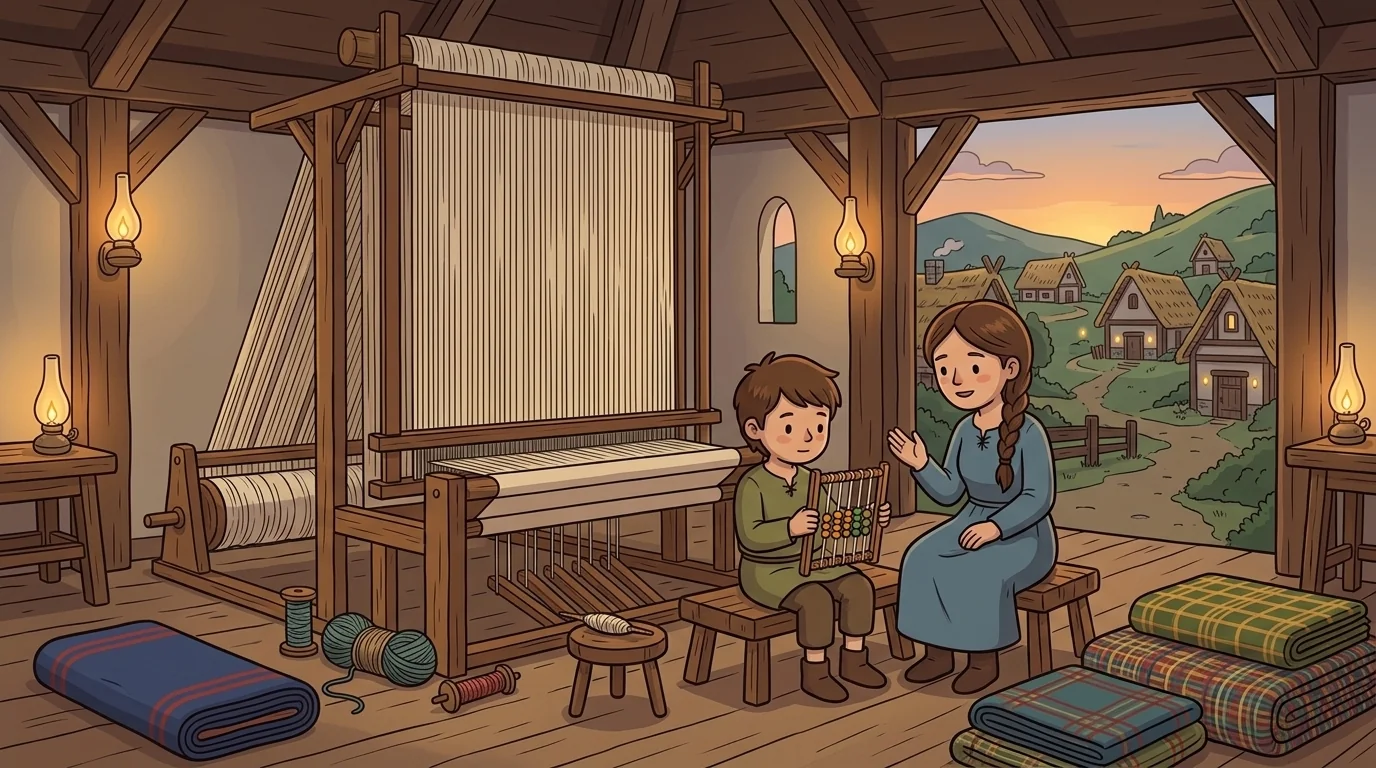
Her family were weavers in the hill-village of Selvage. From before she could remember, Warp was set to the smallest tasks at the great loom: counting threads, tying broken ends, watching the pattern grow one row at a time. And a loom, seen up close, is a discouraging thing to a child. It is thousands of separate threads. Each one is thin and pale and, on its own, nothing — a single strand you could snap between two fingers. Warp spent her early years staring at individual threads and feeling, quietly, that a single thread was all she herself would ever be.
Her given name was Selvage, the same as the village, though she had been called Warp since she was ten. Her grandmother, who ran the loom, watched the girl grow sad among the threads and one evening lifted the finished cloth off the beam and shook it out into the lamplight — a whole bolt, deep blue shot with a thread of red every fifth line — and said, "Look. Not at the thread. At the cloth. Every one of those threads you counted is still there. But now they are a whole, and the whole is the thing worth having."
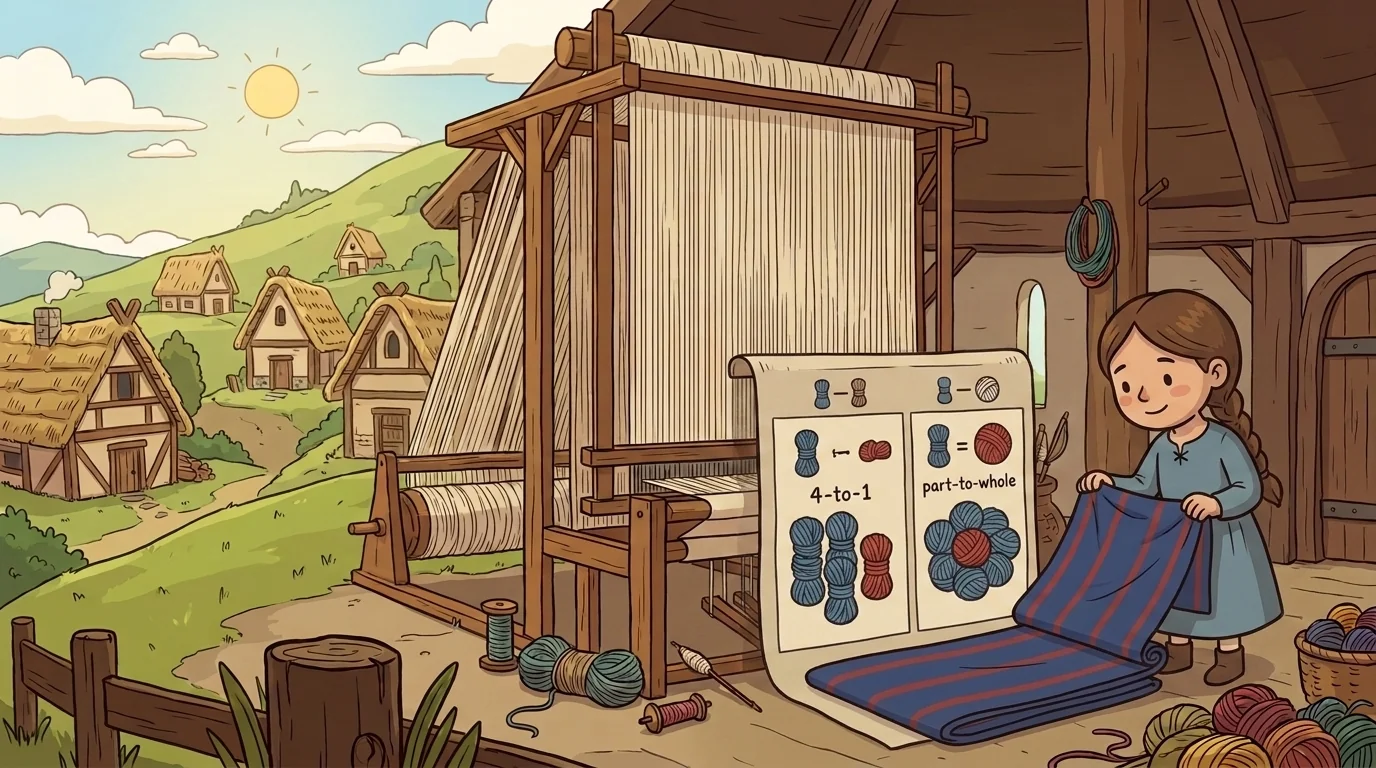
That was the evening Warp learned to hold two views of the same thing at once. She could see the cloth as threads against threads — for every red thread there were four blue, a 4-to-1 pairing, red and blue standing side by side. And she could see the cloth as thread against whole — one thread in every five was red, so red was one fifth of the whole bolt. Both were true. They described the same cloth. They answered different questions.
She had spent so long feeling like a lonely part that the discovery landed in her like warmth: a part is only lonely until you name the whole it belongs to. A red thread compared to a blue thread is a rivalry. A red thread compared to the whole cloth is a belonging. Same thread. Different question.
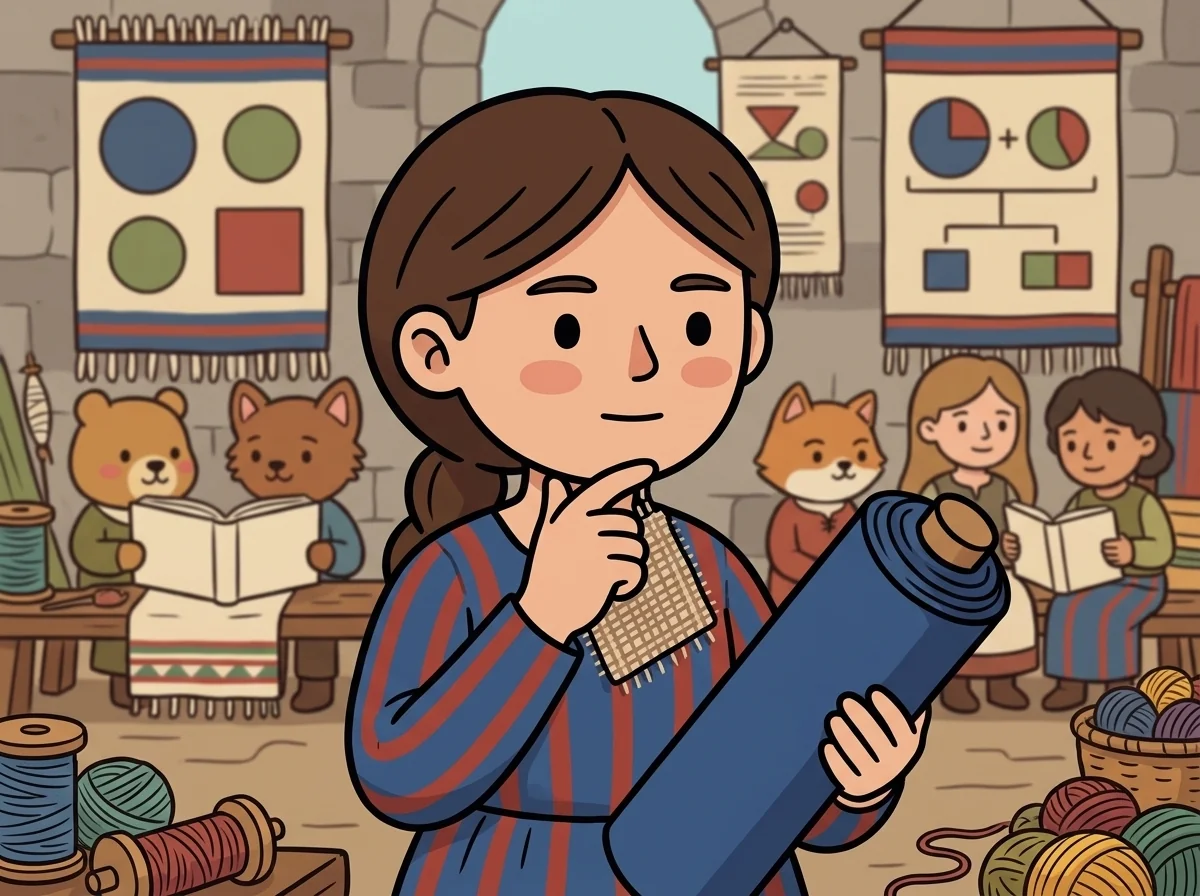
A cloth-buyer from the RatioRealm academy came to Selvage for the village's famous blue-and-red weave and found Warp, grown now, explaining to an apprentice why the same bolt could be called "four blue to one red" and "one red in five," and why a customer's question decided which name to use.
"You are naming part-to-part and part-to-whole," the buyer said. "Children muddle them constantly — they answer 'out of the whole' when the question asked 'compared to the other part,' and get a true number to the wrong question. You have it clear."
Warp had never wanted to leave the loom. But she liked the thought of children learning to feel less like lonely threads. She has taught this distinction for eight years.
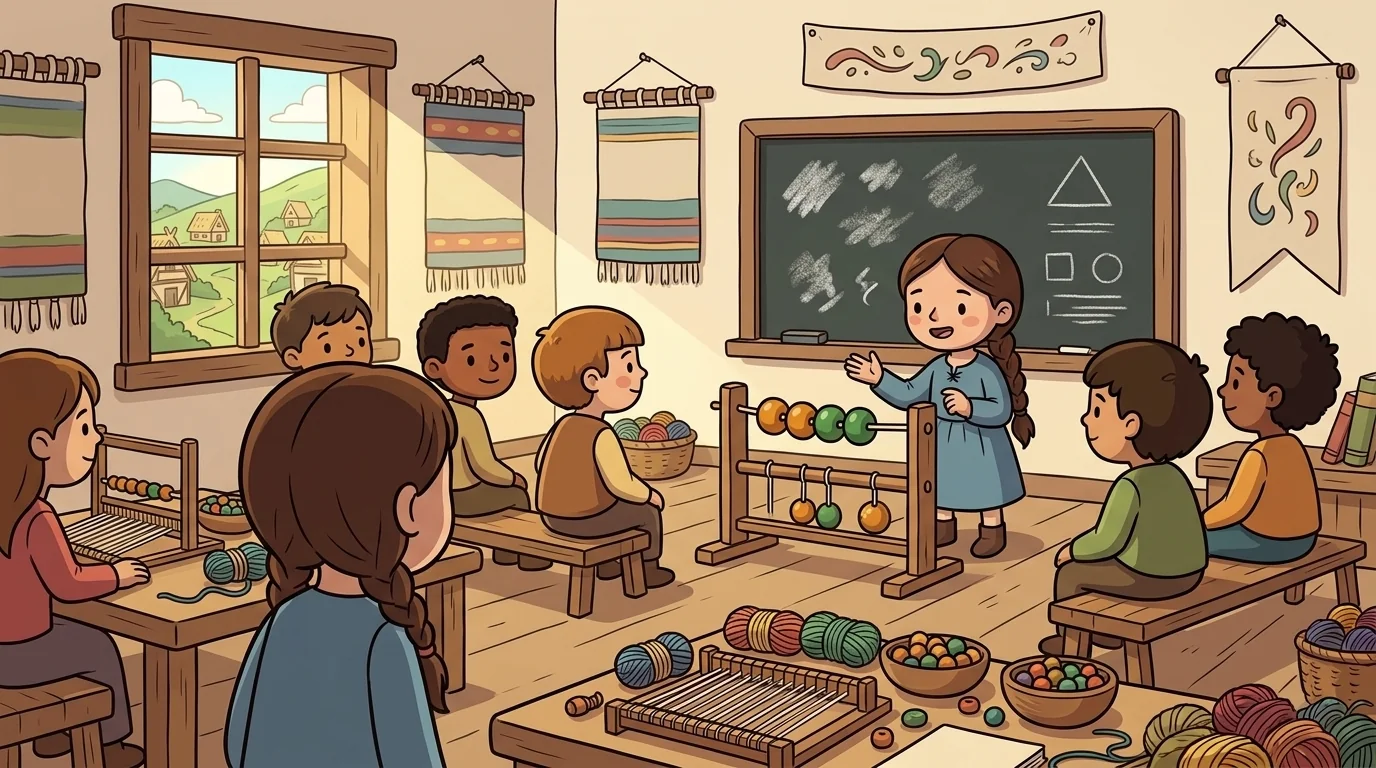
In her classroom Warp keeps a small hand-loom strung with beads — three amber, two green, five in all. She begins the same way each year. She asks, "What is the ratio of amber to green?" The children count: three amber, two green. "Three to two," they say. "Yes," says Warp. "That is part to part — one color set against the other." Then she asks a different question: "What fraction of the beads are amber?" The children pause, then count differently — three amber out of five beads in all. "Three fifths," they say. "Yes," says Warp. "That is part to whole — one color set against the total. The beads did not change. Only the question changed. Three-to-two and three-fifths are the same handful of beads, named for two different questions." Then she gives them the trick that keeps them from muddling: "Before you answer, ask compared to what? Compared to the other part, or compared to the whole? Find that first, and the number follows."
A boy named Lisle stayed after, turning the beaded loom in his hands, and said the strange comfort of the lesson was the part he could not quite name: that a thing which felt small on its own was still counted, still there, still part of the whole, no matter which way you looked at it.
Warp sat beside him. She said she had felt exactly that among the threads as a girl — that a single strand seemed like nothing until her grandmother shook out the cloth. "You are never only the part," she said. "You are always also the whole you belong to. Both are true at once. The trick is remembering to look at the cloth, not only the thread." Lisle looked at the little loom — three amber, two green, five together, one small bright weave — and felt the quiet steadiness of belonging to something whole, the ache of feeling like only a part easing into the comfort of being counted in.
Warp is gentle, unhurried, and cannot look at a group of anything without silently naming it two ways. She still goes back to Selvage at the shearing, and she still works a few rows at the great loom by lamplight, and she still, she says, likes the cloth best when it is shaken out whole.
The RatioRealm ensemble
Warp the Part-and-Whole Namer is part of RatioRealm's distributed-narrative cast. Each character embodies a different curricular primitive; together they teach the full subject.
-

Pair the Ratio-Speaker
Simple ratios (a:b) — the foundational "for every A, there are B" pattern
-

Scale the Doubler
Equivalent ratios (scaling both parts by the same factor; recipe-doubling primitive)
-

Unit the Per-One-Counter
Rates and unit rates (the per-one normalization that lets us compare different rates)
-

Cross the Proportion-Solver
Proportions and cross-multiplication (the canonical "if a/b = c/d then ad = bc" mechanic)
-

Centa the Percent-Translator
Percentages — the per-hundred special case + percent change
-

Crux the Two-Directions
Direct versus inverse proportion (when one goes up, the other goes up — or down)
-

Keel the Constant-Keeper
The constant of proportionality (the fixed number that links the two quantities)
-

Portion the Fair-Divider
Sharing a quantity in a given ratio (splitting fairly by parts)
-

Splay the Scale-Keeper
Scale factor (scale drawings, maps, and models)