Splay the Scale-Keeper
SCALE FACTOR AND SCALE DRAWINGS — enlarging or reducing every length by the same factor keeps a shape's proportions true. A map at scale 1 to 100 means one step on the paper is a hundred steps on the ground; a drawing enlarged by a factor of 3 has every length tripled but its shape unchanged.
A story read by Splay the Scale-Keeper
Loading audio…
Press play to listen along. The line being read lights up as you go.
Show full transcript
Loading transcript…
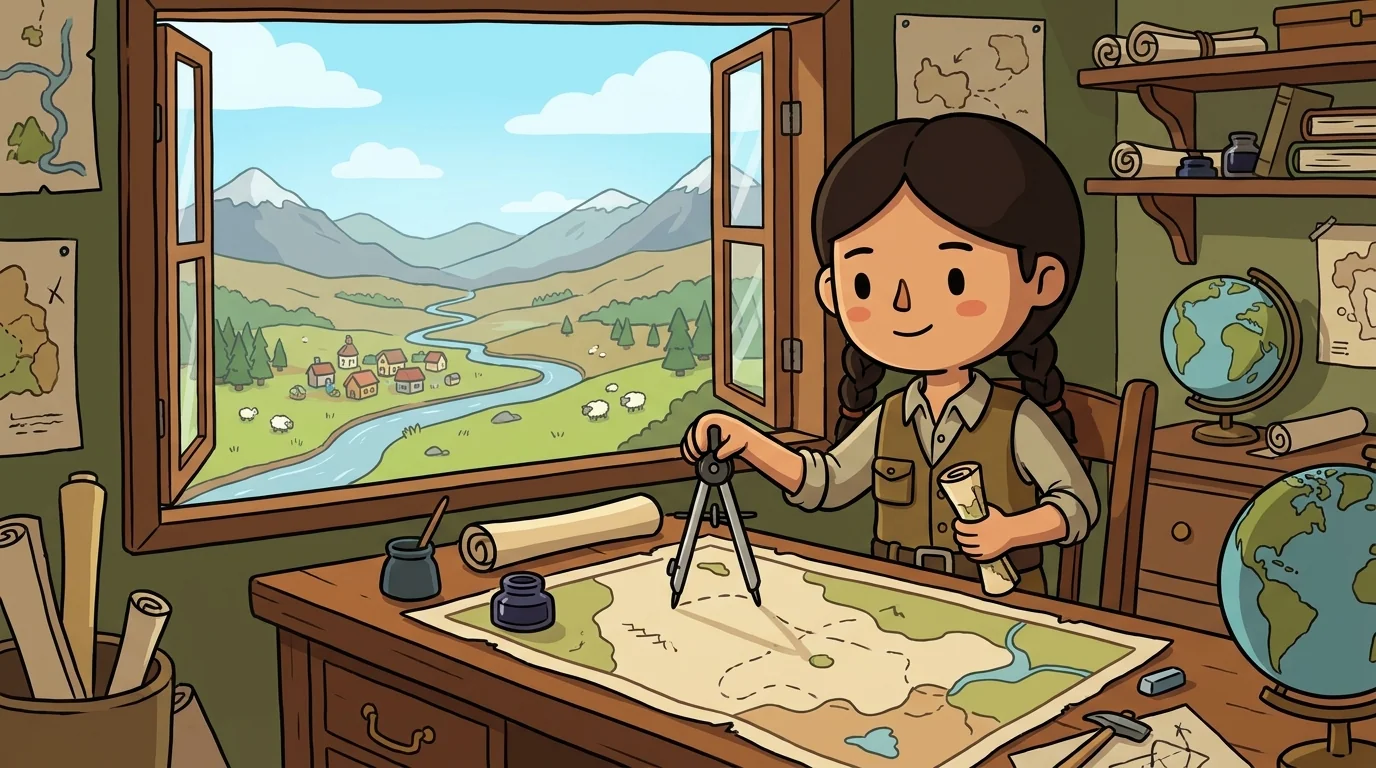
Splay grew up drawing maps, and she learned that you can hold an entire valley in your two hands if you shrink it honestly.
Her family were the valley's mapmakers, in the surveyor's house above the town of Furlong. Travellers, traders, and shepherds all came to them for maps — of the passes, the fords, the grazing-grounds — and a map is a strange and wonderful lie: it is a whole landscape, miles across, drawn small enough to fold into a saddlebag. Splay's father taught her that the lie only works if it is honest in its shrinking. Every distance on the ground had to shrink by the same amount to fit the paper. If the road shrank by a hundred but the river shrank by fifty, the map would be a monster — river and road in false relation, and a traveller lost by nightfall.
So the mapmakers worked to a scale: a fixed factor by which the whole world was reduced. One step on the paper stood for a hundred steps on the ground — a scale of one to a hundred — and every single line on the map obeyed it. The mountains, the meadows, the crooked lanes: all shrunk by the same hundred, so that the small paper valley had the same shape as the great real one.
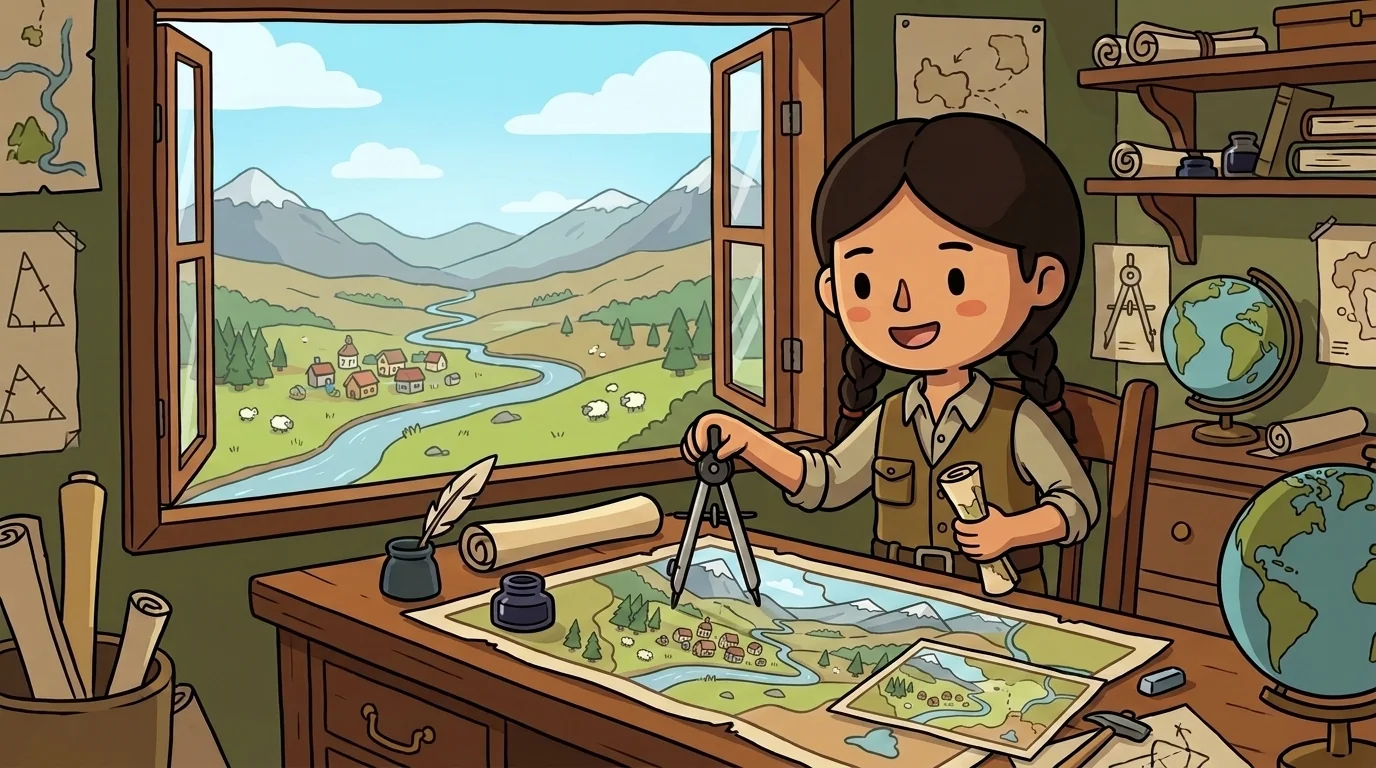
Her given name was Furlong, the same as the town, though she had been called Splay since she was ten, when she copied her father's great wall-map onto a card small enough for a shepherd's pocket, tripling nothing and shrinking everything by the same careful factor, and the shepherd came back a season later to say he had never once been lost.
She understood, young, what a scale factor is. It is a single number that multiplies every length. Shrink by a factor and you get a map; enlarge by a factor and you get a plan a builder can work from. And the one iron rule, the one her father repeated until it was part of her, was that the factor must touch everything equally. You cannot scale the length and forget the width. You cannot enlarge the door and leave the window. A shape stays true only when every length is multiplied by the same factor; the moment you play favorites, the shape distorts and the map lies.
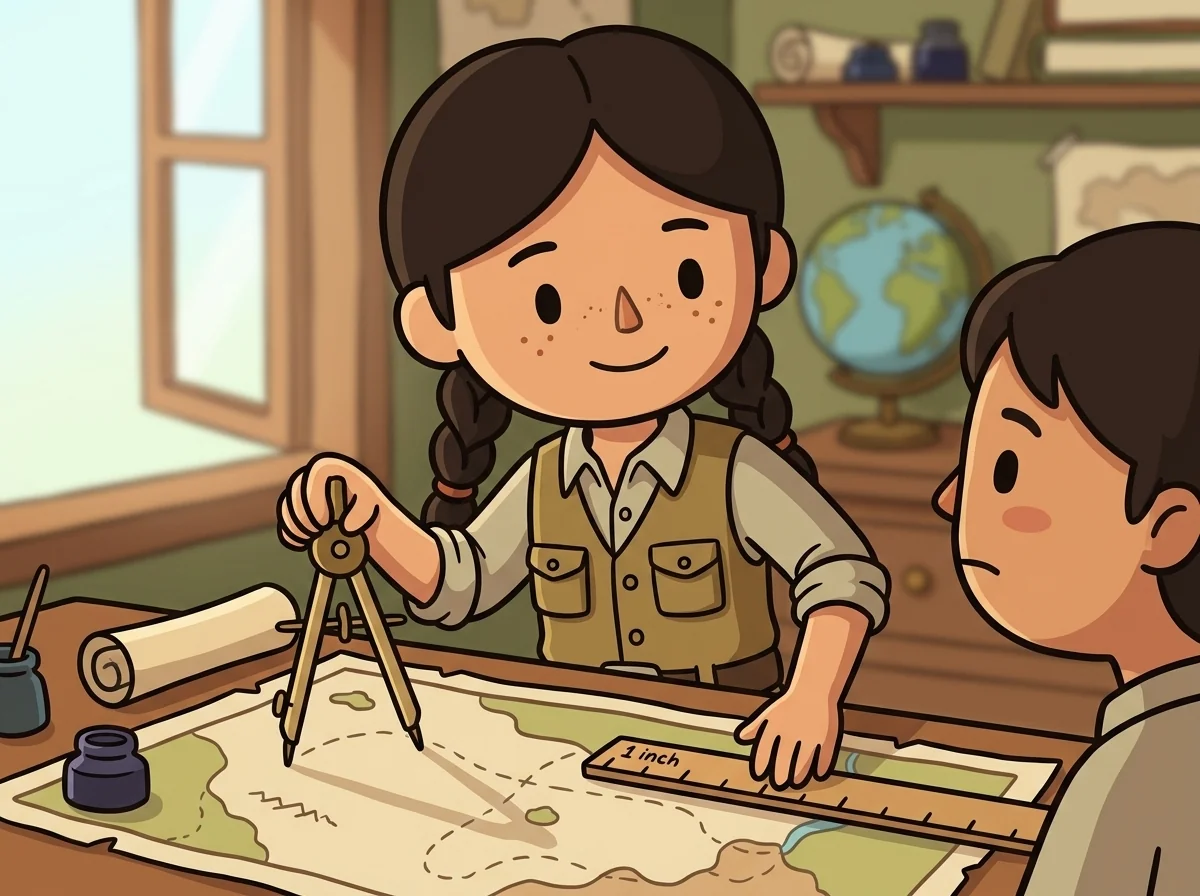
A cartographer from the RatioRealm academy came to Furlong for a map of the northern passes and found Splay, grown now, teaching an apprentice to read a scale-bar — how many real miles hid in one inch of paper.
"You are working with scale factor," the cartographer said. "Scale drawings and maps. Our students grasp the arithmetic but forget that the factor must be the same for every measurement, and their shapes come out crooked. You have the iron rule."
Splay had never wanted to leave the valley. But she liked the thought of children learning to hold big things faithfully in small hands. She has taught scale for seven years.
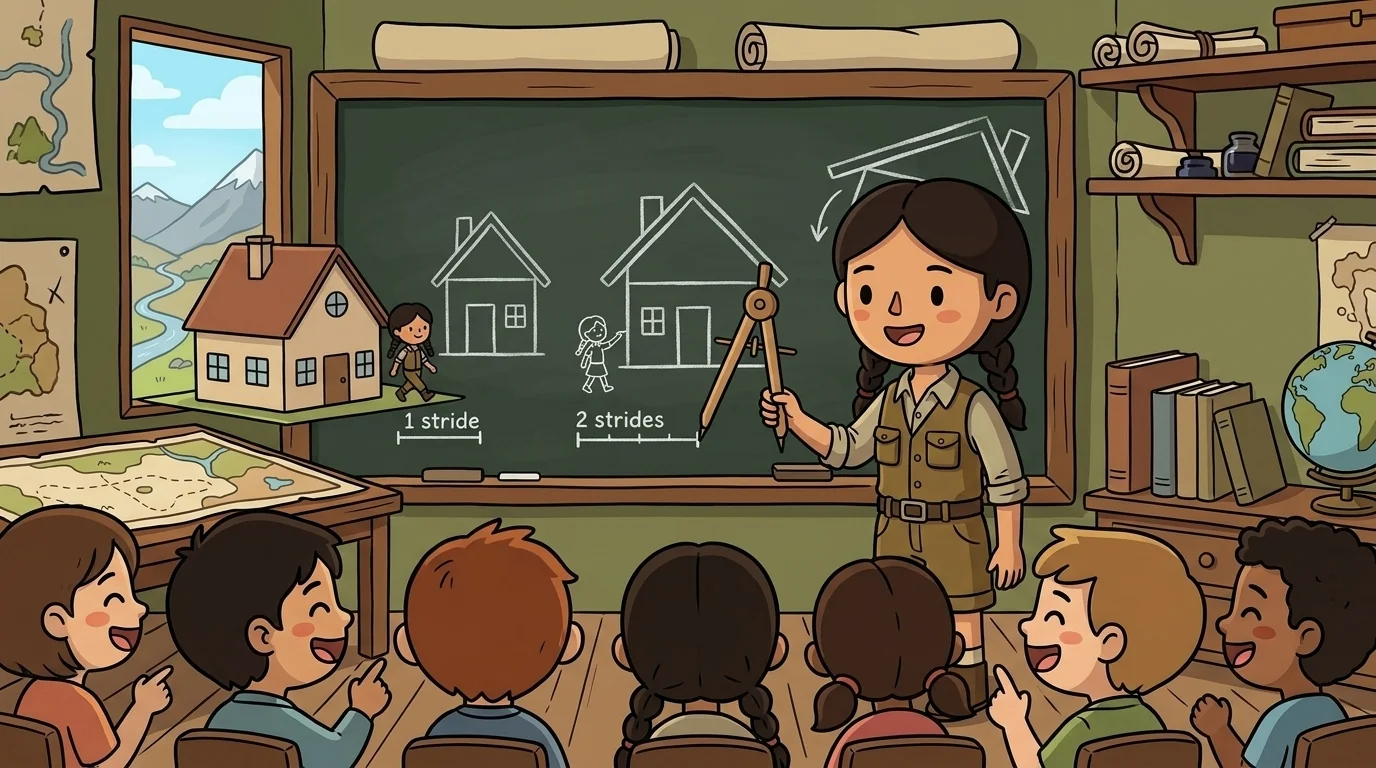
In her classroom Splay keeps a small drawing of a house and a scale-bar beneath it: 1 finger-width = 2 strides. She begins the same way each year. "This drawing is small," she says, "but it is true — every length was shrunk by the same factor. The door is one finger-width on the paper; how tall is the real door?" The children read the scale-bar: one finger-width is two strides, so the door is two strides tall. "And the wall, three finger-widths on the paper?" Six strides. "The chimney, four?" Eight. The children see that reading a scaled drawing is just multiplying every paper-length by the same factor. Then she shows them the danger: she draws a second house, but she cheats — the door scaled by two, the roof scaled by three — and the class laughs, because the poor house comes out lopsided, its roof sliding off. "That," says Splay, "is what happens the moment the factor stops being the same. The shape only stays true if every length gets the same multiplier."
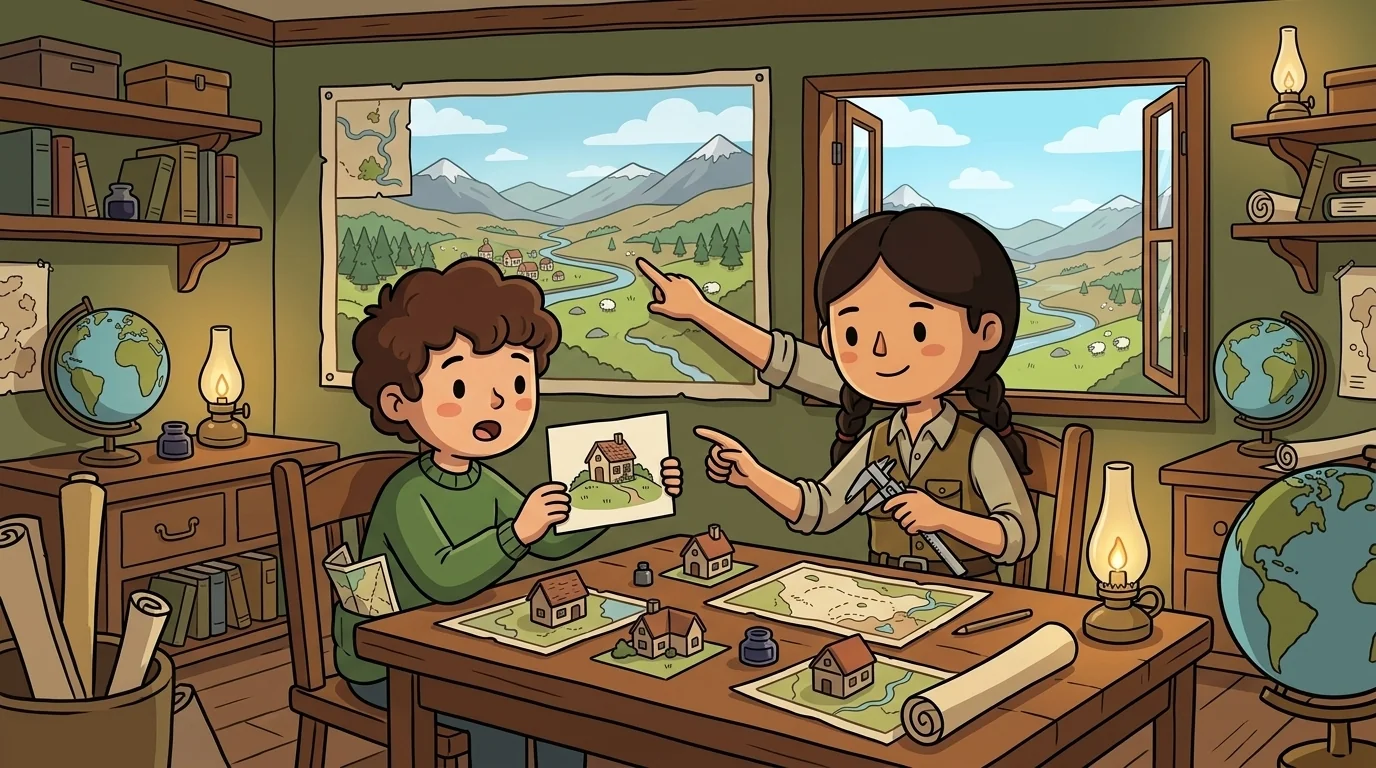
A boy named Corin stayed after, holding the little house-drawing up to the light, and said the wonder of it, to him, was that something as big as a valley could be made small enough to carry and still be itself — still true, just tiny.
Splay sat beside him. She said that was the thing that had kept her at the drawing-board as a girl, long after she was allowed to stop: the feeling of taming something enormous by shrinking it faithfully, of holding a whole valley folded in a pocket without losing one true relation. "A thing made smaller by the same factor everywhere is not lost," she said. "It is held. You can carry it, and plan with it, and find your way home by it, because it kept its shape." Corin looked at the small honest house in his hand — a whole home shrunk to a card and still standing true — and felt the particular calm of an overwhelming thing made small enough to hold, and trustworthy still.
Splay is precise, calm, and cannot look at a drawing without checking that its lengths all obey one factor. She still climbs to Furlong at the year's survey, and she still copies the great wall-map by lamplight, and she still, she says, likes the valley best when it is small enough to fold.
The RatioRealm ensemble
Splay the Scale-Keeper is part of RatioRealm's distributed-narrative cast. Each character embodies a different curricular primitive; together they teach the full subject.
-

Pair the Ratio-Speaker
Simple ratios (a:b) — the foundational "for every A, there are B" pattern
-

Scale the Doubler
Equivalent ratios (scaling both parts by the same factor; recipe-doubling primitive)
-

Unit the Per-One-Counter
Rates and unit rates (the per-one normalization that lets us compare different rates)
-

Cross the Proportion-Solver
Proportions and cross-multiplication (the canonical "if a/b = c/d then ad = bc" mechanic)
-

Centa the Percent-Translator
Percentages — the per-hundred special case + percent change
-
Crux the Two-Directions
Direct versus inverse proportion (when one goes up, the other goes up — or down)
-

Keel the Constant-Keeper
The constant of proportionality (the fixed number that links the two quantities)
-
Portion the Fair-Divider
Sharing a quantity in a given ratio (splitting fairly by parts)
-

Warp the Part-and-Whole Namer
Part-to-part versus part-to-whole ratios (naming what is compared to what)