Crux the Two-Directions
DIRECT VERSUS INVERSE PROPORTION — in direct proportion, two quantities rise and fall together (twice the cloth costs twice the coin). In inverse proportion, one rises as the other falls, but their product stays fixed (twice the workers, half the time; workers times time is constant).
A story read by Crux the Two-Directions
Loading audio…
Press play to listen along. The line being read lights up as you go.
Show full transcript
Loading transcript…
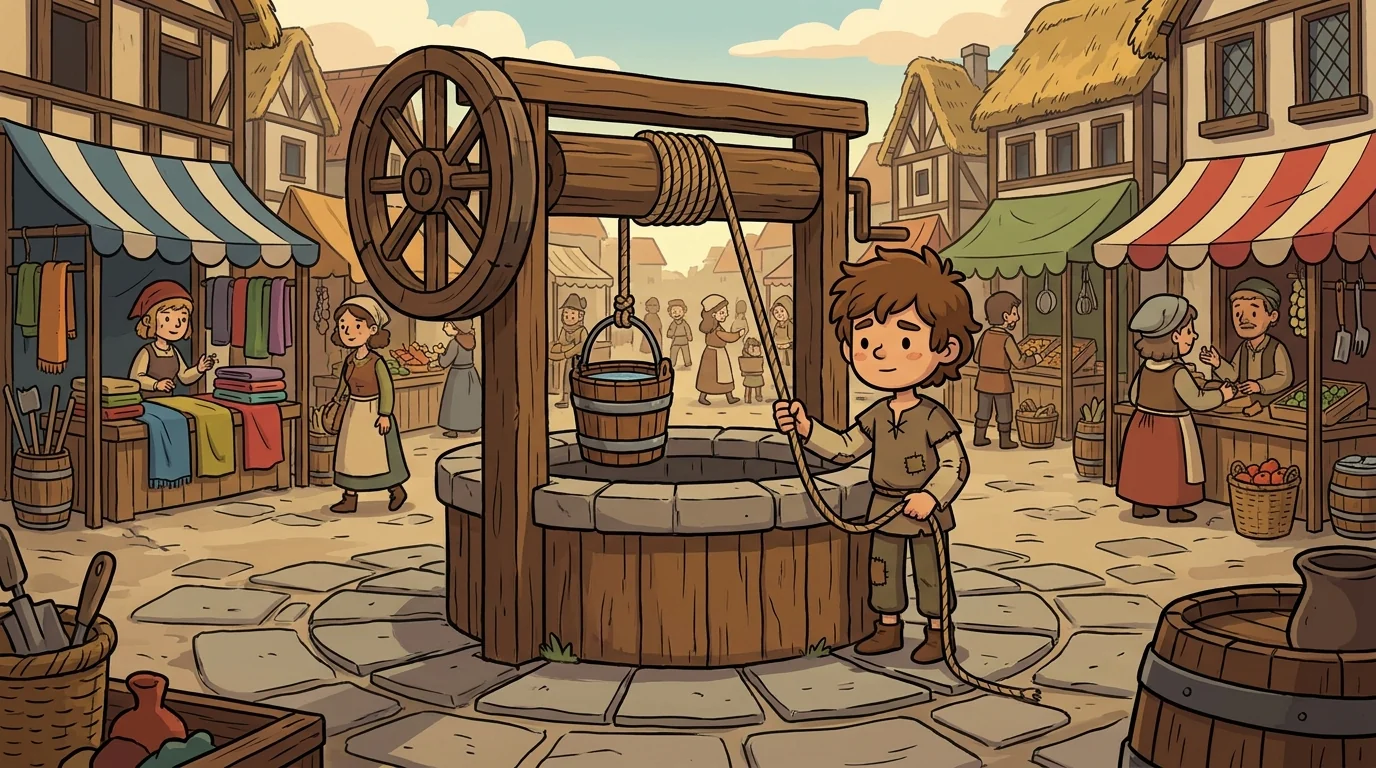
Crux grew up at a well, where he learned that two things can be bound together and still move in opposite directions.
His family kept the great draw-well in the market square of Winch, the deep well that watered half the town. It was worked by a wheel and two ropes: as one rope was hauled down, the other rope — with the bucket — rose up. Down and up, bound to the same wheel, forever opposite. Crux spent his childhood at that wheel, and he grew up knowing in his hands that some things go together and some things go against.
He saw both kinds everywhere once he started looking. At the cloth-stall, more cloth meant more coin — buy twice as much, pay twice as much; the two rose together. That was one kind of pairing. But at the well, and at the harvest, and at any job shared among workers, it was the other kind: put twice as many workers on a task and it took half the time. The workers went up; the time went down. Bound together, moving against. Two ropes on one wheel.
Crux — whose given name was Winch, the same as the town, though he had been called Crux since he was ten — came to see that the crux of any such problem, the very hinge it turned on, was a single question asked before anything else: do these two rise together, or do they trade off?
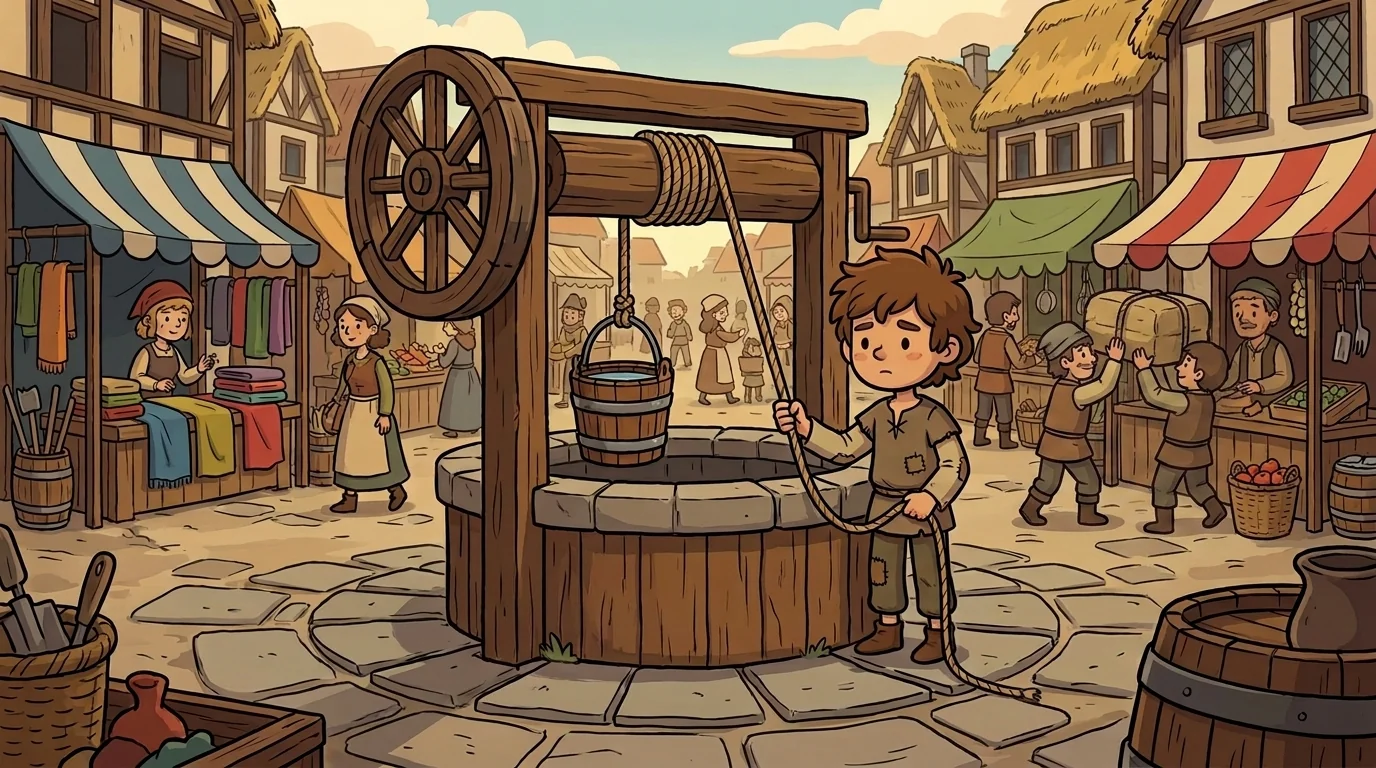
The difference was not a detail; it changed the whole method. When two things rise together — direct proportion — you scale them the same way: double one, double the other. But when two things trade off — inverse proportion — doubling one halves the other, and the thing that stays fixed is not their ratio but their product. Two workers taking six hours; the product is twelve. Four workers? The product must still be twelve, so the time is three. At the well, one bucket of water always cost the same total effort, however you split the pulling.
Get the crux wrong — treat a trade-off as if it rose together — and every number after it is wrong. Crux had seen grown traders make that mistake and lose a day's wages to it. So he learned to ask the hinge-question first, always, before reaching for any arithmetic.

A well-master from the RatioRealm academy came to Winch to study its famous deep well and found Crux, grown now, teaching an apprentice why "more workers, less time" was a different animal from "more cloth, more coin."
"You are separating direct and inverse proportion," the well-master said. "Our students slam every proportion problem through the same method and are baffled when the inverse ones come out backwards. You ask which kind it is first."
Crux had never wanted to leave the well. But he liked the thought of children learning to ask the right question before the hard work. He has taught direct-and-inverse for seven years.
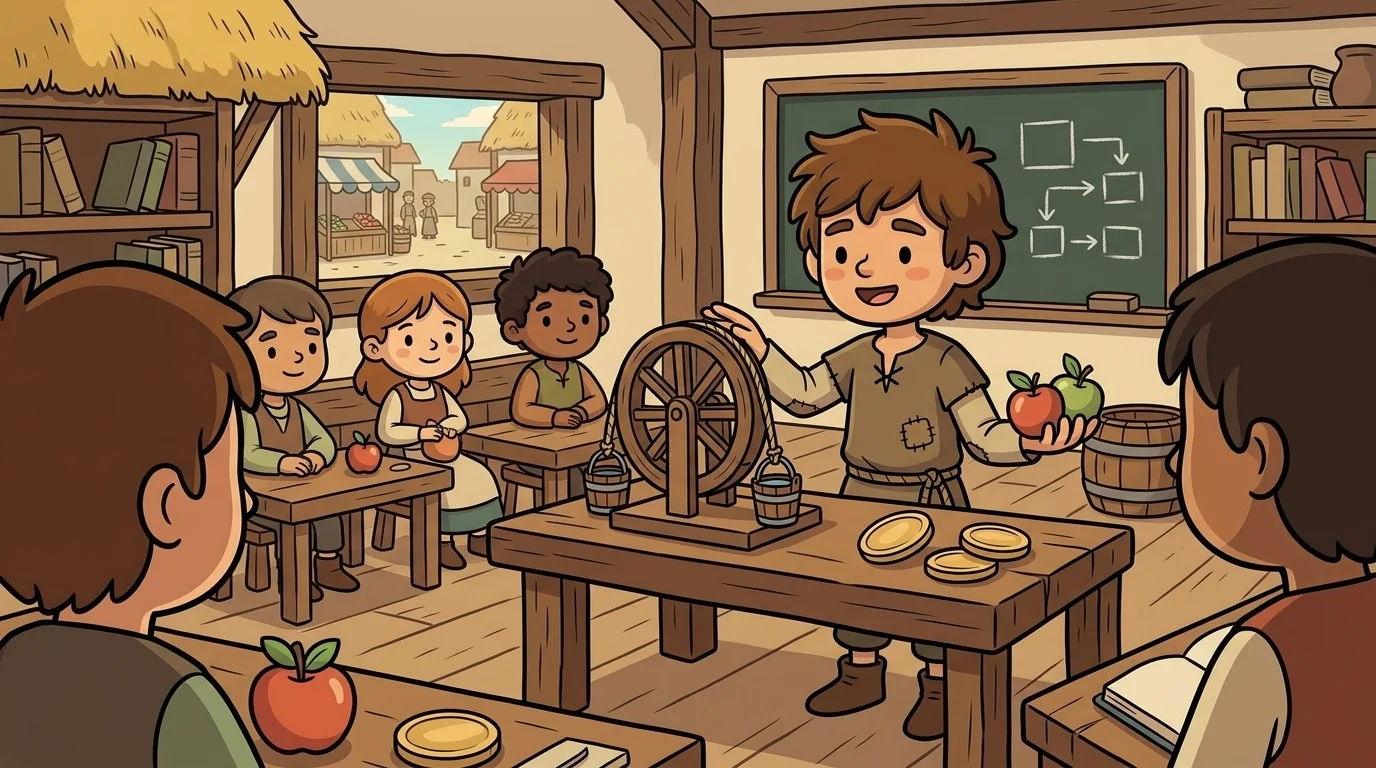
In his classroom Crux keeps a little model wheel with two ropes. He begins the same way each year with two stories. "Story one: apples cost two coins each. More apples?" More coins. "They rise together — that is direct. Double the apples, double the coins." Then he turns the wheel. "Story two: six workers dig a ditch in four days. More workers?" Fewer days. "They trade off — that is inverse. And here is the trick: when things trade off, it is not their ratio that stays fixed, it is their product. Six workers times four days is twenty-four. Twelve workers? The product is still twenty-four, so the days are two." The children watch the wheel — one rope down, one rope up — and feel the difference in their hands before they see it in the numbers. Then Crux gives them the hinge: "Before you solve any of these, ask the crux-question. Do they rise together, or trade off? Get that first, and you will never solve one backwards."
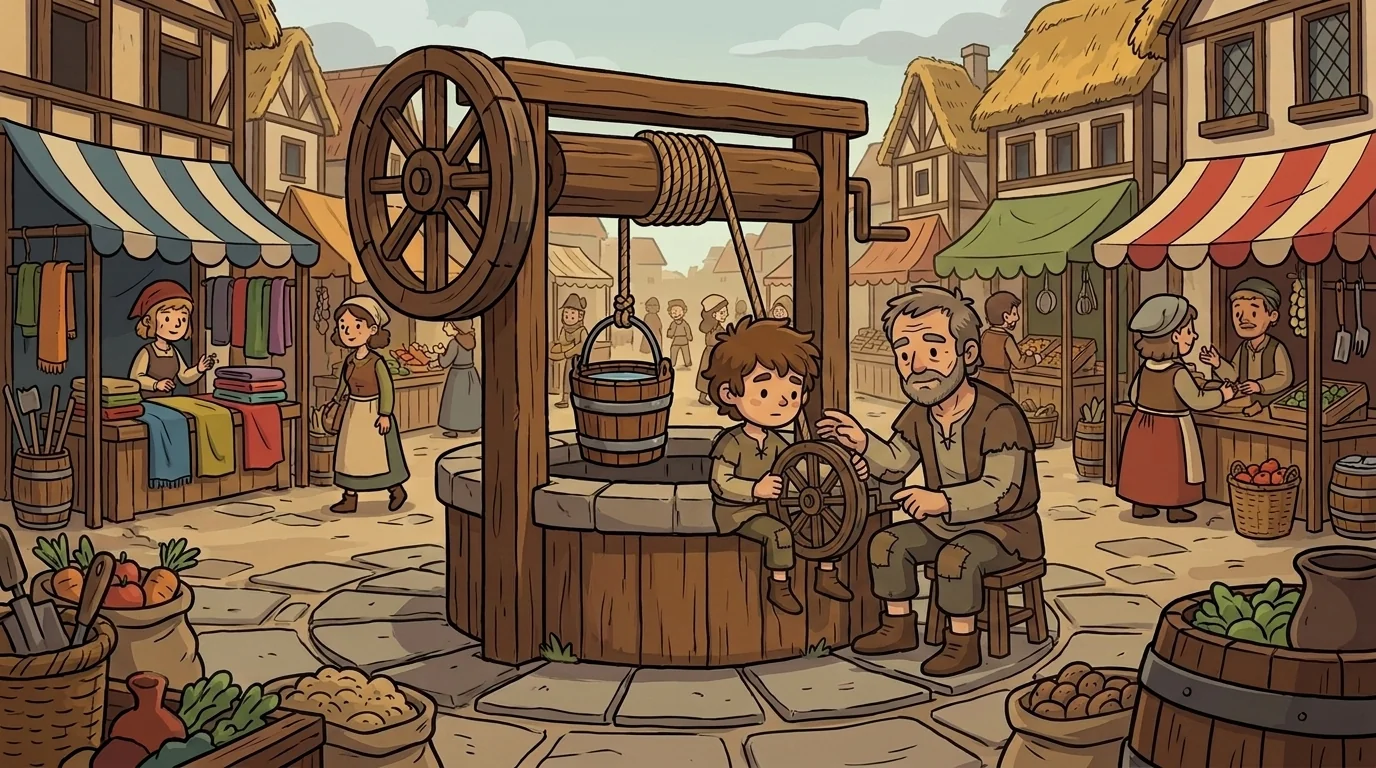
A boy named Fenn stayed after, turning the little wheel, one rope sinking as the other climbed, and said the thing that stuck with him was not the arithmetic but the idea — that two things could be tied tightly together and still, honestly, be pulling opposite ways.
Crux sat beside him at the wheel. He said the well had taught him that young, and that it was oddly comforting once you understood it. "Two things moving opposite isn't a mistake or a conflict," he said. "Sometimes it is exactly how they are bound — like the two ropes, which need each other precisely because one goes down when the other goes up. You only get into trouble when you expect them to rise together and they don't. Ask which kind it is first, and the opposite-motion stops being confusing and starts being useful." Fenn worked the little wheel once more — down, up, down, up — and felt a small settling, the ease of understanding a thing that had looked like a contradiction and turned out to be a design.
Crux is thoughtful, deliberate, and cannot meet a proportion problem without first asking which way its two quantities move. He still returns to Winch at the dry season to work the great wheel, and he still feels, in his shoulders, the down-and-up of the two ropes, and he still thinks the well is the clearest teacher he ever had.
The RatioRealm ensemble
Crux the Two-Directions is part of RatioRealm's distributed-narrative cast. Each character embodies a different curricular primitive; together they teach the full subject.
-

Pair the Ratio-Speaker
Simple ratios (a:b) — the foundational "for every A, there are B" pattern
-

Scale the Doubler
Equivalent ratios (scaling both parts by the same factor; recipe-doubling primitive)
-

Unit the Per-One-Counter
Rates and unit rates (the per-one normalization that lets us compare different rates)
-

Cross the Proportion-Solver
Proportions and cross-multiplication (the canonical "if a/b = c/d then ad = bc" mechanic)
-

Centa the Percent-Translator
Percentages — the per-hundred special case + percent change
-

Keel the Constant-Keeper
The constant of proportionality (the fixed number that links the two quantities)
-

Portion the Fair-Divider
Sharing a quantity in a given ratio (splitting fairly by parts)
-

Splay the Scale-Keeper
Scale factor (scale drawings, maps, and models)
-

Warp the Part-and-Whole Namer
Part-to-part versus part-to-whole ratios (naming what is compared to what)