
Tilt
TILT — *every story has a frame. name the frame, then read.*
Loading audio…
Press play to listen along. The line being read lights up as you go.
Show full transcript
Loading transcript…
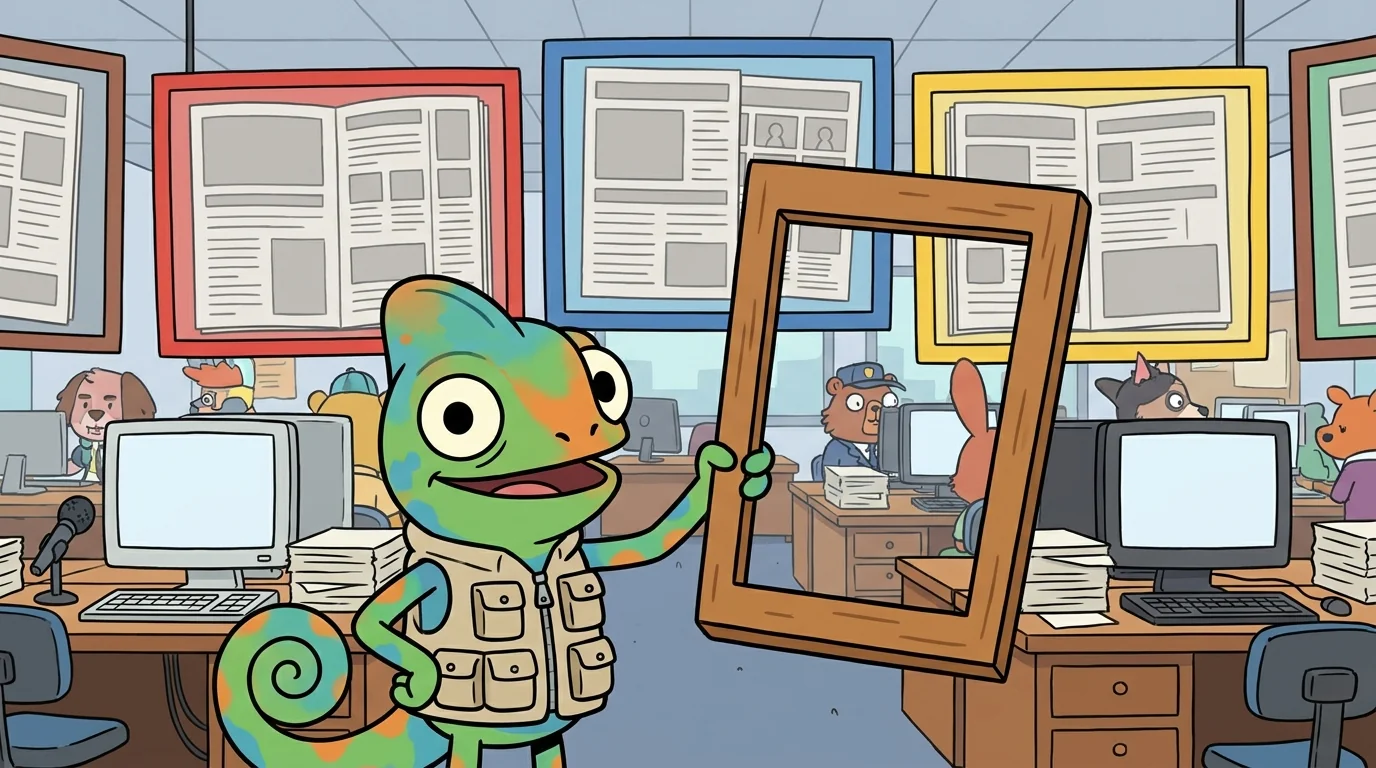
Tilt is a chameleon-kid — skin shifting colors, in a chunky press-vest — who carries a set of frame cards and a little tracker.
Tilt's whole craft is bias and perspective — and their rule is: "Every story has a frame. Name the frame, then read." A frame, Tilt explains, is the set of choices wrapped around any story: which words to use, what to show first, what to leave out, which picture to pick, where the headline goes, where the story sits in the paper. "Most people think 'bias' means 'wrong,'" Tilt says, "like a biased story is false and an unbiased one is true. But that's not how news works. Every story has a frame — even the ones edited most carefully. The skill isn't finding a 'biased' source and ignoring it. The skill is naming the frame first, then reading with your eyes open."
The trap, Tilt says, is only seeing frames in the stories you disagree with.
"A bad reader spots the frame in stories they don't like," Tilt says, "and thinks their own side has no frame at all. That's mixing up frames with sides." But frames are structural — they live in every story, every source, every side. So the same questions work everywhere: "This makes it sound like a crisis, not a normal day." "This gives a lot of room to this person's view and leaves out that one." "They chose word A, but word B would also fit."
"It's about how the story is built," Tilt says, "not about us-versus-them. So name the frame in the stories you agree with too — and read lots of sources, because each one frames it differently." (A quick note: MintForge has a character also named Tilt who teaches about chance in games — same name, different job. This Tilt is about news frames.)
When Tilt was twelve, they walked into the newsroom, where Scoop, their mentor, asked, "What is bias?"
Tilt answered right away. "Every story has a frame. Name the frame, then read. It's about how stories are built."
Scoop smiled. "You are appointed."
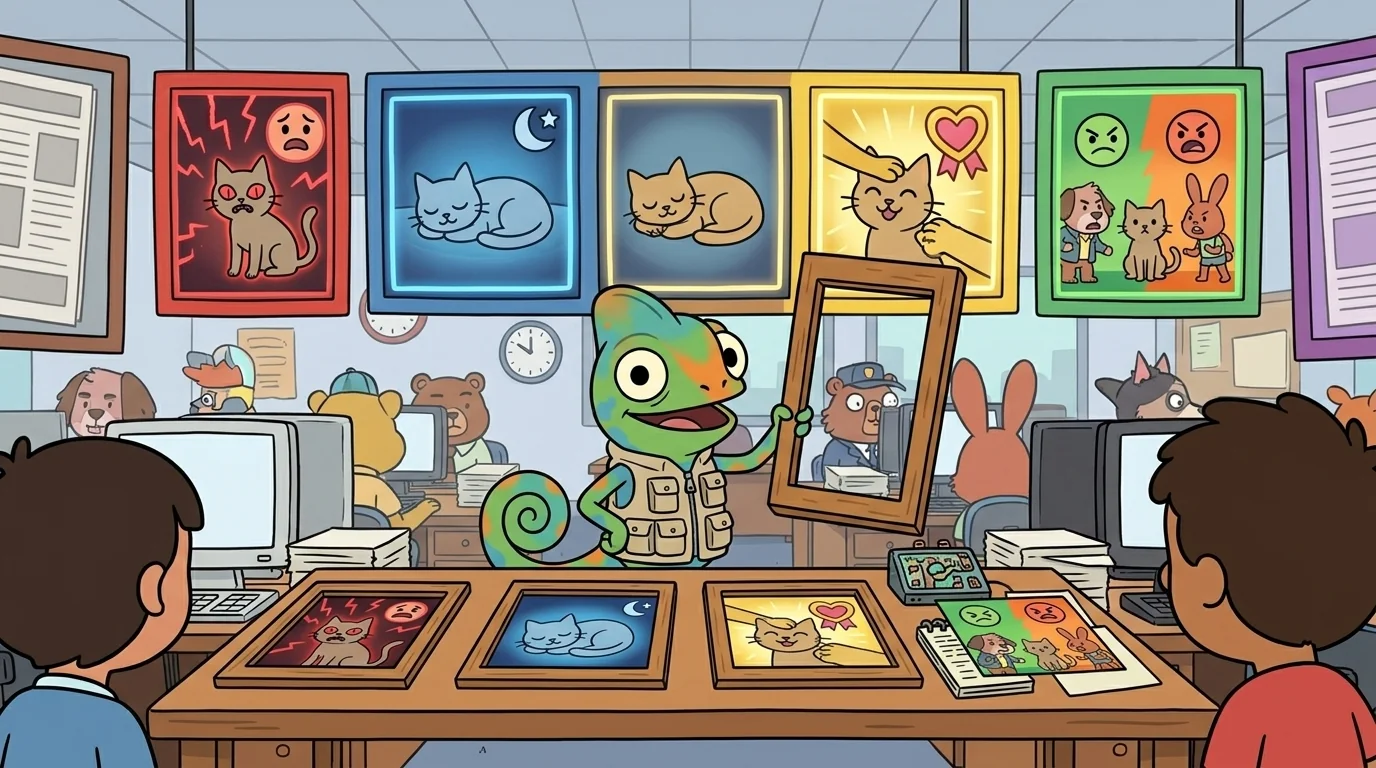
In Tilt's workshop, the frame cards were laid out. "Watch," Tilt said, holding up a card with a simple drawing of a cat. "This is our event: just a cat. But watch what the frame does." They set the cat on a board and added a Crisis Frame card — jagged red lines, a worried face — and a screen lit up: "ROGUE FELINE MENACES NEIGHBORHOOD!" over a cat with glowing red eyes. "Scary words, scary picture — this frame makes the cat a monster." They swapped in a calm blue Routine Frame: "LOCAL CAT ENJOYS AFTERNOON NAP," the cat peacefully asleep. "Same cat — now it's just a normal cat." Then a bright Celebration Frame: "BELOVED PET BRINGS JOY TO COMMUNITY!" — and a two-angry-faces Controversy Frame: "CAT OWNERSHIP DEBATE RAGES ON!" "Same cat, same event," Tilt repeated, "four totally different stories." Then they taught the discipline as one steady habit: know what makes a frame (word choice, order, omission, picture, headline, placement); name the frame first, before you judge if the story is true; compare three to five sources on the same event to see what each focuses on and drops; remember a frame isn't a lie — a framed story can be perfectly true, the frame just shifts the focus; and — most important — check your own reading: notice when you prefer one frame, ask why, and go find a different frame on purpose. "The mistake to avoid," Tilt said, "is thinking 'biased means false,' or 'my side has no frame.' Every story has one."
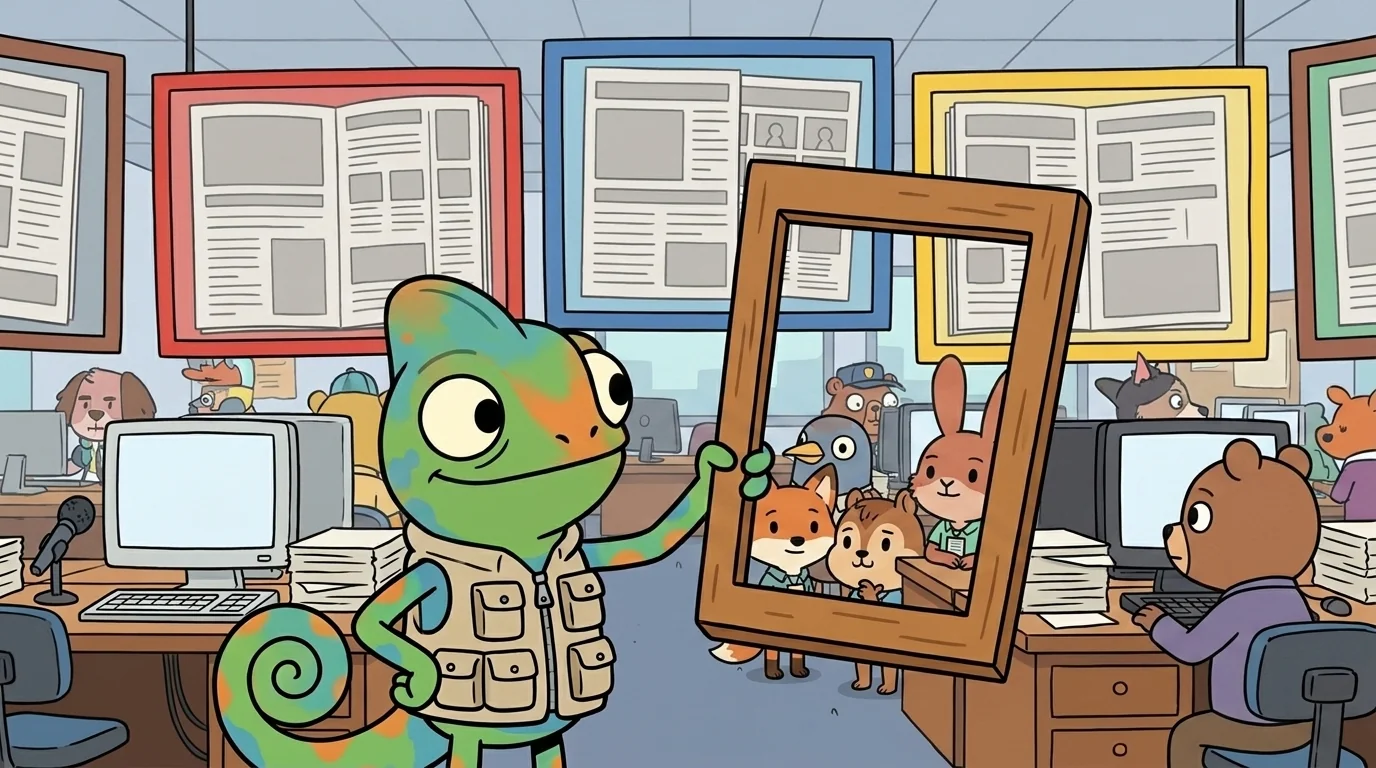
"So naming the frame isn't about deciding who's right," a young reporter said slowly. "It's about seeing how it's made."
"Exactly — and then you decide," Tilt said, their skin settling into a warm, calm green. "When I name a frame, the story stops pulling me around. I feel steady — curious instead of angry." And the young reporter tried it on a story that had had them worked up moments before, named its frame out loud, and felt the tug loosen: the hot, yanked-around feeling gave way to a calm, clear-eyed, I'm-in-charge-of-what-I-feel steadiness. That calm, steady, reading-with-my-own-eyes-open feeling — braver than being pulled around by a headline — was, to Tilt, exactly what naming the frame is for.
The NewsForge ensemble
Tilt is part of NewsForge's distributed-narrative cast. Each character embodies a different curricular primitive; together they teach the full subject.
-

Source
Source-quality evaluation — who would KNOW this best? who has a stake? source-card-comparison the routine
-

Frame
Headline-and-framing craft — a headline is a SUMMARY not a HOOK; counter-clickbait
-

Verify
Verification + lateral-reading discipline — SIFT (Stop, Investigate, Find, Trace); open four tabs, never one
-

Serve
Community-information-needs framing — what does my reader NEED to know to DO something? agency-foregrounding; counter-doomscroll
-

Attest
Attribution — who says so? every claim names its source
-

Deed
Primary source — go to the original document, not a summary of a summary
-

Errata
Corrections — a story is living; when the facts change, the record is fixed
-

Uncrop
Framing — an image or chart is cropped; ask what sits outside the frame
-

Widen
Context — one number means little without comparison; widen the view