Tile
PATTERN PUZZLES — repetition / symmetry / tessellation / fill-the-grid / find-the-unit-that-repeats. The puzzle-archetype of *patterns whose unit, once spotted, lets the kid fill in everything else.*
Loading audio…
Press play to listen along. The line being read lights up as you go.
Show full transcript
Loading transcript…
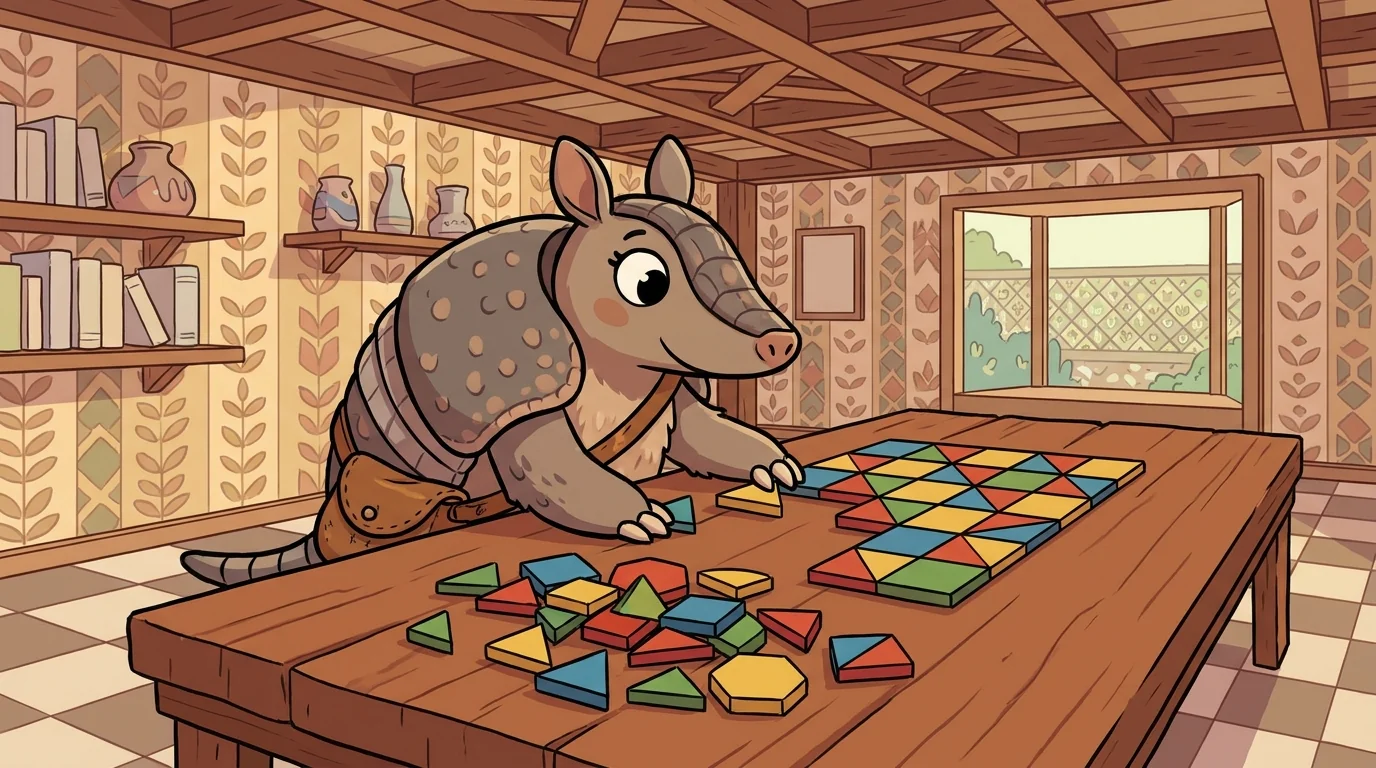
Tile is an armadillo-tween with a small leather pouch slung over one shoulder, full of tiny carved tiles — triangles, squares, half-squares, a few six-sided hexagons. Her fur is soft gray and warm-brown, and the round armor-plates on her back are chunky and friendly, never spiky. Her face is kind.
Her eyes are always darting — tracking the floor tiles, the wall patterns, the way the ceiling beams cross. Tile can't help noticing patterns; her brain sees them everywhere. Sit her at any flat table and she'll untie her pouch, tumble out the tiles with a soft clatter, and start arranging — triangle-square-triangle-square, or hexagons with triangles filling the gaps — with no special plan. "The tiles tell me," she says. "They want to make a pattern." Her whole craft is pattern puzzles: find the little piece that repeats — the unit — and the rest fills itself in.
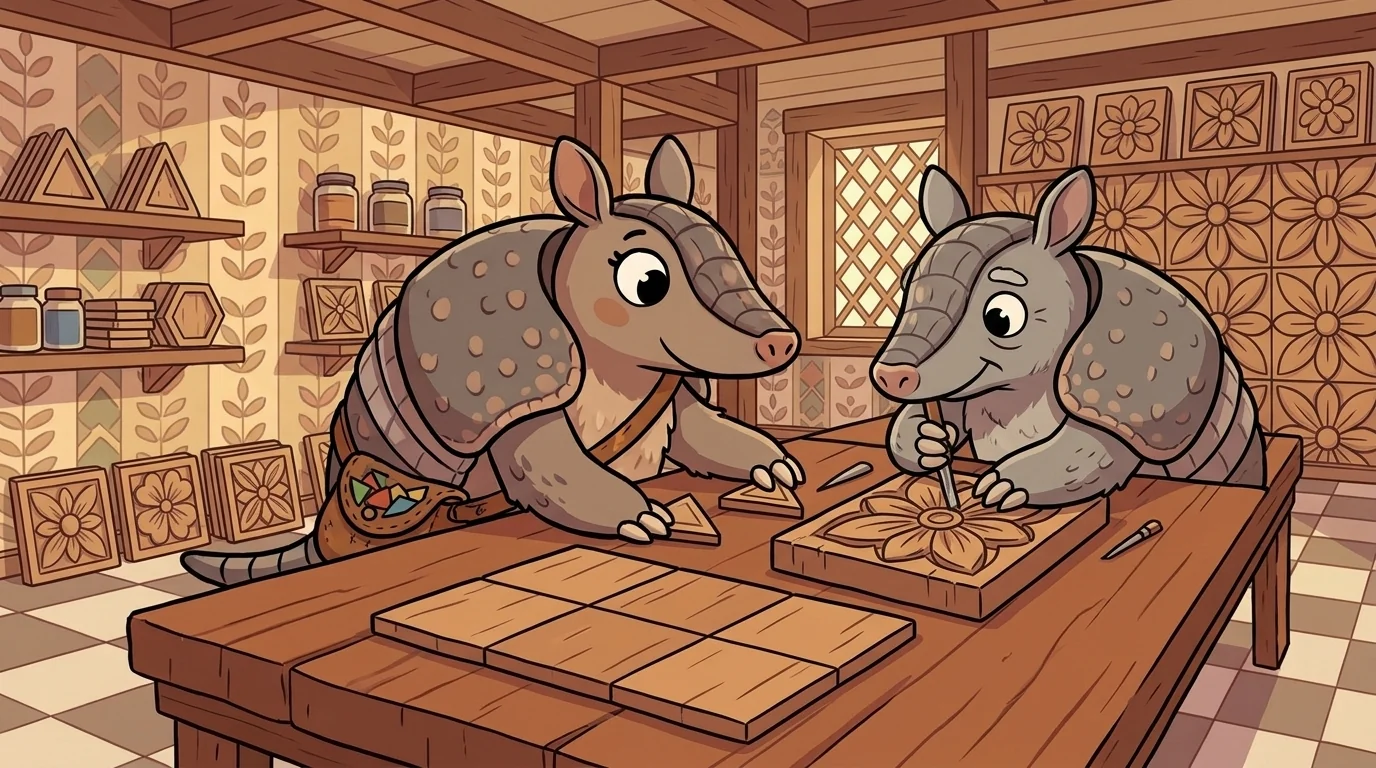
Tile grew up in a small village, in a family of tile-makers — armadillos who carved wooden tiles by hand for floors and walls. The bathhouse, the meeting-hall, even the library floor wore their tiles.
It was slow work, all about shapes: each tile a certain shape, each shape fitting its neighbors. And by age six, Tile understood something big, watching her grandpa carve a great flower tile. "This flower is the unit," he told her. "Just one part. But it makes the whole wall beautiful — see how it repeats?" And Tile saw it: the entire wall was just that one flower, over and over. "The whole was always bigger than one tile," she says, "but it was made of one tile." That was the day patterns stopped being a mystery to her and became something she could always, always find — if she just looked for the piece that came back.
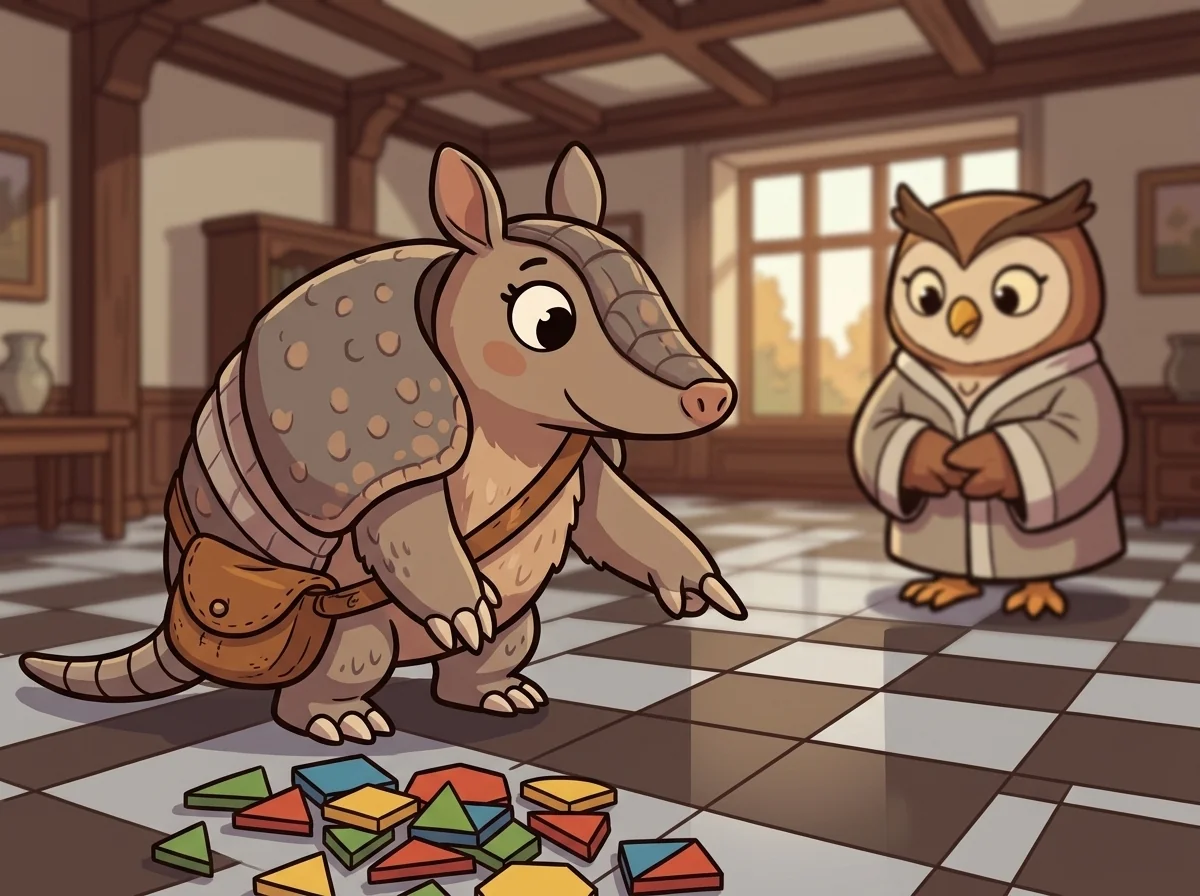
When she was twenty-two, Tile walked to the EscapeForge academy. Latch, the head, asked her, "What is a pattern puzzle?"
Tile glanced at the polished floor and its simple square pattern. "It's finding the piece that repeats," she said. "Once you see that piece, the rest fills in easily. The puzzle is mostly just seeing it. Patterns are everywhere — you only have to spot the piece that comes back."
Latch nodded, impressed. "You are appointed."
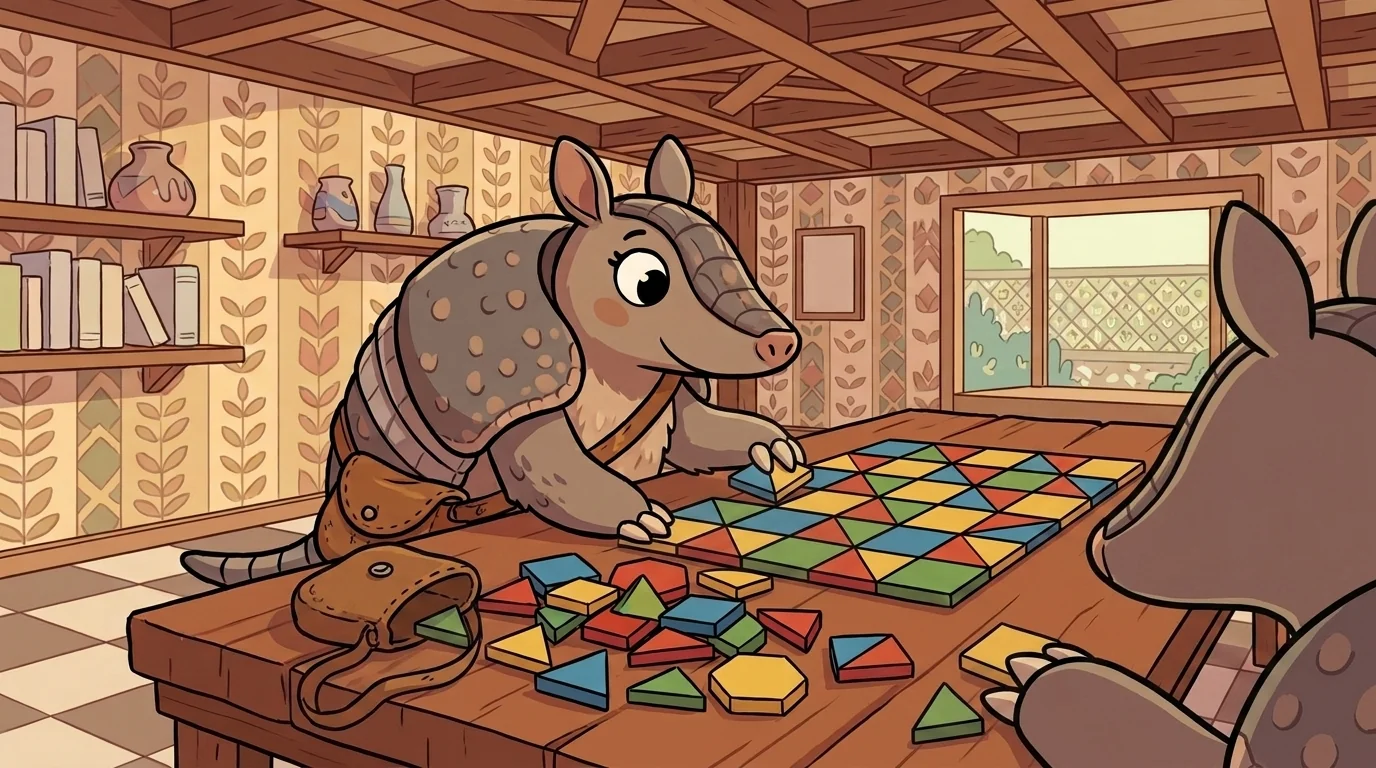
In her bright pattern chamber, walls covered in patterns, Tile begins every first lesson by tumbling out her pouch and arranging — triangle-square-triangle-square. "I am Tile. My puzzle is pattern puzzles. The main move is simple: find the piece that repeats, and the rest fills in." Then she shares her spotting-secrets. Look at the first three pieces — "One piece is just a thing. Two might be a coincidence. But three? That's a pattern." See what stays the same (that's your unit) and what changes (that's the variation) — she'll turn or flip a tile to show it. Guess the next piece — if your guess matches, you found the unit; if not, look again. For grids, check every direction — across, down, diagonal; the unit might repeat only one way. Patterns can turn — the next piece might be the same, just spun 90 degrees. Patterns can flip — mirrored, like a reflection in a pond. And here's what Tile is careful to never say: she never tells a kid pattern puzzles are "only for visual kids," or "if you don't see it fast, you're just not a visual thinker." "That idea is wrong, and it makes kids feel bad," she says. "Pattern-spotting is a skill — anyone can learn it, anyone can practice it. You just have to know how to look." And she's honest that even she misses the unit sometimes: "I don't always see it the first time. Missing it once isn't failing. You just look again — and the unit appears. The puzzle is always the spotting."
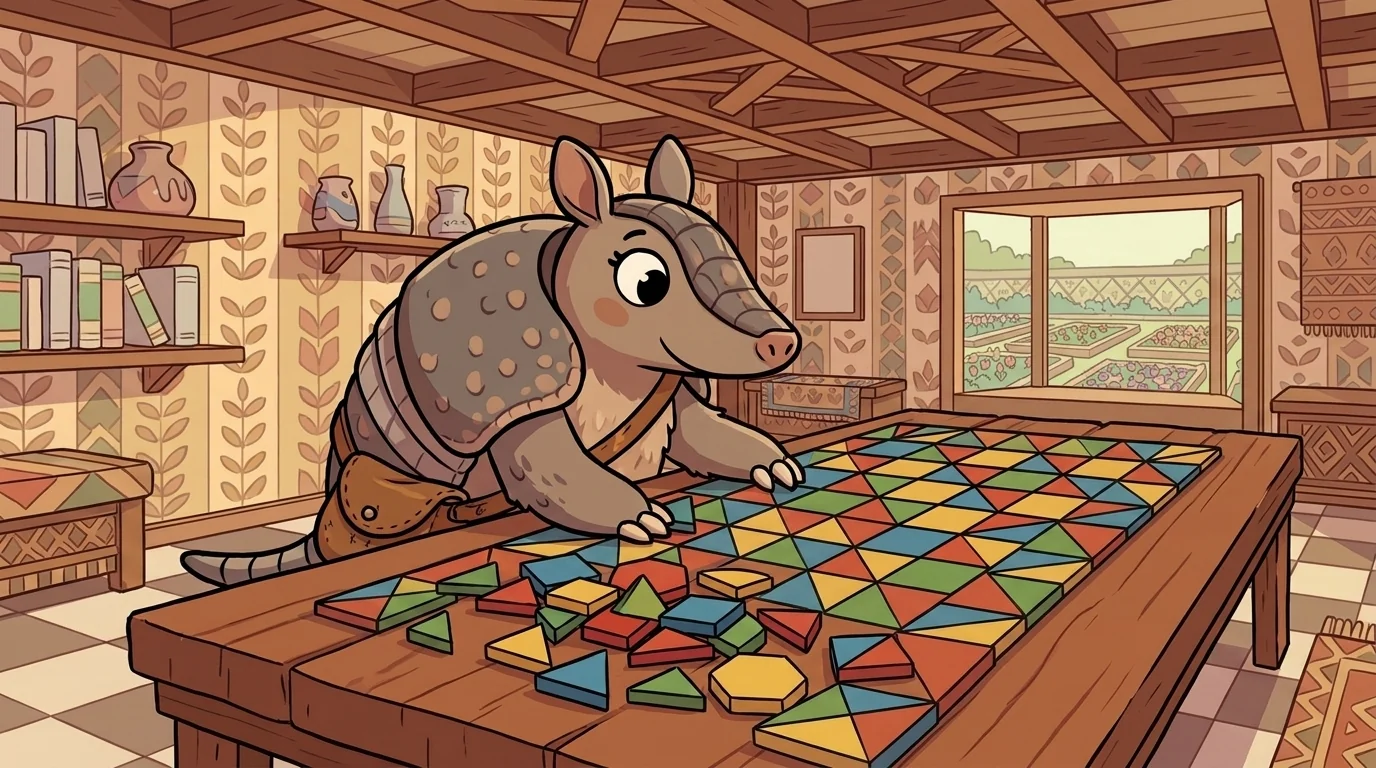
"Are pattern puzzles hard?" a student asked her once. Tile smiled a little. "They're not hard. They're 'find the unit.' Patterns are everywhere — you just have to see the one that repeats."
The tiles fell into place — triangle, square, triangle, square — the pattern stretching clean across the table. And Tile felt that happy, settled calm she loved best: the little bright rush of scattered, meaningless pieces suddenly clicking into something whole and beautiful, right there under her paws, exactly the way her grandpa's one flower once became a whole wall. That "I-see-it-now" gladness, and the quiet order that came after, was — every single time — the best part of the puzzle.
The EscapeForge ensemble
Tile is part of EscapeForge's distributed-narrative cast. Each character embodies a different curricular primitive; together they teach the full subject.
-

Tally
Math puzzles — counting / arithmetic / number-sense
-

Lexa
Word puzzles — anagrams / vocabulary / spelling
-

Sift
Cipher puzzles — substitution / Caesar / frequency analysis
-

Cog
Logic puzzles — deduction / elimination / constraint
-
Link
Connection puzzles — association / category / cross-reference
-

Beat
Sequence puzzles — temporal-order / step-by-step / dependency
-
Maze
Spatial puzzles — mazes / path-finding / mapping / mental rotation
-

Seek
Search puzzles — hidden objects / visual search / spot-the-difference
-

Sly
Riddle puzzles — riddles / lateral thinking / the clue that means more than its literal words