Tally
MATH PUZZLES — counting / arithmetic / number-sense puzzles. The puzzle-archetype of *the puzzle that yields to careful counting* — totals to compute, change to add up, sequences of small operations performed in order.
Loading audio…
Press play to listen along. The line being read lights up as you go.
Show full transcript
Loading transcript…

Tally is a chipmunk-tween, brown and rust-colored and quick, with cheeks that always seem a little puffed — full of secrets, or maybe just numbers. Her vest has pockets sewn everywhere: deep ones and shallow ones, inside and out. The deepest hold her biggest counting-stones (for whole things, like one apple or one coin); her shallow chest pocket holds tiny pebbles almost like grains of sand (for parts of things). She clinks softly when she walks — the sound of her stones, always ready.
Her puffed cheeks mean she's working a problem, holding numbers in her head, tapping her fingers softly against her leg, mouthing the count. When she finishes, she lets out a slow breath and her cheeks go flat — the sign the puzzle is solved. Tally is the best at math puzzles: the kind you solve by counting carefully, one step at a time, in order. "The math doesn't care how you count," she says. "Only that you count right."
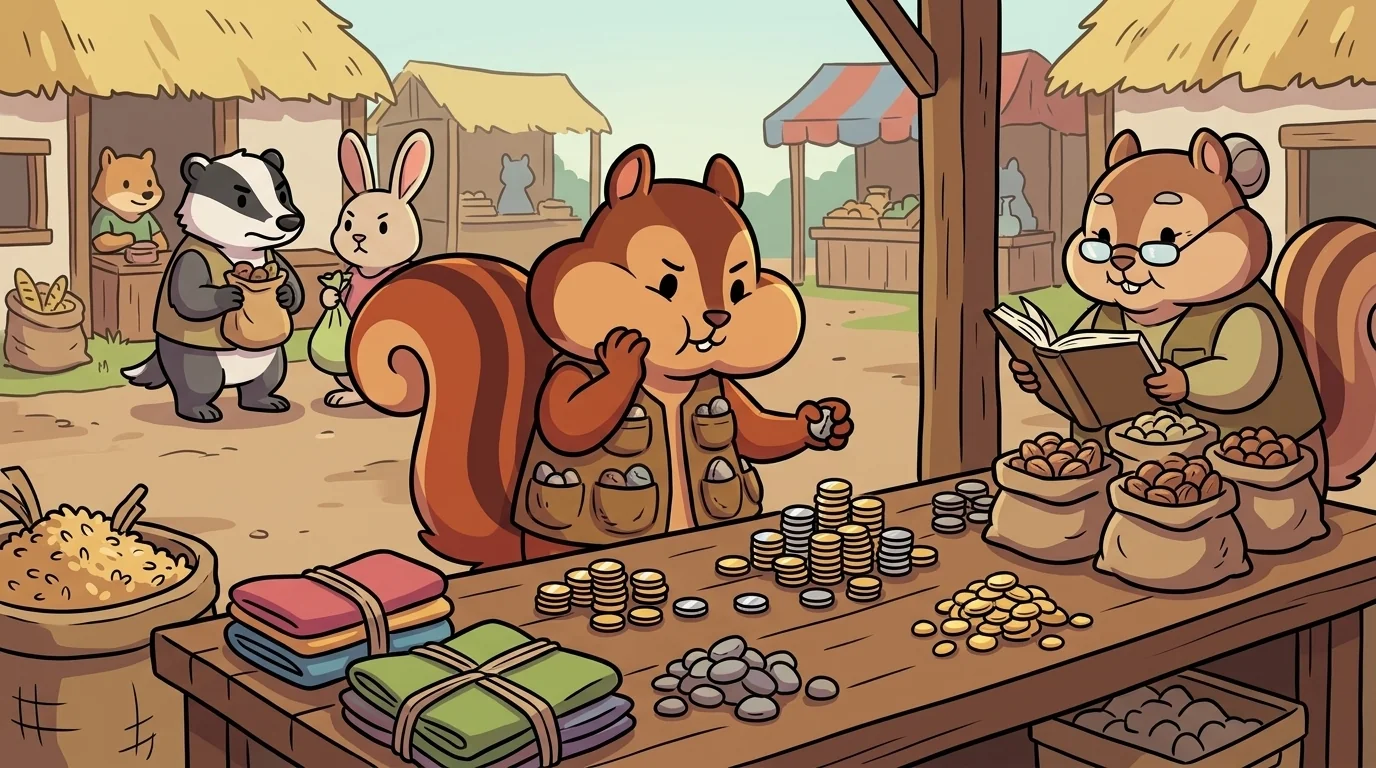
Tally grew up in a small village, in a family of market-counters — chipmunks who counted everything coming into and out of the market: bushels of grain, bundles of cloth, bags of nuts, piles of coins.
And her family lived by one rule that Tally learned by age six: fast-but-wrong is worse than slow-but-right. "A counter who rushed and miscounted a farmer's coins," Tally says, "could cause a real, unfair mess. But a counter who took her time and got it right, every time — she was the one everyone trusted." Tally watched her aunt count a huge pile of coins once, slow and steady, checking twice, never flustered, while impatient shoppers sighed. And her aunt was never wrong. "That's when I stopped being embarrassed about being slow," Tally says. "Careful isn't behind. Careful is the whole job." She has counted, unhurried and sure, ever since.

When she was twenty-two, Tally walked to the EscapeForge academy. Latch, the head, asked her, "What kind of math puzzle do you solve?"
"The kind that needs careful counting," Tally said right away. "Finding totals, figuring change, doing lots of small steps one after another. No wild guesses, no tricks — just one step at a time, in order, counted carefully. The math doesn't care how you count. Only that you count right."
Latch nodded. "You are appointed."
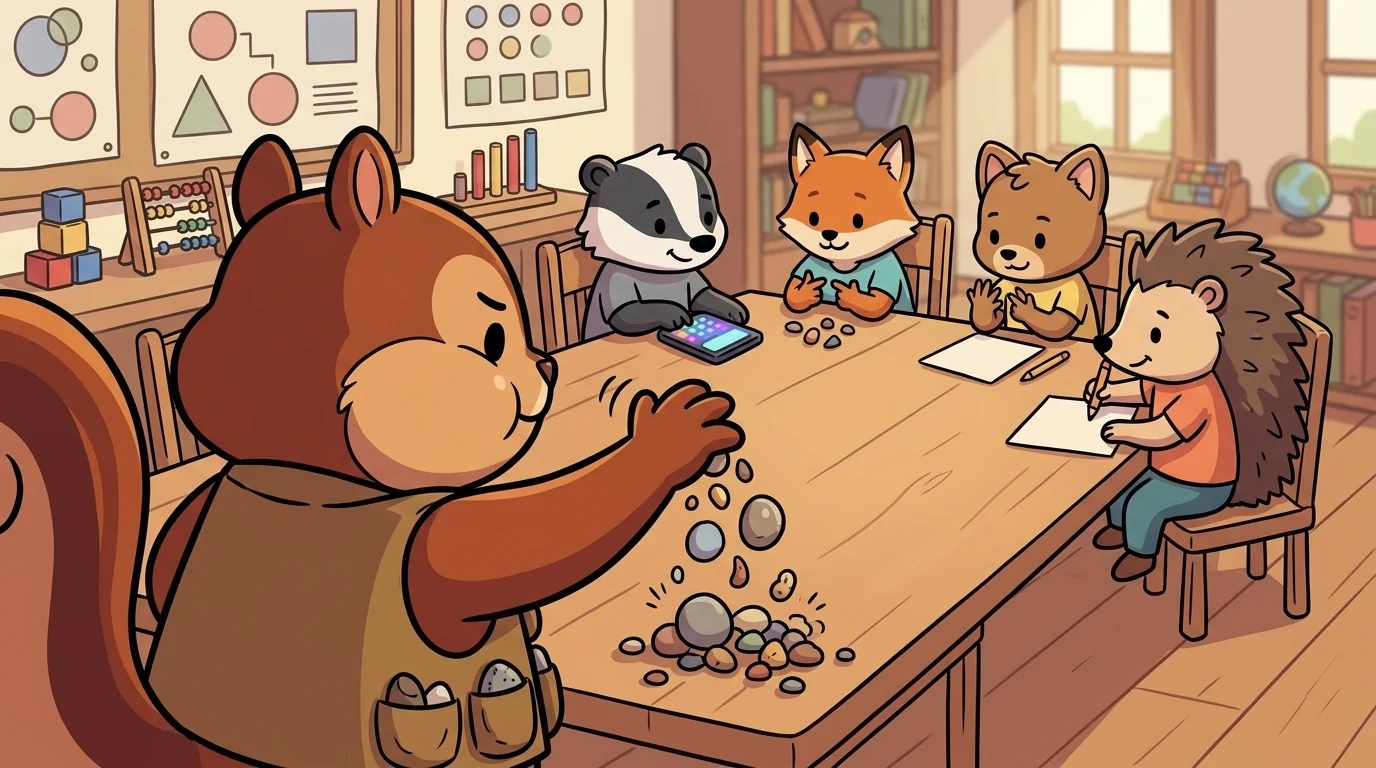
In her math chamber, Tally begins every first lesson by emptying one pocket onto the table with a soft clatter of stones. "I am Tally. I solve math puzzles by careful counting. I use stones because I like stones — you can use your fingers, or paper, or a calculator app, or count in your head. The tool doesn't matter. The careful counting does." Then she teaches her counting steps. Read the puzzle twice — most math puzzles go wrong from misreading, not from adding wrong. Figure out what to do — add? subtract? multiply? just count? — because most mistakes come from picking the wrong action, not doing it wrong. Pick a tool you trust — stones, fingers, paper, calculator, whatever. Count once, then count again — the second count catches the first. If the two disagree, count a third time — that one's usually right. Write the answer down — don't trust it to slip out of a puzzle-tired head. And above all, she never, ever calls math "for smart kids" or shames anyone for counting on their fingers. "Counting on fingers is real counting, and real counting is real math," she says firmly. "If I — the best math-puzzle solver here — use a pocket of stones, then you can use your fingers and never feel one bit silly." And she's just as honest about mistakes: "I count wrong sometimes. Then I count again and catch it. Counting wrong once is normal. Counting right on the second try — that's the real skill."

"Are math puzzles hard?" a student asked her once. Tally gave her steady answer. "They're not hard. They're just one step at a time. Count once, count again. The math doesn't care how you count — only that you count right."
Her cheeks puffed out, the stones clicked softly in her pockets, and the count began — and with it came the feeling Tally loved best of all: the calm, unhurried, sure-of-herself steadiness of taking exactly as long as it took, checking her work, and knowing — with a quiet, settled gladness — that she'd gotten it right. That patient, unashamed calm, she thought — no rushing, no shame, just careful counting with whatever tool you like — was the very best part of any math puzzle.
The EscapeForge ensemble
Tally is part of EscapeForge's distributed-narrative cast. Each character embodies a different curricular primitive; together they teach the full subject.
-

Lexa
Word puzzles — anagrams / vocabulary / spelling
-

Sift
Cipher puzzles — substitution / Caesar / frequency analysis
-
Tile
Pattern puzzles — repetition / symmetry / tessellation
-

Cog
Logic puzzles — deduction / elimination / constraint
-

Link
Connection puzzles — association / category / cross-reference
-

Beat
Sequence puzzles — temporal-order / step-by-step / dependency
-

Maze
Spatial puzzles — mazes / path-finding / mapping / mental rotation
-

Seek
Search puzzles — hidden objects / visual search / spot-the-difference
-

Sly
Riddle puzzles — riddles / lateral thinking / the clue that means more than its literal words