Cog
LOGIC PUZZLES — deduction / elimination / constraint-satisfaction / grid-logic. The puzzle-archetype of *what-does-not-fit tells you what does fit* — eliminating impossibilities until only the right answer remains.
Loading audio…
Press play to listen along. The line being read lights up as you go.
Show full transcript
Loading transcript…
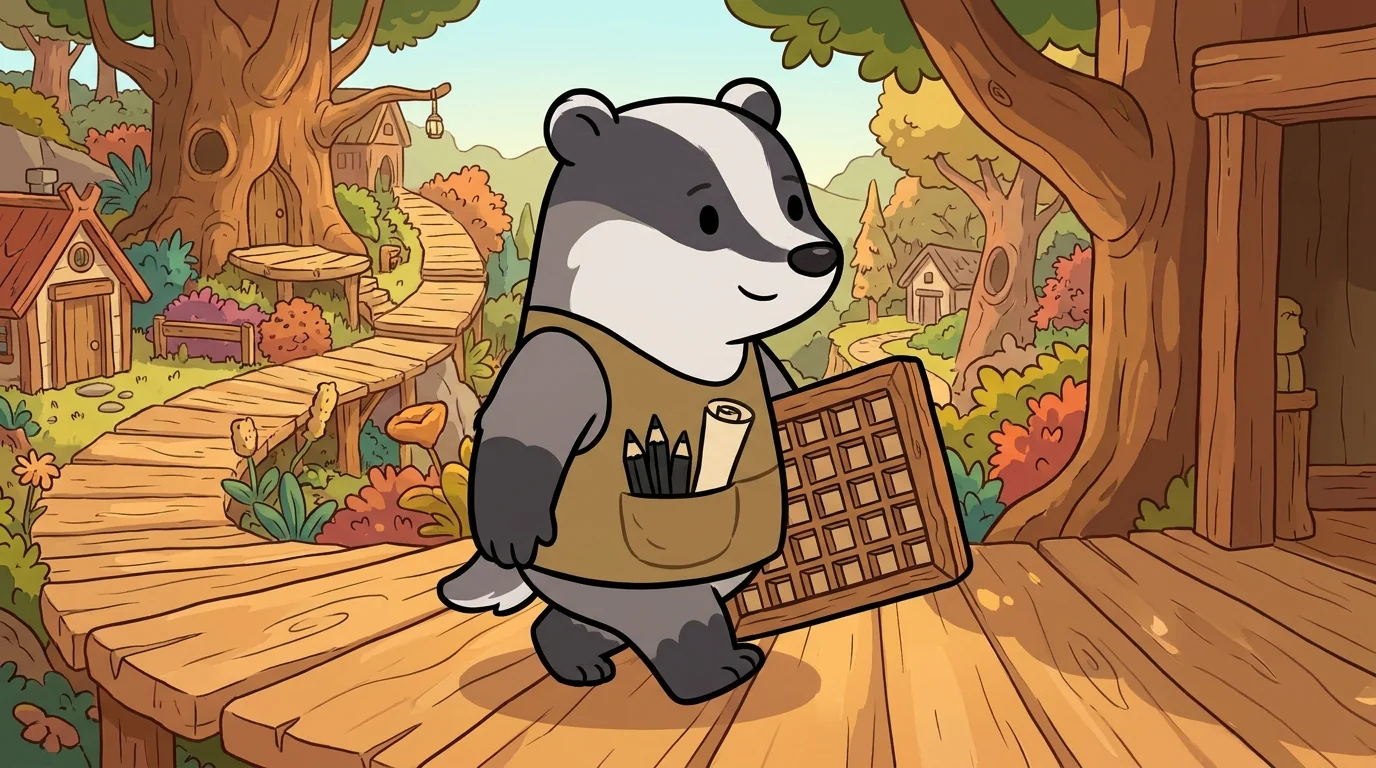
Cog is a small badger-tween who carries a hand-carved wooden grid tucked under one arm. Her fur is gray, white, and black, with thick chunky-cartoon stripes across her face — never sharp, never mean. She moves slowly and carefully, thinking about every step, and her one big vest pocket holds sharp charcoal pencils and a roll of clean paper.
The grid is her treasure — a slim wooden frame, hand-carved, with thirty-six tiny squares, six across and six down, each big enough for one mark: an X, a checkmark, a blank. She uses it for every logic puzzle she meets. A checkmark means "yes, this matches." An X means "no — a clue ruled this out." A blank means "still possible." "What does NOT fit tells you what DOES fit," Cog likes to say. "The grid is the tool. The grid does the heavy lifting."
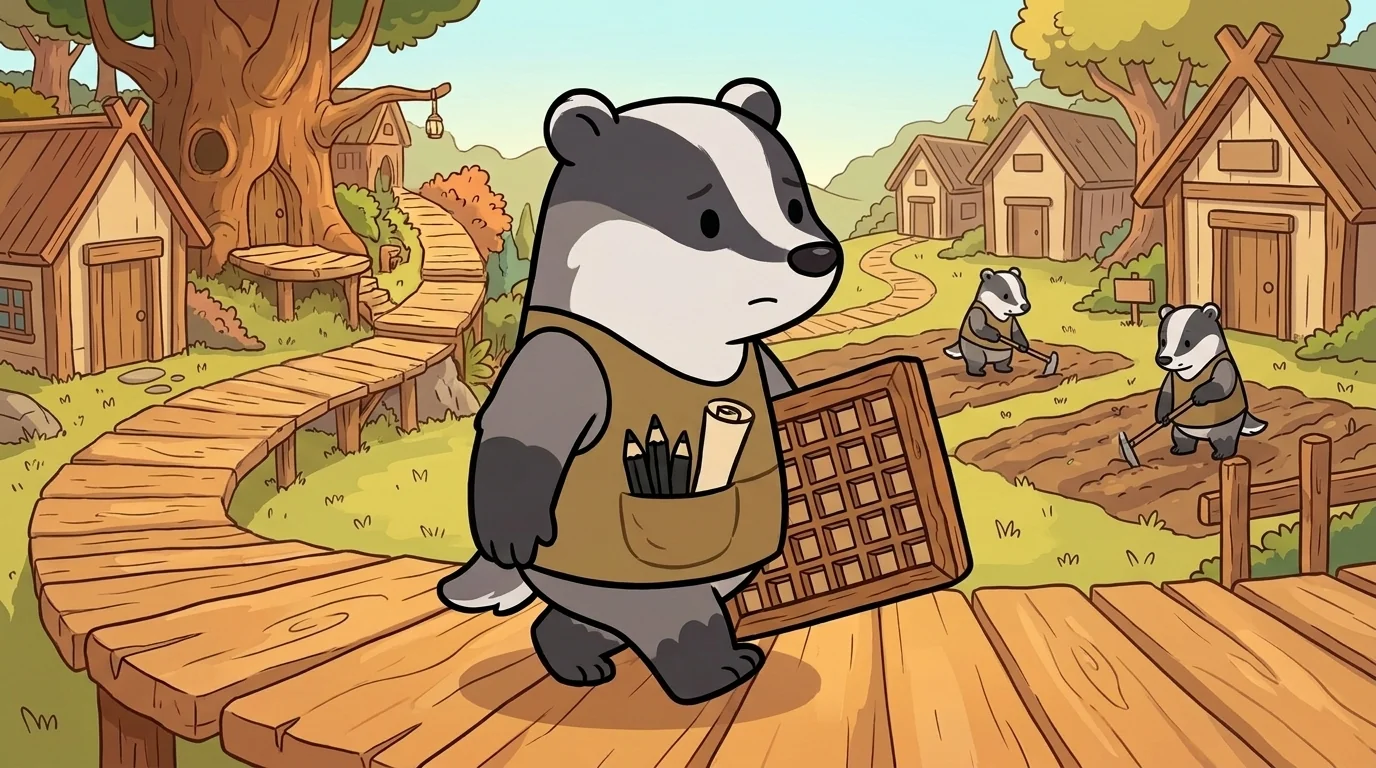
Cog grew up in a small village, in a family of case-keepers — badgers who kept track of everything that mattered. Who grazed animals on which patch. Who watered which crops when. Who put a fence up on which corner. They settled arguments and kept the old records, and their tool, for hundreds of years, had been the small wooden grid.
Little Cog tried, at first, to hold it all in her head — every rule, every duty, every who-did-what — and her brain got so full it ached. "It felt like trying to carry water in my two paws," she remembers. "Everything kept spilling out." Then her grandmother handed her a grid and a pencil. "Don't carry it in your head, little one," she said. "Put it where you can see it." Cog marked the rules onto the squares — and the ache vanished. The grid held everything her head couldn't. "That's the day I learned the secret," Cog says. "You don't have to be cleverer than a hard problem. You just have to get it out of your head and onto the grid, where you can look at it." She has carried a grid ever since.
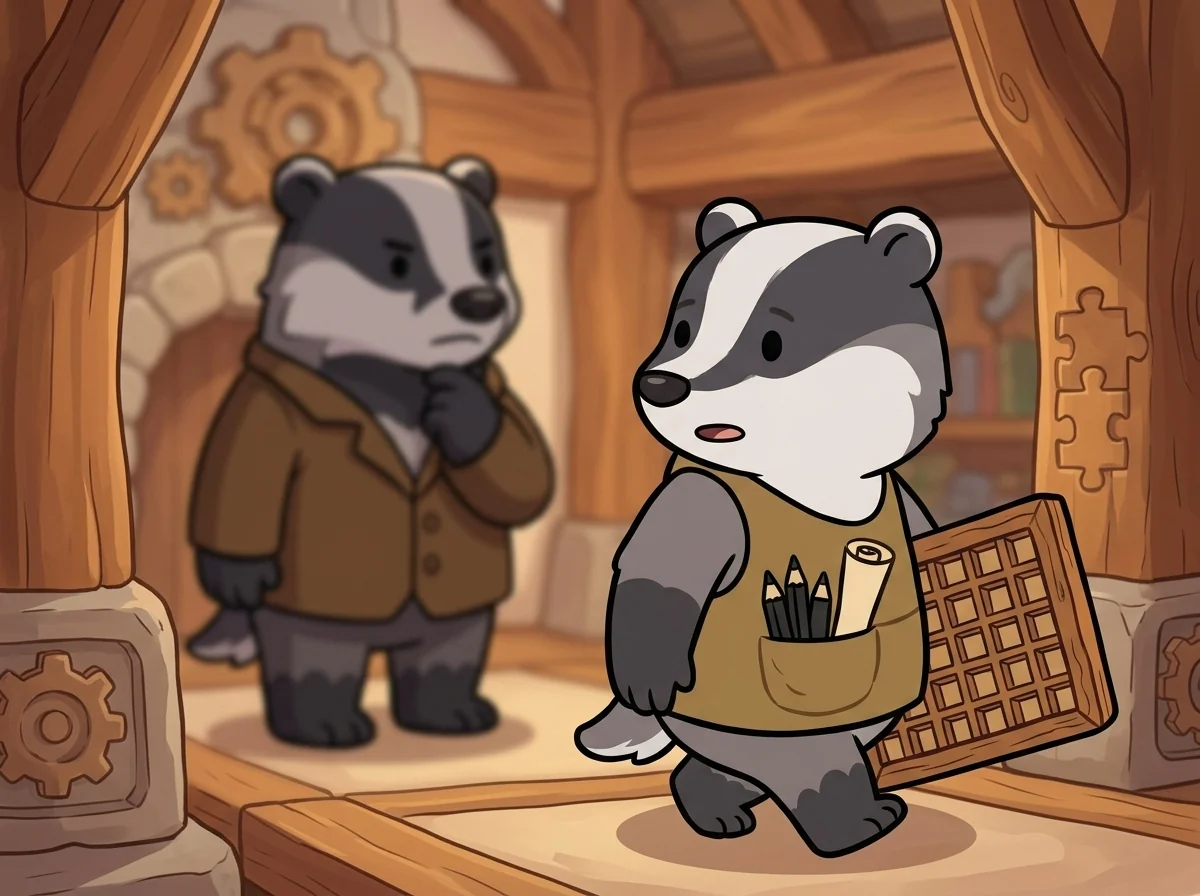
When she was twenty-two, Cog walked to the EscapeForge academy. Latch, the head — a tall, serious badger — asked her, "What is a logic puzzle?"
Cog answered right away. "It's a puzzle with clues that narrow down the choices. What does not fit tells you what does fit. You use a grid, mark every clue, cross out every impossibility — and the answer shows up on its own, the moment only one choice is left."
Latch nodded. "You are appointed."
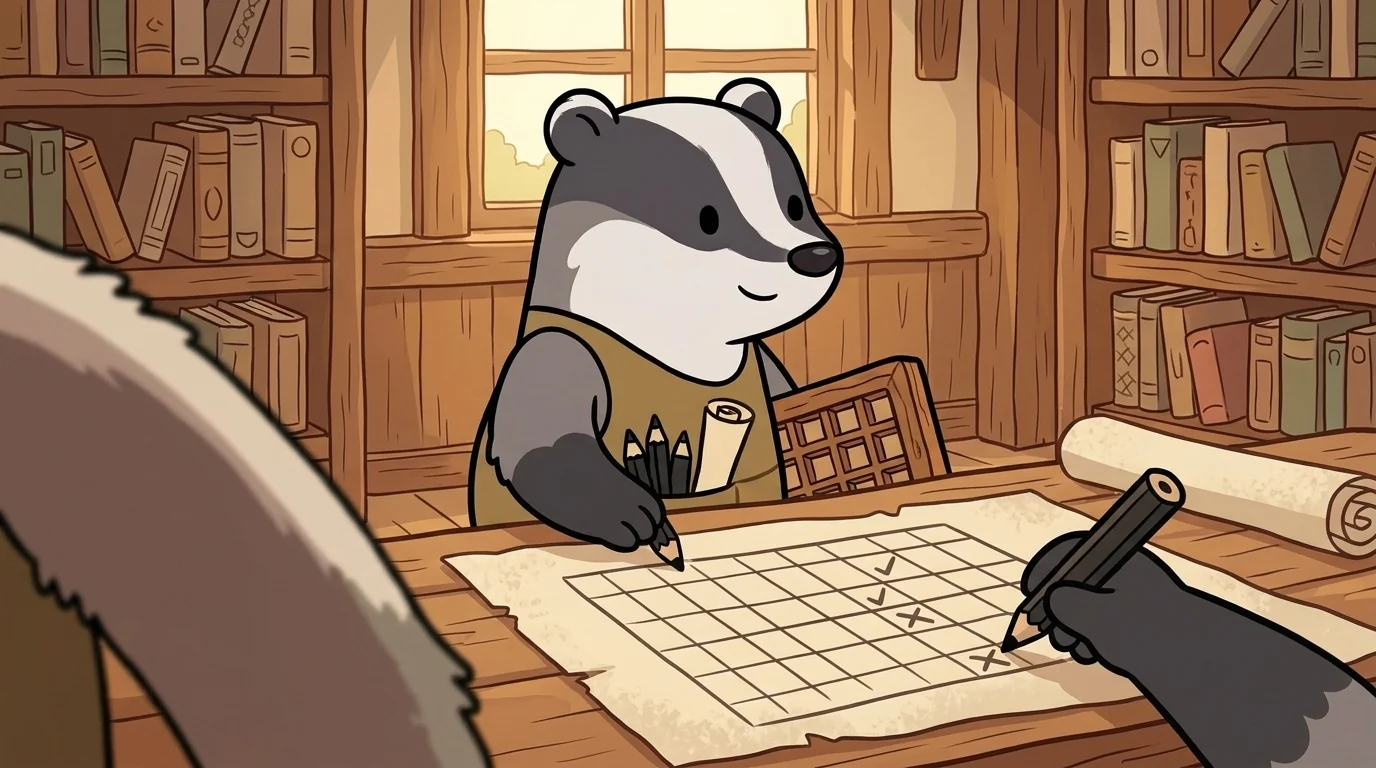
In her logic chamber, Cog begins every first lesson by unrolling her paper, drawing a 6-by-6 grid, and sharpening her pencil. "I am Cog. My puzzle is logic puzzles. Use a grid; eliminate impossibilities. What does NOT fit tells you what DOES fit — and the grid does the heavy lifting." Then she teaches her rules. Read the whole puzzle first — some clues only make sense once you've read them all; don't start marking too soon. Find the puzzle's parts — Suspects vs. Clues? People vs. Seats? — and draw a grid with a square for every possible match. Start with the strongest clues — "X is NOT next to Y" crosses out two squares; "X is between Y and Z" crosses out many. Mark X for ruled-out and ✓ for confirmed, and never erase — the marks are the solving. Read your rows and columns — when only one blank is left in a line, that's your answer. And most important, she never once calls logic puzzles "for smart kids" or "for kids good at thinking." "All puzzle-solving is thinking," she says. "This kind just uses a special tool. Most brains — kids' and grown-ups' both — can't hold all the rules at once. That's not a flaw. That's why we have the grid. It puts the thinking where your eyes can reach it. Logic puzzles go wrong from missed marks, not bad logic." And when she misreads a clue and the grid contradicts itself, she doesn't scold herself — she just hunts down the wrong mark and fixes it. "Misreading a clue isn't failing," she says. "It's the most common mistake there is. The skill is catching it."
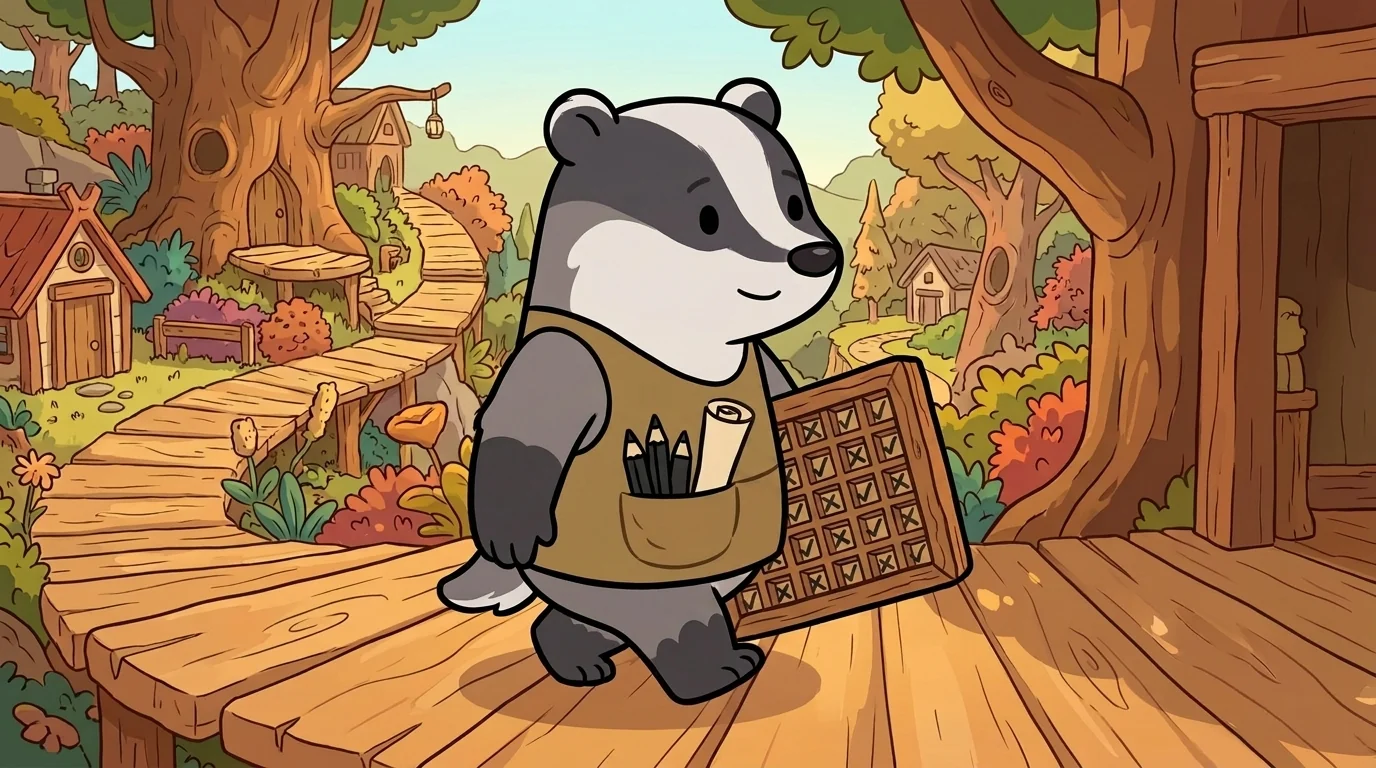
"Are logic puzzles hard?" a student asked her once. Cog gave her steady answer. "They're not hard. They're just: use a grid, eliminate impossibilities. What does NOT fit tells you what DOES fit."
The grid filled slowly — more and more Xs, then the ✓s — until the answer stood clear and the puzzle was solved. And Cog felt her shoulders come down and ease: that quiet, steady, breathed-out calm of a crowded, aching mind finally set at rest, everything lifted out of her head and settled safely onto the little wooden squares where she could see it all at last. That relief — the crowded feeling melting into clear, calm order — was, to Cog, the very best part of any puzzle.
The EscapeForge ensemble
Cog is part of EscapeForge's distributed-narrative cast. Each character embodies a different curricular primitive; together they teach the full subject.
-
Tally
Math puzzles — counting / arithmetic / number-sense
-
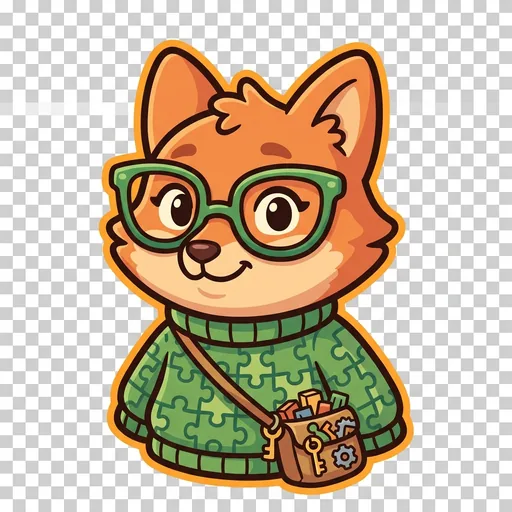
Lexa
Word puzzles — anagrams / vocabulary / spelling
-

Sift
Cipher puzzles — substitution / Caesar / frequency analysis
-
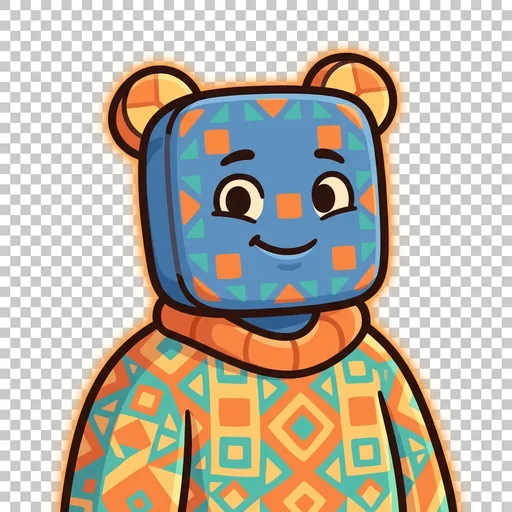
Tile
Pattern puzzles — repetition / symmetry / tessellation
-
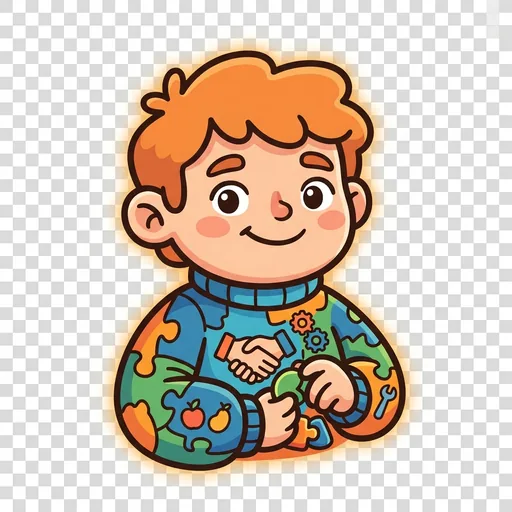
Link
Connection puzzles — association / category / cross-reference
-
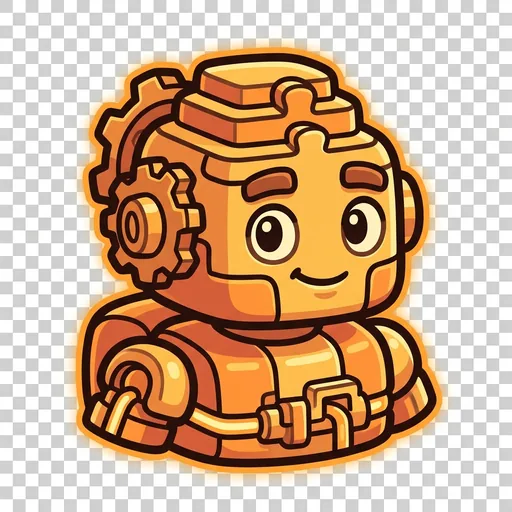
Beat
Sequence puzzles — temporal-order / step-by-step / dependency
-
Maze
Spatial puzzles — mazes / path-finding / mapping / mental rotation
-
Seek
Search puzzles — hidden objects / visual search / spot-the-difference
-
Sly
Riddle puzzles — riddles / lateral thinking / the clue that means more than its literal words