The Wandering Forge · Reader · ages 6-8
Listen along
Loading audio…
Read by an AI-generated voice. The words on this page are the transcript.
1. One Bell
The hammer rang once. A spark jumped off the anvil and did not go out. It waited. They followed.
It was a windy morning, and the Green was full of blowing leaves. Inkling sat on the low wall with her belt across her knees. She had two tools on it now: the tick-weight and the tally-peg. Beto had two as well: the even-rule and the key-tag. He kept turning the key-tag over and over in his fingers, reading the little marks.
"Four towns," said Inkling. "And four tiny hammers. The clock in Tickwell. The bridge plank in Halvingford. The patch on the pump in Fourways. The first stone in Reedmere."
"I noticed," said Beto.
"I noticed first," said Inkling.
"You named it first," said Beto. "That's not the same."
Inkling opened her mouth, and then closed it again, because it was true.
The spark bounced over the wall, skittered through the leaves, and dropped into the forge on Fiddle's cart. The coals woke up orange, then gold.
Fiddle climbed out from under the canvas with a smudge of soot on her nose. She was holding a bent spoon, as if she had been in the middle of something.
"There you are," said Fiddle. "Somewhere has broken something."
"Fiddle," said Inkling, "who scratches the little hammers?"
Fiddle looked at her for a long moment. Her eyes were bright behind her black mask.
"What does the road tell you?" she said.
"The road doesn't tell me anything," said Inkling. "It's a road."
"Then keep looking," said Fiddle. "Try it and see."
Beto climbed up on the right. Inkling climbed up on the left. Their belts clinked.
The cart's bell rang once, and the wheels began to turn.
2. The Bell on the Bank
The road ran down beside a river. At first it was a stream they could have jumped. Then it was a stream they could have waded. Then, all at once, it was a wide, slow, brown river with ducks on it, and boats, and a town on both banks.
"Brimwater," said Fiddle, reading a painted sign.
The cart stopped at the top of a ramp that went down into the water. At the bottom of the ramp was a ferry: a flat wooden boat, long and wide, with a rope that ran across the river to the far side. A man in a wet coat was coiling the rope. He was the ferryman.
On the bank beside the ramp sat a bell.
It was the biggest bell Inkling had ever seen up close. It was dark and shiny and taller than Beto, and it sat on a wooden frame with a rope tied round it. Somebody had polished it so well that Inkling could see her own face in it, stretched long and funny.
On the far bank, across the water, stood a stone tower with an empty arch at the top.
"The old bell cracked last winter," said the ferryman. "The town saved up for a new one. It came by road, all the way from the foundry. Now it has to cross to its tower. And I won't take it."
"Why not?" said Beto.
The ferryman pointed at a post beside the ramp. Painted on it, in big white letters, was: NO MORE THAN 400 KG.
"Four hundred kilograms," said the ferryman. "That's what my ferry can carry safely. Any more and the water comes over the sides, and down she goes, bell and all."
"How heavy is the bell?" said Beto.
The ferryman spread his hands. "Nobody knows," he said. "The foundry sent a letter with the weight on it, and the letter blew into the river on the way here."
"Then weigh it," said Inkling.
"With what?" said the ferryman. He nodded up the street at the market square. In the middle stood a balance: a long iron beam with a pan hanging from each end. Next to it was a box of iron weights.
"The market balance weighs twenty kilograms at a time," said the ferryman. "Flour, potatoes, apples. Not bells. You can't even lift a bell onto it. Ten people couldn't."
3. It Looks Small
Inkling walked all the way round the bell. Then she walked round the cart. Then she walked round the bell again.
"It's smaller than our cart," she said. "And our cart isn't very heavy, because Fiddle pulls it. So the bell can't be very heavy either. I can name it! Call it three hundred. That's under four hundred. Load it!"
She was already reaching for the rope.
A round green frog hopped onto the ramp right in front of her feet. He was the colour of pond weed and as wide as a dinner plate, and he looked up at her with big calm eyes.
"Looking is not the same as knowing," said the frog.
Inkling stopped.
"My name is Glug," said the frog. "I live under the ramp, and I watch everything that goes over it. I have seen a cart that looked light sink a ferry to its rail. I have seen a box that looked heavy turn out to be full of feathers."
"But it looks small," said Inkling.
"It looks small," said Glug. "How would we know for sure?"
Inkling thought about it. The bell was made of metal, all the way through. The cart was mostly wood and canvas and air.
"Metal is heavier than wood," she said slowly.
"Glug, glug, let's see," said the frog. "If you guess three hundred, and it's really five hundred, what happens?"
Inkling looked at the ferry. She looked at the wide brown river. She thought about the bell sinking down through the water, all that polishing for nothing, and lying on the bottom with the fish.
Her cheeks went hot. She had done it again. She had named it too soon.
"Don't trust the look of it," said Glug kindly. "It's not a bad guess. It's just a guess. A guess is not a weight."
Beto had been listening with his hands in his pockets. "So we need a way to weigh something we can't lift," he said.
"Yes," said Glug. "And I don't know one. I only know how to check."
4. What the Water Says
They all looked at Fiddle. Fiddle was sitting on the edge of the cart, swinging her feet, eating an apple.
"Fiddle," said Inkling. "How do we weigh it?"
"What does the water tell you?" said Fiddle.
"Water doesn't talk," said Inkling.
"Everything talks," said Fiddle, "if you poke it gently and then look again." She took another bite of her apple and said nothing else at all.
Beto walked down the ramp to the ferry. It bobbed at the bottom, empty, its edge high out of the water. He looked at it for a while. Then he stepped in.
The ferry dipped. Not much. Just a little. A dark wet band appeared along its side where the water had come up.
"How does it work?" said Beto. "Inkling, get in."
Inkling stepped in beside him. The ferry dipped down more. The wet band grew a little wider.
"Now get out," said Beto.
Inkling stepped out. The ferry rose a little.
Beto stepped out too. The ferry rose a little more, back to where it had been.
"It sits lower when it carries more," said Beto. "And higher when it carries less."
"Everybody knows that," said Inkling. "Boats go down when you get in them."
"I know," said Beto. "But look." He pointed at the side of the ferry. "It goes down to the same place every time I get in. Exactly the same place. The water knows how heavy I am."
Glug hopped down onto the ferry's edge and looked over at the water.
"Pour it back and check," said Glug, which was what he always said. So Beto got in and out three more times, and every time, the water came up to exactly the same place on the wood.
Fiddle threw her apple core into the river for the ducks. She did not say a word. But she was smiling.
5. The Same Mark
In the little park beside the ramp there was a see-saw. A small white bunny in orange dungarees was sitting right in the middle of it, where the plank balanced on its post. On one end sat a bear cub. The other end was empty, and the bear's end was down on the grass.
"Whoa, down I go!" said the bear cub cheerfully. "The heavy side goes down."
"That's Teeter," said Glug. "And that's Evenly. They keep the see-saw."
The bunny hopped off the middle, picked up a bag of sand in both paws, and dropped it on the empty end. The plank swung up. The bear swung up too, until both ends hung in the air and the plank was perfectly flat.
"Same on both sides, and it's level," said Evenly. She sounded very pleased. "Level means equal."
Inkling sat down on the grass. Beto sat down beside her.
"We're trying to weigh the bell," said Inkling. "But it won't go on the balance. And we can't just guess."
"I tried," said Teeter. "I sat on it. It didn't tip."
Evenly looked from the see-saw to the ferry and back again. One long ear tipped to the side, the way it did when she was thinking.
"When Beto got in the boat," she said, "the water came to one line. Every time. The same line."
"Yes," said Beto.
"And if something else made the water come to that very same line," said Evenly, "then it would weigh the same as Beto. Wouldn't it? The water can't tell the difference between Beto and a bag of sand, if they push the boat down the same."
"The same mark means the same," said Inkling slowly.
"Make it match," said Evenly. "So. Put the bell in the boat. See where the water comes. Then take the bell out, and put in things you can weigh, until the water comes to the same mark. Then weigh those."
Beto jumped up. "Stones!" he said. "There are stones all along the river! We could put stones in, and then weigh the stones on the market balance, a few at a time!"
"Even, even, even," said Evenly, and settled back down in the middle of the see-saw as if she had never moved.
Inkling looked at Fiddle. Fiddle was very busy looking at a cloud.
6. Two Lines
It took most of the town to get the bell into the ferry.
They laid long planks down the ramp, side by side. They put rollers under the bell's wooden frame. Then everybody who could hold a rope held a rope, and everybody who couldn't held the planks still, and the ferryman shouted "Easy! Easy!" and the bell rolled down the planks, one slow turn at a time, and onto the ferry.
The ferry sank. It sank a long way. Inkling held her breath. But the water stopped well below the top of the sides, and the boat floated, heavy and low and steady.
"Quick," said Beto, "before anything moves."
He lay on his tummy on the ramp, leaned out over the water, and took the even-rule off his belt. With its sharp brass corner he scratched a line into the ferry's wooden side, right where the water touched it. It was hard, wet work. He scratched it twice to make it deep.
Then he stopped.
Just above his new line was another line. It was very old, so worn down that it was more of a dent than a scratch. And beside the old line, tiny, almost smoothed away, somebody had scratched a hammer.
"Inkling," said Beto. "Inkling, come here."
Inkling lay down beside him and looked. For a moment neither of them said anything.
"Five towns," Inkling whispered. "A clock and a plank and a pump and a stone. And now a boat. Somebody weighed something here before. Somebody did this exact thing."
"With a line and a little hammer," said Beto. "And no name."
The ferryman leaned down to see what they were looking at. He scratched his head.
"That old mark?" he said. "That's been there since my grandad's time. Before, even. He said the town weighed the old bell like that, the one that cracked. Somebody who came through with a cart showed them. Nobody remembers who."
"Nobody ever remembers who," said Inkling.
"They didn't want to be remembered," said Beto, thinking about it. "Or they'd have written their name."
They both looked round for Fiddle. She was sitting on the cart with her chin in her paws, watching them. When she saw them looking, she only raised her eyebrows, as if to say: well?
7. Stones
The bell had to come off again. That was the hard part, because rolling something up a ramp is much harder than rolling it down. It took the whole town and both horses from the bakery. But at last the bell sat on the bank again, and the ferry floated high and empty.
Now they needed stones.
There was a beach of river stones just downstream, round grey stones of every size. The town brought baskets, all the baskets they had: apple baskets and laundry baskets and fishing baskets. Children filled them. Grown-ups carried them. One by one, the baskets were tipped into the ferry.
A small yellow bean hopped up onto the ferry's rail and sat there, swinging his legs. He was round and shiny, about the size of Inkling's thumb.
"One more! That's one more," said the bean, as the first basket went in. "I'm Bop. I count them all, one by one."
"Why?" said Beto.
"Because later somebody will want to know how many," said Bop. "And if I skip one, the number is wrong forever. Hop, and one." Another basket went in. "That's two."
So every basket that went into the ferry was a basket Bop counted. He never looked away. When two baskets went in at once, he counted two. When a basket spilled and half the stones went back on the beach, he made them fill it up again before he counted it. "Every one gets a hop," he said. "Don't skip any!"
The ferry sank lower and lower. Beto kept leaning out to look at his line.
The afternoon went on. The sun slid down behind the bell tower. The baskets got slower. The children's arms ached. One little boy sat down on the beach and cried, and his mother picked him up and carried him and a basket at the same time.
Then Beto leaned out, and his stomach went cold.
His line was gone. It was under the water.
"We put in too many," he said. "We've gone past it."
A groan went round the whole town.
"It's nearly dark," said the baker. "My feet hurt. Let's just say four hundred and go home."
"We could guess the rest," said somebody else. "It's near enough."
Everybody looked tired and cross and cold. The ferryman looked at the post, and at the water, and rubbed his face with both hands.
Bop sat very still on the rail.
"I counted them in," he said in a small voice. "I can't count them out. Nobody told me we'd need to go backwards."
It was the worst moment of the day.
8. Not Yet
Inkling wanted to say a number. She could feel it sitting in her mouth, ready to jump out. Four hundred. Near enough. Load it and go home. She always wanted to say the number. It was the thing she was best at and the thing that got her into trouble.
She thought about Glug. A guess is not a weight. She thought about Evenly. The same mark means the same.
"Not yet," said Inkling.
Everybody turned and looked at her. Her cheeks went hot, but this time she didn't mind.
"Not near it," she said. "On it. The same mark. Not nearly the same mark. If we stop now, we'll have weighed the bell and some extra stones. That's not the bell."
Evenly had come down from the see-saw to watch. "Make it match," she said softly.
"Bop," said Inkling, "can you count backwards?"
Bop thought. "One less," he said. "That's one less. Yes. I can do that."
So they took stones out. Not baskets this time: stones, one at a time, lifted out of the ferry and put in a new basket on the bank. Beto lay on the ramp with his face right by the water. Inkling held a lantern so he could see.
"Still under," said Beto. A stone came out. "Still under." Another. "Nearly." Another. "Nearly."
The water went down so slowly it hardly seemed to move. Then, with one more small stone, the water slid down the wood and sat exactly on Beto's scratched line. It kissed the line, and stopped.
"There," said Beto. "Right there. Don't anybody breathe."
Nobody breathed.
"Level with the line," said Inkling. "Now the stones in the boat weigh the same as the bell."
The stones they had taken back out went into their own basket, and that basket was set aside, because those stones did not count.
That night nobody weighed anything. Everybody went home and slept.
In the morning, the town carried the stones up to the market square, basket by basket, out of the ferry and onto the big iron balance.
Teeter the bear cub stood beside it. He was the best at the balance, because he had spent his whole life on a see-saw.
"Put it on the pan and watch," said Teeter.
Into one pan went a twenty-kilogram iron weight. Into the other pan went stones from the ferry, a few at a time, until the beam stopped tipping. "It tips toward the more," said Teeter. "Up a bit, down a bit, there!" When the beam sat level, that pan held twenty kilograms of stones, and they tipped them into a basket.
They did it again. And again. Bop sat on the beam and counted every basket: "One more! That's one more." Evenly checked that the beam was truly level each time, not nearly level.
At the very end there were not enough stones left to make twenty. Teeter put a ten-kilogram weight and a two-kilogram weight in the other pan, and the last stones balanced them.
"Ten and two," said Teeter. "That last basket is twelve."
9. Tens and Ones
Bop looked at all the full baskets standing in a row across the square. There were a lot of them.
"Seventeen," said Bop. "Seventeen full baskets of twenty. I counted every single one. And one basket of twelve."
"Seventeen twenties," said Beto. "That's a lot of adding. Twenty, forty, sixty..."
A soft, heavy loaf of bread came rolling slowly across the cobbles. It was brown on top and pale underneath, and it sighed comfortably as it stopped.
"Tens first, then the ones," said the loaf. "Hello. I'm Loaf. Bop's friend. He counts the ones and I carry the tens. Ten ones make one ten."
Loaf rolled along the row of baskets and stopped after the tenth. "Squish these into a ten," he said. "There. That's one ten of baskets."
Seven baskets were left after that.
"One ten and seven ones," said Loaf. "Seventeen."
"But each basket is twenty," said Inkling.
"So a ten of baskets is ten twenties," said Loaf. "Two hundred. And seven baskets is seven twenties. A hundred and forty. Two hundred and a hundred and forty is three hundred and forty."
Beto wrote it on the cobbles with a piece of chalk from Fiddle's cart. Then he added the last basket.
"Three hundred and forty," he said, "and twelve more. Three hundred and fifty-two."
They all turned and looked at the ferry post. NO MORE THAN 400 KG.
"Under four hundred," said Inkling. "By forty-eight!"
"So my first guess was wrong," she added, more quietly. "Three hundred. I was fifty-two short."
"Your first guess was a guess," said Glug, who had hopped all the way up from the ramp to see. "Now you know."
The ferryman read the chalk numbers twice. He walked along the row of baskets and counted them himself. Then he nodded.
"Three hundred and fifty-two," he said. "My ferry will carry that."
Down the ramp went the bell again, rolling on its planks. The ferry sank to Beto's line, exactly, and not a finger more. The ferryman pulled on the rope, hand over hand, and the ferry slid across the wide brown river with the bell sitting in it like a great black egg.
On the far side, the whole town pulled the bell up into its tower with ropes and a pulley. And at noon, for the first time since winter, the bell of Brimwater rang out over the water.
10. The Fifth Tool
Fiddle lit the forge at the end of the ramp. She let Beto work the bellows and Inkling hold the tongs. In the coals they softened a thin rod of brass, and drew it out longer and thinner, and filed one end to a point so fine it glinted.
"A scriber," said Fiddle. "For scratching a level line. Push it, pull it, twist it, see."
She dropped it into Inkling's hand, still warm.
Inkling looked at it for a long time. Then she looked at the old mark on the ferry's side, the worn-down line and the tiny hammer.
"Fiddle," she said. "Did you make those? The hammers?"
"No," said Fiddle.
"Do you know who did?"
Fiddle thought about it. "I won't tell you," she said. "It will."
"What will?"
But Fiddle only hung the scriber's loop on Inkling's belt, next to the tick-weight and the tally-peg, and went to pack up the forge.
The cart's bell rang twice, and the road ran home.
The spark dimmed to a warm dot and settled back on the anvil. The Green was just the Green again.
Back on the Green
That afternoon Lan came running across the Green with her big pink shell, the one she had found at the seaside.
"How heavy is it?" said Lan. "I want to know. It won't go on the kitchen scale, it rolls off."
Inkling took her to the mending shed. She filled the big washing-up bowl with water, floated a little plastic tub in it, and put the shell in the tub. The tub sank down. With her new scriber, Inkling scratched a line on the tub, exactly where the water came.
Then she took the shell out, and dropped in marbles, one at a time, until the tub sank to the very same line. Lan counted. "Twelve marbles!" said Lan. "My shell weighs twelve marbles!"
"Now we just weigh twelve marbles," said Inkling. "And they'll go on the scale."
Bà Tư was sitting at the bench with her sewing basket, mending a sock. The basket was very old. Its handle had broken once and been mended with neat twists of wire.
Inkling looked at the mend. Then she put her face very close to it.
Beside the wire, scratched into the wood, was a tiny hammer.
"Bà," said Inkling. Her voice came out funny. "Bà, who made this?"
Bà Tư put down the sock. She looked at the little hammer for a long while, the way you look at a photograph of somebody you used to know.
"I did," said Bà Tư. "When I was eight. I rode the cart once, for a summer, with a tinker who had a forge on the back. We went from town to town, mending. I scratched a hammer by every mend, because we were not allowed to sign our names."
"The clock?" said Inkling. "The bridge? The pump?"
"Some of the hammers you found are mine," said Bà Tư. "Some were old even when I saw them. Every child who rides the cart scratches the same mark. That is how you know a child was there before you."
"Why not?" said Lan.
"Because a mend is for the town," said Bà Tư. "Not for the mender."
"Who rang the hammer for you?" said Inkling.
Bà Tư smiled. "Somebody older," she said. "That's all I knew. Somebody older, who thought I was ready."
Inkling sat very still. Then she took Lan's wooden toy boat, the one with the wobbly wheel, and fixed the wheel back on with a tiny peg. Beside the mend, with her new scriber, she scratched a tiny hammer.
She did not write her name.
Then she took Lan by the hand, and they walked out across the Green to the anvil. The wind had dropped. The leaves had settled. Inkling picked up the little hammer that lay beside the anvil.
She rang it, once, for Lan.
And somewhere, a spark jumped.
Tell the story back to someone. How did they weigh a bell that was too heavy to lift? And one day, when you are ready, somebody older will ring the hammer for you. Then, one day, you will ring it for somebody else.
Saved. The next chapter will be here whenever you come back.
Who you met
-
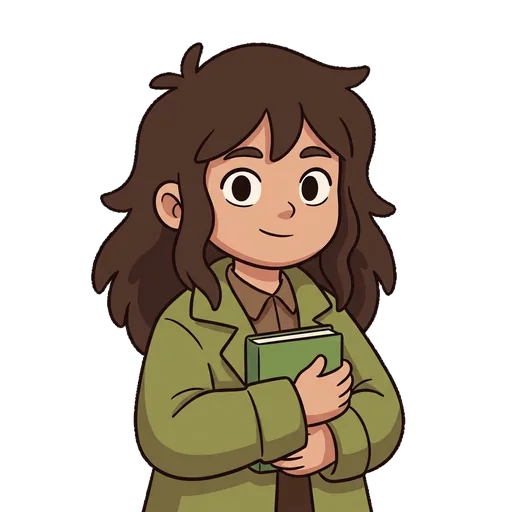 Inkling a child of the Green Names what she notices
-
 Glug Looking is not the same as knowing — check it from PourTots
-
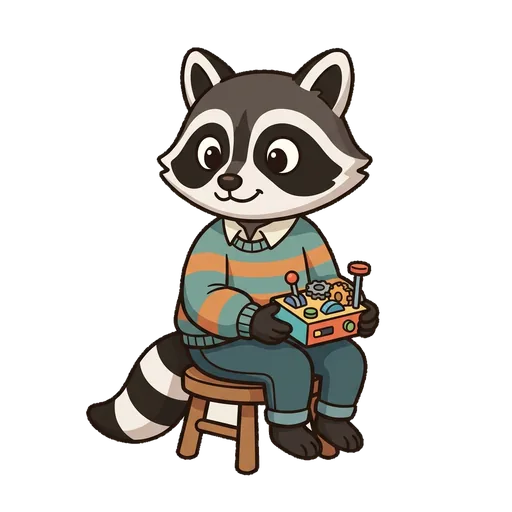 Fiddle You learn what a thing does by trying it — the playing is the learning from AweForge
-
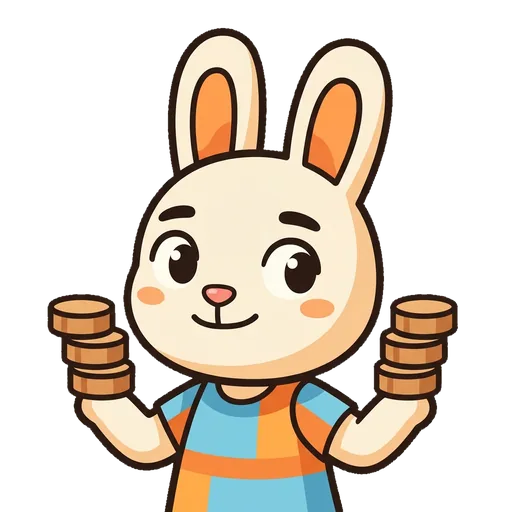 Evenly The same on both sides means level, and level means equal from TeeterTots
-
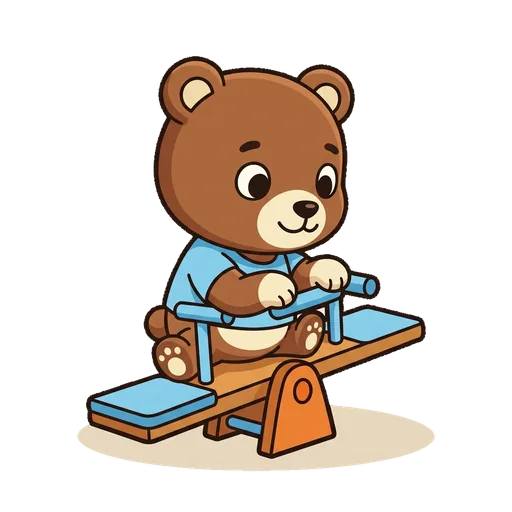 Teeter The heavier side goes down — a balance tells you which is more from TeeterTots
-
 Beto a child of the Green Takes things apart
-
 Bop Count one at a time, every single one from CarryPals
-
 Loaf Ten ones squish into one ten, so a big count is tens and ones from CarryPals
Every recurring character has a short tune, so you can tell who is on stage before a word is said. The tunes play only when you tap, and the Reading Access sound switch turns them off.
The Honest Page
Which parts of this story are true, stretched or made up?
True
- A floating boat sinks lower when it carries more weight. If two loads make the same boat sit at the same waterline, they weigh the same. Source
- Seventeen baskets of twenty kilograms make 340 kilograms. With one more basket of twelve, that is 352, which is 48 under the limit of 400.
- Lương Thế Vinh (1441–1496) was a real Vietnamese mathematician. He wrote a book of mathematics that was used to teach and test students for hundreds of years. Source
- In Vietnam, schoolchildren read a lesson called Cân voi, Weighing the Elephant, about this trick; in today's Kết nối tri thức textbooks it is in third grade. Source
Stretched
- Lương Thế Vinh is said to have weighed an elephant this way, with a boat, a mark and a pile of stones. What we simplified: This is a giai thoại, a story told about a real person. Nobody wrote it down when it happened, and almost the same story is told in China about a boy called Cao Chong. The man is in ink; the story is in pencil.
- In the book the water stops exactly on Beto's line. What we simplified: A real boat bobs, so people read the line when the water is still and allow a little either way. A boat also has to be safe for the load; the ferryman checks that too.
Made up
- Brimwater, its talking frog, bunny, bear cub, bean and loaf, and the tiny hammer on the hull are made up. Never load or ride a boat without a grown-up.