The Day Before · Reader · ages 6-8
Listen along
Loading audio…
Read by an AI-generated voice. The words on this page are the transcript.
1. Houses on Legs
The hammer rang once. A spark jumped off the anvil and did not go out. It waited. They followed.
It had been a week since the sand road and the sledge and the girl with the water jars. Every day since, Lan had gone to look at the anvil on the Green. The little scratched D was still there on its side. She ran her finger over it every time, to make sure it was real.
"Do you think there'll be another letter?" she said.
"Only if we go somewhere else," said Inkling. "And work something out."
The spark did not take them to the warm patch of grass this time. It hopped down to the edge of the duck pond, where the grass was cool and damp, and the ducks were arguing about bread. Then it simply waited there.
Warm wind blew the Green away, and the ground under their feet was somewhere else, the day before.
The air was cool and wet and smelled of reeds. They were standing at the edge of the widest marsh Lan had ever seen. It went on and on, green and brown and silver, with water shining between the clumps of reeds, all the way to a line of blue hills. Ducks paddled about. A heron stood on one leg, perfectly still.
Right beside the water stood a village.
It was not like any village Lan knew. Every house stood up on tall wooden posts, high above the wet ground, like a row of herons on their legs. One of the oldest posts had cracked down its middle and been bound tight with a thick twist of bark. Just above the binding, Inkling noticed a tiny scratched hammer, cut neatly into the wood. The houses had walls made of woven sticks and clay, and roofs of thick reeds that came down low like hats. Ladders led up to the doors. Under the houses, between the posts, there were canoes pulled up on the mud, and piles of nets, and a goat looking thoughtful.
People were busy everywhere. A woman was mending a fishing net with quick fingers. Two men were carving a canoe from one huge log, scraping out the inside. A girl was carrying a basket of hazelnuts up a ladder. Smoke came out of the reed roofs in lazy threads.
"They built all this," whispered Inkling. "On the water. Without falling in."
At the edge of the village, where a path went off towards the forest, a boy about Lan's age was pulling on a rope. He was pulling so hard that he was leaning almost flat, with his heels dug into the mud. On the other end of the rope was an enormous oak log, as long as a bed and as thick as a barrel. It had not moved at all.
He saw them, and stopped pulling, and stared. They were in their own clothes, with their trainers and their jumpers, and Lan had a hair clip shaped like a strawberry. But the boy did not seem to mind. He just looked very tired.
"Are you here to help?" he said. "Please say you're here to help."
"What is it for?" said Inkling.
"It's the new post for our house," said the boy. He pointed at a house near the end of the row. One of its tall legs was rotten and leaning, and the whole house tipped a little to one side. "The old one is going soft. Father cut this one in the forest. I promised I'd bring it to the village." He looked at the sky, and then at the hills, where the clouds were starting to pile up. "The autumn rain comes tomorrow. Everybody says so. When it rains, the marsh rises, and the forest path goes under water. Then nobody can bring anything from the forest until spring."
"And the post is still in the forest," said Lan.
"Most of it," said the boy, and pulled again, and nothing happened.
Lan and Inkling went with him along the forest path to see. It was a narrow path of beaten earth that wound between the reeds and the alder trees, soft and springy underfoot. In places, long split logs had been laid across it to make a walkway over the wettest parts. Here and there, puddles already shone in the hollows.
"This is the dry way," said the boy. "In the rain, the marsh comes up over all of it. You need a canoe to get to the forest then, and you can't put a post in a canoe."
At the end of the path, where the trees began, there was a clearing full of wood chips and the smell of fresh sap. A stump stood there, cut flat and pale. Beside it the boy's father had left the oak post lying in the grass, already trimmed of its branches.
"He cut it with a stone axe," said the boy proudly. "It took him three days. And then he hurt his back, and I said I'd bring it. I said it would be easy."
"I say things like that," said Lan. "All the time."
The boy looked at her and almost smiled.
2. The Buzzing Word
Lan knew exactly what he needed. She had known it the moment she saw the log on the ground and the rope and the boy leaning flat. She had seen it a thousand times. Every car, every bike, every pushchair, every supermarket trolley. It was so obvious it was almost funny.
"I know what you need!" said Lan. "It's easy. It's got a name! I promise, I'll show you. You just need a..."
The word came out wrong.
It did not come out as a word at all. It came out as a buzz, like a bee trapped in a jam jar. Bzzz. Bzzz, bzzz.
The boy stared at her.
Lan tried again, slower. She thought about the word very hard and made her mouth go round it. Bzzzzzz.
"Is she all right?" said the boy to Inkling.
Inkling tugged Lan's sleeve, and pulled her a few steps away.
"It's the door," she whispered. "Remember? It did it last time. You can't bring the answer. You can only bring the question."
Lan's face went hot right up to her ears. She had been so sure. She had been sure last time too, on the sand road, and the words had buzzed then as well. She had promised again, before she had even counted. She always did.
"So what do we do?" she whispered back.
"Help," said Inkling. "And ask."
3. Drag
The boy's three cousins came running from the village. They were two girls and a boy, all bigger than him, and all very cheerful about being asked to pull a log.
"Six of us," said the boy. "That should do it."
They found a flat board, a wide plank of split wood that somebody had been using as a table. They rolled the log onto it, which took a lot of grunting, and tied it on tightly with rope made of twisted bark. Then all six of them took hold of the long rope: the boy, his three cousins, Inkling and Lan.
"Pull!" said the oldest cousin.
They pulled.
The board scraped. It shuddered. It slid forward a little, and then it dug into the soft ground at the front like a spade. Mud piled up in front of it in a brown heap. They pulled harder. The board went forward a hand's width, and the heap grew bigger.
They pulled until their hands were sore and their arms were shaking. Lan's trainers were caked in mud up to the laces. When they finally let go and looked back, they had gone ten steps. The village was still a long, long way off, and the forest path stretched behind them, and the sky over the hills was getting greyer.
"Ten steps," said the youngest cousin, flopping down on the grass. "We need about a thousand more."
"We'll get more people," said the boy. "We'll get everyone."
But everyone was busy. The rain was coming tomorrow for them too. They had nets to bring in and canoes to tie up and nuts and firewood to carry up the ladders before the water rose.
4. What Is Touching?
Inkling did not pull. She did not try to name anything either, though Lan could see a name trying to get out of her. Last time, on the sand road, she had learned to look first.
She lay down on her tummy in the mud, which made the cousins laugh, and looked along under the board.
"What is touching the ground?" said Inkling.
Lan lay down beside her. They looked together.
The board was flat. Its whole underneath was pressed against the ground, from one end to the other. Every bit of it was touching the mud. And when they pulled, every bit of it rubbed against the mud at once, and scraped, and dug in, and pushed up the heap in front.
"All of it," said Inkling slowly. "The whole flat bottom. All of it rubbing at once."
"Is that bad?" said Lan.
"I don't know yet," said Inkling. "I'm still asking."
The boy crouched beside them, curious. He looked under the board too. He had pulled heavy things all his life, logs and stones and baskets of clay, and he had never once lain down in the mud to look underneath one.
"Why does it matter what's touching?" he said.
"I don't know that yet either," said Inkling honestly. "But it's the only part that's fighting us. So I want to know what it's doing."
5. Rollers
The boy's oldest cousin was looking at the pile of logs by the canoe makers, short round pieces left over from all the trees they had cut.
"Wait," she said. "My grandmother told me something once. When they moved the big stones for the fireplace, they put logs under them."
She fetched four short round logs and laid them across the path, one after another, like the rungs of a ladder lying down. Then they all pushed the board up onto the first log.
"Pull!"
They pulled. And the board did not dig in. It did not scrape. It rolled. It went sailing forward over the logs, smooth as anything, and all six of them nearly fell over backwards because they had pulled so hard.
They cheered. The goat looked up.
Then the board rolled off the back of the last log, and the front of the board came down off the front log, and it stopped dead.
"Oh," said Lan.
Every few steps, a log rolled out from under the back of the board. Somebody had to pick it up and run it all the way round to the front and put it down again, in front of the board, before the board got there. Then another one came out at the back. Then another.
So they made a plan. Three of them pulled the rope. Three of them were runners, picking up the logs that came out at the back and carrying them round to the front. It worked. The board rolled along, and the log rode on top of it, and they went faster than they had ever gone dragging.
But it was very hard work. The runners ran and ran, bent over, carrying heavy logs, round and round, round and round. After a while the pullers swapped with the runners. After a while longer, everybody was too puffed to swap.
"Half of us are carrying logs," gasped the boy. "Instead of pulling."
Lan counted. Six people. Three pulling. Three running. Half.
They had gone a lot further than ten steps. They passed the place where the walkway logs were laid across the path, and found that the board rolled even better on them than on the mud. They passed a family carrying baskets of firewood the other way, who stopped and stared and then laughed and called out encouragement in a language Lan did not understand but somehow did. But the village was still far away, and the clouds were coming up over the hills.
6. Round and Flat
They stopped for a rest. The boy's cousins shared a handful of hazelnuts with them, cracked between two stones.
Inkling did not eat hers straight away. She was watching one of the rollers. The youngest cousin had rolled it under the board on its own, and Inkling was pushing it to and fro with her foot.
"I noticed something," said Inkling. "Look. The board touches the ground all over. But the roller only touches along one thin line. Right underneath. See?"
Lan crouched down and looked. It was true. The round log only touched the mud along one line, where its curve met the ground. All the rest of it was up in the air.
"And when you push it," said Inkling, pushing, "it doesn't rub. It turns. A new bit comes down to touch the ground, and the old bit goes up. It never scrapes."
She thought for a long moment more, the way she was learning to. Then she said it.
"I can name it now," said Inkling. "A round thing rolls where a flat thing drags."
The boy repeated it under his breath. "A round thing rolls. A flat thing drags." He looked at the rollers lying in the mud, and then at the long way back to the village, and nodded slowly, as though he was putting it away somewhere safe.
7. Evening
They worked all afternoon. Pull, run, pull, run. The board rolled, the logs came out at the back, the runners carried them round. Their legs ached. Their hands were raw from the bark rope.
When the light began to go orange and low, the log was halfway along the path. Halfway. The village was close enough now that they could hear the goat, but it was still too far to reach before dark.
And the clouds had come right up over the hills. They were not white clouds any more. They were heavy and grey and full, sitting on top of the hills like a lid.
"It'll rain in the morning," said the oldest cousin. "Maybe before."
The cousins went home to help their own families. The boy sat down on the log with his head in his hands.
Lan sat down beside him. She was so tired that she felt small all over, the way you feel small at the end of a long day at the seaside. Her trainers were full of mud. She did not think she could carry one more roller if she tried.
"It's hopeless," she said. "We're too tired. And the rollers keep getting left behind, and somebody has to carry them, and there aren't enough of us."
Inkling sat on her other side and said nothing. She was looking at the rollers lying in the grass behind the board, where they had come out.
8. The Question
Lan looked at the rollers too. Left behind. Every time. That was the whole trouble. The round things were brilliant, but they would not stay.
Then she remembered the door. She could not bring the answer. She knew she couldn't. The buzzing word was still sitting in her mouth. But she could bring a question. Nobody had stopped her asking questions.
She turned to the boy.
"The rollers keep getting left behind," said Lan. "Could the round thing come WITH us? Could it stay under the board, instead of being left behind?"
The boy lifted his head.
He looked at Lan. He looked at the rollers in the grass. He looked at the board with the log on it. Lan could see him thinking, the same way Inkling thought, very carefully, with his eyebrows pulled together.
Then he jumped up and ran into the village, and came back with his father's axe, which had a sharp stone head bound to a wooden handle, and a short sharp stone for making holes.
He did not ask for any help. He knew exactly what to do with an axe, much better than Lan did. He took one of the thick rollers and cut a round slice off the end of it, as thick as his hand. Then another. Two big wooden coins.
"They'll fall over," said Inkling.
"Not if they're on a stick," said the boy. He was talking to himself now, working it out. "A stick through the middle. And the stick has to be held under the board." He worked at the middle of each round slice with the sharp stone until there was a hole right through it. He did not make the hole round. He made it square.
"Why square?" said Inkling.
"So it can't slip," said the boy. "So they turn together. The stick and the round things, all together."
He found a strong straight stick, and shaved the ends square to fit the holes, and pushed it through both wooden coins, one at each end. He tied the stick firmly under the front of the board with bark rope. Then he did it all again with two more slices and another stick, for the back.
Now the board had four round wooden coins under it, two at the front and two at the back. They did not touch the board. They only touched the ground, each along its one thin line.
"Pull," said the boy, in a small voice, as if he was afraid to try.
Lan and Inkling took the rope. The boy took it too.
They pulled.
The board rolled forward. And it kept rolling. And the round things did not come out at the back. They stayed exactly where they were, under the board, turning and turning, coming along with them. Nobody had to run. Nobody had to carry anything.
Three of them, tired and muddy and too puffed to swap, pulled the oak post all the way along the path to the village in the last of the light.
9. Before the Rain
That night the boy's father and uncles stood the new post up in its hole beside the old rotten one, and packed earth and stones around it, and lashed the floor of the house to it. The house stopped leaning.
It started to rain just after midnight. Lan and Inkling heard it drumming on the reed roof, where the boy's family had let them sleep on a pile of soft skins. By morning the forest path was under water, just as everybody had said.
But the post was in.
At first light, the boy took the board with the four round coins out onto the muddy patch under the houses, and pushed it up and down, up and down, just to watch it roll. He put the goat on it. The goat did not like it at all. He put his little sister on it, and she shrieked with joy. Soon half the children in the village were taking turns.
The grown-ups came down the ladders one by one to look. The woman who had been mending the net came, and the two canoe carvers, and the boy's father, walking stiffly with one hand on his sore back. They stood in the rain and watched the board go up and down, and they talked in low voices, and pointed at the square holes and the sticks. One of the canoe carvers knelt down in the mud and turned a wooden coin round and round on its stick with his finger, very slowly, as if he could not quite believe it.
Then the boy's father said something, and pointed at the pile of firewood that still had to come up from the edge of the marsh. And the canoe carver said something back, and pointed at a heavy stone that had been waiting all summer to become a new grinding stone.
Lan did not need to understand the words. She could see them thinking of all the heavy things in the village that had always had to be dragged or carried. She could see them already planning.
"It needs a name," said the boy, laughing. "Doesn't it?"
Lan opened her mouth, and closed it again. She was not going to try. She knew what would come out.
"You name it," said Inkling.
The boy thought about it. Then he said a word in his own language that Lan did not know, and everybody near him laughed and said it too.
Nobody would ever write down his name. Nobody would write down what he called it, either. But in the mud under the houses on legs, his little sister kept riding up and down, and the round things kept turning.
Warm wind blew the day before away, and the grass under their feet was the Green.
The ducks were still arguing about bread. Lan's trainers were clean, as if they had never been near a marsh. But her hands were still sore from the bark rope.
She went straight to the anvil. On its side, beside the little D, there was a new letter. A small round O.
"Round," said Inkling. "For round."
The spark dimmed to a warm dot and settled back on the anvil. The Green was just the Green again.
Back on the Green
At home, Lan's little brother Tí was crying, because his toy truck had lost a wheel and would only drag along the floor on one corner. Lan found a bottle top and made a hole in the middle with a pencil, and pushed the pencil through, and wedged it under the truck.
It rolled right across the kitchen floor and under the fridge. Tí stopped crying straight away.
Tell the story back to someone. Why did the flat board drag? Why were the rollers not quite right? What did the boy do that made the round things come along?
Saved. The next chapter will be here whenever you come back.
Who you met
-
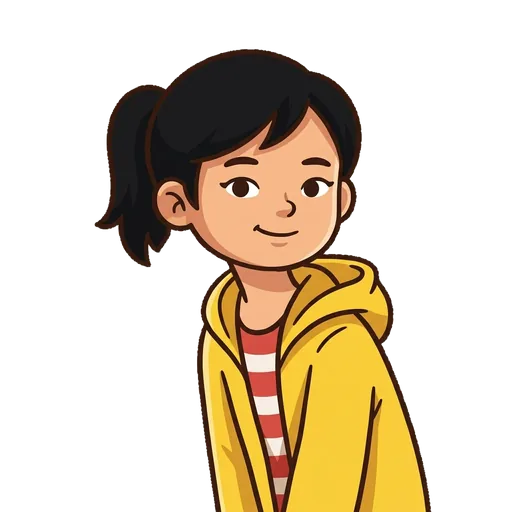 Lan a child of the Green Goes first; makes a friend in a minute
-
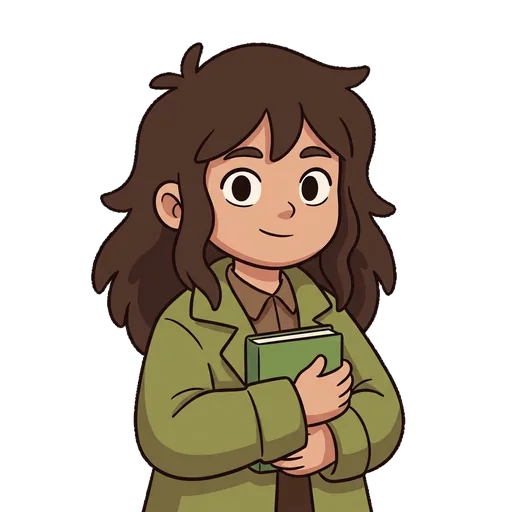 Inkling a child of the Green Names what she notices
Every recurring character has a short tune, so you can tell who is on stage before a word is said. The tunes play only when you tap, and the Reading Access sound switch turns them off.
The Honest Page
Which parts are true, stretched or made up — and what does nobody know?
True
- In 2002 a wooden wheel was found in the Ljubljana Marsh in Slovenia. It is about five thousand one hundred to five thousand three hundred and fifty years old, one of the oldest wooden wheels ever found. Source
- The wheel is made of ash wood and is seventy-two centimetres across. Its oak axle had a square end, so the wheel and the axle turned together. It belonged to a small two-wheeled cart. Source
- A wheel seventy-two centimetres across rolls about two and a quarter metres every time it turns once.
Stretched
- In the story the wheel comes straight from the rollers in one day. What we simplified: Historians think wheels grew out of people using logs as rollers, but nobody saw it happen, and it probably took a very long time.
Made up
- Lan and Inkling, the spark, the buzzing word, the boy and his family's new house post are made up. So is the rain that was coming tomorrow.
Nobody knows
- Nobody knows who made the first wheel, or where. Wheels seem to have appeared at about the same time in different places, and the people who made them left no names. Source