← The Water in Front of the Sledge
The Day Before · Reader · ages 6-8
Listen along
Loading audio…
Read by an AI-generated voice. The words on this page are the transcript.
1. A Warm Patch of Grass
The hammer rang once. A spark jumped off the anvil and did not go out. It waited. They followed.
Lan was first, as usual. She ran after the spark across the Green with her shoes untied, and Inkling came behind her, holding her notebook against her chest so the pages would not flap.
The spark did not go to a door this time. It did not go to the print shop or the mending shed or the little museum. It hopped once, twice, three times, and landed on a patch of grass near the old oak, where the sun had been shining all afternoon. Then it sat there and glowed, and waited.
Lan put her hand on the grass. It was warm. Warmer than grass should be in autumn. Warm like a pavement in the middle of summer.
"I think it's called a..." Inkling began, and then stopped herself. "No. I don't know what it's called. Let's look first."
They stepped onto the warm patch together.
Warm wind blew the Green away, and the ground under their feet was somewhere else, the day before.
The light was the first thing. It was so bright that Lan had to squint. The sky was a hard, clean blue with no clouds in it at all. Under their feet was sand, pale gold and fine as flour, and it was hot even through Lan's shoes. Not far off, a wide brown river slid past, slow and enormous, with tall palm trees leaning over the water as if they were trying to see their reflections.
And on a road of beaten sand, right in front of them, lay the biggest statue Lan had ever seen.
It was a man, made of pale stone, sitting very straight with his hands on his knees. Even lying on its back it was taller than a house. Lan could have walked along its arm like a bridge. It rested on a great wooden sledge, a flat sled made of thick beams tied together, with two long smooth runners underneath and no wheels at all. One runner had split once, long ago, and been mended with a row of copper pins. Beside the mend, so small that only Inkling noticed it, somebody had scratched a tiny hammer.
From the front of the sledge, ropes ran forward across the sand. Not two or three ropes. Four long rows of them. And on every rope, people. Dozens and dozens and dozens of people, all standing ready, with the ropes over their shoulders.
"Oh," said Inkling, very quietly.
A girl about Lan's age came walking down the line of pullers. She had a water jar balanced on her hip and a cup in her hand. At each puller she stopped, poured a cup, waited while they drank, and moved on. She did not spill a drop.
When she reached the end of the line, she saw Lan and Inkling, and stared at their shoes.
"Are you new?" said the girl. "Have you come to pull? You're small."
"We're..." said Lan. She did not know what they were. "We're visiting."
"Then you've come on the worst day," said the girl. She set her jar down in the shade of the sledge. "The boat leaves the landing at sunset tomorrow. The statue has to be on it. And look." She pointed down the road toward the river. "It's hardly moved since this morning."
2. The Rule of the Door
Lan looked at the statue, and the sledge, and the sand, and suddenly she knew. She was sure of it. She had seen a picture once, in a book at school, of people pouring water in front of a sledge like this one. She could tell them. She could fix everything in one sentence.
"I know how to do it!" said Lan. "I read it! I promise, I know. What you have to do is..."
But the words did not come out.
What came out was a buzz. A small, angry, wobbling buzz, like a bee trapped in a jar. Bzzz, bzzz, bzzzz.
The girl took a step back.
Lan clapped her hand over her mouth. She tried again, slower. "You have to put..." Bzzz. "On the sand in front, you..." Bzzzzz.
The girl looked at Inkling. "Is she all right?"
"I think so," said Inkling. She pulled Lan a little way off, round the end of the sledge, and spoke very low. "Lan. I think it's the door. Remember the spark wouldn't go to a proper door? This isn't a story place. It's a real place. On the real day before."
"So?" said Lan. Her eyes stung.
"So we can't bring the answer," said Inkling. "We can only bring the question. If you try to tell it, it comes out as noise."
Lan sat down in the sliver of shade by the runners. Her face was hot, and not only from the sun. She had been so sure she would be the one who knew. She had promised, before she had even counted what she was promising.
"Then what am I for?" she said. "I know what that means, the picture in the book. I know it!"
Inkling thought about it. "Asking," she said. "And trying. And watching what happens."
3. Try One: Pull Harder
At the front of the line stood a man with a strong voice. Lan thought he must be the overseer, the one in charge. He shouted, and every puller leaned into the ropes. Someone at the side began to clap a steady beat, clap, clap, clap, and the pullers stepped together on every clap.
The ropes creaked. The beams of the sledge groaned.
The sledge moved. It crept forward the width of a hand, then another. Lan held her breath.
Then it stopped.
The pullers leaned harder. Their feet slid in the sand. Their arms shook. The clapping went on, clap, clap, clap. But the sledge did not move at all.
The overseer sent for more people. Ten more came and took the ropes. Then ten more. They all pulled together, and the sledge crept forward one more hand's width, and stopped again.
Lan walked to the front of the sledge to see what was holding it.
There, right in front of the runners, the sand had piled up. It had heaped into a little hill, like a wave of sand frozen in front of the wood. And every time the pullers pulled, the runners shoved the hill along, and it grew a little higher, and a little higher, until it was like trying to push a sledge up a slope.
"More people won't fix that," said Lan, half to herself. "They'll just make the hill bigger."
She was right. By noon, there were so many pullers that some of them had no room to stand, and the sledge had moved only the length of a cart.
"I'll go first, I promise I can pull!" said Lan, when the overseer called for another try. "I'll take a rope. I'll do it!"
Nobody stopped her. A tall woman at the end of the last rope made room, and showed her how to put it over one shoulder and lean, not pull with her arms. Lan leaned. The clapping began. Lan stepped on the clap and leaned with everything she had, and felt the rope go tight as iron.
It was like leaning on a wall. A wall that did not care how hard you leaned.
The sledge crept, and stopped, and Lan fell over in the sand, and the tall woman laughed and pulled her up again.
"Come on, quick, again!" said Lan, red in the face. But even she could feel it. The rope did not give at all.
While Lan pulled, Inkling counted. She counted the pullers on the first rope, then the second, then the third and fourth, moving her lips, starting again whenever someone stepped away for water. Counting things made her feel calm, the way some people hum.
"A hundred and seventy-two," she said, when Lan came back with sand in her hair. "That's how many are pulling. I counted twice. And the sledge still stopped."
"That's a lot of people," said Lan.
"I think it's called..." said Inkling, and then caught herself, and shook her head. "No. Wait. I'm not naming it yet. I don't know what it is yet."
4. Ask, Then Look
Inkling wanted to name it. Lan could see her wanting to. Her mouth kept opening and closing, the way it did when a word was on its way.
But this time she waited.
"Why does it stop?" said Inkling. "What is the sand doing?"
The girl with the water jars had come back. She looked at Inkling as if no one had ever asked her a question like that before. "It always does this," she said. "Every time. The sand comes up at the front."
"Can I look?" said Inkling.
She lay down on her tummy in the hot sand, right next to the runner, with her chin on her hands. When the pullers pulled, she watched.
The dry sand did not hold together at all. It slid and tumbled. The grains rolled over each other like tiny marbles. When the runner pushed into them, they did not stay put. They ran up the front of the wood and piled up there, the way snow piles up in front of a spade when you push it along a path.
"It's stuck because the sand keeps moving," said Inkling slowly. She sat up. Her chin was covered in gold dust. "I think. The sand runs away from the runner and then heaps up. I'm not sure yet, though."
"That's more than anybody else has said," said the girl.
5. Try Two: The Spilled Jar
In the hottest part of the afternoon, the girl came hurrying down the line with the biggest jar of all, almost as tall as her knees. She was going too fast, because the pullers were thirsty and the sun was cruel.
Her foot caught on a rope. She tripped.
The whole jar tipped over and emptied onto the sand, a great glugging gush of water, right in front of the sledge.
"Oh no," said the girl, on her hands and knees. "Oh no, oh no, that was all of it."
But at that very moment the overseer shouted, and the pullers pulled.
And the sledge slid.
For one whole pull, the sledge slid forward over the wet patch, smooth as a boat on water. Lan gasped. Inkling grabbed her arm. All along the ropes, people looked up in surprise.
Then the runners reached the middle of the spill, where the sand was soaked right through. It was not sand anymore. It was mud, thick and brown and sucking. The front of the sledge sank into it with a slow, wet sound. The pullers pulled and pulled, and the sledge did not slide. It stuck.
"Too much," said the girl, staring at the mud. "Too much water."
"But for a moment," said Lan. "For one moment, it worked."
"It half worked," said Inkling. She was frowning, the way she did when a puzzle had a piece missing.
The overseer was not pleased about the mud. It took the rest of the afternoon to dig the runners out and lay wooden boards so the sledge could get back onto firm sand. Lan and Inkling helped carry the boards. The girl did not say anything at all. She refilled her jar at the river and went back to giving out cups of water, with her head down.
6. The Footprint
When the digging was done, Inkling went back to the place where the jar had spilled.
The middle of the spill was still mud, all churned up and dark. The far edges were dry again already, pale gold, baked by the sun. But in between, in a ring around the mud, there was a band of sand that was only just damp. It was darker than the dry sand, the colour of brown sugar.
And in that damp ring, there was a footprint.
It was the girl's footprint, from when she had tripped. Inkling could see every toe. She could see the curve of the heel. The edges were sharp and clean, as if someone had pressed a shape into clay.
Inkling looked at the dry sand next to it. There was another footprint there, from earlier. But it was hardly a footprint at all. It had crumbled in on itself, the grains rolling back into the hole, until it was only a soft, shapeless dip.
"Lan, I noticed something here," said Inkling. "Come and look at this. Don't say anything. Just look."
Lan looked. She looked at the crumbly footprint in the dry sand. She looked at the crisp footprint in the damp sand. Then she pressed her own hand down, once in the dry sand, and once in the damp.
The dry sand let her hand sink in and ran back over her fingers. The damp sand pushed back. When she lifted her hand away, the damp sand kept the shape of her palm.
Here is the place, if you are reading this to someone, to try it. Find a tray of dry sand, or dry sugar, or salt. Push a small block across it and watch the heap. Then sprinkle a few drops of water, just a few, and push again.
"Wait, I can name it now," said Inkling. "I noticed something. Damp sand is firm. Dry sand runs away and heaps up. And very wet sand is mud."
"Just damp," said Lan slowly. "Not dry. Not soaked. Just damp. I know what that means now. Properly, this time."
7. Evening
The sun went down red over the river.
The pullers sat in the long shadows, rubbing their shoulders. The statue lay on its sledge, still a long way from the landing. Lan could see the boat at the river's edge, a big wooden boat with a tall mast, waiting.
The overseer walked along the line and spoke to everyone. Lan could not understand all of it, but the girl told them afterwards.
"He says we'll try again at dawn," she said. "With fifty more people."
"Will that work?" said Lan.
The girl shook her head. "There isn't enough shade for fifty more," she said. "There isn't enough water for fifty more. I can only carry so many jars." She looked at her hands. "And it's my fault about the mud."
"It isn't," said Inkling. "The mud was a clue."
The girl did not look as if she believed her.
Lan climbed up onto the warm wooden edge of the sledge and sat with her knees pulled up. The stone was still warm from the day, like a sleeping animal. She thought about the boat leaving at sunset. She thought about fifty more people with no shade. She thought about the answer she had brought from home, stuck in her mouth like a bee in a jar, and how useless it was.
It felt hopeless. For a long time, she did not say anything at all.
Then she remembered what Inkling had said. We can only bring the question.
"Inkling," said Lan. "What if I can't tell her the answer, but I can ask her something? Something she can try?"
"Then ask," said Inkling. "But ask it so she can find out for herself."
Lan lay back on the sledge and looked at the stars coming out, more stars than she had ever seen over the Green, and she thought about what to ask.
8. Try Three: Just Enough
At dawn, the overseer shouted, and the pullers took up the ropes. The fifty new people had not come yet.
Lan found the girl filling her jar at the river.
"Can I ask you something?" said Lan. And this time the words came out as words, clear and plain. Lan was so surprised that she nearly forgot the question.
"Go on," said the girl.
"The footprint," said Lan. "Yours. In the damp sand. It kept its shape. Could the sand in front of the sledge be like that? Not soaked. Just damp. What if you stood on the front of the sledge and poured a little, just until the sand goes dark? A little at a time, as we go?"
The girl stood very still with the jar in her arms. Lan could see her thinking. She could see her remembering the slide, and the mud, and the footprint.
"A little," said the girl. "Not the whole jar."
"Not the whole jar," said Lan.
The girl did not ask anyone's permission. She climbed up onto the front of the sledge, between the ropes, with a small cup and her jar. The overseer opened his mouth to shout at her, and then closed it, and watched.
She dipped the cup. She sprinkled the water in a little arc on the sand in front of the runners, the way you water seedlings. The pale sand went dark, the colour of brown sugar. Not mud. Just damp.
"Pull," said Lan, very quietly. And then, because nobody had heard her, much louder: "Pull!"
The clapping started. Clap, clap, clap.
The pullers pulled.
The runners slid onto the damp sand, and nothing heaped up in front of them. The sand stayed firm, like a smooth path. The sledge moved forward a hand's width, then an arm's length, then the length of a whole person, and it did not stop.
The girl dipped her cup again, and sprinkled again, always just in front, always just enough. The sledge slid and slid.
All along the ropes, people began to laugh. The ropes were looser in their hands. Some of them let go, because they were not needed, and walked alongside instead, and still the sledge kept moving.
"I noticed something about the ropes!" said Inkling, pointing. "Look. They hardly need half of them."
There had been one hundred and seventy-two pullers on the ropes that morning. Inkling had counted them while they waited, because counting things calmed her down. With the damp sand, about half of that many would have been enough.
"Come on, quick, keep pouring!" said Lan, running alongside. "Keep going!"
9. The Landing
They reached the landing in the middle of the afternoon, long before sunset.
The boatmen stared. The overseer laughed out loud, a big surprised laugh, and clapped the girl on the shoulder so hard she nearly fell off the sledge. Then he said something to her that made her go very red and very pleased.
It took the rest of the day to load the statue onto the boat. Lan and Inkling could not help much with that part. But they carried cups of water for the girl, up and down the line, so that she could rest.
When the boat was loaded and the sun was low, the girl came and found them at the edge of the river.
"You asked the right question," she said to Lan.
"You found the answer," said Lan. "I only asked."
"And you looked," the girl said to Inkling. "At my footprint. Nobody looks at footprints."
She poured one last cup of water onto the sand at their feet, for luck, and laughed when it splashed their shoes.
Lan wanted to ask her name. She opened her mouth to ask it. But she knew, somehow, the way you know things in a dream, that it was not hers to carry home. Nobody would write it down. In four thousand years, nobody would know it.
So instead she looked at the girl's face very carefully, to remember it.
10. The Letter on the Anvil
The spark was waiting on the sand, glowing, in a patch of shade under the palm trees. When they stepped next to it, the air began to shimmer.
Warm wind blew the day before away, and the grass under their feet was the Green.
It was evening there too. The ordinary, cool, autumn evening of the Green, with the leaves on the oak just starting to turn. Lan's shoes were full of sand.
They walked back to the old anvil in the middle of the Green, the anvil nobody remembered putting there.
On its side, low down, there was something new. A small letter had been scratched into the dark metal, so neat it looked as if it had always been there.
D.
"D for what?" said Lan.
"I think it's called something, but not yet," said Inkling. Then she smiled. "I'm not going to name it too soon."
The spark dimmed to a warm dot and settled back on the anvil. The Green was just the Green again.
Back on the Green
On Saturday, Tí tried to drag his toy wagon across the big sandpit by the swings. The wheels sank, and the sand heaped up in front of them, and he got cross and kicked it.
Lan did not tell him what to do. She fetched a cup of water from the drinking fountain and held it out to him.
"What if you pour a little in front?" she said. "Just a little. Until the sand goes dark."
Tí poured it all at once, of course, and made a puddle. But the second time he poured just a little. And the wagon rolled.
Tell the story back to someone. Why did the sledge stop on the dry sand? Why was a little water better than a whole jar?
Saved. The next chapter will be here whenever you come back.
Who you met
-
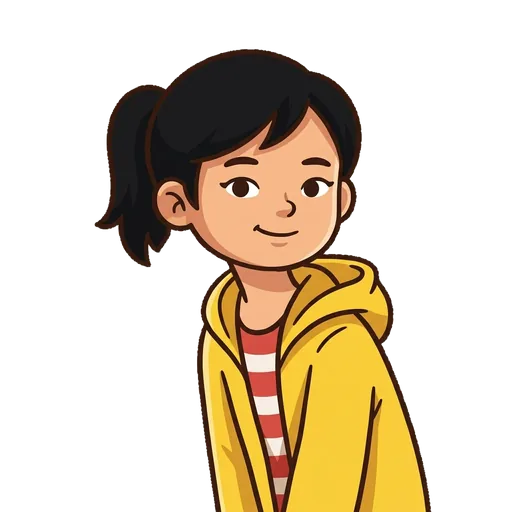 Lan a child of the Green Goes first; makes a friend in a minute
-
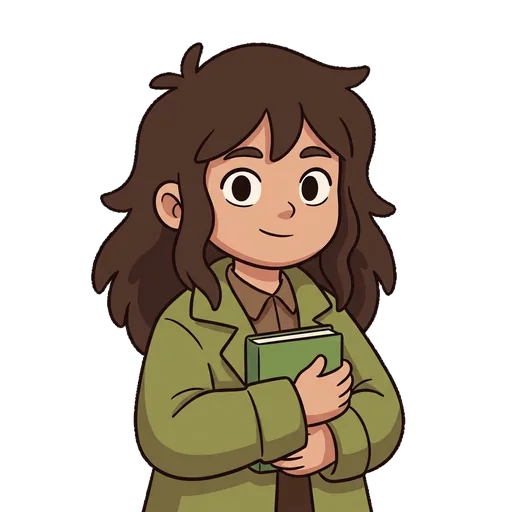 Inkling a child of the Green Names what she notices
Every recurring character has a short tune, so you can tell who is on stage before a word is said. The tunes play only when you tap, and the Reading Access sound switch turns them off.
The Honest Page
Which parts are true, stretched or made up — and what does nobody know?
True
- A painting in the tomb of Djehutihotep, a governor in Egypt nearly four thousand years ago, shows a huge statue of him on a sledge pulled by 172 workers, with water being poured on the sand in front. Source
- In 2014 scientists tested a sledge on sand. Dry sand heaps up in front of the runners. The right amount of water makes the sand about twice as stiff, so nothing heaps up, and about half as many pullers are needed. Source
- The tomb's paintings were made by an artist whose name we do know: Amenaankhu. Source
Stretched
- In the story a whole jar turns the sand to mud and the sledge sinks. What we simplified: The scientists found there is a best amount of water for sand to be firm. We showed 'too much' as mud to keep it simple.
- The story squeezes the hauling into one day and a morning. What we simplified: Moving a statue that size took much longer, and the road was prepared with care.
Made up
- Lan and Inkling, the spark, the buzzing words and the girl's trip with the jar are made up. So is the boat that leaves at sunset.
Nobody knows
- Nobody knows the name of the person pouring the water in the painting, or of the girl in our story, or who first thought of wetting the sand. The record does not say. Source