
Sunk-Cost Cyril
SUNK COST — *refusing to change course because of past investment.* The fallacy of *letting unrecoverable past costs determine current decisions when they should be evaluated independently.*
A story read by Sunk-Cost Cyril
Loading audio…
Press play to listen along. The line being read lights up as you go.
Show full transcript
Loading transcript…
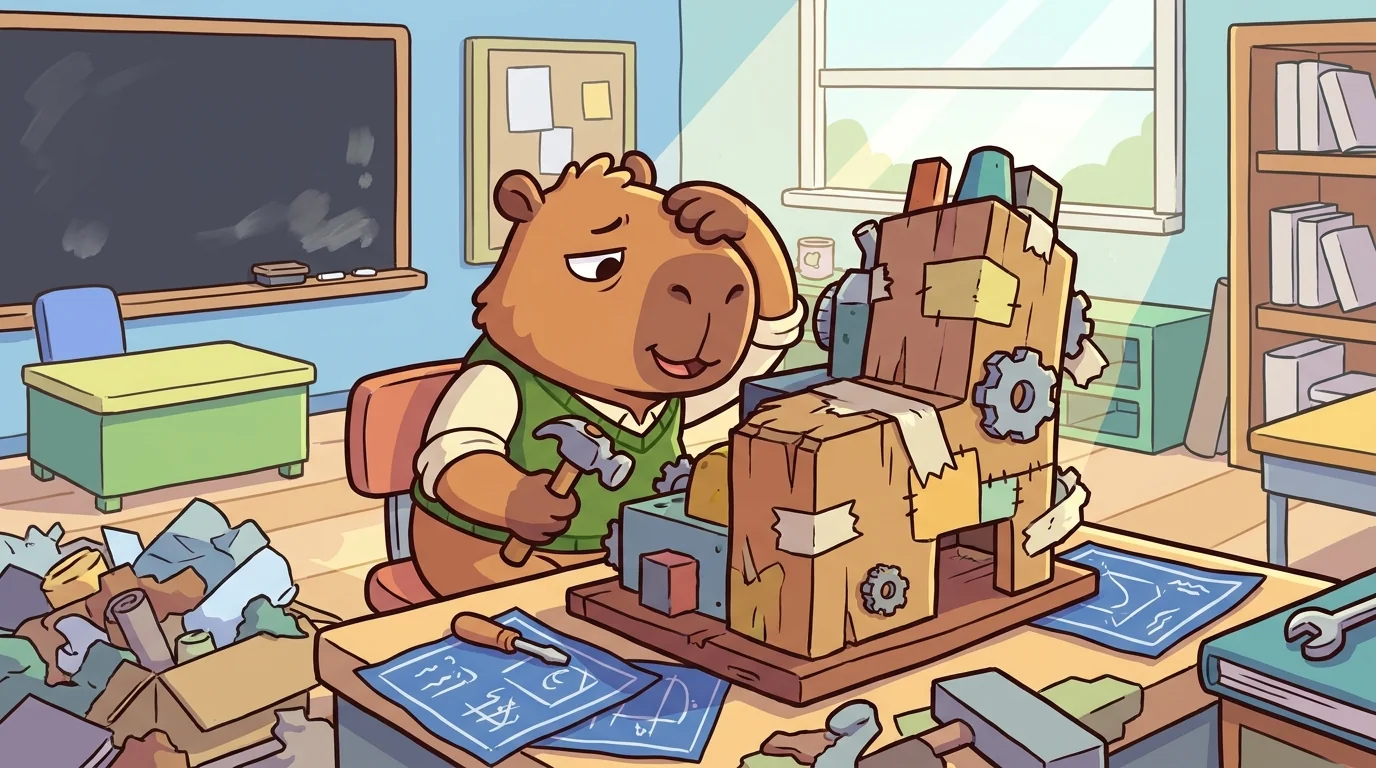
Cyril was a capybara — warm brown and cream, not big, but steady, with a quiet, stubborn way about him. He had one habit that got him stuck again and again: once he'd poured a lot of effort into something, he could not, would not, let it go — even when it clearly wasn't working. "I've already spent so much on this," he'd say. "I can't quit now."
He wasn't a villain. He was a teacher, and he got himself gloriously, visibly stuck right out in the open, so you could feel the heavy pull of all that past effort — and learn that the past can't be un-spent, so it shouldn't be the thing steering you.
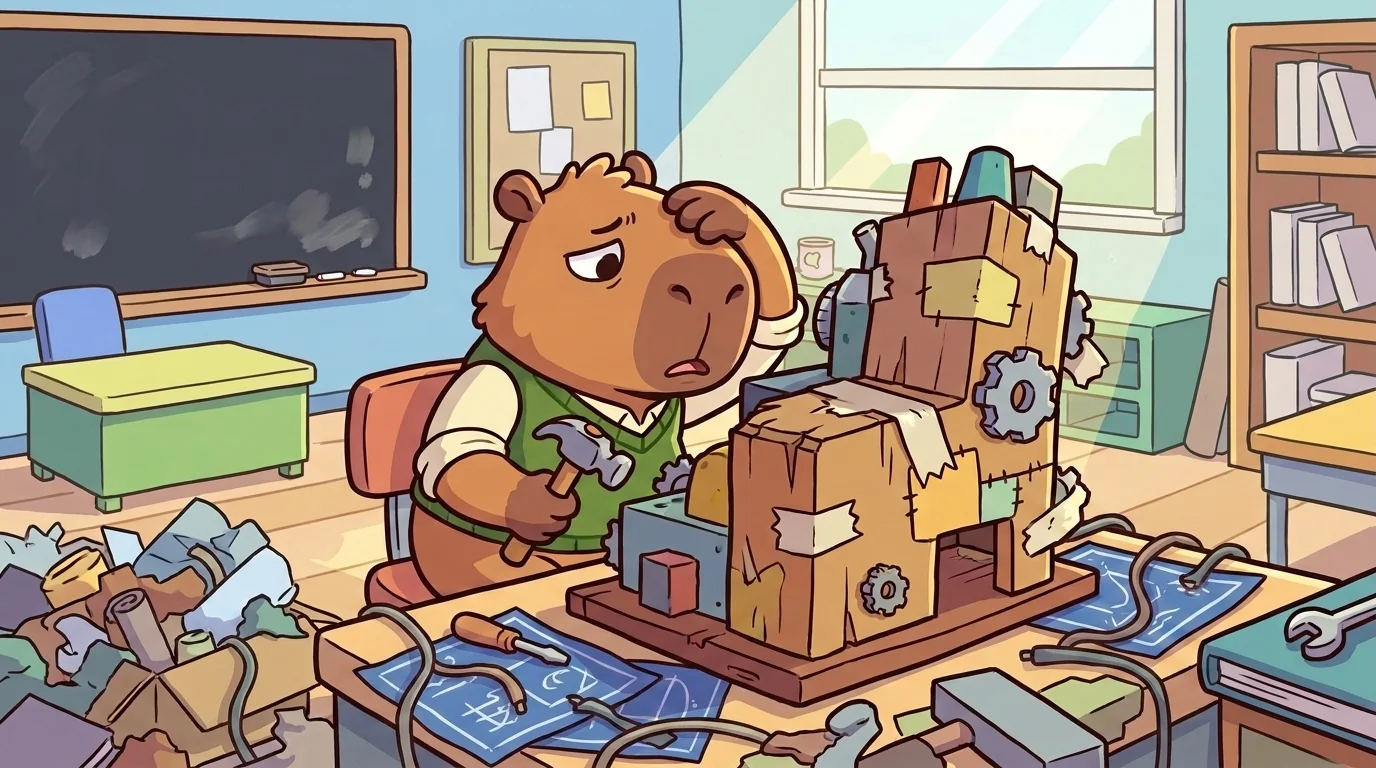
Cyril's trap grew from something almost noble: he hated waste. Effort mattered to him — the digging, the hauling, the careful shaping — and the idea of all that effort coming to nothing felt unbearable. So somewhere along the way, "I worked hard on this" turned into "therefore I must see it through," as if quitting would erase the hours and stopping would make them a lie.
What it actually did was chain him to sinking ships. Cyril spent three hours on a thing that wasn't working, then three more to "not waste" the first three, and ended up with six hours in a mess instead of three. The past effort was already gone — it was gone whether he stopped or not — but he kept letting it vote on what to do next. Once he saw that clearly, he couldn't un-see it. He decided to teach the trap that had cost him so many afternoons.

Cyril ambled into LogicQuest — steadily, of course — and settled in front of Inspector Logos.
"What is the sunk-cost trap?"
"It's letting the time or effort you already spent decide what you do now," Cyril said, "when that spent effort is gone either way and shouldn't get a vote." He looked a little sheepish. "I do it because I hate waste. If I stop, all that work feels wasted — so I keep pushing on things that aren't working. The skill is deciding from here forward — what's the best move now — not from all the effort behind me."
Inspector Logos nodded. "The past is spent. The only question a good decision asks is what happens from here." She smiled. "Hired. Take your time to your desk. But not on a sinking sandcastle."
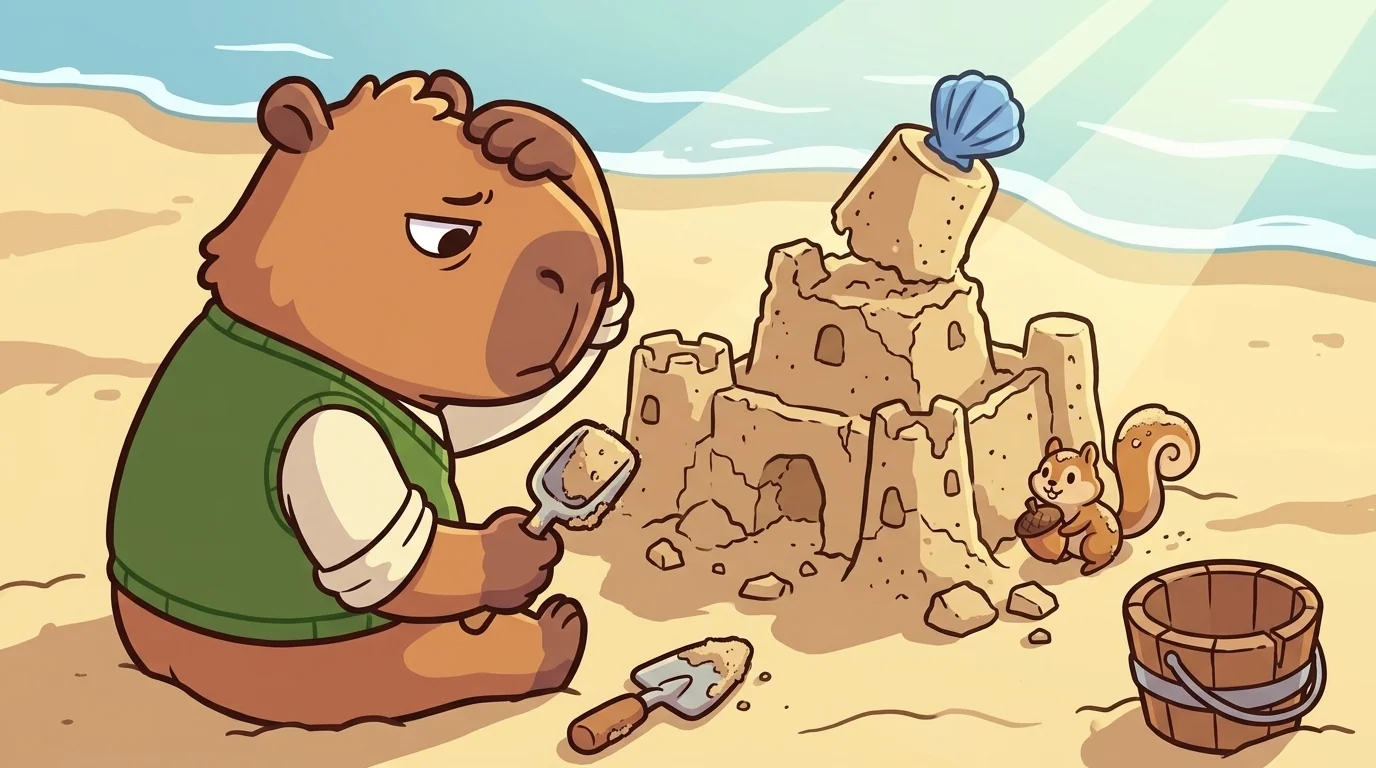
Cyril's best lesson was a sandcastle he called Fort Awesome — three hours of digging a moat, hauling sand, placing a special blue shell on top. The trouble was, Fort Awesome was wobbly, and dry, and collapsing. A chunk of wall went thump.
His friend Pip the squirrel scampered up. "It looks like it's falling apart."
"It is," Cyril admitted, scooping more sand onto the leaning tower. "But I can't quit — I've spent three whole hours. If I stop now, all that work is wasted."
Pip munched an acorn. "But if you keep going and it keeps falling, you're just spending more time on something that's still falling. And those three hours?" She looked at the flattened wall. "They're gone anyway, Cyril. Whether you stop or keep going. You can't get them back."
Cyril went very still, staring at the blue shell in his paw. "So... the time I already spent — it doesn't make the fort better now?"
"Nope. It just makes you tired."
"And it doesn't mean it'll get better if I keep going?"
"Not if the sand's too dry."
And Cyril — this was the whole lesson — turned to the others watching and said it plainly: "That's the trap. Freeze on it. The right question isn't 'how much have I already put in?' It's 'what's the best thing to do from here?'" He pointed his sandy paw. "So: first, notice when you're arguing from already-spent effort — 'I've come too far,' 'I can't waste it.' Second, remember the spent cost is gone either way — it's the same whether you stop or continue. Third, ask only the future question: starting from right now, what's the smartest move?" He looked at the wet, firm sand near the waves. "And sometimes the answer is: build a new fort, where the sand actually holds."
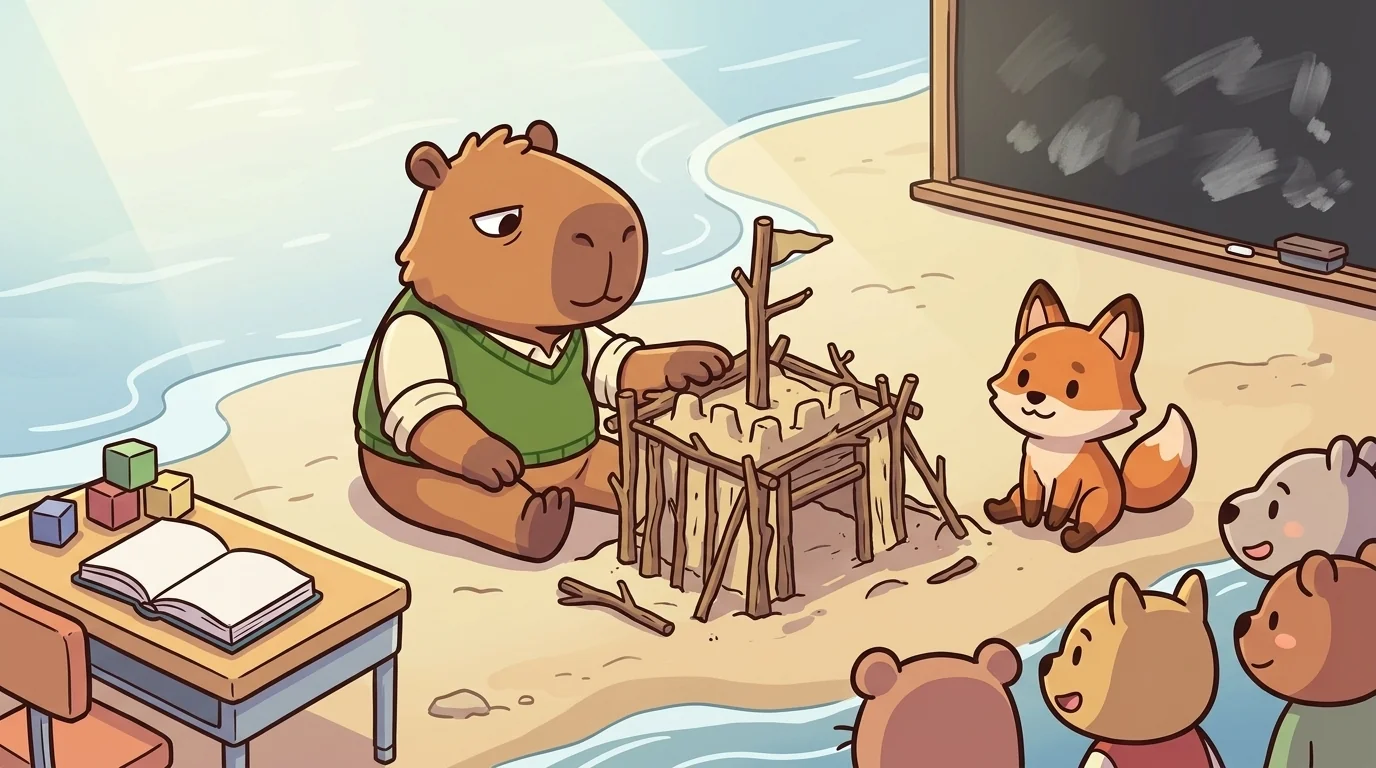
Later, Cyril sat by the new fort — standing straight in the wet sand — and let out a long breath. Pip climbed up beside him.
"I still feel a little sad about Fort Awesome," Cyril admitted. "All that work."
"Yeah," Pip said gently.
"But also..." Cyril searched for it. "Lighter. Like I set down something heavy I'd been dragging around all morning."
"That's the feeling," Cyril said — teaching even now — to the young ones nearby. "When you finally let the old effort be past, and choose from here instead, there's this ache for the thing you gave up, sure. But underneath it — feel for it — there's a loose, easy, weight-set-down calm. You feel a little sad and a little free, both at once." He smiled at the standing fort. "Deciding from the future is the skill. But that free feeling — the lightness when you stop dragging the past — that's the one that lets you start something new. Chase the free part. And build on wet sand."
The LogicQuest ensemble
Sunk-Cost Cyril is part of LogicQuest's distributed-narrative cast. Each character embodies a different curricular primitive; together they teach the full subject.
-

Ad Hominem Hannibal
Attacking the arguer, not the argument
-

Strawman Stella
Misrepresenting the opponent's argument
-

Slippery-Slope Sam
Chaining dire consequences from a small first step
-

Appeal-to-Authority Auntie
Citing irrelevant / unqualified authority as proof
-

Red-Herring Reggie
Deflecting to an irrelevant topic
-

Circular-Reasoning Cici
Assuming the conclusion in the premise
-

False-Dichotomy Fia
Presenting only two options when more exist
-

Bandwagon Bran
Truth-by-popularity
-

Whataboutism Wanda
Deflecting criticism via someone else's wrongdoing
-

Equivocator Eva
Sliding a word's meaning mid-argument
-

Tu-Quoque Tessa
"You too!" — dismissing criticism by accusing the critic of the same thing
-

Modus-Ponens Mo
If P then Q; P; ∴ Q
-

Modus-Tollens Tara
If P then Q; ¬Q; ∴ ¬P
-

Syllogism Solon
All M are P; all S are M; ∴ all S are P
-

Disjunctive-Syllogism Dior
P ∨ Q; ¬P; ∴ Q
