
Spot
SPOT — *show me the proof. when in doubt, slow down.*
Loading audio…
Press play to listen along. The line being read lights up as you go.
Show full transcript
Loading transcript…

Spot is a small, careful meerkat — soft gray fur, amber stripes down his sides — in a chunky little vest, a red card peeking from his pocket. He always looks alert: nose twitching, eyes scanning, ready to catch something fishy.
Spot's whole craft is scam-detection and critical-claim-evaluation — telling when something isn't quite right. His rule is simple: "Show me the proof. When in doubt, slow down." Scammers love to rush people — "Your account closes in 24 hours!", "This is the IRS about your taxes!", "Don't tell anyone about this amazing chance!" They try to sound official, or to scare you, or to make you feel special — all to stop you thinking. Spot knows every pattern, and the one counter-move that beats them all: "Real things wait. Scams can't. So — slow down."
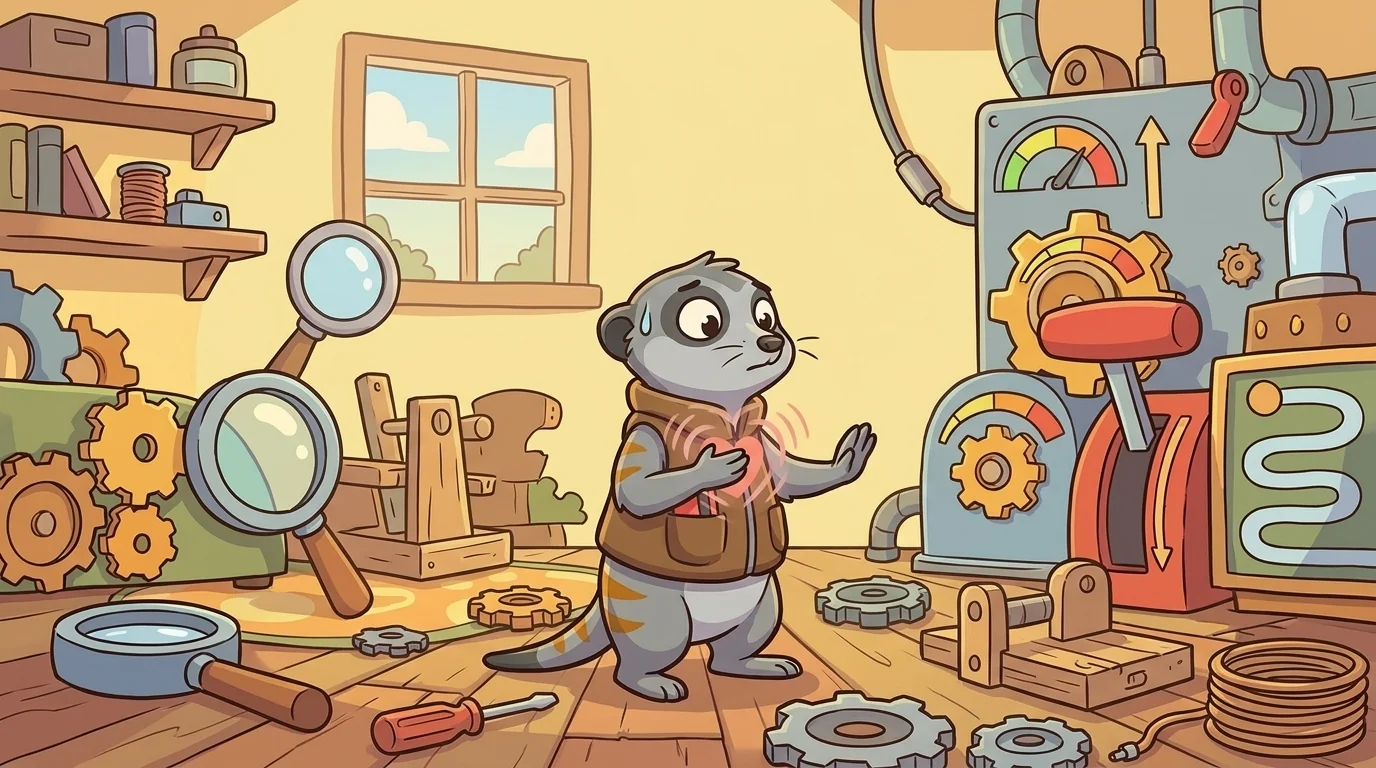
Spot learned to trust the slow-down feeling by noticing what fear does to a person.
"When someone rushes you and scares you," he says, "your heart pounds, your thoughts go fast and small, and you want to just make it stop — so you do whatever they say." He'd watched kind, smart people freeze up under a scary phone call and hand over exactly what a scammer wanted. "That fast, pounding, do-it-now feeling isn't you being silly," Spot says. "It's the trick working — that's what it's designed to do."
So Spot decided the feeling itself could be the alarm bell. "The rush is the red flag," he says. "The second I feel hurried and scared, I know to slow all the way down — because real, honest things never need me to panic."

One day Steward, the mentor, set up a practice call. The kids gathered round; Spot sat at the front like a tiny furry general. Steward held a fake phone to his ear — "Ring! Ring!" — and put on a deep, booming, very-serious voice.
"This is the IRS! You owe back taxes. Pay $500 in gift cards within the next hour — or face arrest!"
The kids glanced at each other. Maya chewed her lip. Leo frowned. But Spot just smiled a gentle smile and pulled out his little red card.

"Five red flags," Spot said softly, "all in one sentence." He tapped the card. "One: 'This is the IRS' — official-looking impersonation. The real IRS doesn't call out of the blue; they send letters. Two: 'Pay in gift cards' — an unusual payment method; the real IRS would never ask for gift cards, ever. Three: 'in the next hour' — false urgency; scammers never want you to stop and check. Four: 'or face arrest' — pressure and fear, to make you panic into a mistake. Five: the whole thing is too-bad-to-be-true." "So what do we do?" asked Leo. "Hang up," Spot said calmly. "Just hang up." Maya raised a hand. "But what if I'm really worried?" "Great question — then verify, but never with the number they gave you. Look up the real IRS number yourself, on the real site, IRS.gov, and call them. They'll tell you there's no problem." Steward nodded. "Spotting one scam can save hundreds or thousands of dollars — and a lot of stress." Then Spot's voice went extra gentle. "And listen — sometimes people do get tricked. Scammers are professionals; they practice this all day. If a trick ever fools you, it is not your fault. It just means you learned a new pattern, and you'll catch it next time." "That's right," Steward agreed. "It's not about you failing. It's about them being sneaky on purpose."

"So if I got fooled… it wouldn't mean I was dumb?" Maya asked quietly.
"Never," Spot said, warm and sure. "It'd mean a professional trickster did their job — and now you know their trick." And Maya felt something ease at that: the tight, hot, it'd-be-my-fault worry loosened, and in its place came a calm, steady, I-know-the-pattern-now feeling — safe not because scams would stop coming, but because the fear couldn't rush her anymore. That unhurried, un-blamed, I-can-just-slow-down feeling — the opposite of the panic the scammer wanted — was, to Spot, the real armor he most wanted every kid to carry. He held up his red card one last time. "Remember: when in doubt, slow down."
The LifeQuest ensemble
Spot is part of LifeQuest's distributed-narrative cast. Each character embodies a different curricular primitive; together they teach the full subject.
-

Save
Budgeting + financial planning — 'Money is a tool. Plan the tool.'
-

Parse
Reading-comprehension for adult docs — 'Slow down. Read it ALL.'
-

Fill
Forms + paperwork + simplified taxes — 'Fill out. Then double-check.'
-

Cook
Meal planning + nutrition + budget-cooking — 'Eat well. Spend smart.'
-

Say
Self-advocacy + interview-craft — 'Be clear. Be kind. Be specific.'
-

Sort
Comparison-shopping — line options up side by side and compare real value, not loud labels
-

Borrow
Credit & debt basics — borrowed money isn't free; interest is the cost; a tool with rules, not a judgment
-

Vault
Digital privacy — some things stay locked; strong separate passwords; know who's actually asking
-

Dial
Time-management — the day is a pie; aim your hours at what matters, break big tasks small, keep a slice for rest