Parse
PARSE — *slow down. read it ALL. small print is often big print in disguise.*
Loading audio…
Press play to listen along. The line being read lights up as you go.
Show full transcript
Loading transcript…
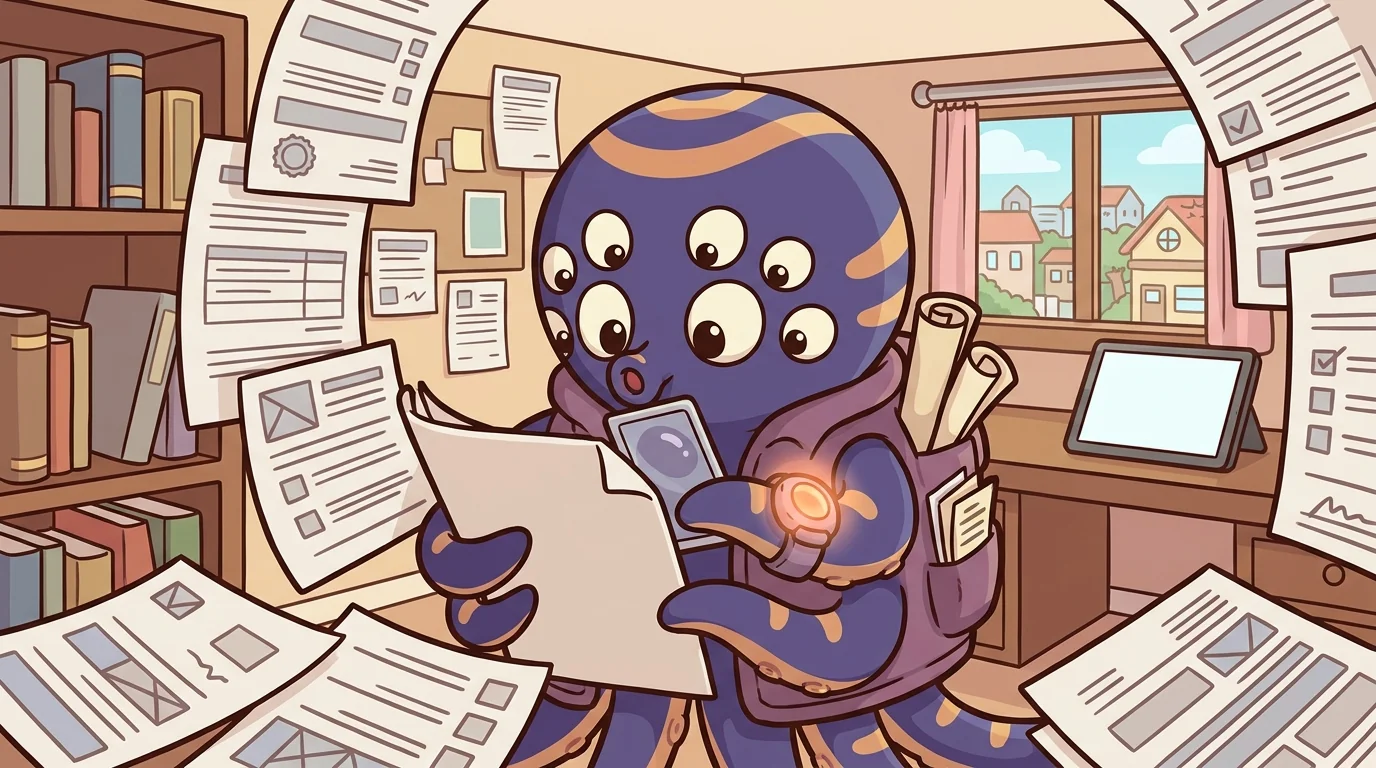
Parse is a careful octopus-tween — cool deep purple with soft amber stripes — with eight eyes, each able to focus on a different word at once. She wears a chunky document-vest with papers poking from every pocket, carries a small magnifying-card, and a slow-read-tracker pulses on her wrist.
Parse reads every single word. "Slow down. Read it ALL," she likes to say. "Small print is often big print in disguise." That's her whole craft: reading-comprehension for adult documents — the life-skill of reading it all, deliberately. Grown-up papers — leases, contracts, phone terms of service, warranty cards, healthcare forms — are slow reading, built to be skimmed. And the big traps hide exactly where people skim: the footnotes, the "by accepting, you agree…" lines, the auto-renewal rules. Parse's tracker glows over precisely those sections.

Parse learned to read every word after watching someone she loved get caught by a line they'd skipped.
A grown-up in her family had signed something fast — just skimmed it, signed, felt like a real grown-up — and months later a hidden fee arrived, then a bill that had quietly doubled. "It wasn't their fault," Parse says firmly. "The paper was built to be skimmed. The trap was hiding in the boring part on purpose."
That was the day Parse decided she'd never let a document hurry her again — and that she'd teach other kids the same. "The trap is invisible if you skim," she says, "and obvious if you read it all. So I read it all." Eight eyes, one word each, all the way to the end.

One day Steward, the mentor, set out a thick packet that looked like a phone-plan contract. "Who wants a new phone?" Parse asked, and a few hands shot up. "Great — but first, we sign this."
Leo groaned. "Do we have to read all that?"
Parse smiled with all eight eyes. "Yes, Leo. Every single bit." She spread the contract on the table, tentacles holding the pages flat. "Let's pretend you're signing up for that cool new phone."
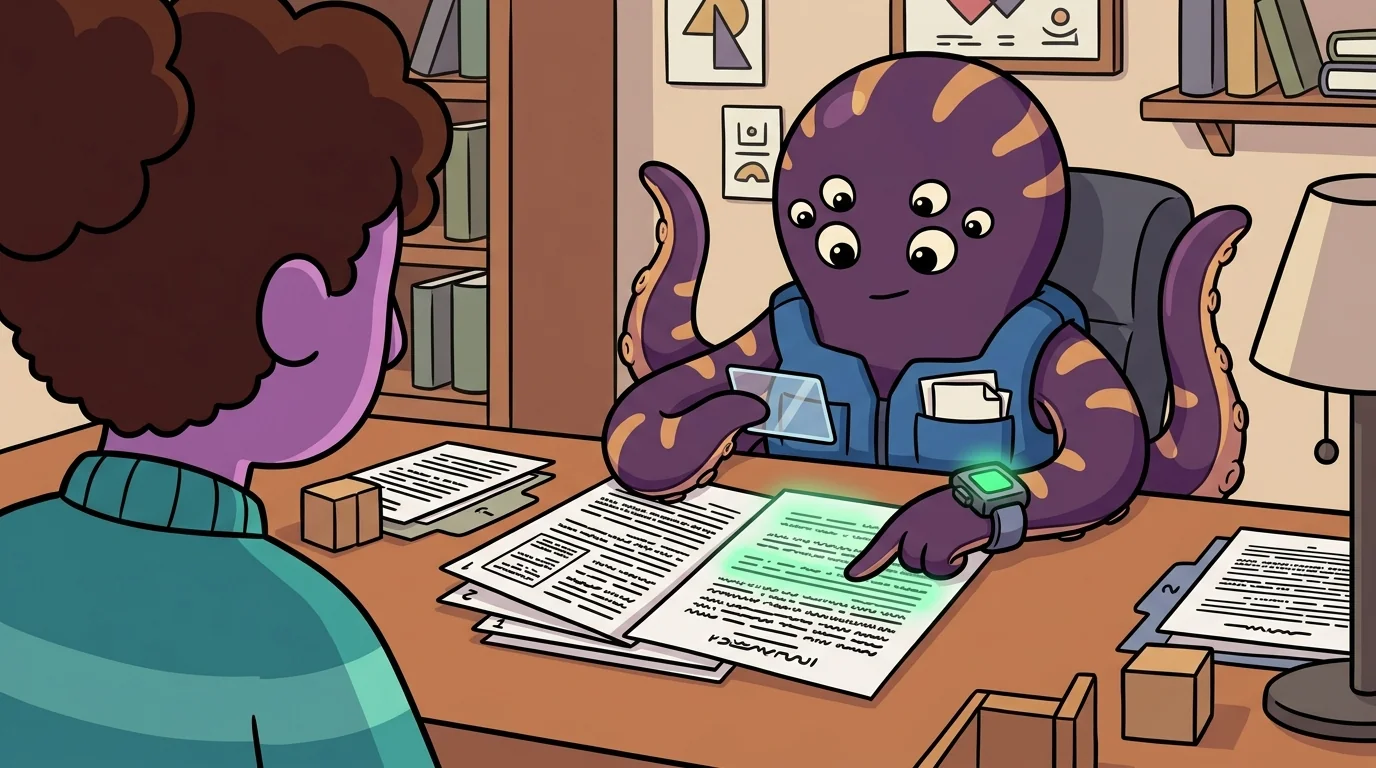
She slid the magnifying-card over the pages. "Page 1 — fine, it's about the phone. Page 2 — fine, the monthly cost." Then, on page 3, a block of tiny print, and her slow-read-tracker began to pulse soft green. "Ah — a special section." Maya squinted. "It's so small. Can't we skip it?" "Many people do," Parse said gently. "That's where the trap hides." She traced the line with a tentacle and read slowly: "'This contract auto-renews for 24 months at the then-current rate unless cancelled with 60 days written notice.'" She looked up, eyes serious. "That means your plan keeps going for two more years, automatically — and the price can go up, maybe even double — and you have to cancel in writing, sixty days ahead. Skim past page 3, and you'd auto-renew at twice the price." Leo's eyes went wide. "Double? Just because I didn't cancel?" "Exactly." Steward stepped over and nodded. "Parse's craft saves people hundreds of dollars a year — and when families do get caught, that's not their fault; these papers are built to confuse. Parse just shows us how to catch them." Then Parse showed more: a toy warranty ("void if not registered online within 30 days"), a game's terms ("company can change the rules anytime") — each time the tracker glowed, each time a hidden trap surfaced. "So what do we do?" Maya asked. "We slow down," Parse said. "We read every paragraph, even the boring ones. We flag what we don't understand. Then we ask questions. Think of it as a treasure hunt — the treasure is your money, the map is the whole document, and the X is always in the small print."
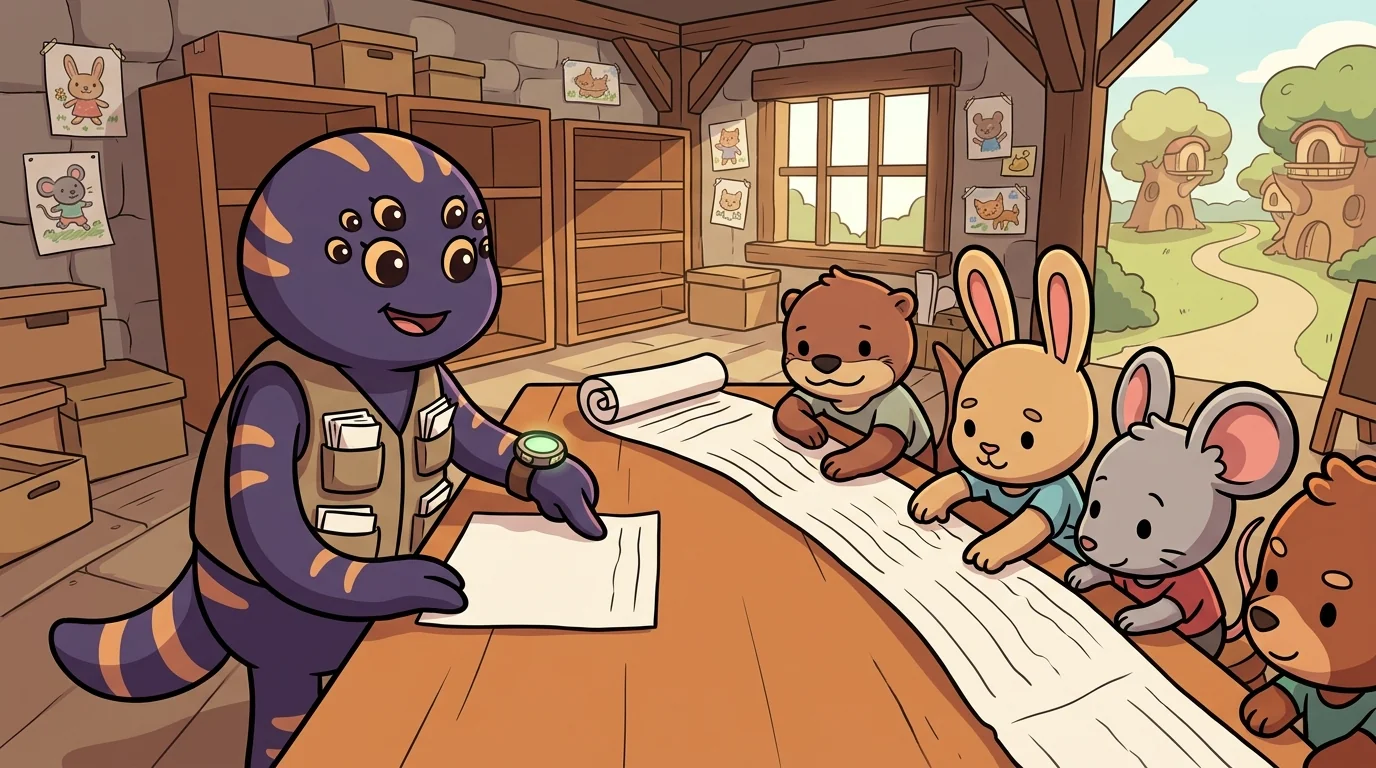
"So the boring part is actually the important part," Leo said slowly.
"Almost always," Parse said warmly. And as the kids leaned in and read page 3 together — out loud, all the way through, no skipping — Parse watched the worried, rushed look leave their faces. The trapped, hurry-up-and-sign panic was gone; in its place was a calm, steady, we-can-take-our-time feeling, the quiet safety of knowing that nothing in the paper could sneak up on you once you'd truly read it. That unhurried, nothing-hidden, take-your-time feeling — the opposite of being rushed into a yes — was, to Parse, the whole reward of reading it all the way to the end.
The LifeQuest ensemble
Parse is part of LifeQuest's distributed-narrative cast. Each character embodies a different curricular primitive; together they teach the full subject.
-

Save
Budgeting + financial planning — 'Money is a tool. Plan the tool.'
-

Spot
Scam-detection + critical-claim-evaluation — 'Show me the proof.'
-

Fill
Forms + paperwork + simplified taxes — 'Fill out. Then double-check.'
-

Cook
Meal planning + nutrition + budget-cooking — 'Eat well. Spend smart.'
-

Say
Self-advocacy + interview-craft — 'Be clear. Be kind. Be specific.'
-

Sort
Comparison-shopping — line options up side by side and compare real value, not loud labels
-

Borrow
Credit & debt basics — borrowed money isn't free; interest is the cost; a tool with rules, not a judgment
-

Vault
Digital privacy — some things stay locked; strong separate passwords; know who's actually asking
-

Dial
Time-management — the day is a pie; aim your hours at what matters, break big tasks small, keep a slice for rest