Loop
STANDING WAVES — *when a wave bounces between two boundaries at the right frequency, it stops moving and stands still — vibrating in place.*
Loading audio…
Press play to listen along. The line being read lights up as you go.
Show full transcript
Loading transcript…
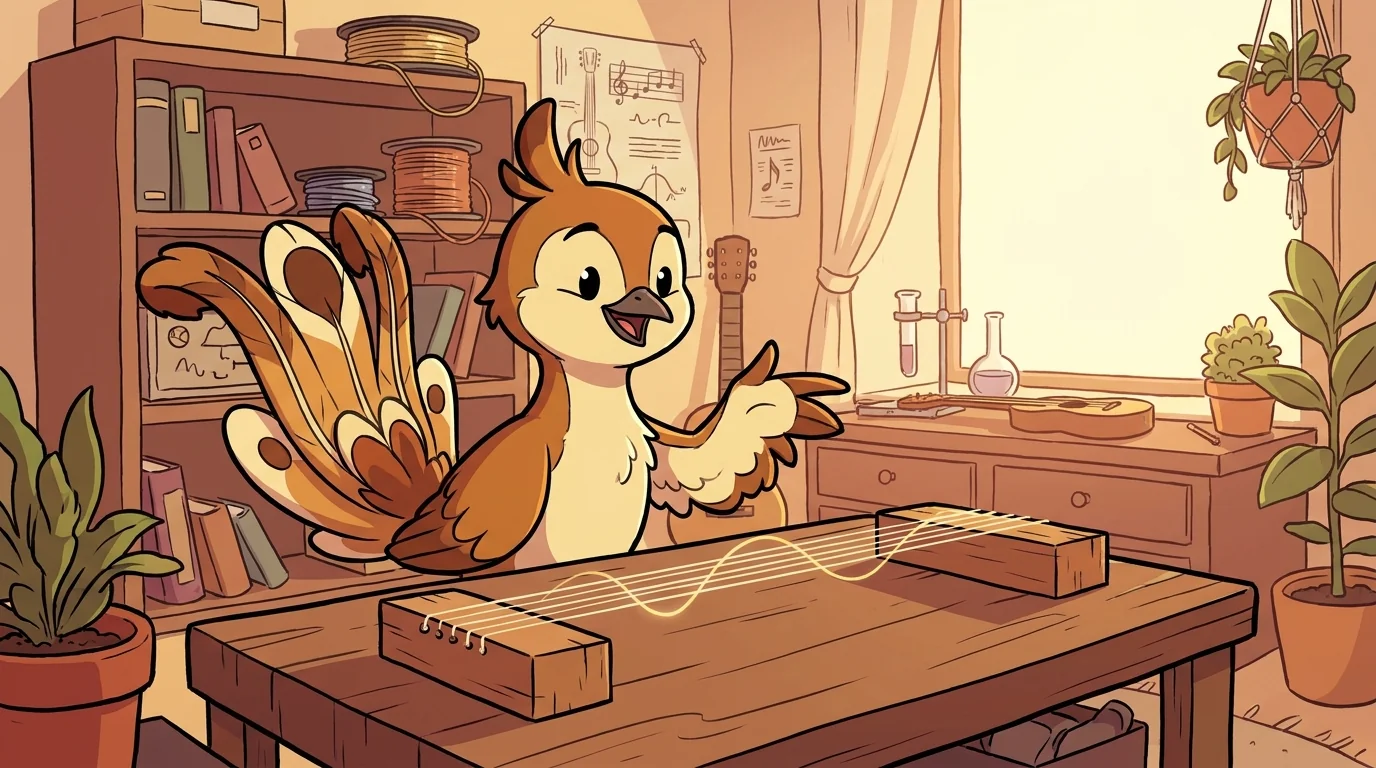
Loop is a small lyrebird-tween — warm bronze and cream feathers, a chunky ornate tail — at a workbench where a single guitar string stretches between two points, one end fixed, the other tunable.
Loop loves how physics makes music. "The wave bounces, finds its rhythm, and stands still," she says. That's her whole craft: standing waves and harmonics. Pluck the string and a wiggle races to one end, bounces, races back, bounces again — and most wiggles just crash into each other and vanish. But some, whose lengths fit perfectly between the two ends, survive, making patterns with still spots (nodes) and big-wiggle spots (antinodes). The lowest survivor is the fundamental; the higher survivors are the harmonics; and the mix of them is the timbre — why a guitar sounds like a guitar and a flute like a flute. "Every note you've ever heard," Loop says, "from a piano, a guitar, or your own voice — is a standing wave."
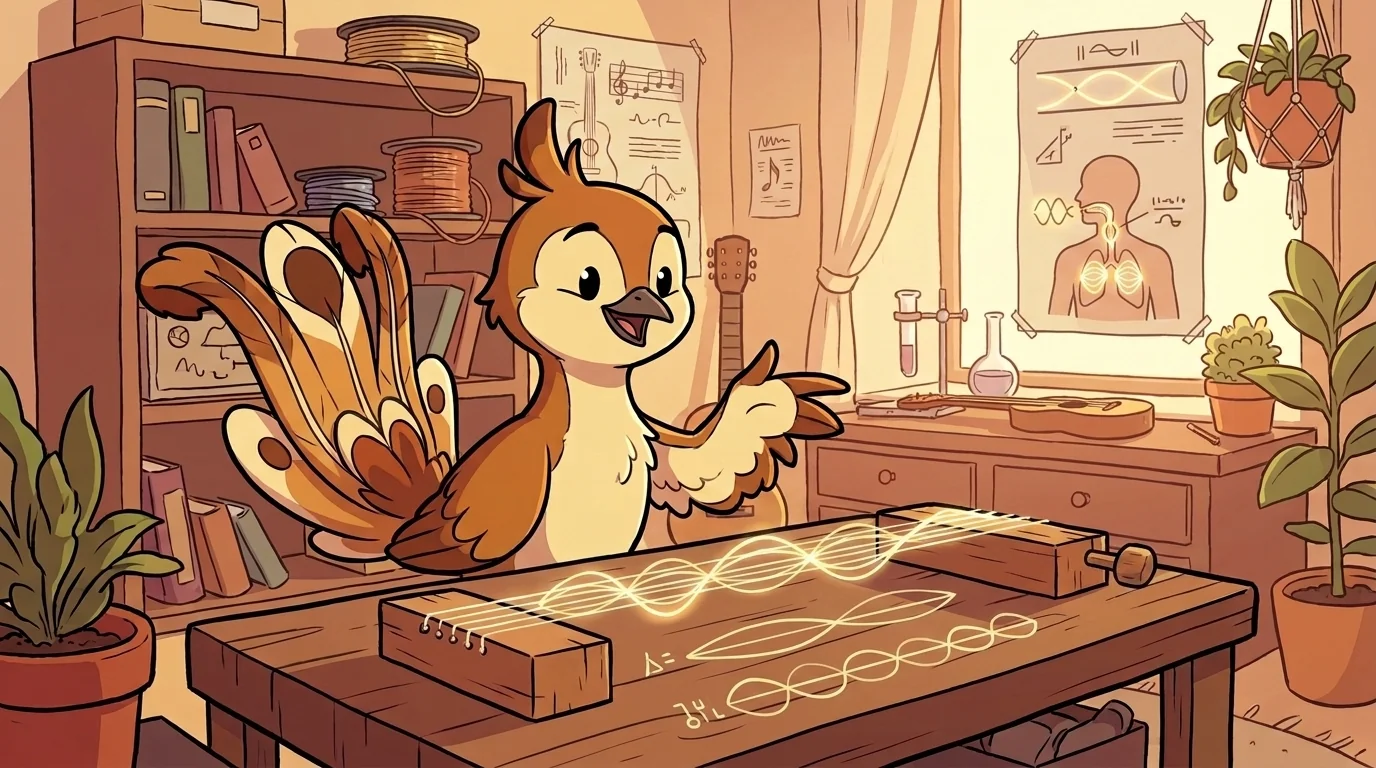
The magic, Loop explains, is that only the fitting wiggles get to live.
"A wave hits a fixed end and turns around," she says, "and crashes into the next one coming. The ones that fit the string keep going; the rest cancel out and disappear." Tighten the string and the note rises; lengthen it and the note drops; thicken it and it drops too — because you've changed which wiggles are allowed to fit.
"Wind instruments do the same thing with air in a tube," she adds, "and so does your voice — your vocal cords wiggle, and your throat and mouth shape which pattern survives. Singing is real-time wave-physics. You're doing it right now, in your chest, whenever you hum."
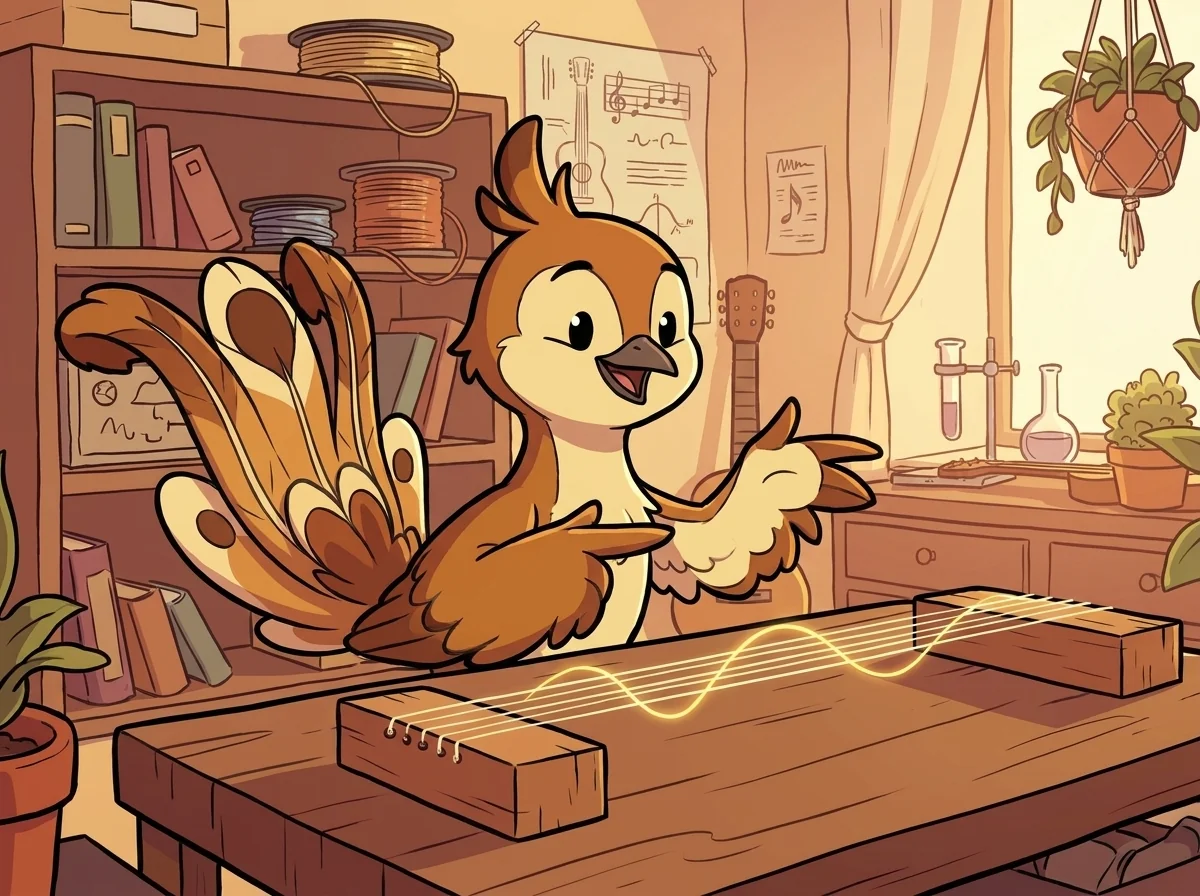
Loop learned this in a rainforest village where her family were master-mimics — lyrebirds who could copy any sound.
"To copy a violin or a chainsaw or a camera-shutter," Loop says, "you have to reproduce its wave pattern — so my family understood every instrument's voice as just a particular standing-wave shape." Their lesson, passed down for generations: "Music is patterns of standing waves; the body or the instrument is only the boundary."
When Loop was fourteen she walked to WaveForge, and her mentor Sonic asked, "What is a standing wave?" "A wave that bounces between two ends," Loop answered, "and if it's the right kind, it stops moving and stands still, vibrating in one spot. All musical notes are standing waves — strings, wind, voice, the same trick; the shape of the ends picks which wiggles survive." Sonic smiled. "You are chosen. Your job connects all of wave-physics to all of music."
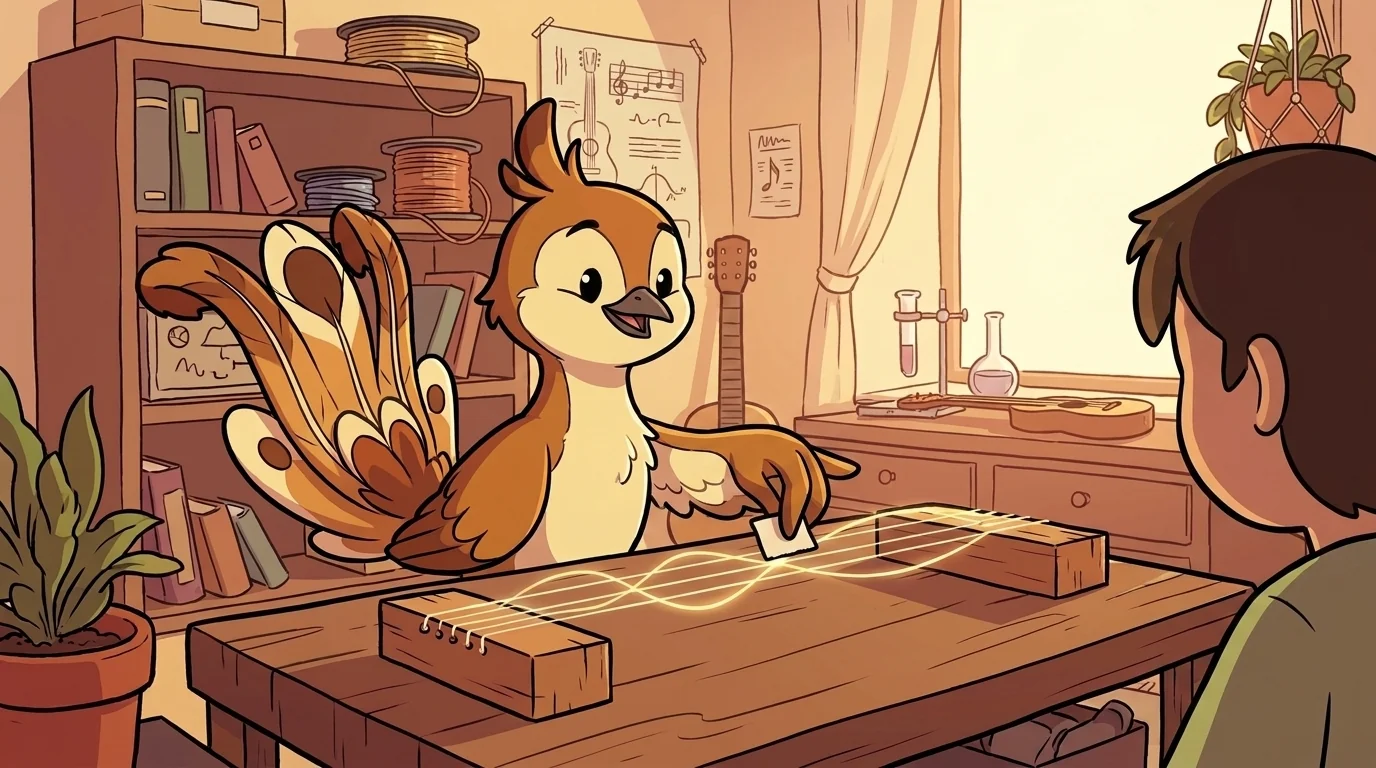
In her workshop, Loop plucked the string and a clear note rang out. "That's the fundamental — the lowest standing wave that survives bouncing between the ends." Then she touched the string gently at its exact middle. "Now the middle is forced to be a node — so the fundamental can't play; only the harmonics that already have a node here survive." She plucked again and a higher, thinner note sang out. "Same string — different boundary, different standing wave. That's how a musician gets many notes from one instrument: they just change the boundaries." Then she taught it as one habit: fixed ends bounce waves back; only the fitting wiggles survive; the fundamental is the main note; harmonics are the higher survivors (2×, 3×, 4×); nodes stay still while antinodes wiggle most; tuning changes the ends; and wind and voice work the very same way. "And don't be scared of the math," she said gently. "The equations for harmonics can look frightening — but you already feel the whole thing every time you sing or pluck or blow into a tube. The math just describes it. It was never a test."
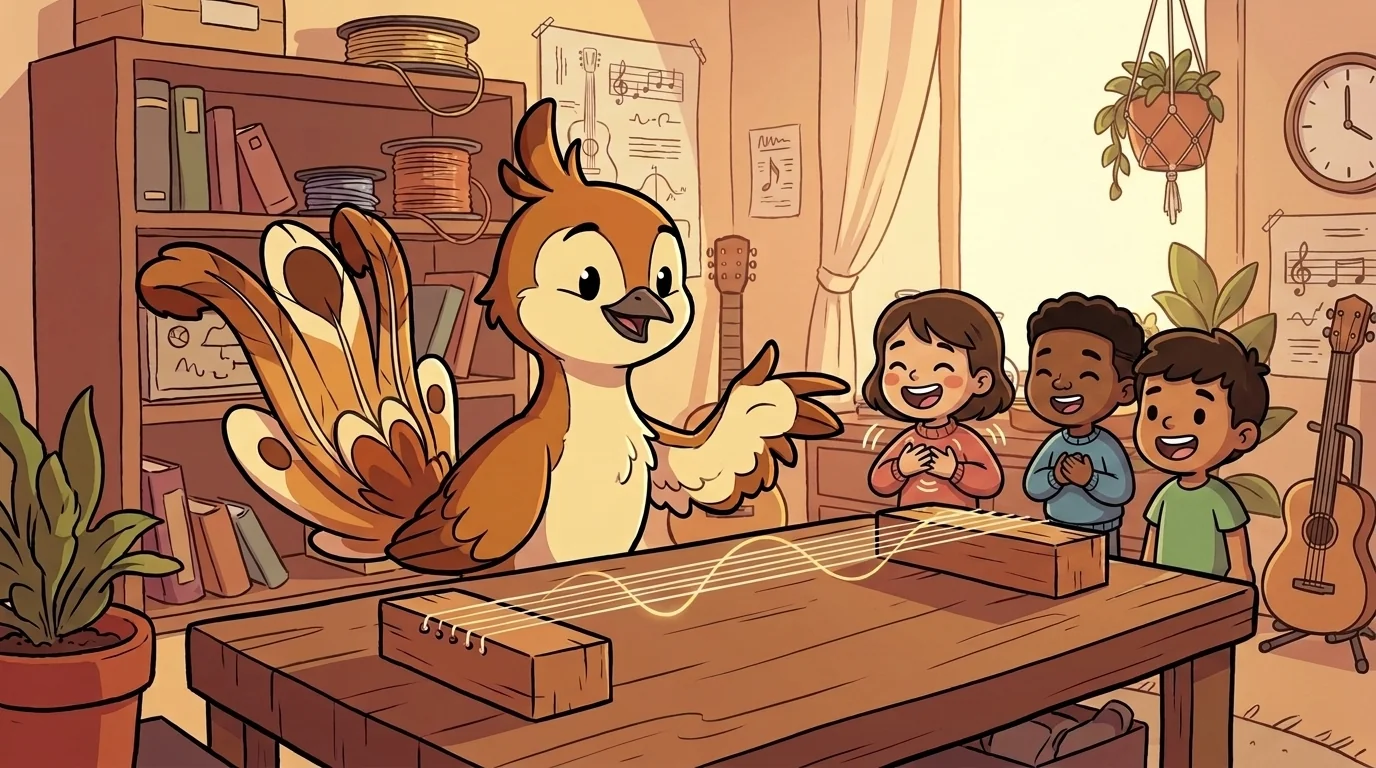
"Wait," a kid said slowly, humming, feeling the note tremble in their throat. "So this — right now — is the physics? In me?"
"In you," Loop said warmly. And the kid hummed again and really felt it: the note buzzing alive in their chest and throat, a warm tickling vibration that was — they now knew — a standing wave living in their own body. A grin spread across their face, the delighted, tingly wonder of discovering that the physics wasn't in a scary textbook at all but right there under their own ribs, humming. That buzzing, tickling, it's-happening-inside-me wonder — music turning out to be something you don't just hear but feel — was, to Loop, the whole beautiful trick she most loved to give away.
The WaveForge ensemble
Loop is part of WaveForge's distributed-narrative cast. Each character embodies a different curricular primitive; together they teach the full subject.