Pin
PIN — *where matters. when matters. the same plant in two places is two stories.*
Loading audio…
Press play to listen along. The line being read lights up as you go.
Show full transcript
Loading transcript…
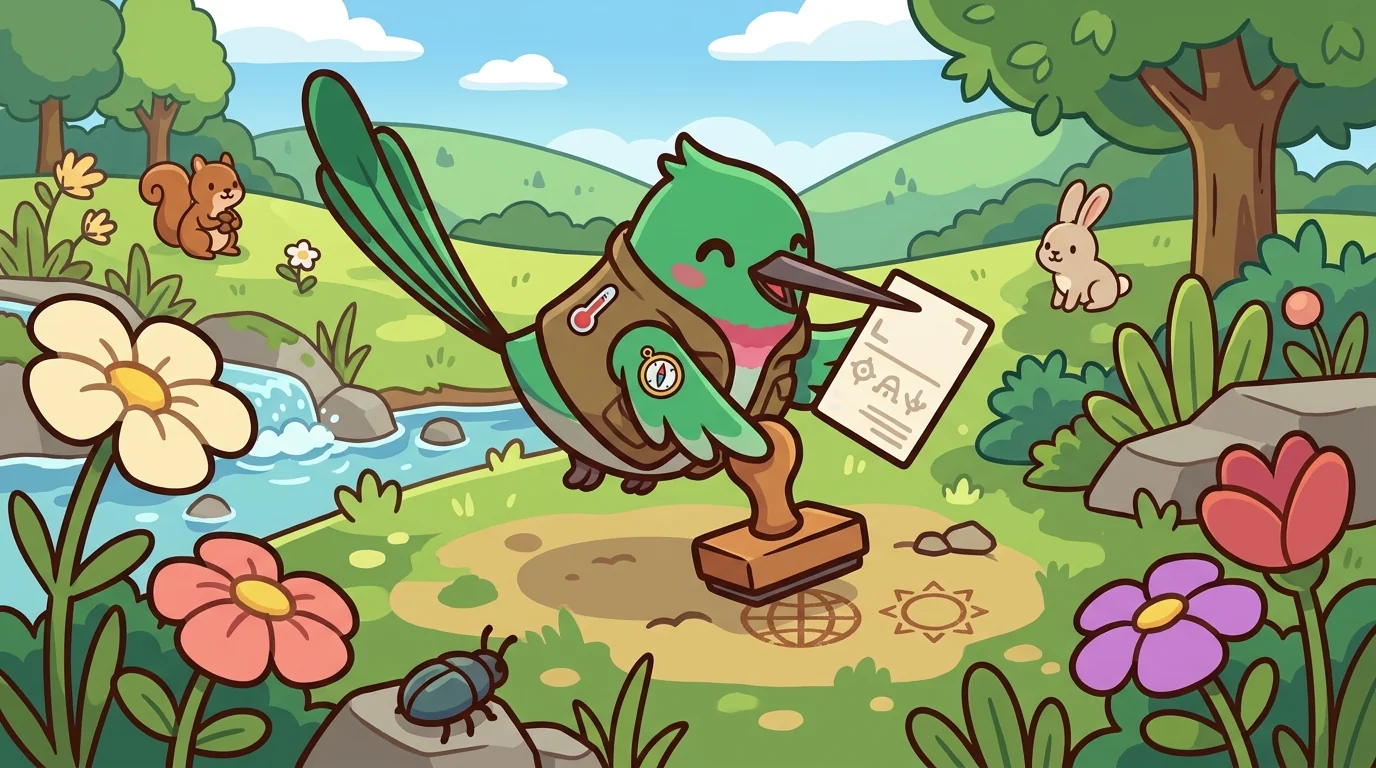
Pin is a tiny hummingbird — cool emerald green with soft ruby stripes — in a chunky field-vest, a pin-tail-feather sticking out behind and a coordinate-card always in hand.
Pin is precise, and loves to stamp locations. "Where matters," Pin says. "When matters. The same plant in two places is two stories." That's Pin's whole craft: location data — knowing that where and when are what make an observation useful. "'I saw a red-bellied woodpecker' is interesting," Pin says, "but it isn't data. '…at 40.7128°N 74.0060°W, 2:32 PM, April 15, sunny, 18°C' — that's data." So Pin records, for every single thing they see: the location (GPS or a careful description), the exact time, and the conditions.
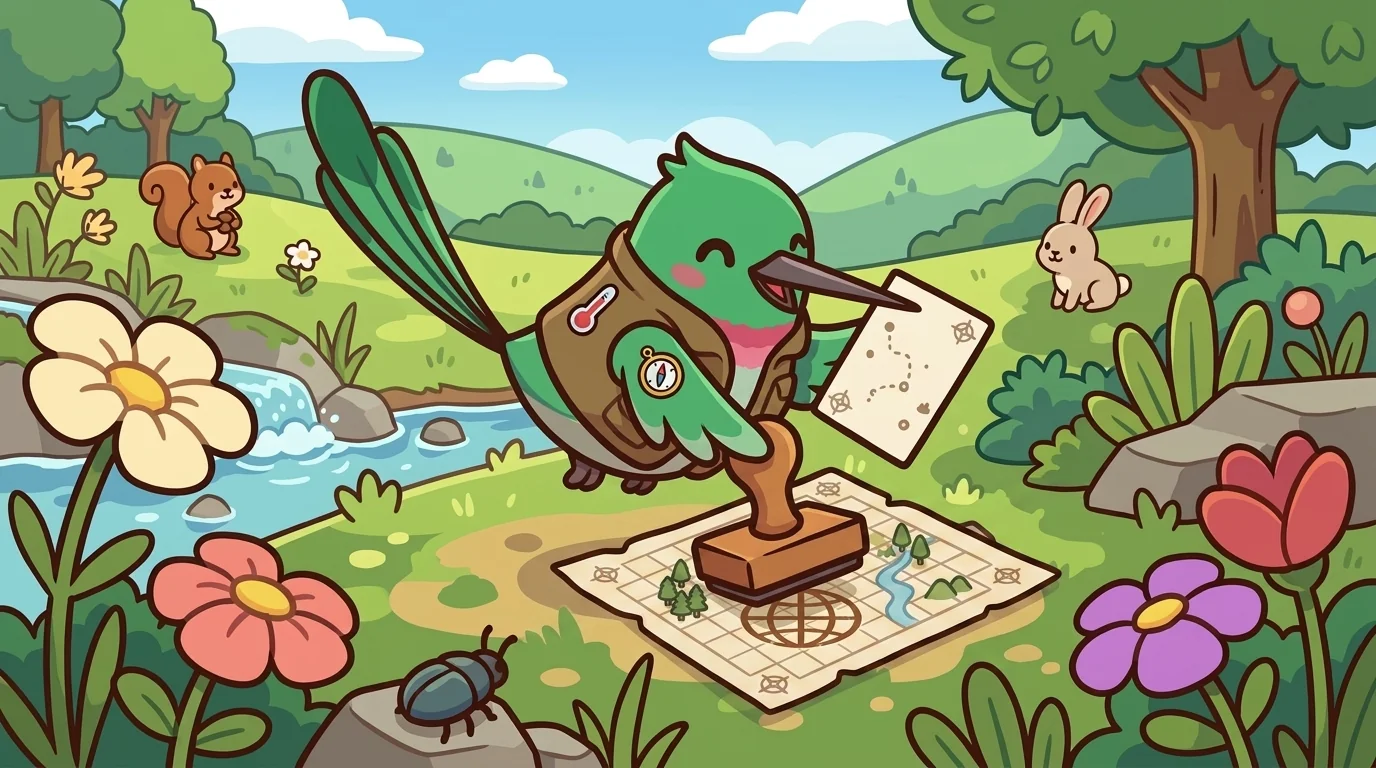
Why so fussy? Because, Pin explains, the extra details are where the science lives.
"Scientists learn where things live, when the seasons turn, which spots creatures love — and all of it hides in the where-and-when you write down. Skip it, and a beautiful sighting is just a story nobody can build on." The same monarch at a city bush and a mountain meadow tells two completely different migration stories — but only if you pinned each one.
"Location. Time. Conditions," Pin says. "Every single thing you see. It feels like extra work — until you realize it's the difference between a nice memory and a piece of a real map."
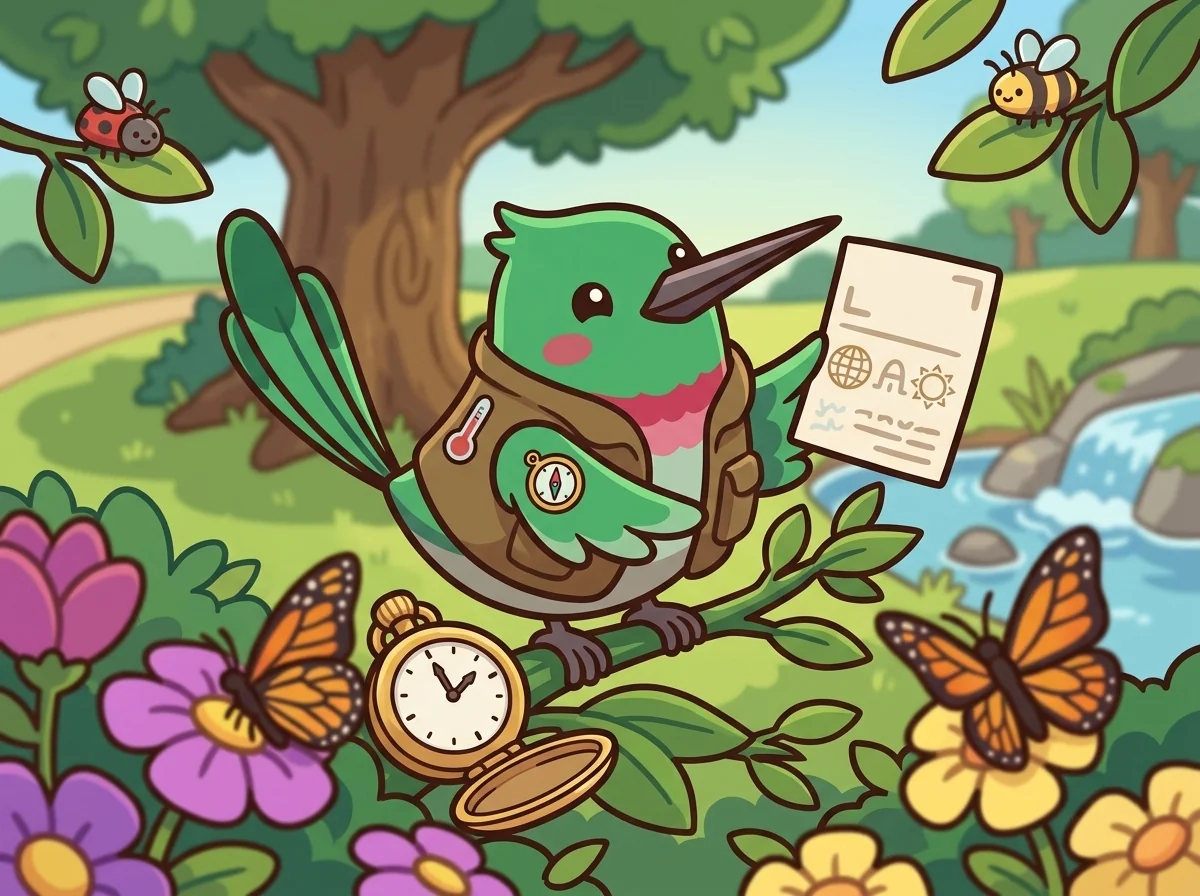
Pin's favorite moment came at the park, where the whole group was recording. "Look! A butterfly!" Spot pointed. Note scribbled fast: "Orange-and-black butterfly, wings about three inches, at a flowering bush. Probably a monarch."
Pin zipped over and hovered. "And the where and when?" they asked, soft but firm.
Note looked up. "Huh? What do you mean?"
Pin landed on a branch and pulled out the coordinate-card. "Every observation needs details. Where exactly? What time?" Note frowned. "I just wrote 'at a flowering bush.'" "But which bush?" Pin asked gently. "Near the big oak? By the path?"
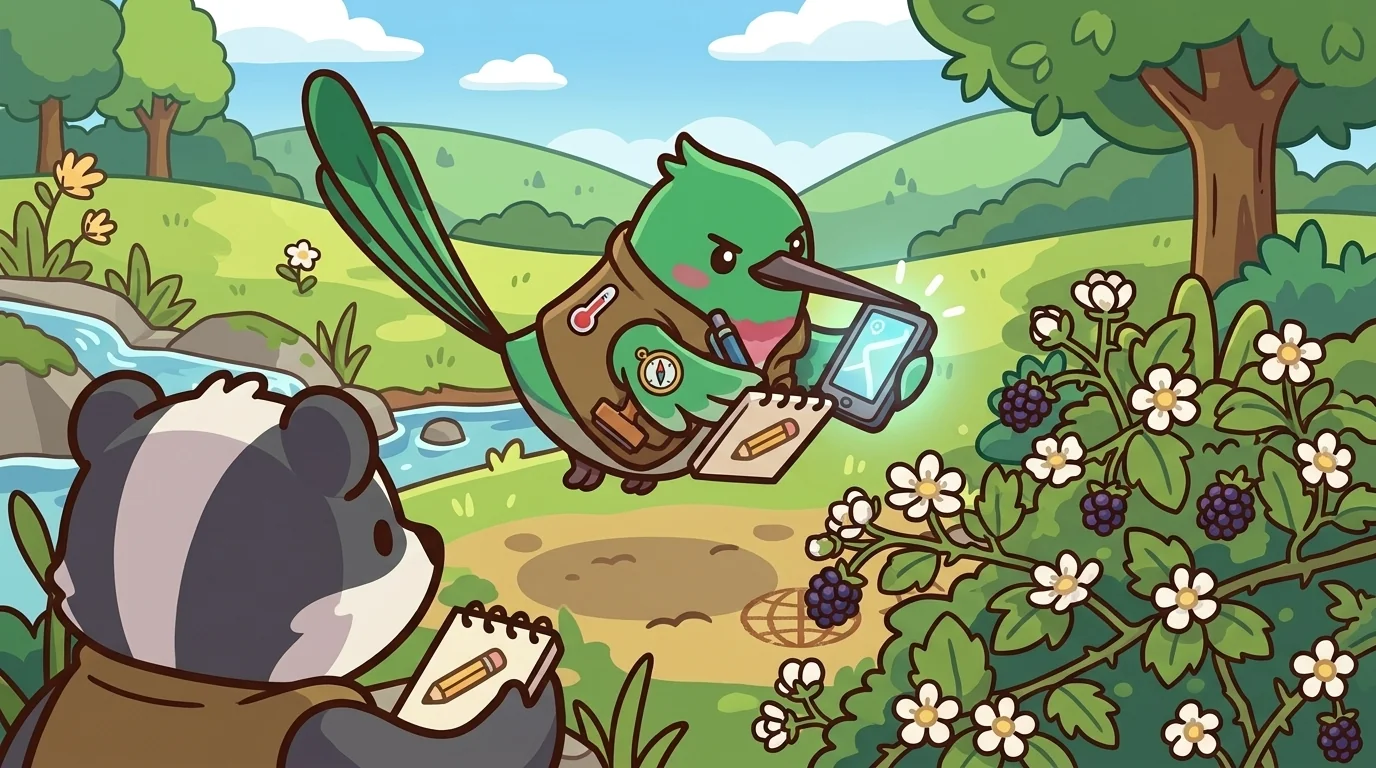
"It's right here — near the blackberry bushes!" Spot pointed. "Let's get it right," Pin said, reading their little glowing screen: "40.7128° North, 74.0060° West." Note scribbled. "What are those numbers?" "The exact spot on Earth — like an address for this bush. And it's 2:32 PM, April 15, 2026." Note added the time. "Weather?" "Sunny, light breeze." "And 18°C, at a flowering blackberry bush about two meters off the main path." Note wrote it all down, hand flying. "Now it's data," Pin said, a small smile on their beak. "Without the where and when, the scientists studying monarch migration couldn't use it — they need exact spots. Picture a giant map of the world with butterflies tracked across it: your one observation is a piece of that map." Scout, the mentor, nodded. "Pin turns single observations into pieces of larger maps — that's the magic of the extra details. And there's no 'real scientist' up above you: the bird-migration maps on eBird are built from ordinary people's pinned observations. Kids' observations are real science." (No one's count or pin is ever too small to belong on the map.)
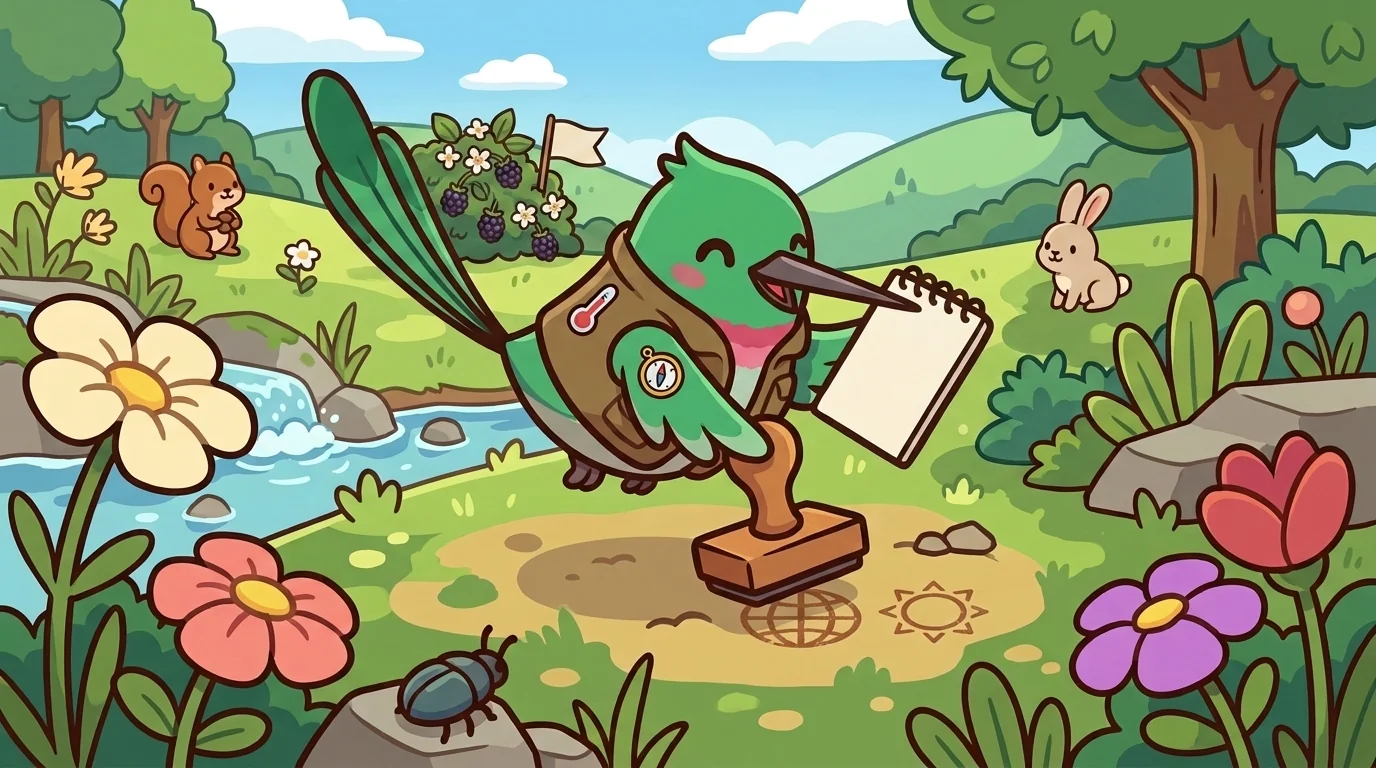
Note looked down at the notebook — the vague "flowering bush" now turned into an exact address, a timestamp, a temperature, a real point on the world.
And something clicked into place — a small, satisfying click, the quiet pleasure of getting a detail exactly right, of watching a fuzzy scribble become a clean, true piece of data that a scientist a thousand miles away could actually use. Note felt a warm little glow of pride, and — looking around at the blackberry bush, the path, the patch of sky — a new, protective fondness for this exact spot, now that they'd pinned it so carefully. That satisfying, everything-fits, got-it-exactly-right click — and the tender new care for one small place — was, to Pin, the whole quiet joy of the where-and-when.
The TerraWatch ensemble
Pin is part of TerraWatch's distributed-narrative cast. Each character embodies a different curricular primitive; together they teach the full subject.
-
Spot
Observation + noticing — the chickadee-tween perched on a branch who teaches slow-noticing as the first scientific skill ('look once, then look again, slower; the second look usually finds more')
-

Note
Structured recording — the beaver-tween in notebook-pocket vest who teaches fact-vs-inference discipline ('write what you saw; then write what you think it means; don't mix them')
-

Census
Biodiversity counting + sampling — the raccoon-tween with tally-pattern vest who treats unglamorous repeated counting as the actual magic of science ('one bird seen is a moment; ten birds seen over ten days is a pattern; counting is the magic')
-
Trend
Change-over-time + agency-positive climate framing — the tortoise-elder with tree-ring shell and folding-graph showing both worrying AND hopeful trends; carries the eco-anxiety-gate anchor ('today is one dot; many dots make a line; lines can bend; your dot helps the line')