Scour and Silt
TORN DOWN AND LAID BACK DOWN — the wearing-away of the land and the settling of the land are one connected cycle. What Scour breaks loose and carries off (weathering and erosion), Silt receives and lays down in layers (deposition). The same grain is a mountain, then a river's cargo, then a new layer of ground — nothing lost, only moved.
Loading audio…
Press play to listen along. The line being read lights up as you go.
Show full transcript
Loading transcript…
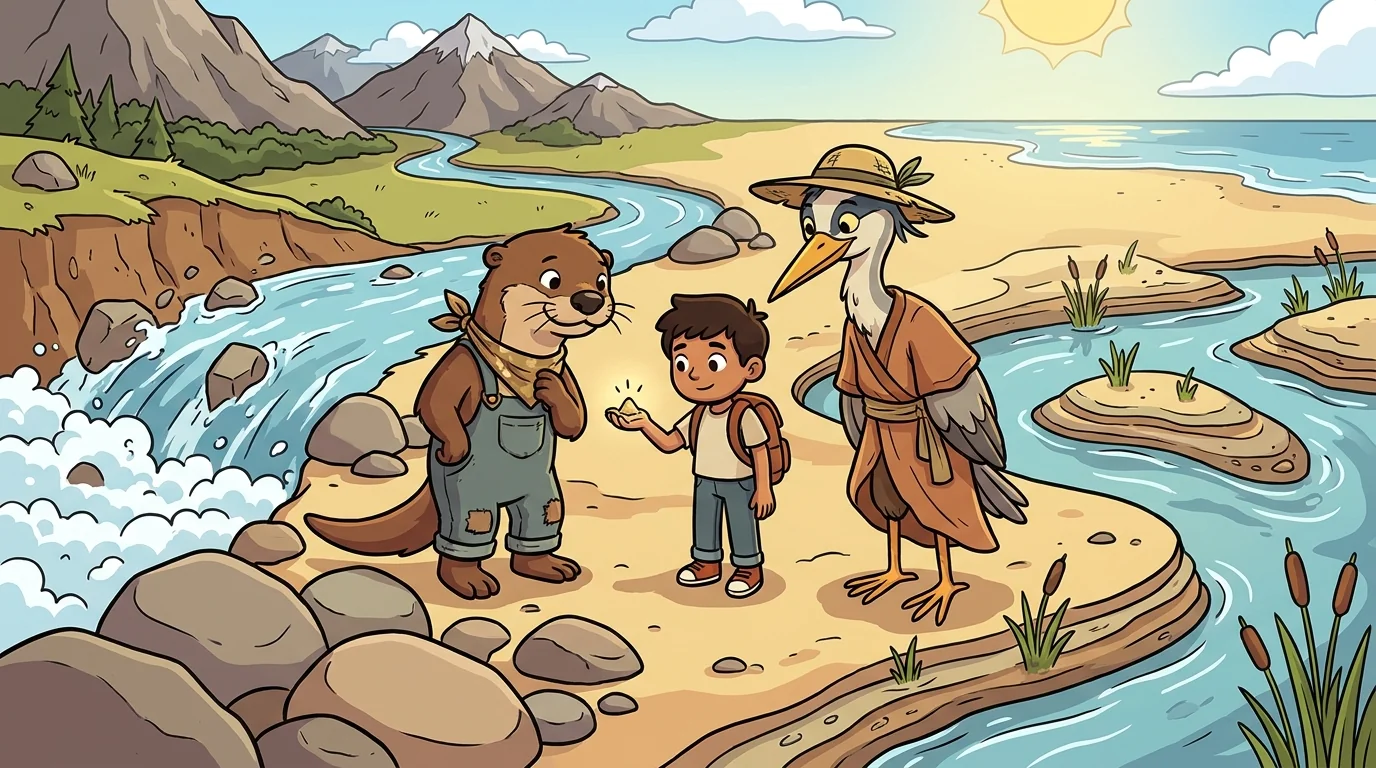
A young student came to TectonicForge with a single grain of sand in her palm and a question that pulled two teachers together.
She had found the grain on a beach far from any mountain, and she wanted to know where it came from and where it was going. So she asked Scour, the river-otter-tween who wore the land away, and then Silt, the heron-tween who laid the land back down — and the two of them, who worked at opposite ends of the river, ended up standing together over the one small grain.
And at first, each told only her own half.
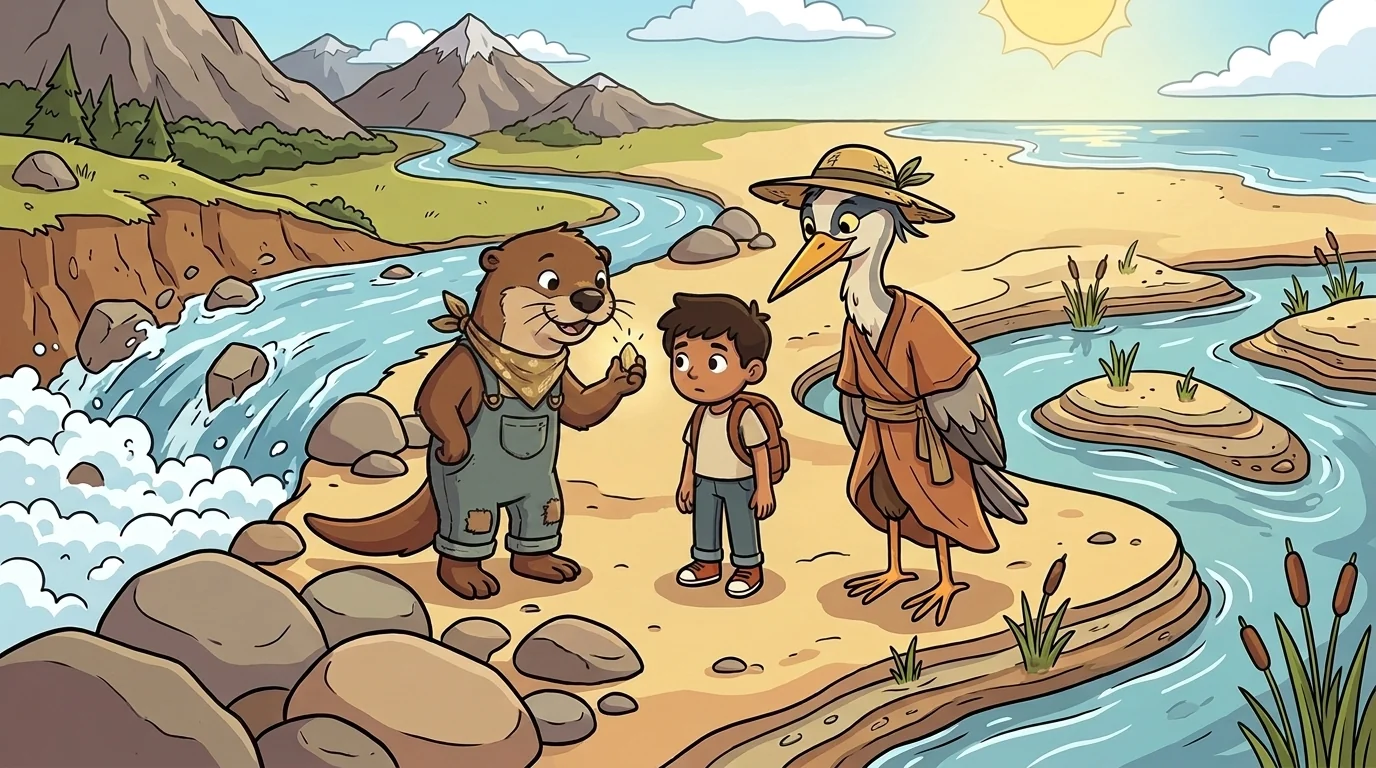
Scour went first, because the grain's journey began with her. "This grain was once part of a mountain," Scour said, turning it in her paw. "High up, sharp, hard. Then the rain froze in its cracks and split it. The wind scraped it. A river caught the broken piece and tumbled it — for years, for thousands of years — wearing off every edge until it was this smooth little grain, and carrying it all the way down from the peak toward the sea. That is my work: weathering and erosion. I break the mountain loose and I carry it away." She held the grain up proudly. "This grain is proof that I can bring even a mountain low."
The student looked at the grain — but she still didn't know where it was going, only where it had been.
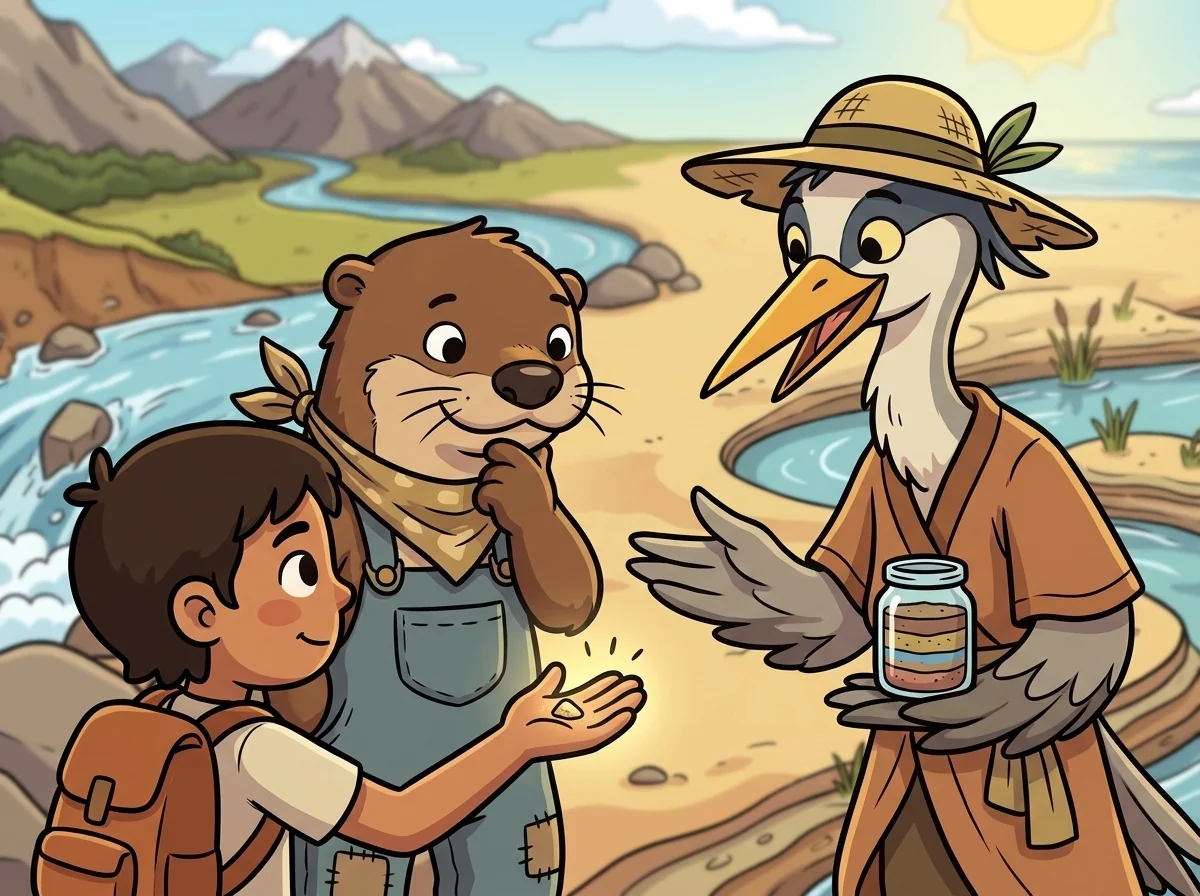
Silt had been standing quietly, and now she spoke. "Scour's work is true," she said, "but it is only the first half of the grain's life. A carried grain cannot travel forever. The river slows — at a lake, at the sea, at a still place — and the grain does what all carried things finally do. It settles." She tipped her layer-jar so its bands lay level. "It comes to rest, and another grain rests on top of it, and another, until they build a layer. That is my work: deposition. What Scour carries off, I lay back down. This grain's journey does not end when the mountain wears away. It ends — for now — as a new grain of new ground, in a new layer, at the bottom of the sea."
The student turned from one to the other, beginning to see that neither had the whole story alone.
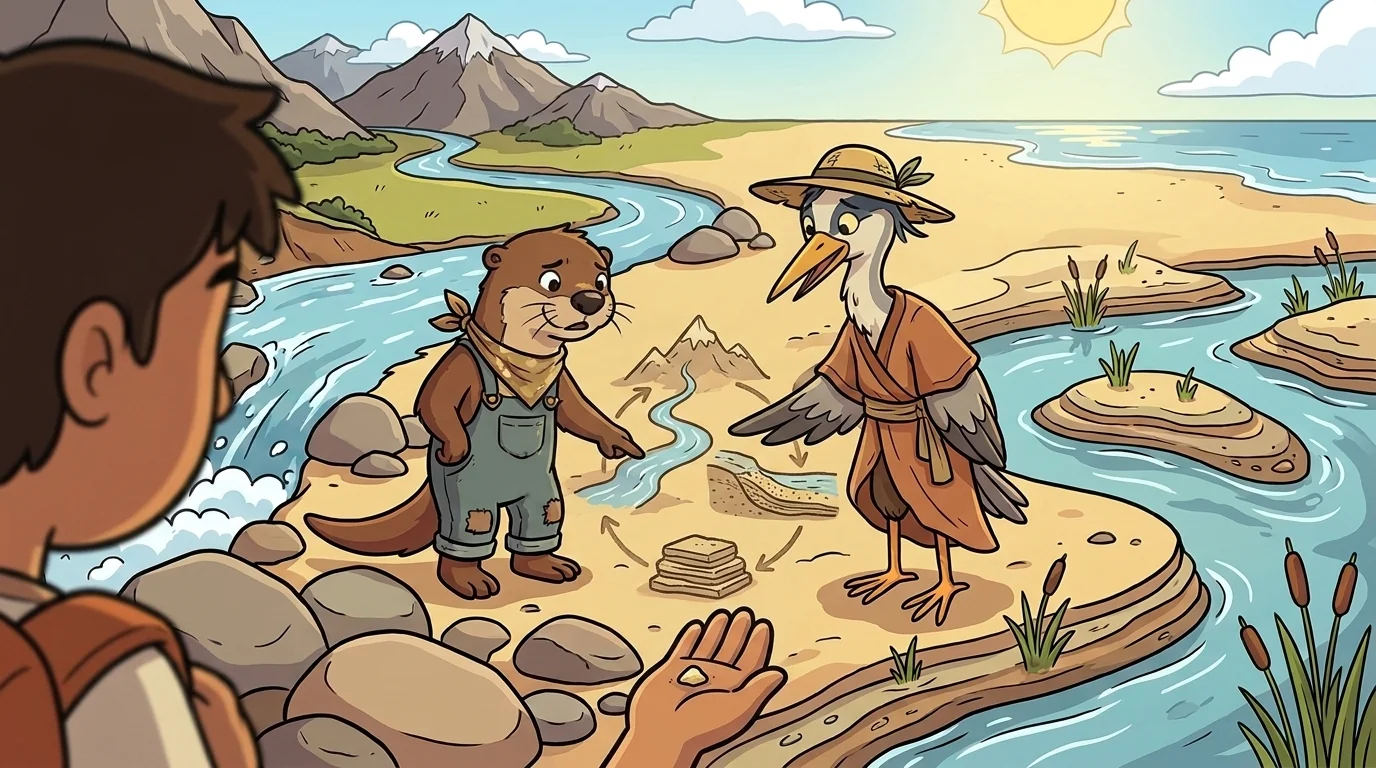
And then, over the single grain, the two of them told the whole journey together — and had the student trace it, so she could feel that the tearing-down and the laying-back-down were one unbroken cycle.
"Follow the grain," Scour said, "and you will pass through both our hands." So they traced it as one. It begins as mountain — high and hard (this is where Heave's work ends and Scour's begins). Scour breaks it loose and the river carries it down — weathering, then erosion. The river slows, and the grain settles — deposition, Silt's work — and lies down as the newest band in a stack of layers. And there, buried under more and more layers over ages, it may press into stone, and one day rise as a new mountain, to be worn away again. The student watched the grain travel the full loop — mountain, to river's cargo, to new layer, to stone, to mountain — and understood: what Scour tears down is exactly what Silt builds up. The wearing-away is not an ending; it is the first half of a laying-down. "I don't destroy the land," Scour said. "I hand it to Silt." "And I don't invent new land," said Silt. "I receive what Scour brings me." Two halves. One grain. One endless give-and-take.
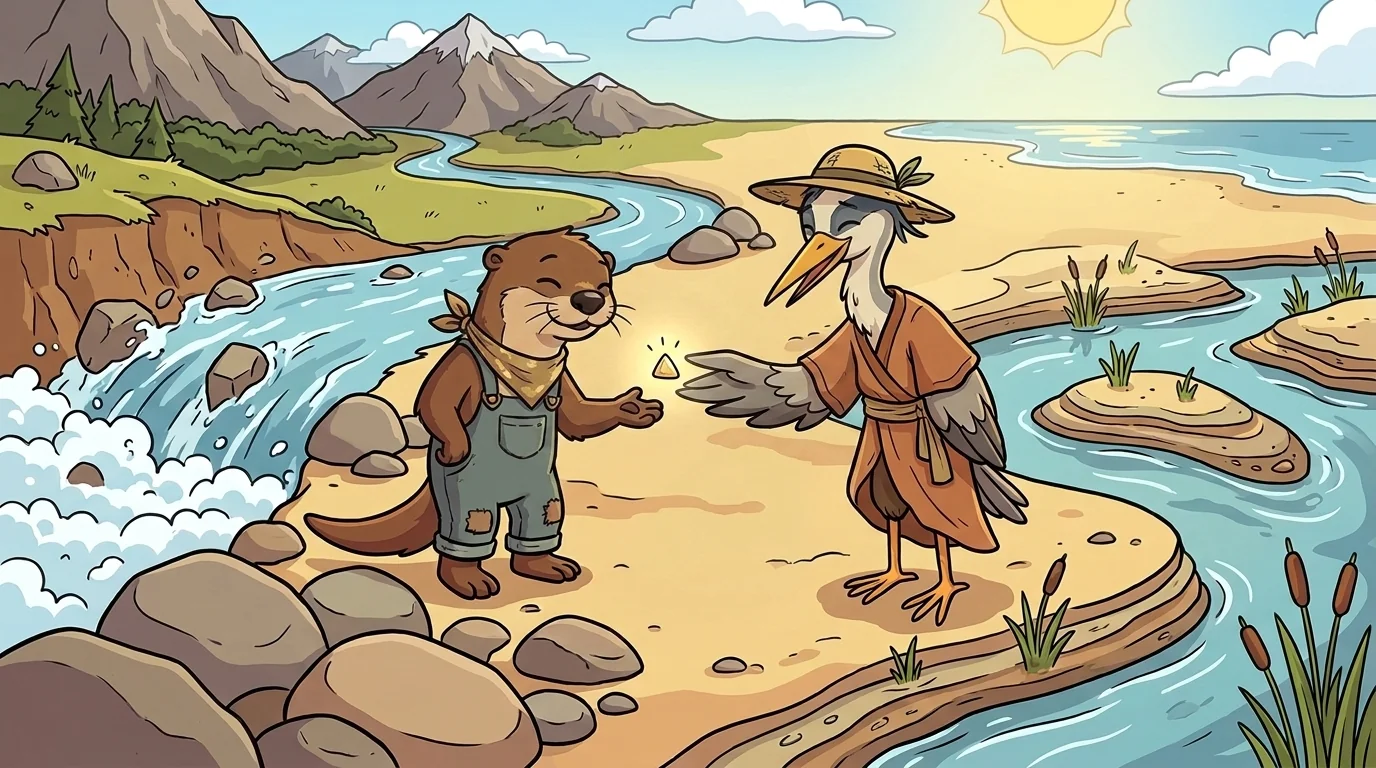
Afterward, watching the student carry her grain carefully away, Scour admitted she had always thought of her work as an ending — the mountain worn down, gone. And Silt admitted she had thought of her layers as appearing from nowhere, the ground simply arriving. Neither was true. Scour's wearing-down was Silt's beginning; Silt's laying-down was Scour's completion. The tearing-away and the settling were not two separate stories but one long sentence, passed grain by grain from the otter's quick paws to the heron's still shallows.
They began teaching the surface-cycle together after that, one grain, two hands. And the students who learned it that way carried something past the model room: that what one place lets go of, another place is waiting to receive — that a loss in one story is a beginning in another — and that the world is far more connected, and far less wasteful, than it first appears. Scour and Silt, who had worked at opposite ends of the river for years, found they had always been holding the same grain, one passing it gently to the other, forever.
The TectonicForge ensemble
Scour and Silt is part of TectonicForge's distributed-narrative cast. Each character embodies a different curricular primitive; together they teach the full subject.
-

Sink
Convergent/subduction boundary — the heavier plate finds its way down; it takes a long time; that's okay
-

Spread
Divergent boundary + new crust — when something pulls apart, something new is forming in the middle
-

Slide
Transform boundary + stored energy — two plates sliding past; they catch, they hold, then they let go
-

Vent
Volcanism + magma chemistry — eruptions tell us what was happening below
-

Tremor
Seismology + earthquake preparedness — earthquakes are the Earth telling its story; we can read the lines; we can be ready
-

Churn
Mantle convection — the engine that drives the plates — 'Deep heat moves the whole map.'
-
Heave
Mountain-building — folding + uplift at collisions — 'Push long enough and mountains rise.'
-
Remake
The rock cycle — igneous, sedimentary, metamorphic — 'Nothing is ever really finished.'
-

Scour
Weathering + erosion — wearing down the land — 'Water and time win.'
-

Silt
Deposition + strata — reading rock layers as time — 'Every layer is a page.'