
Savor
SAVOR — *a little salt wakes the food up. taste as you go. salt doesn't make food salty — it makes food taste more like itself.*
Loading audio…
Press play to listen along. The line being read lights up as you go.
Show full transcript
Loading transcript…

In a small village beside the herb-terraces, there lived a badger named Savor who tasted the village soup more times than anyone could count.
Savor was round and unhurried, with a soft grey-and-white face and gentle paws. She wore a plain apron with a wide front pocket. The pocket held a tiny wooden spoon — her tasting-spoon — and a little pinch-pot of salt. All afternoon, while a soup cooked, Savor would dip her small spoon, taste, think, and sometimes add the smallest pinch of salt, and taste again.
Savor had a sentence she liked to say, soft and sure.
"A little salt wakes the food up," Savor would say. "Taste as you go. Salt doesn't make food salty — it makes food taste more like itself."
People sometimes thought seasoning meant dumping salt in and hoping. Savor would just shake her head, dip her spoon, and taste.

When Savor was small, her grandmother had taught her at the big soup-pot.
Her grandmother made a vegetable soup that the whole village loved, and one day she let small Savor taste it before any salt went in. Savor made a face. The soup was… flat. Dull. Like the vegetables were sleeping.
"Now watch," her grandmother said, and added one small pinch of salt, stirred, and gave Savor the spoon again.
Savor tasted. And the soup woke up. The carrot tasted more like carrot. The onion tasted more like onion. Nothing tasted salty — it just tasted more, brighter, fully awake.
"See?" her grandmother said. "The salt didn't cover the soup. It woke it up. A little salt lets each thing be more itself." Savor felt a small wonder open in her chest — that the tiniest touch, added gently, could make everything more truly what it already was.

Savor came to SaffronLab as a young badger, because a place that studied how food becomes delicious ought to understand the quiet magic of seasoning.
The old cook who welcomed her asked one thing. "Here is a stew with no salt. Make it right — but do not ruin it."
Savor did not dump in salt. She tasted first. Flat. She added one small pinch, stirred, tasted again. A little better. Another tiny pinch, taste again — and there it was, the moment the whole stew woke up and each vegetable spoke clearly. She stopped. "It is awake now," she said. "One more pinch would make it salty. This is just right." The old cook smiled. "You taste as you go. You have the gift. Most cooks salt once, blindly, and pray. You listen."
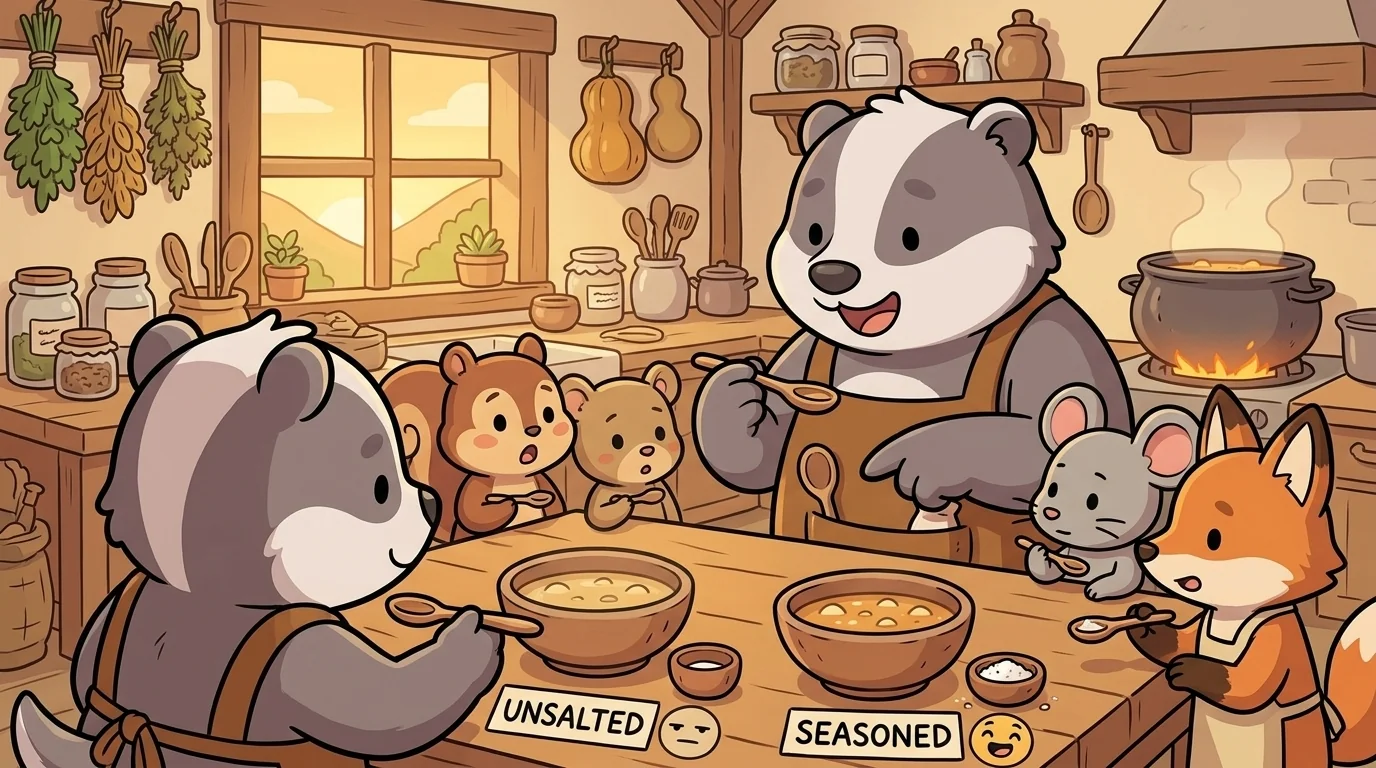
In her kitchen, Savor set two bowls of the same broth before her students — one unsalted, one seasoned. "Taste the first," she said. They made faces. Flat, dull, sleepy. "Now the second." Their eyes widened — the same broth, but alive, each flavor clear and bright. "I added no new food," Savor said. "Only a little salt. Salt is not a flavor you taste instead — it is the thing that makes every other flavor louder and truer." Then she taught them her real secret, the one that mattered more than salt itself: "Add a little. Taste. Add a little more only if it needs it. Taste again. You can always add another pinch — but you can never take salt back out. So go slowly, and kindly, and let the pot tell you when it is awake." She passed the little tasting-spoon around, and each student tasted, added a pinch, tasted again, learning to listen instead of to guess.
She said it warmly. "Seasoning is not force. It is attention. You taste, and you notice, and you add just enough to help the food be its best self — no more. That is the whole of it."

"A little salt wakes the food up. Taste as you go — and let each thing be more itself." And when Savor said it, dipping her small spoon one last time, her round face filled with a warm, contented glow — the cozy, settled happiness of helping something good become fully what it already was, gently, a pinch at a time, without ever once trying to make it into something it wasn't.
The SaffronLab ensemble
Savor is part of SaffronLab's distributed-narrative cast. Each character embodies a different curricular primitive; together they teach the full subject.
-

Whisk
Mixing + emulsions — the energetic hummingbird-tween who treats mixing as conversation between ingredients ('quick wrists, patient eyes — air goes in, lumps come out')
-

Simmer
Heat application + states of matter — the patient tortoise-tween who treats heat as the slow-revealer ('heat moves slow, food changes slower; watch the bubbles — they're telling you')
-

Rise
Fermentation + leavening — the wise badger-elder who treats fermentation as the patient art of working with living things, foregrounding cross-cultural traditions ('living things take time — wait; the bread knows when it's ready')
-

Crisp
Maillard + caramelization — the focused fox-tween who treats browning as the flavor-creating frontier ('sugar meets heat, protein meets heat — new flavors are born')
-

Brine
Preservation + food safety — the careful axolotl-tween who treats food safety as care-for-the-eater, foregrounding cross-cultural preservation traditions ('salt remembers, vinegar remembers, cold remembers — food keeps if it's kept right')
-

Bind
Thickening — roux, reduction, how a sauce comes together — 'Patience turns liquid into silk.'
-

Mince
Knife-work — uniform cuts + mise-en-place — 'Prep first. Cook calm.'
-

Steep
Infusion — drawing flavor from aromatics + herbs — 'Give it time to open up.'
-

Zest
Acidity + brightness — balancing richness — 'A squeeze wakes it all up.'