Nigh
ROUNDING AND ESTIMATION — replacing a messy number with the nearest friendly one (the nearest ten, hundred, or thousand). Forty-seven is nigh to fifty; three hundred forty is nigh to three hundred. An estimate is not a wrong answer — it is a well-aimed guess that is close enough to act on.
Loading audio…
Press play to listen along. The line being read lights up as you go.
Show full transcript
Loading transcript…

Nigh grew up on the river, where nobody could count anything exactly and everything floated anyway.
His family ran the flat-bottomed ferry that carried market crowds across the wide brown river below the town of Ware. On market mornings the crowd surged onto the deck — farmers, geese in baskets, sacks of grain, a cart or two — and somebody had to decide, before the ropes were cast off, whether the ferry could carry the load or whether it sat too low and would ship water.
Nobody could weigh each passenger. Nobody could count each grain. The crowd moved, the baskets shifted, the geese objected. And yet the ferry had to launch or not launch, right then, on a number.
So Nigh's family judged by nearness. A grown farmer was nigh to a hundredweight. A child was nigh to half that. A full grain-sack was nigh to two hundredweight. You did not need the true weight of the load. You needed the nearest round one — and if the nearest round one was under the ferry's limit with a little to spare, you launched.
"You cannot know the true weight," his mother would say, coiling rope. "You can know the nigh weight. The nigh weight is enough to float on."

Nigh's given name was Corin, but he had been called Nigh since he was ten, when a bargeman asked him how much a stacked wagon weighed and Corin answered, without pausing, "Nigh to nine hundred," and was proven right within a sack.
He learned nearness the way other children learn their letters — early, and without noticing. A number was never just itself; it was always closest to some friendly landmark. Forty-seven leaned toward fifty. Forty-two leaned toward forty. A number sat between two landmarks and belonged, for the ferry's purposes, to whichever it was nearer.
The hard cases were the ones that sat exactly between. Forty-five — was it forty or fifty? Nigh's mother had a rule, and it was the same rule the academy would later teach: when a number sits at the halfway mark, round it up, to the higher landmark, so that everyone uses the same rule and no two ferrymen ever disagree about the same load.

A travelling proctor from the academy crossed on Nigh's ferry one autumn and watched the boy — grown now — call out load-weights all morning without a scale.
"You are estimating," the proctor said.
"I am judging the nigh weight," said Nigh.
"That is the same thing," said the proctor. "In the academy we round numbers to the nearest ten or hundred and reason with those. It is faster than the exact number and, for most questions, exactly as useful. We could use a mind like yours."
Nigh had never left the river. He thought about it for a season. Then he handed the ferry-pole to his cousin and walked to the academy, where he has taught rounding for nine years.
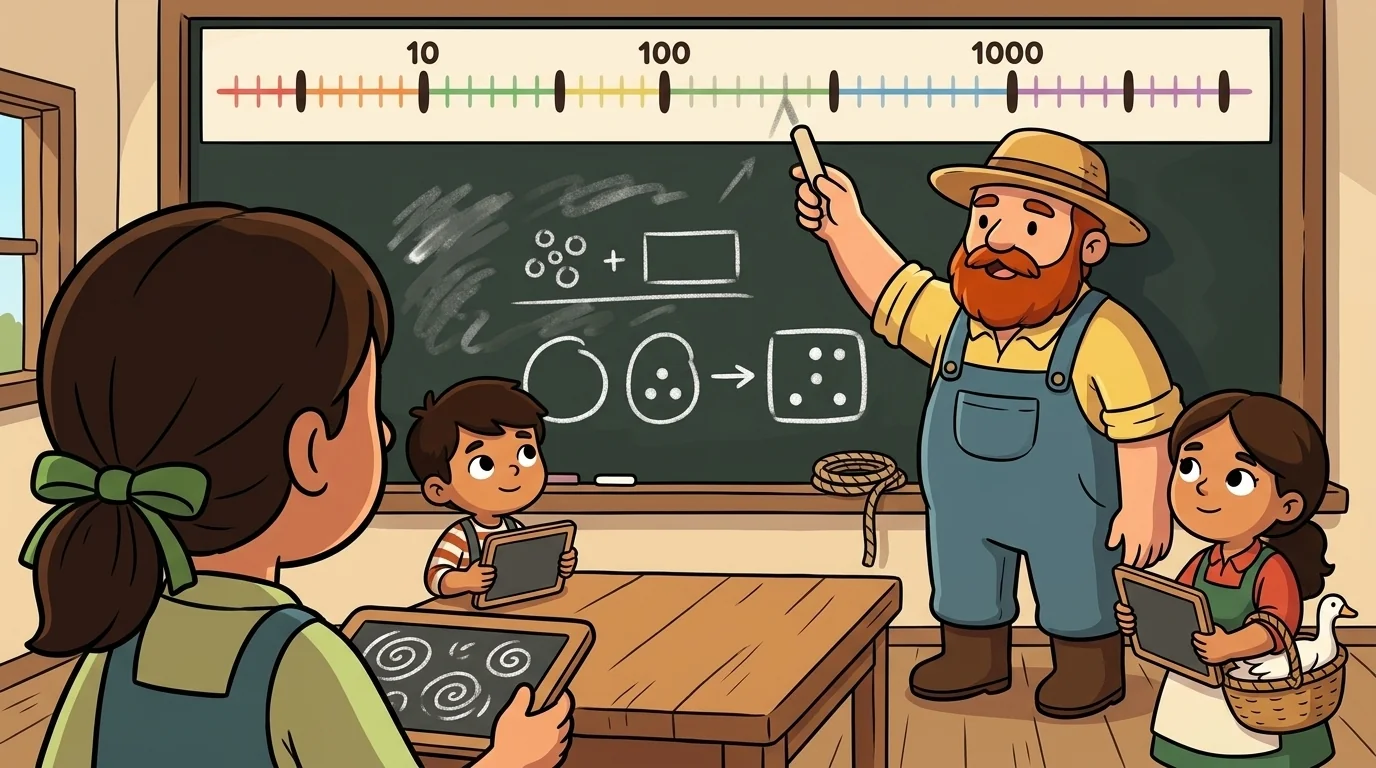
In his classroom Nigh keeps a long painted number line along one wall, with the tens marked bold and the numbers between them marked faint. He begins the same way each year. He points at sixty-three and asks, "Which bold mark is it nearest?"
The children look. Sixty-three sits just past sixty, far from seventy. They say sixty.
"Yes," says Nigh. "Sixty-three rounds to sixty, because it is nigh to sixty. Now — sixty-eight?" The children see it lean the other way, toward seventy, and say seventy. "Yes. And sixty-five, sitting square in the middle?" The children hesitate. Nigh gives them the ferryman's rule: "At the halfway mark, we agree to round up. Sixty-five rounds to seventy. Not because it is truly closer — it is exactly between — but because we all keep the same rule, so we all get the same answer."
Then he shows them why it is worth doing. He writes a hard sum — 312 + 289 — and before anyone reaches for a slate he says, "Round first. Three hundred and nigh three hundred. That is six hundred. The true answer is near six hundred. Now if a friend tells you the answer is nine hundred, you already know they are wrong, because you knew the nigh answer before you knew the true one." The children realize they can catch mistakes with an estimate — that the round guess is a lantern held up before the exact number arrives.

A girl named Perrin once stayed after the lesson, troubled. She said rounding felt like cheating — like giving a wrong answer on purpose. If sixty-three was not really sixty, wasn't she lying to say it was?
Nigh sat down on the low bench beside her. He said no — a good estimate is not a lie, because you never claimed it was the exact number. You claimed it was nigh, and it was. "When I said a wagon weighed nine hundred and it weighed nine hundred and forty, I was not wrong," he said. "I was close enough to float on. That is a real kind of right. It has kept people out of the river for three generations of my family."
Perrin thought about the ferry. She thought about being close enough. Something in her that had been braced — the part that thought every number had to be pinned down exactly or it did not count — loosened a little, and she felt lighter, the way you feel when you learn you are allowed to guess well instead of guessing not at all.
Nigh is unhurried, and speaks slowly, and squints the way he used to squint at the far bank. He still crosses the river twice a year to visit his cousin, and he still calls out the load-weight from the dock out of habit, and he is, his cousin says, still nigh every time. There is a deep contentment in him at being close enough — a calm that being exactly, anxiously right never once gave him — and he wishes it, more than anything, for every worried child who thinks a good guess does not count.
The MathVerse ensemble
Nigh is part of MathVerse's distributed-narrative cast. Each character embodies a different curricular primitive; together they teach the full subject.
-

Tenfold
Place value — powers of 10, positional notation
-

Zeph
The zero placeholder — its load-bearing role in positional notation
-

Mirror
Negative numbers — reflection across zero on the number line
-

Skip
Skip-counting and multiples — repeated addition as forward stepping
-

Tug
Inverse operations — addition ↔ subtraction (and the same idea for × ↔ ÷) as opposite pulls on the same line
-

Rive
Factors, divisors, and prime numbers (splitting a number into what divides it)
-

Vie
Comparing and ordering (magnitude — greater-than and less-than)
-

Weld
Number bonds (part-part-whole decomposition; making ten)
-

Yoke
Parity (even and odd numbers)