Earn and Give
EARN & GIVE — *money moves. it comes to you (Earn) when you're useful to someone, and it can move on from you (Give) when you choose to help someone. it isn't only a pile to guard — it's a flow you stand in the middle of, and you get to decide what it's for.*
Loading audio…
Press play to listen along. The line being read lights up as you go.
Show full transcript
Loading transcript…

A student thought money was one thing — a pile — and two very different creatures showed her it was really a river.
"Money's a pile you build up and sit on," she said, hugging her jar. "You get it, you guard it, that's money."
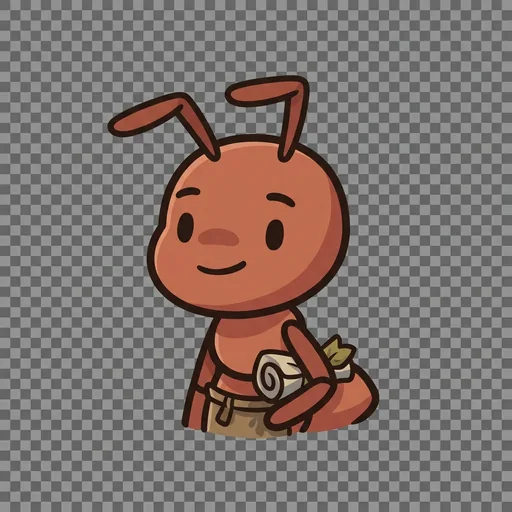
"That's part of money," said Earn the ant, who was, as ever, carrying something. "But watch how it got into your pile in the first place."
"And watch how it might move on from your pile, if you want it to," said Give the dolphin, easy and open.
The student blinked between the small tireless ant and the wide easy dolphin. "Move? I thought the whole point was to not let it move. To keep it."
"Keeping is fine — Nest will tell you all about it," Earn said. "But money isn't only a still pile. It's a flow. It came to you because you were useful —" she set down her load "— and it can move on from you when you help —" she nodded at Give "— and you're the one standing in the middle, deciding. Money isn't a stone you sit on. It's a river you stand in."

Earn showed the money coming in.
"Here's how it reaches you," she said, hoisting her crumb. "You did something useful — braided a bracelet someone wanted, raked a yard, solved a problem. And because it was worth something to them, money flowed to you. That's income. The pile in your jar didn't fall from the sky; it came in through your usefulness, coin by coin." She marched the crumb toward the jar. "So the first thing to understand about your pile isn't how to guard it. It's that it arrived — it flowed to you because you gave value first. Money comes in to the useful."
The student looked at her jar with new eyes. "So my pile is really... value I gave, flowed back to me as coins?"
"Every coin in there is a useful thing you did, returned to you," Earn said. "That's the in half of the flow." She nodded across at Give. "But a river doesn't stop when it reaches you. Money that flows in can also flow on — if you decide it should. And that's Give's half."

Give showed the money that could move on.
"Earn's right that your pile flowed in," she said, arcing easily. "Now — here's the part people forget. Some of what flows in, you can let flow on, to help someone else. Not because you must. Because you choose to." She nudged a small bowl. "Money spent on yourself is you enjoying the flow. Money saved is you holding some of the flow for later. And money given is you sending a little of the flow onward — to a friend who's short, a food drive, a cause you care about." She smiled, warm and unpushy. "It's completely your call. Keep it all, and that's honest and fine. Send some on, and that can feel wonderful — because you chose it, never because anyone made you."
The student looked at the bowl, a little wary of being preached at. "But I don't have to send any on?"
"Never," Give said at once. "That's the whole freedom of it. The flow is yours to direct. Enjoy it, hold it, or pass some on — three real choices, all yours, no right answer, no one owed." She grew gentle. "I'm not here to tell you to give. I'm here to show you the flow can move on through you, if that's what you decide your money's for."

Then Earn and Give showed the whole river, and the student saw money move.
"Watch it flow, start to finish," Earn said, and marched a coin in to the jar. "It comes to you — you were useful, so value flowed back as money. In."
"And then," said Give, lifting a coin from the jar toward the give bowl, "some of it can flow on — you choose to help, so a little moves from your hands to someone else's. Out." She paused. "Or it stays, to spend or save. Also fine. The point isn't that it must flow out. The point is that it can — that you're not just sitting on a stone. You're standing in a river, and you hold the direction."
The student watched the coin come in through usefulness and, by her own choice, some of it move on to help. "So money isn't a pile I guard," she said slowly. "It's a flow I stand in the middle of. It comes to me for being useful. And I decide — enjoy it, keep it, or send some on. It moves, and I steer it."
"That's the whole shape of money," said Earn and Give together. "It flows in when you're useful, and it can flow on when you choose to help — and everything you do with it in between is you, deciding what it's for." Earn added, "The pile matters — you've got to have some to steer. But money that only ever sits still, guarded, never useful to anyone including you, is a river dammed to a puddle."
"And a river you send some of, by your own free choice, where you think it'll do good," Give said, "is money doing one of the most satisfying things money can do — because you chose it."

Later, the student sat between the tireless ant and the easy dolphin, watching a coin she'd earned move — by her own decision — partly to a classmate who'd needed it.
"I thought money was just a pile to protect," she said. "It never crossed my mind it was moving — in to me, and maybe on from me."
Earn hoisted her crumb. Give arced in the shallows. Neither rushed.
"Most people learn only to get and guard," Earn said. "Useful stuff — you do need to earn it, and keep some. But that's half a river."
"And the other half," Give said, "is that it can move on through you, by your choice, to do good somewhere else. Not a rule. An option. A freedom." She clicked softly. "Alone, Earn might leave you thinking money's only about bringing it in. I might leave you thinking it's only about sending it on. Together we show you the whole flow — in through usefulness, out through choice — and you, in the middle, steering."
The student turned an earned-then-partly-given coin in her fingers, feeling the whole river of it.
"So money comes to me for being useful," she said, "and where it goes from there — kept, spent, or shared — is mine to decide."
"Every coin that ever moved through anyone's hands," said Earn and Give together, softly. And the three of them sat by the small moving river of it, and something in the student went warm and settled and glad — the quiet gladness of understanding, at last, that money had never been a stone to sit on. It was a flow she stood in the middle of, arriving for her usefulness and moving on by her choice, hers to steer toward whatever she decided it was for.
The MintForge ensemble
Earn and Give is part of MintForge's distributed-narrative cast. Each character embodies a different curricular primitive; together they teach the full subject.
-

Coin
Currency + exchange — what money is, what it does, what it can't measure
-

Tag
Percentage + markup — the transparent math of how prices are built
-

Grow
Compound interest — patient math of money over time
-

Plan
Budget allocation + opportunity cost — the math of choosing with limited resources
-

Tilt
Risk + variability — the math of uncertain outcomes, distributions over destinies
-
Due
Borrowing and debt — money owed carries a cost; what does it really cost to borrow?
-
Earn
Income — money comes from the value of work; earning before spending
-

Give
Generosity — giving is part of a budget; deciding what to share
-

Nest
Saving — setting money aside toward a goal, a little at a time
-

Wary
Money safety — spotting scams and keeping your money safe