
Column and Yardstick
COLUMN & YARDSTICK — *a statement can be perfectly true and still mislead — two different ways. Column guards against smuggled OPINION (what-I-think dressed as what-happened); Yardstick guards against missing CONTEXT (a number with no yardstick). true is not the same as honest; you have to guard both leaks.*
Loading audio…
Press play to listen along. The line being read lights up as you go.
Show full transcript
Loading transcript…

A young reporter came to InkQuest genuinely upset. "Someone accused me of writing a false story," they said, "and I can prove every single word is true. I checked it. Not one fact is wrong! But... people did come away with an impression that wasn't fair. How can a story be all-true and still be dishonest? That doesn't even make sense."
Column the penguin and Yardstick the inchworm looked at each other — the one who watches for smuggled opinion, the one who watches for missing context — and both nodded slowly, because the reporter had stumbled onto the trickiest truth in all of journalism.
"It makes perfect sense," said Column, patting her two pockets. "And it's the most important thing you'll learn here. True and honest are not the same word."
"A fact can be spotless," said Yardstick, unlooping her tape, "and still lie to the reader — two different ways. Show us your story. Let's find both leaks."
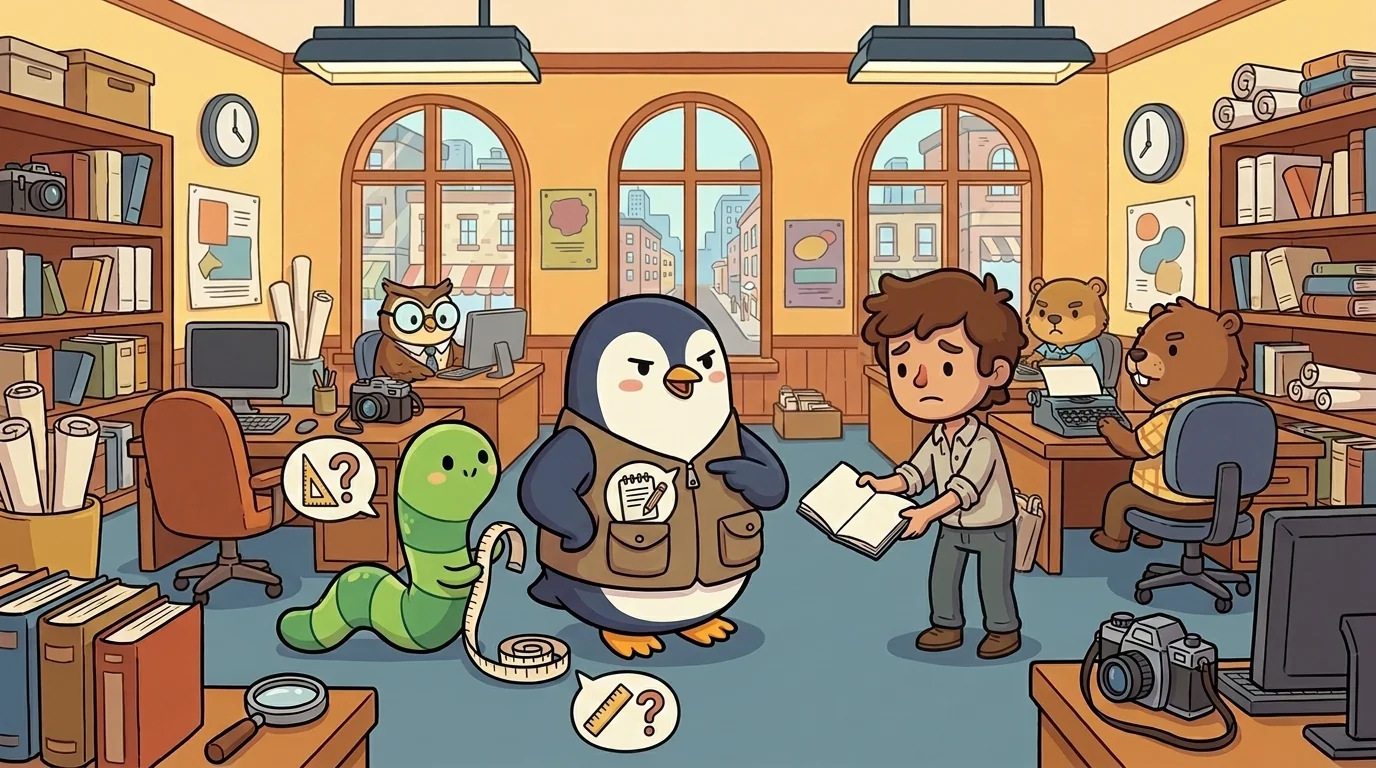
Column went first, because the first leak is opinion wearing a costume.
"Read me your story," Column said, and the reporter read: The council foolishly threw away a shocking 30% of the town budget on the disastrous new fountain. Column tilted her sleek head. "Every fact true?"
"Yes! It really was 30%. It really is a new fountain."
"But listen to the words," Column said. "Foolishly. Shocking. Disastrous. Those aren't facts. Nobody can check 'foolishly.' Those are your opinions — smuggled into a report so smoothly the reader swallows them as facts." She patted her WHAT HAPPENED pocket. "The happened is: the council spent 30% of the budget on a new fountain. Clean, checkable, fair. But you dressed it in foolish and disastrous — your judgment, disguised as news — so the reader ends up thinking the council is foolish and believes they learned it, rather than were argued at. That's leak one: a true fact, poisoned by an opinion in disguise." She looked across at Yardstick. "Strip out the loaded words and you've plugged my leak. But even the clean version — 30% on a fountain — can still mislead. Because there's a second leak, and it's got nothing to do with opinion. That's hers."
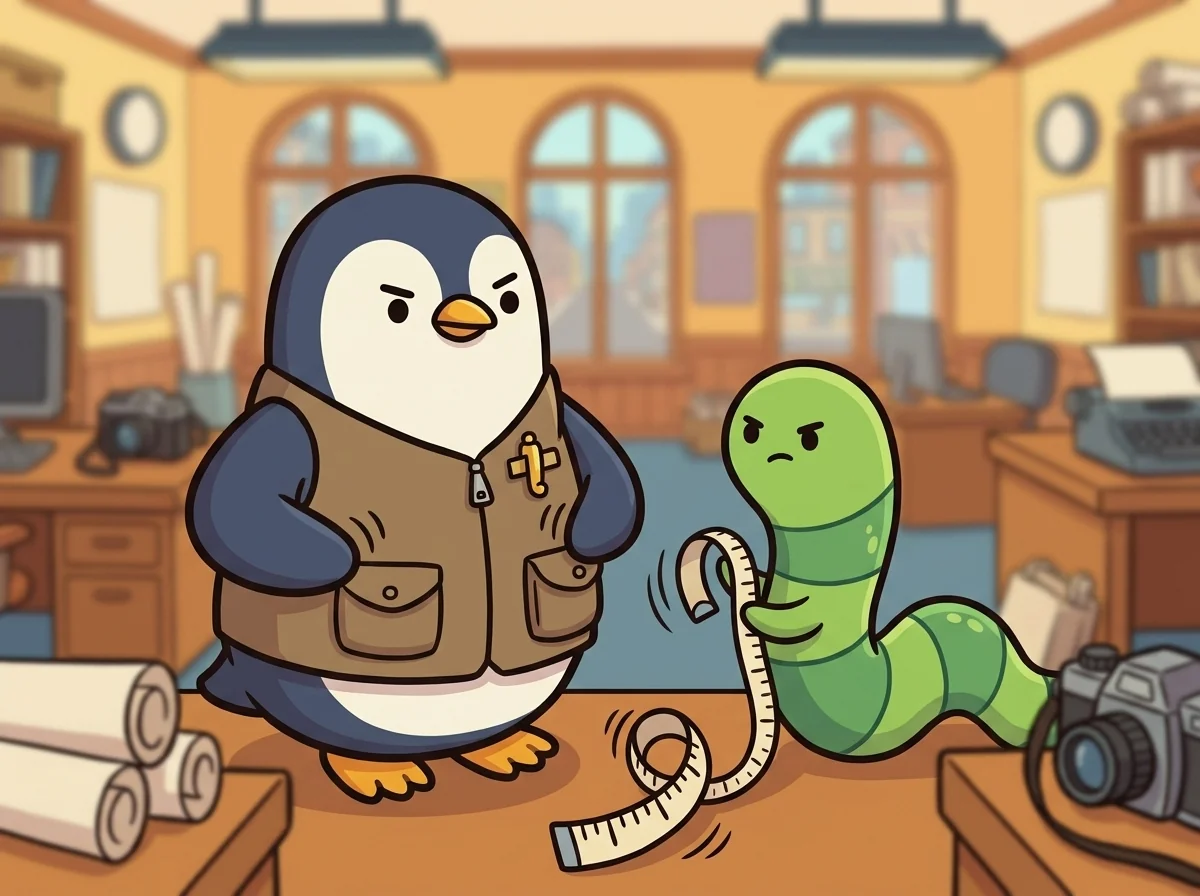
Yardstick took over, tape swinging, because the second leak is a true number with no yardstick.
"Even the council spent 30% on a fountain — all true — can lie," Yardstick said, "if it arrives with no context. 30% — of what? Over how long? Compared to what's normal?" She flipped her cards. "Turns out that '30%' is spread over ten years, it includes the pipes that bring the whole town its drinking water, and the last three towns that built one spent about the same. Suddenly 'threw away a shocking 30%' becomes 'invested in a ten-year water project, in line with what neighbors spent.'" She looped her tape. "The number was true. 30% is 30%. But dropped in bare — no out of what, no over how long, no compared to whom — it told the reader a scary story its own context completely undoes. That's leak two: a true number that misleads by missing its yardstick." She looked at Column. "So even after you plug the opinion leak, the honest-looking clean fact can still fool people if it's got no comparison. You have to plug both."

And then, together, they showed the reporter why true isn't enough.
"So here's the thing that seemed impossible to you," said Column. "A story where every fact is true can still be dishonest — because a fact can mislead in two ways that have nothing to do with being false." She held up one flipper. "Leak one: smuggled opinion. You mix your judgment into the facts — foolish, disastrous — so the reader can't tell where the true part ends and your argument begins. That's mine."
"Leak two: missing context," said Yardstick, holding up her tape. "You drop a true number in bare, with no yardstick, so its real size is invisible and the reader fills in the scariest guess. That's mine." She and Column stood on either side of the reporter.
"And separately," said Column, "you can plug one leak and still mislead through the other. A perfectly opinion-free story —"
"— can lie through a context-less number," said Yardstick. "And a fully-contextualized number —"
"— can lie through a loaded word," said Column. "So true is only the first test. Honest is the harder one — and it means guarding both leaks at once: no opinion smuggled in as fact, and every number carrying its yardstick." She patted her pockets. "That's the difference between a story that's technically accurate and one that actually leaves the reader with a fair, true impression. Your story passed the first test — every fact real — and failed the second, twice: loaded words and a bare number. Both leaks, in one paragraph."
The reporter stared at their own sentence, seeing it now. "So I was telling the truth," they said slowly, "and still not being honest — because I let my opinion in and I dropped a number with no context."
"Now you understand the whole trap," said Column and Yardstick together.

"That's kind of humbling," the reporter admitted. "I was so proud that every fact was true. And that was never the whole job."
Column and Yardstick traded a look, warm now.
"Every fact being true is the floor, not the ceiling," Column said, crisp and kind. "It's necessary — a story with false facts is finished before it starts. But it's not enough, because a fact-checker only catches lies, and the sneakiest misleadings aren't lies at all. They're true things, arranged to leave a false impression." She patted her pockets. "That's why a fact-check alone can't make a story honest. You have to also ask: did I smuggle in my opinion? And did I strip a number of its yardstick?"
"Guard both," said Yardstick, "and you've done the real work — handed the reader the truth clean enough and complete enough to judge for themselves. Which is the whole point. Not to walk them to your conclusion by hiding an opinion or a missing number. To respect them enough to give them the straight, sized, un-poisoned fact — and trust them with it."
The reporter looked from the black-and-white penguin who keeps opinion out of the facts to the inchworm who never lets a number go bare — the two guards of a true-but-honest story — and understood at last that being accurate had never been the same as being fair, and that honesty meant sealing both the leaks a true fact can spring.
And Column and Yardstick felt it settle clean and shared between them — that clicked-together, true is only the first test; honest is the harder one gladness that comes when accuracy and fairness reveal themselves as two different, both-necessary honesties. Column loved keeping the opinion out. Yardstick loved keeping the context in. But what they loved most was this: showing a reporter who thought true-was-enough that the deepest respect for a reader is a fact handed over whole — no judgment smuggled in, no size hidden — so the person on the other end of the page gets to think, clearly and freely, for themselves.
The InkQuest ensemble
Column and Yardstick is part of InkQuest's distributed-narrative cast. Each character embodies a different curricular primitive; together they teach the full subject.
-

Lede
Story-from-data — finding the angle; what's the story under the numbers?
-

Pad
Field-capture + interview craft — open the question; let the answer breathe
-

Crosscheck
Verification + triangulation — three sources say the same thing, now I have something
-

Margin
Data-table + chart-annotation craft — label the axes; caption the chart; credit the data
-

Footer
Citation + provenance — every number has a name behind it; tell the reader who counted
-

Column
Fact-vs-opinion — what happened and what I think about it are two different things; label which is which
-

Dig
Investigative persistence — the first 'no' is where the story starts; keep asking, keep following
-

Errata
Corrections + accountability — when you get it wrong, fix it out loud; a paper owns its mistakes
-

Rejoinder
Fairness + right-of-reply — before you print it, get the other side; everyone named gets to answer
-

Yardstick
Context — a number alone means nothing; compared to what? give the reader something to measure against