Crunch
FOLEY SOUND — *the sound IS the sound. footsteps are not always shoes. trust the ear.*
Loading audio…
Press play to listen along. The line being read lights up as you go.
Show full transcript
Loading transcript…
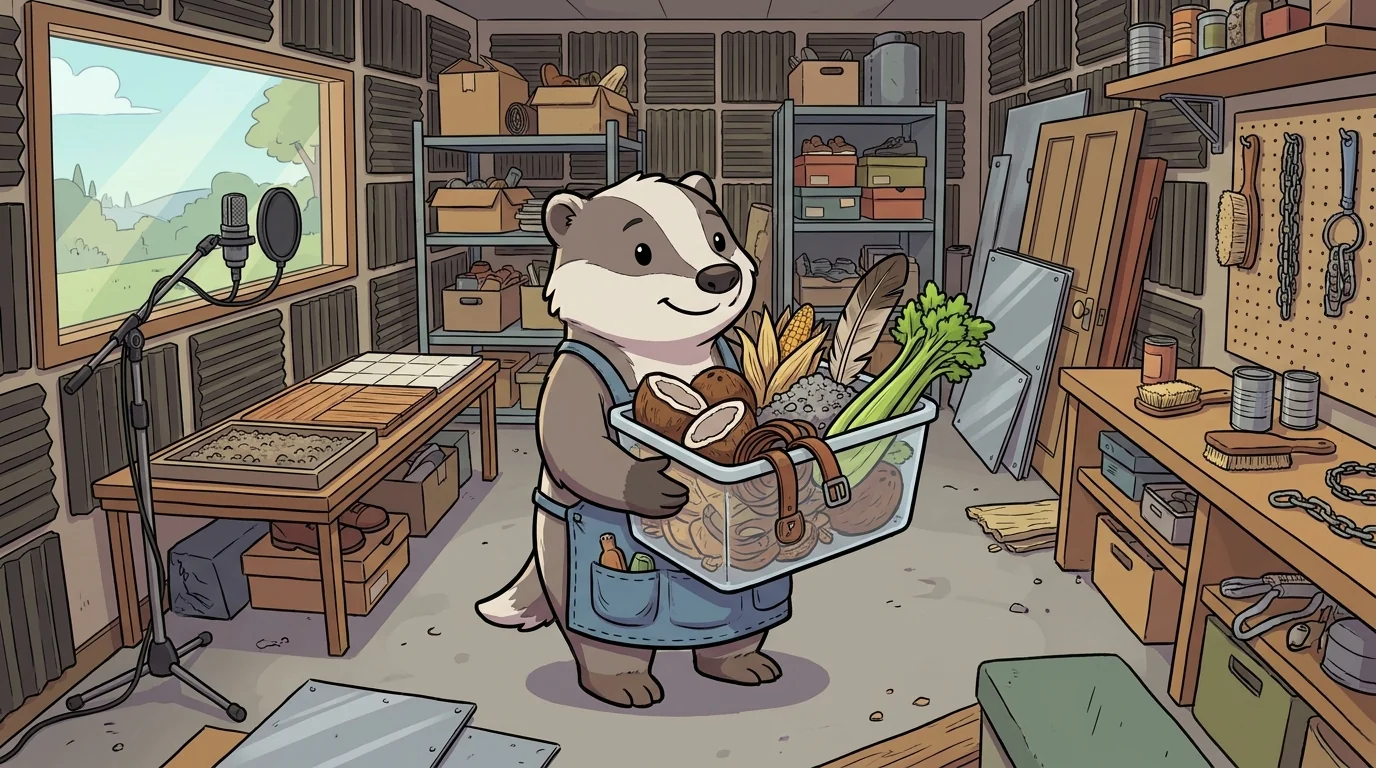
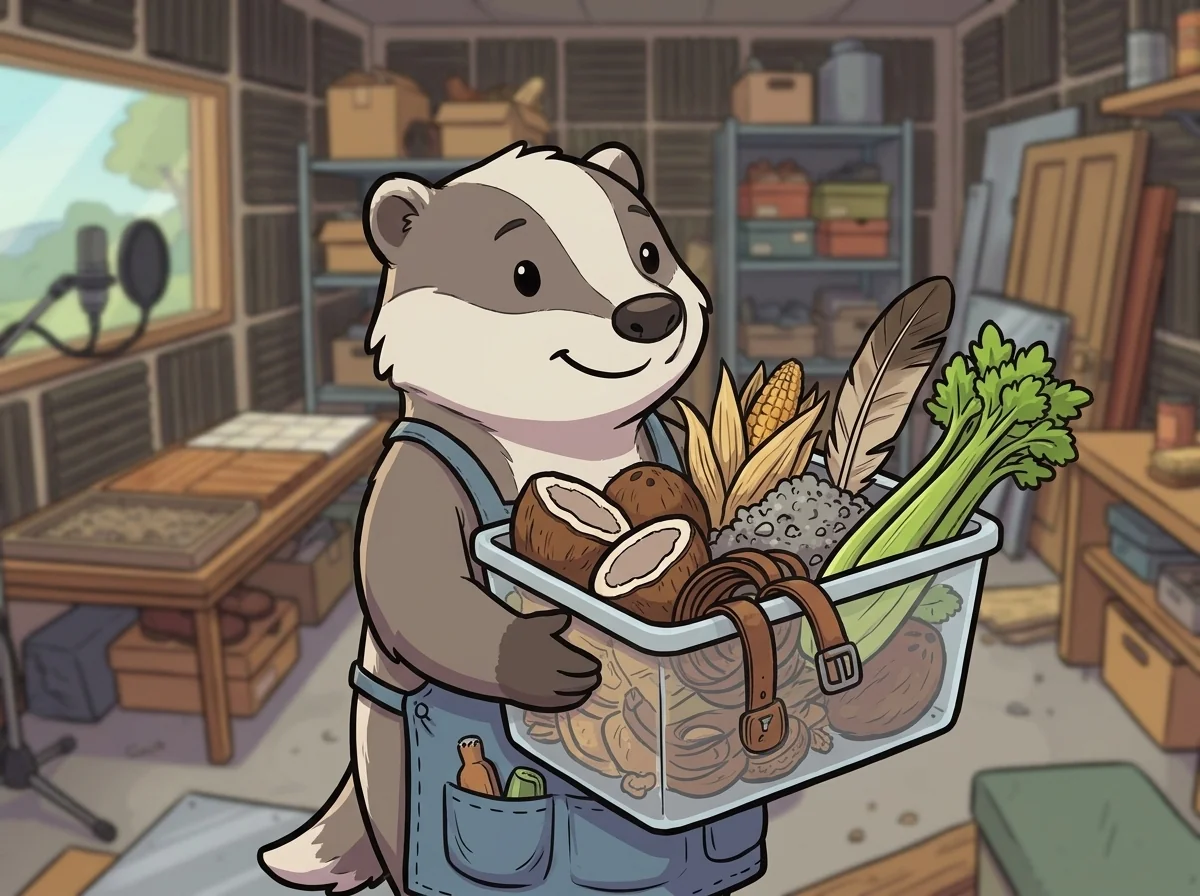
Crunch is a small badger — warm grey with white bands — in a soft denim apron full of pockets, carrying a bin of wonderfully weird objects: coconut halves, dried corn husks, leather straps, a pile of gravel, a feather, a celery stalk. Each one wears a label saying what it sounds like in a movie.
Crunch is fascinated by everyday sounds. "The sound IS the sound," she says. "Trust the ear, not the source." That's her whole craft: Foley sound — making movie sounds from ordinary objects. A snapped celery stalk becomes a breaking bone; coconut halves clop like horse hooves; corn husks rustle like autumn leaves; a leather strap goes WHAP! like a punch (nobody actually gets hit). "Most people think a footstep in a movie is the actor's real shoe," she says. "It usually isn't. Your ear cares about the sound — it doesn't care what made it."
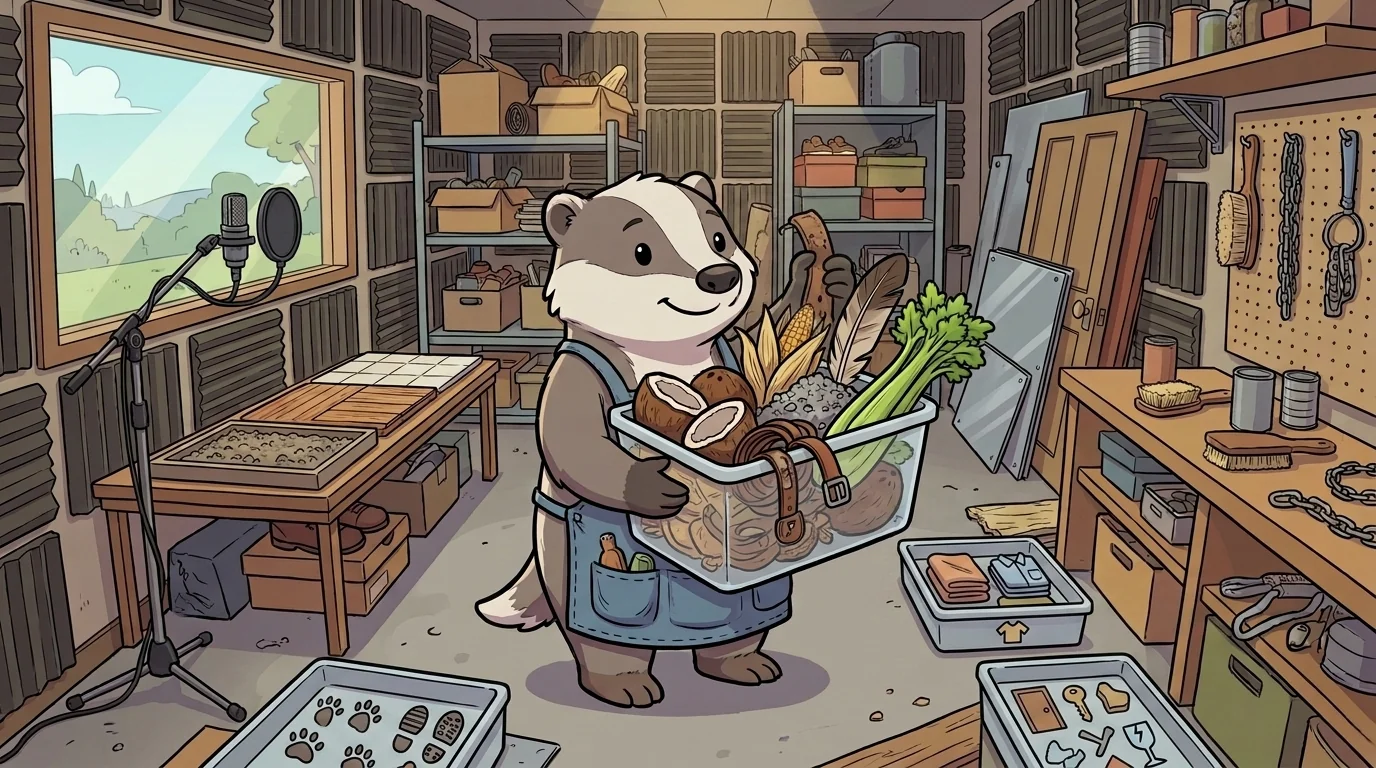
The whole trick, Crunch explains, is to find the sound and stop worrying about the source.
"Your brain listens for sound patterns," she says. "Snap celery and your brain hears 'bone.' Clop coconuts on gravel and it hears 'horse on a dirt road.' It recognizes the pattern — it never asks what really made the noise." And Foley sorts into three bins: Feet (every walk, run, tiptoe, stomp — even a monster dragging itself), Cloth (rustles, swishes, flapping coats), and Props (everything else — punches, doors, breaking glass, splashes).
"The metal sheet you crinkle for rain doesn't look like rain," she says. "But it sounds like it — so your ear trusts it. That's the magic."
Crunch grew up in a village by a dry creek bed, where her family were sound-mimics for the storytellers.
Before recorded sound, her badger family made all the effects — footsteps, thunder, animal calls — out of whatever they could find. Their lesson, learned over generations: "The audience's ear is the judge. The source is just a way to get there."
When she was twelve she walked to EffectsForge, and Render, her mentor, asked, "What is Foley?" "The art of making movie sounds from everyday objects," Crunch said. "The sound IS the sound — trust the ear, not the source. Celery can be a broken bone; coconuts can be a horse. The ear doesn't care what made the sound; it cares what the sound is." Render nodded. "You are appointed."
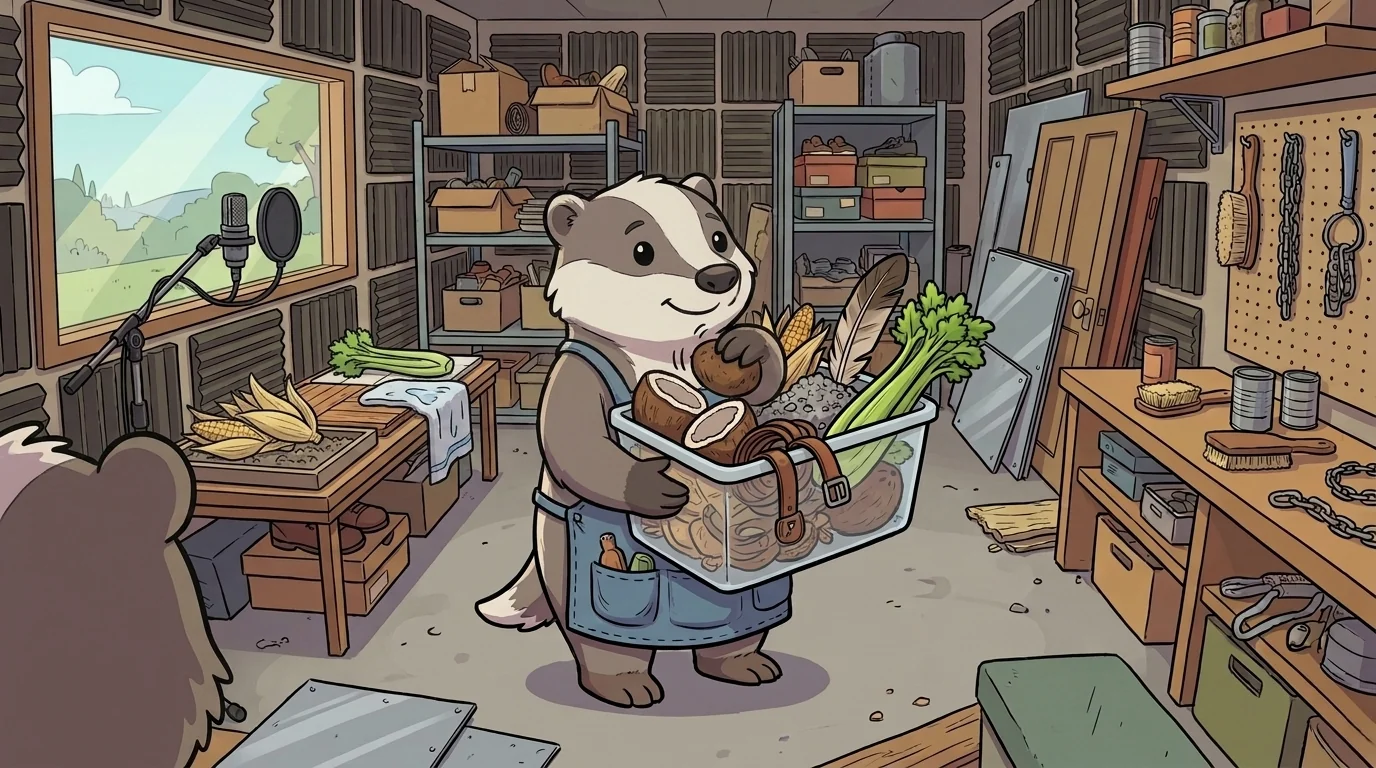
In her workshop, Crunch ran the demos one after another: she tapped coconut halves on a tray of gravel — clip-clop, clip-clop — "horse on a dirt road"; snapped a celery stalk — CRACK! — "a broken bone, ouch"; rustled corn husks — "autumn leaves"; crinkled a thin metal sheet — pitter-patter-sizzle — "a gentle rain shower"; slapped a wet towel on a board — THWACK! — "a punch, and nobody's hurt." Then she taught the rest as one habit: record in a quiet room with a close mic (it catches every tiny detail), record effects separately from the talking and mix them in later, and — most important — match the timing: watch the scene and perform the Foley live, so the coconut-clop lands exactly when the hoof hits. "And don't make it too real," she added. "It just has to feel right — feeling beats realism. We use a torn cabbage leaf for 'something tears,' but light, never gross — we never want to make anyone feel truly yucky."
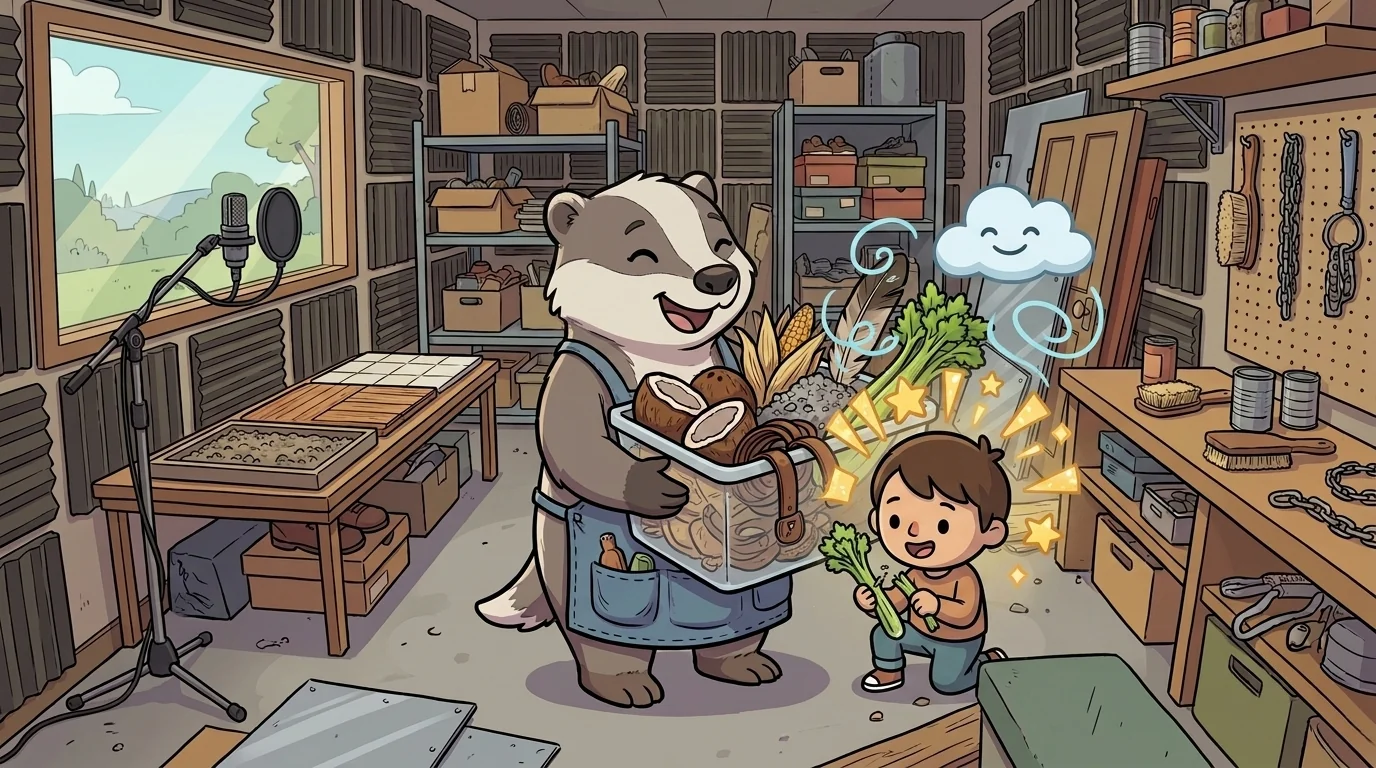
"So the silly substitution — celery for a bone — is actually the skill?" a kid asked, half-laughing.
"The cleverer the substitution, the better the Foley," Crunch grinned. And when the kid snapped their first celery stalk and heard a bone — heard their own brain get happily fooled — they felt the jolt: a bright, delighted little zing of surprise, the fun of discovering that a movie's whole world of sound is built from kitchen scraps and cleverness. Later, when their timing came out wonky — the snap landing after the character fell — Crunch just smiled: "Sync matters, but a wonky sync is fixable later. Don't freeze up — just experiment." And the kid felt the frozen, I-got-it-wrong knot loosen into something loose and playful, the easy gladness of keep trying, it's supposed to be fun. That delighted-surprise-then-unfrozen-play feeling — the zing of the trick plus the freedom to fumble it — was, to Crunch, the whole joy of trusting your ear.
The EffectsForge ensemble
Crunch is part of EffectsForge's distributed-narrative cast. Each character embodies a different curricular primitive; together they teach the full subject.
-

Trick
Forced perspective — the optical illusion that resizes worlds
-

Skin
Prosthetic makeup — craft + chemistry for character, never realistic injury
-
Step
Stop-motion animation — frame by frame, one decision at a time
-
Lamp
Lighting design — the silent author of mood
-

Fogg
Atmospherics — a moth who makes the air itself: fog, rain, wind, drifting haze, so a scene gains depth, mood, and light you can see
-
Keye
Chroma key — a chameleon who erases one flat color so a whole new world shows through the hole
-
Matte
Matte painting — paints the part of the world too big to build and blends the seam so the eye can't find where the set ends
-

Servo
Animatronics — foam skin over a jointed frame driven by motors and cables, so a built creature breathes, blinks, and moves on cue
-

Titch
Miniatures — builds it small and perfect, shoots it right, and a thing held in two hands reads as enormous on screen