Plinth
BASING — a model needs a place to stand. build the little ground, and the figure gains a world, a scale, and a story.
Loading audio…
Press play to listen along. The line being read lights up as you go.
Show full transcript
Loading transcript…
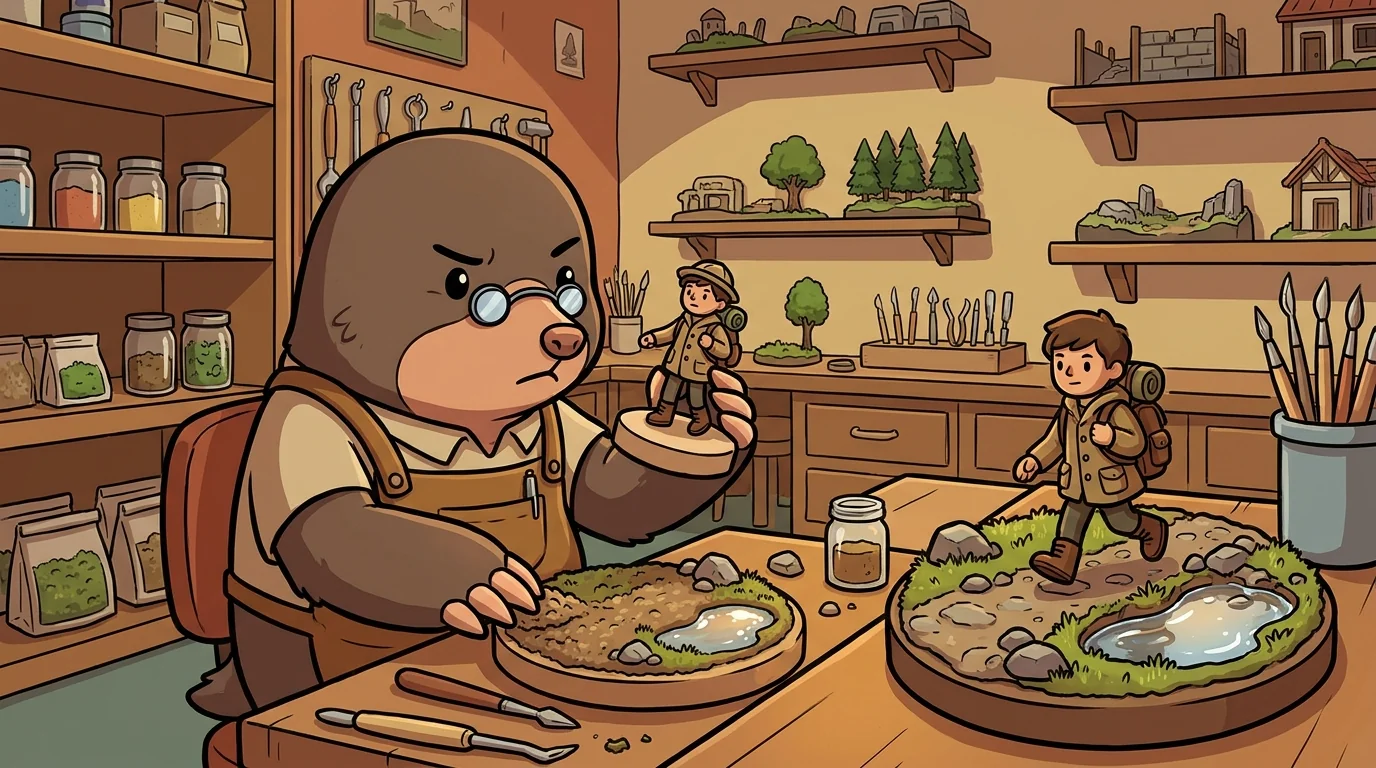
A mole-tween named Plinth held up a beautifully painted little explorer — flawless boots, perfect coat, brave face — and frowned, because the explorer was glued to a bare, blank disc of wood and looked, somehow, wrong.
"That mini is amazing," said a shrew-kit. "What's the problem?"
"She's nowhere," said Plinth. "Look at her. Perfect explorer, standing on a flat white nothing. She's floating." He set the disc down and, with quick fingers, began to work: a smear of textured paste for earth, a scatter of tiny stones, a few tufts of static grass, one small dab of pooled 'water' catching the light. He pressed the explorer's boots into it as it set.
When he lifted her again, everything had changed. The explorer wasn't floating anymore — she was standing, mid-stride, on a rocky trail beside a puddle, as if she'd just walked out of a whole world. She had somewhere to be.
"There," said Plinth, satisfied. "Same paint on the figure. But now she has ground under her feet. A place. A scale — see how the little stones make her feel person-sized?" He tapped the base. "Everybody pours their heart into the figure and forgets she has to stand somewhere. The base isn't leftover space. It's the world the hero lives in. Give her that, and she stops floating and starts to belong."
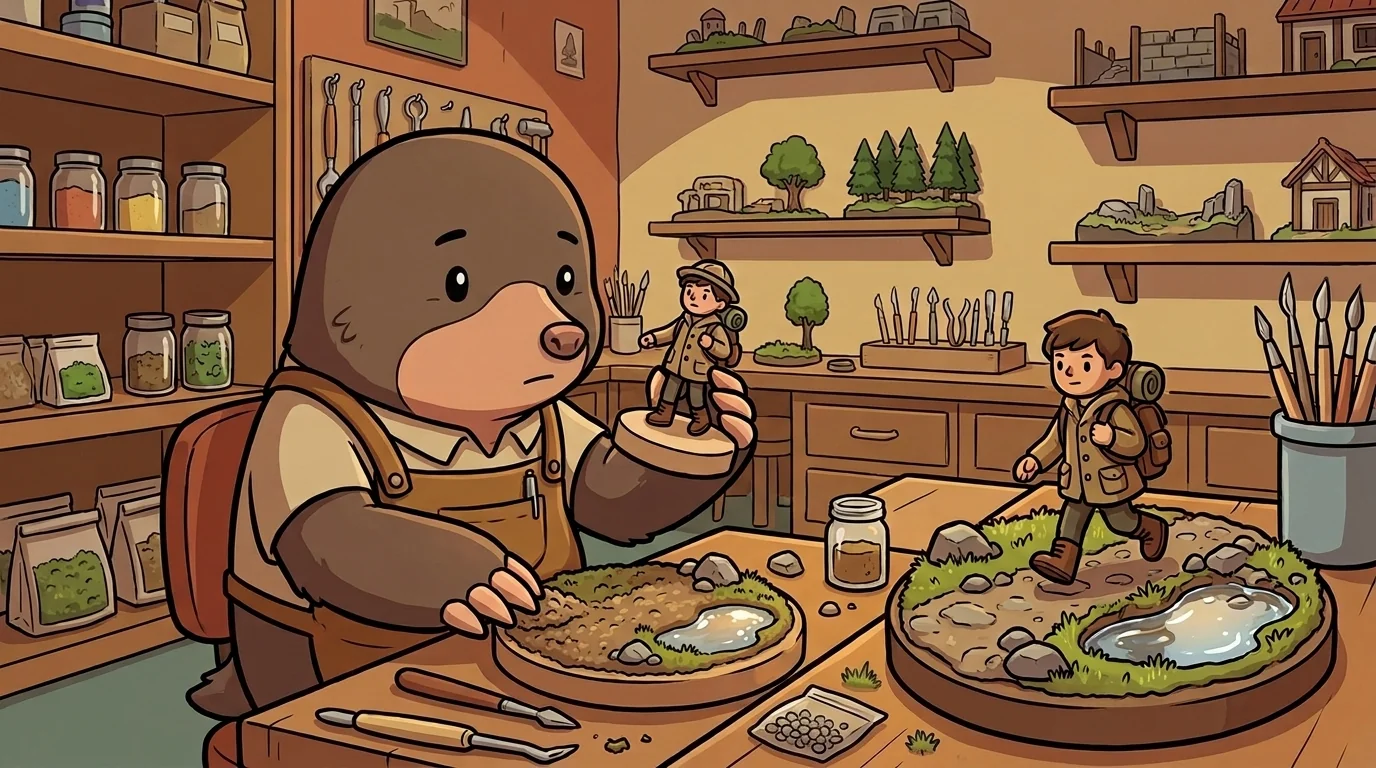
Plinth had learned the worth of good ground down in the dark, where his family dug.
They were tunnel-makers and burrow-shapers, and small Plinth thought the glamorous work was the grand central den — the big open room. He didn't see the point of all the fuss his father made over floors and footings and packing the earth just so.
Then one wet season a hastily-dug neighbor's burrow collapsed, and everyone crowded into Plinth's family's tunnels — which held, dry and solid, because of all that unglamorous fuss over the ground. His father caught him staring at the packed, careful floor.
"Nobody praises the ground," his father said. "They praise the room. But the room only stands because of what's under it." He pressed his paw flat to the solid floor. "Everything that matters needs a good place to stand. A den, a family, a life, a story. Build the ground with care, and everything you put on it feels safe and real. Skip the ground, and the finest thing in the world is just... floating, waiting to fall."
Plinth put his own paw to the floor, and felt how solid it was, and understood at last that the ground he'd thought was boring was the thing holding up everything he loved.
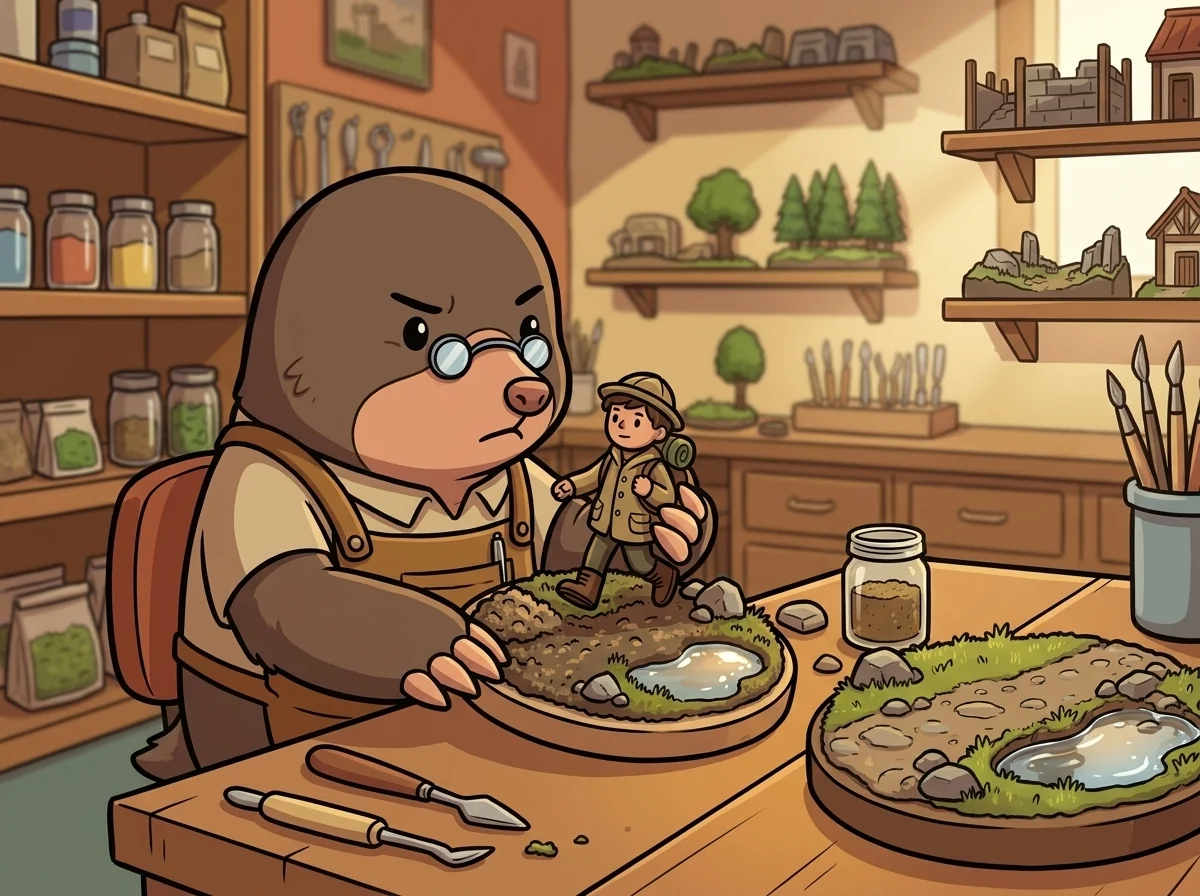
He climbed up to CraftForge because a place full of beautiful figures needed someone who cared where they stood.
Iris, the mentor, met him at the door and asked a single question. "What is basing?"
Plinth didn't answer in words. He took a lovely but lonely little knight, glued to a blank disc, and in a few minutes gave him a world: cobblestones pressed into paste, a tuft of weeds in a crack, a scatter of fallen leaves, the faint gleam of damp. He pressed the knight in and handed him back, now standing guard on a rainy street corner.
Iris turned it slowly. "You didn't touch the knight at all."
"Didn't need to," said Plinth. "The knight was finished. What he was missing wasn't paint — it was a place. A base gives him ground, and scale, and a hint of where he's been. Suddenly he's not a toy on a disc. He's a person, somewhere, in the middle of a story." He nodded at the little rainy corner. "I build the world under their feet, and they come alive standing in it."
Iris studied the knight on his rainy corner for a long moment. "You belong here," she said.
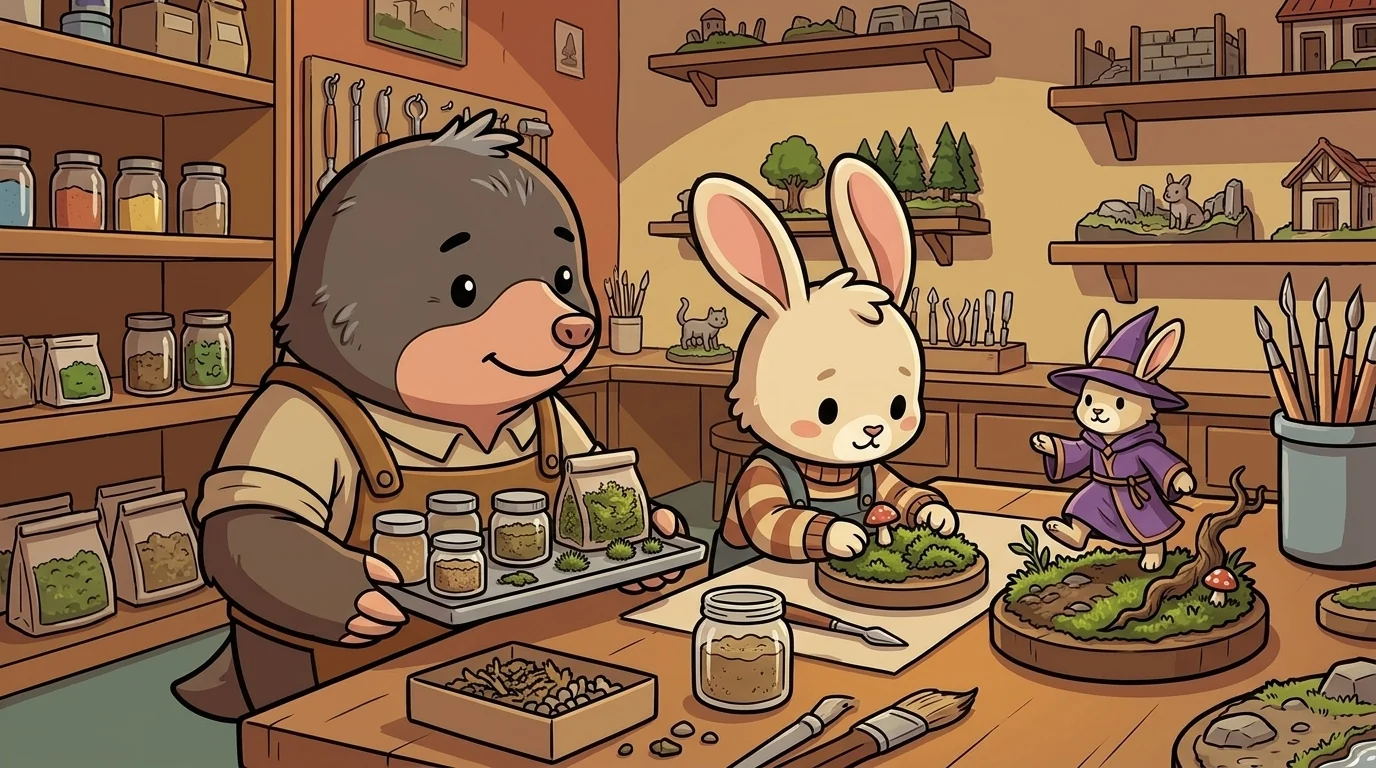
Plinth's corner was where the floating figures came — perfect minis stranded on empty bases, and no one could say why they felt unfinished.
A rabbit-kit set down a gorgeously painted wizard on a bare black disc. "Everyone says he's my best one ever," she said, "but he feels... fake. Like a sticker. I can't figure out why."
"Because he's standing on nothing," Plinth said gently. "He's a wizard from nowhere, in no weather, at no time. Let's give him an afternoon." He handed her paste, sand, a few dried bits, a scrap of moss. "Build him a patch of forest floor. Doesn't have to be big — a little dirt, a root, one mushroom. Just enough that his boots have somewhere to be."
She built it, hesitant at first, then absorbed — pressing in earth, tucking a tiny root by his heel, settling a speck of a mushroom in the moss. When she stood the wizard in his little forest patch, she gasped.
"He's real now," she said. "He's walking through a wood. You can almost smell it."
"There it is." Plinth's eyes shone. "Nothing about the wizard changed. But now he has ground, and the ground gives him a whole world — where he is, what season, what he might be doing. The base did that. The base is half the story, and it's the half everyone forgets." He tapped the little mushroom. "Give a thing a place to stand, and it stops being a figure and starts being a moment."
The rabbit-kit turned her wizard in his forest, and couldn't stop smiling.
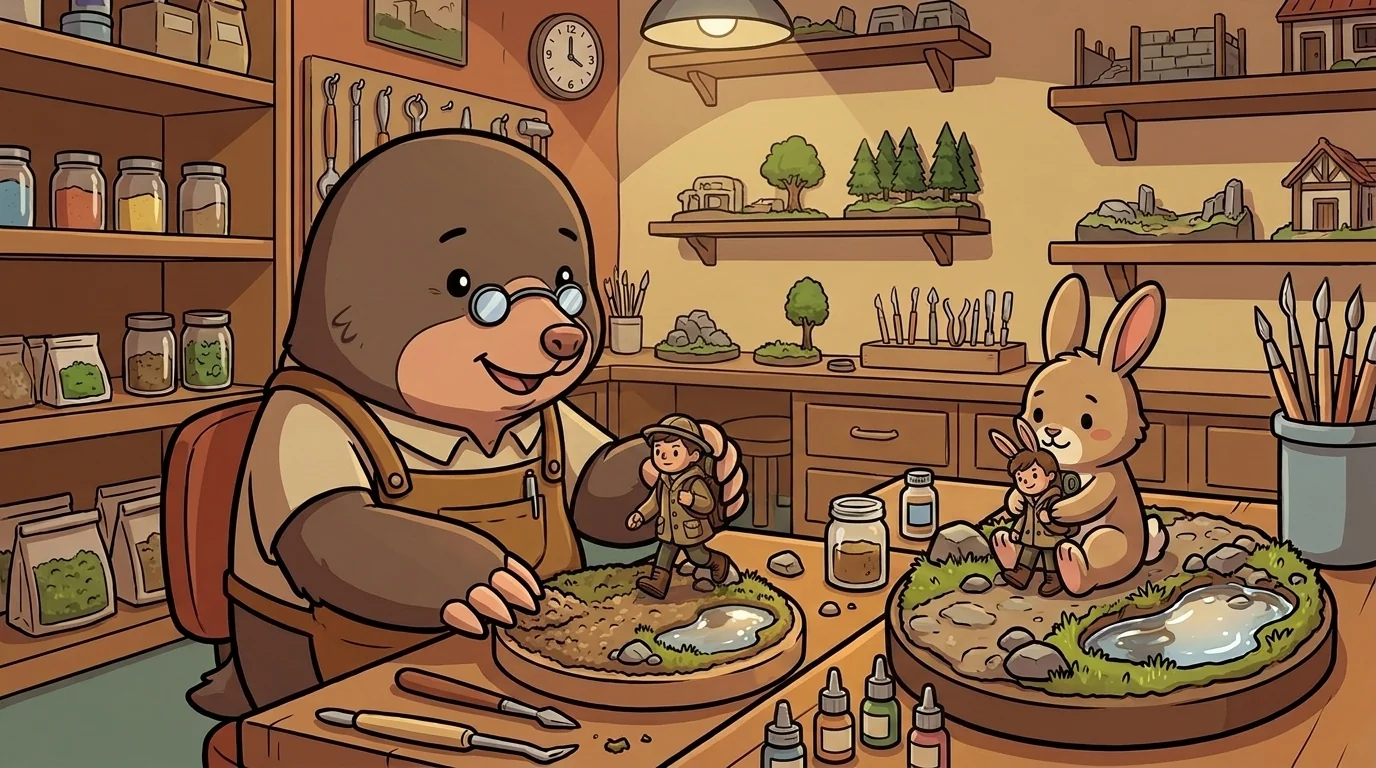
Later, when the corner had emptied, the rabbit-kit stayed, cradling her grounded wizard.
"It's funny," she said. "I spent weeks on him and it was the dirt that finished him. The least fancy part. Why does the ground matter that much?"
Plinth thought about the collapsed burrow, and his family's floor that held, and his father's paw pressed flat to the solid earth.
"Because nothing wants to float," he said. "Not a figure, not a story, not a person. There's this deep, settled steadiness that comes over me when I press a mini's boots into ground I've built for it — a warm, rooted, there-you-are feeling, like tucking something in somewhere it's safe to stand." He smoothed a thumb over the little forest floor. "Everything's better with ground under it. The fanciest thing in the world still needs a plain, careful patch of earth to belong to. Build the ground with love, and whatever you set on it finally comes home."
The rabbit-kit pressed her wizard a little firmer into his forest, and looked, for a moment, as grounded as he did.
The CraftForge ensemble
Plinth is part of CraftForge's distributed-narrative cast. Each character embodies a different curricular primitive; together they teach the full subject.
-

Sand
Surface preparation — the patient pangolin-elder who treats priming as the invisible foundation everything else stands on ('ready surface first; the paint listens to the surface')
-

Dab
Basecoat + wash — the confident vole-tween of broad strokes who treats basecoats as the loud first hello and washes as the quiet shadow-finder ('big shapes first, shadows fall second')
-

Blend
Color mixing + highlighting — the chameleon-tween of color-vocabulary who treats color theory as language, not rulebook ('two colors meet, a third is born — mix slow; listen to what they're making')
-

Coat
Layered application + varnish — the steady badger-tween who treats every coat as deliberate next-stratum patience ('layer waits for layer; patience is the secret pigment')
-
Tip
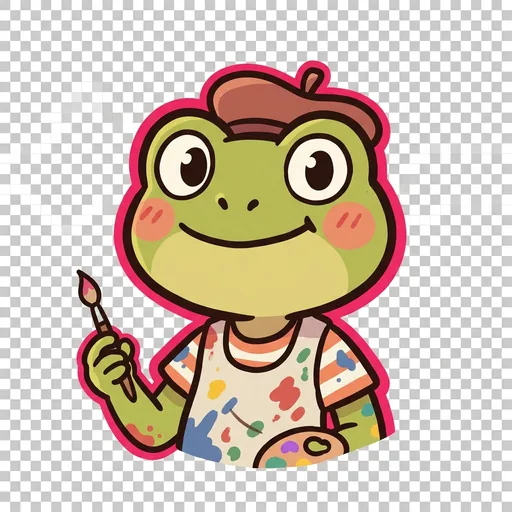
Fine detail + freehand — the relaxed treefrog-tween of fearless small-brush play who carries the cluster's perfectionism-gate anchor ('tiny brushes, loose wrist — wobbly is fine; the eye fixes it from arm's length')
-

Bristle
Dry-brushing — take the paint away, then the little that's left catches the raised edges
-

Chequer
Pattern work — find the one small unit, then repeat it faithfully; the pattern lives in the repeat, not the piece
-
Patina
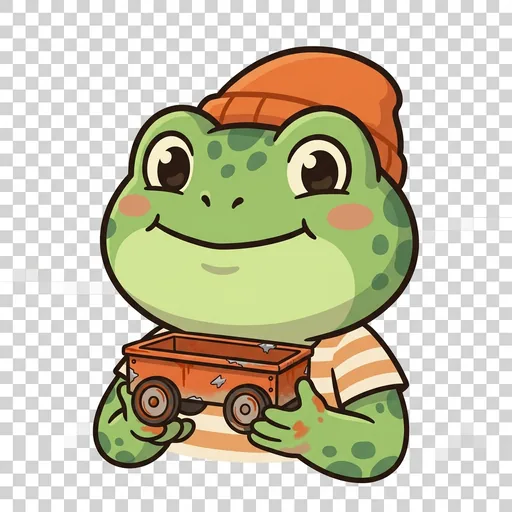
Weathering — a too-clean model looks fake; add the marks of use (rust, chips, dust, wear) and it earns a history
-

Prism
Color harmony — colors don't work alone; put opposites side by side and both catch fire, keep the family warm or cool so it sings