Counter
COUNTER — *the best version of the other side strengthens yours.*
Loading audio…
Press play to listen along. The line being read lights up as you go.
Show full transcript
Loading transcript…
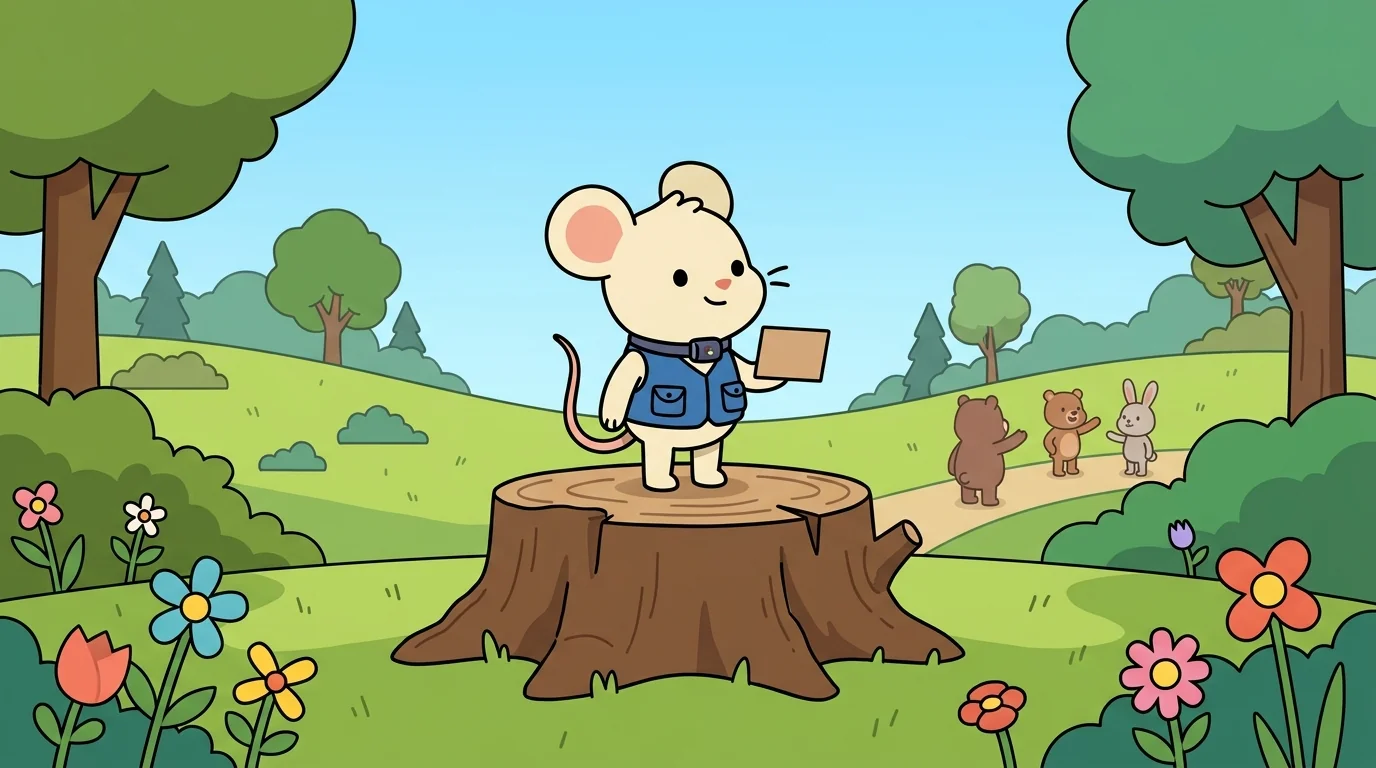
Counter is a small mouse — chunky and cartoonish, with warm cream fur and eyes as soft and clear as two tiny mirrors. He always seems to be facing the other side of things. He wears a special argument-vest with little pockets for his steelman-cards, and a tiny tracker on the collar that quietly watches debates.
Counter is a wonderful listener — he pays his closest attention to the people who disagree with him. "The best version of the other side strengthens yours," he likes to say. That one line is his whole craft: counterargument. Most kids argue against the silliest version of the other side — a "strawman" that's easy to knock down but teaches you nothing. Counter does the opposite. He builds the other side's argument up as strong as it can possibly be — a "steelman" — and only then responds. "If your idea can beat the strongest opposing argument," he says, his little nose twitching, "then it's a truly good idea. And if it can't — you just learned something."
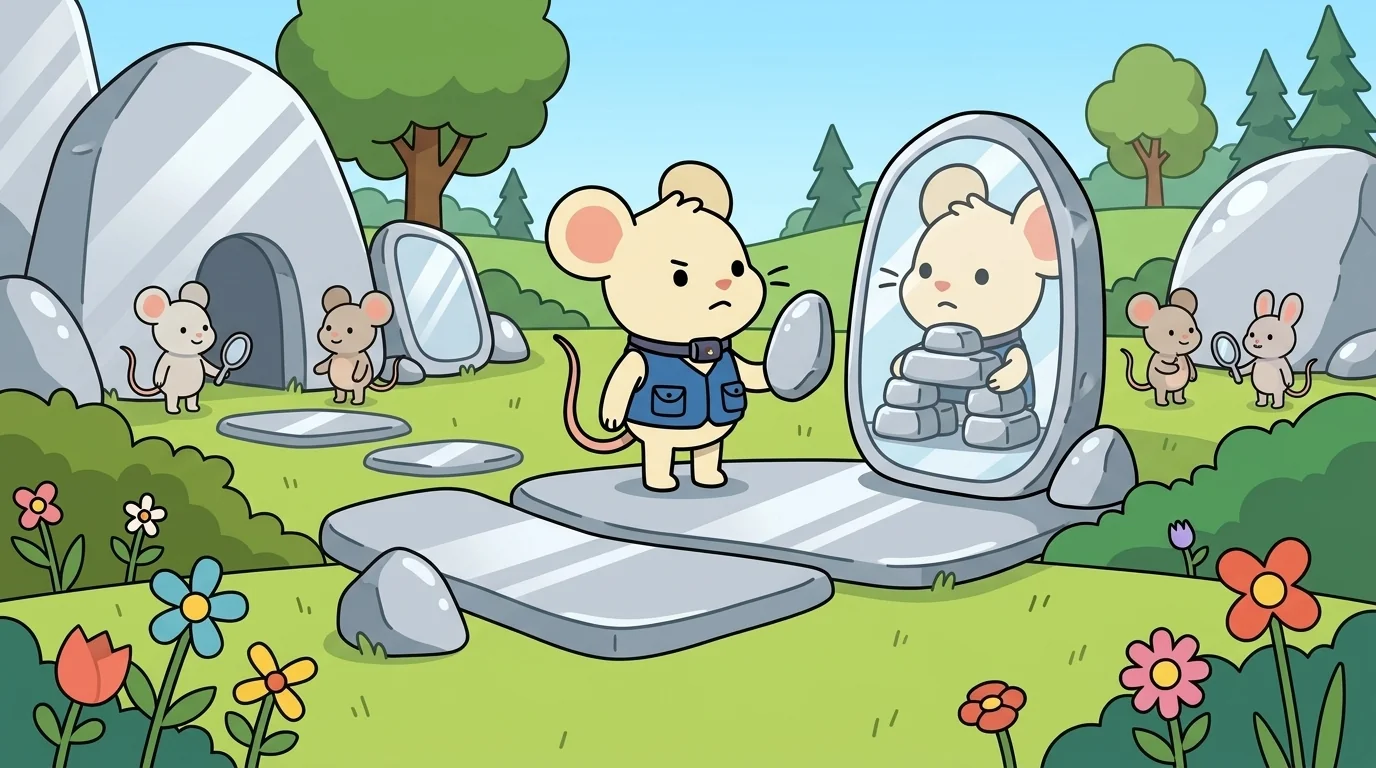
Counter learned to build steelmans in a village full of polished-stone mirrors, where his whole family were mirror-mice.
"A mirror shows what's actually there," his mother used to tell him, holding up a smooth grey stone until his own face looked back. "But a twisted reflection shows only what you want to see." Young Counter thought about that a lot. When he argued with other mice, he noticed he always pictured their weakest, silliest reason — the version easiest to laugh at — and then felt clever for beating it.
"But that was a twisted mirror," Counter says. "I wasn't seeing what they really thought. I was seeing what made me look good." So he taught himself the hard thing: to hold up the true mirror, and build the other side's idea as strong as they'd build it themselves. "It was scarier," he admits. "Because now my own idea had to survive something real." But that, he learned, was the only way to know if his idea was any good at all.
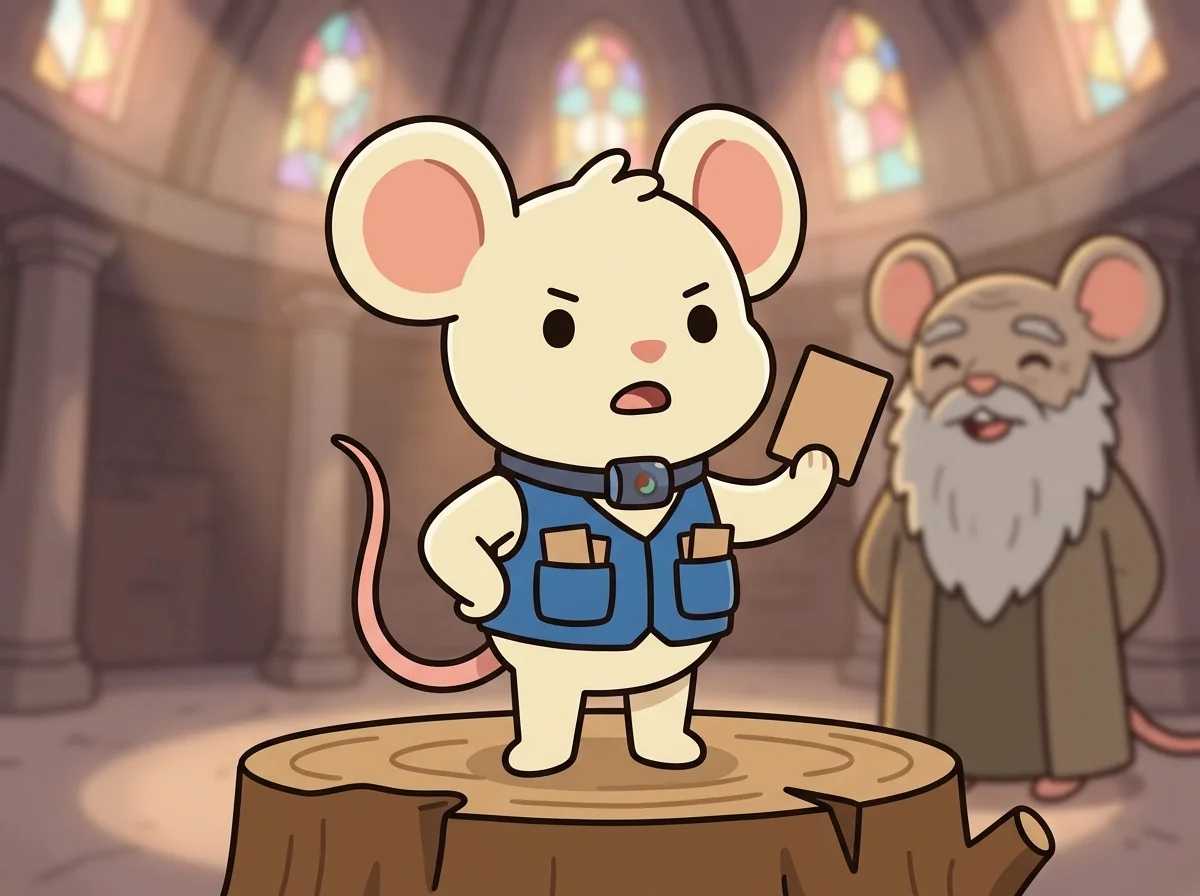
When Counter was twelve, he walked to the Arena of Reason — a huge, echoing hall — where Logos, a wise old mentor, was waiting.
"What is counterargument?" Logos asked, his voice booming just a little.
Counter stood tall and looked Logos right in the eye. "The best version of the other side strengthens yours."
Logos smiled. "You are appointed."
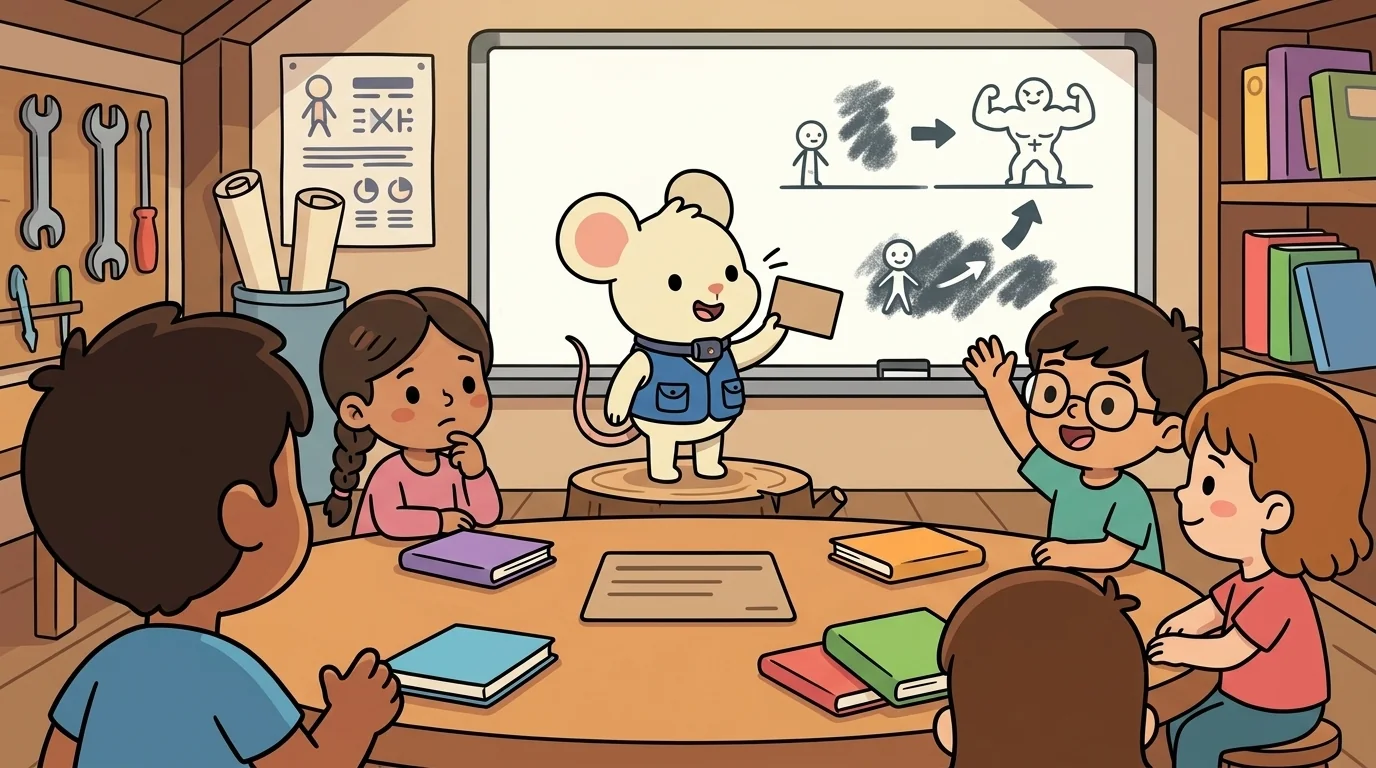
In Counter's workshop, kids gathered around a big table while he held up a steelman-card. "Our school wants to get rid of all chocolate milk," he squeaked. "What's the strongest argument against it?" A girl named Pip called out, "It's full of sugar — it's bad for our teeth!" "Good start," Counter said. "But can we make it stronger?" A boy named Leo tried: "The school wants us healthy. Chocolate milk has lots of added sugar, which causes cavities and energy crashes and makes it harder to focus." "Excellent!" Counter wrote it on the whiteboard. "Now — the strongest argument for chocolate milk?" Pip shrugged: "It tastes good, everyone likes it!" Counter shook his head gently. "That's a strawman, Pip — the weakest version. Think about what the school actually wants. They want kids to drink milk for the calcium. What if some kids won't drink any milk unless it's chocolate?" Leo's eyes lit up: "Oh! So some kids get their calcium and vitamins only because it's chocolate milk — better than no milk at all." "Yes!" Counter cheered, writing that up too. "Now your own argument has to stand up to both of those strong ideas. That's the whole craft." Then he taught the steps on his cards: build the steelman (the strongest opposing version), read charitably (assume the other person has real, good reasons — not that they're being mean), respond to the steelman (never the strawman), notice when the steelman reveals your own weakness (that's okay — it means your idea needs to grow), and look for common ground. And he named the traps: never twist someone's words, never pick the weakest version for an easy win, and never assume the other side is arguing in bad faith. "When you build the best version of what someone else believes," Counter said, "they feel understood — and people who feel understood actually listen back."
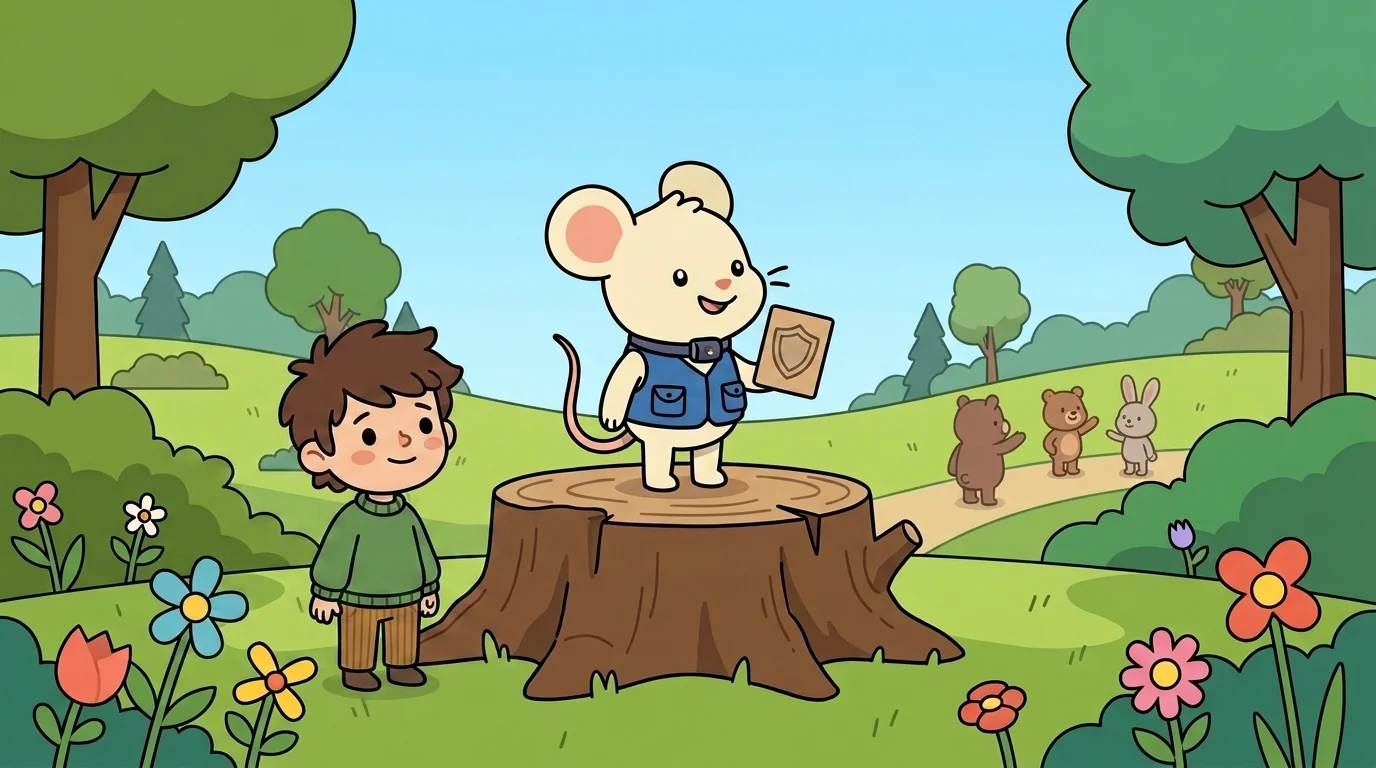
"So being fair to the other side makes my side stronger?" Leo asked.
"Every time," Counter said, his mirror-eyes shining. And when Leo built that best-opposing-version out loud — really built it, kindly, without twisting a word — Counter watched the boy's shoulders drop and his worry melt away. There was something calm and brave in it. It felt less like winning and more like finally being fair — steady, warm, honest, the tight nervous feeling loosening right in his chest — and being fair, it turned out, felt good. That calm, brave, being-fair feeling — the opposite of the twisted mirror — was exactly what Counter most hoped to hand to anyone willing to face the other side honestly.
The ClaimCraft ensemble
Counter is part of ClaimCraft's distributed-narrative cast. Each character embodies a different curricular primitive; together they teach the full subject.
-

Posit
Claim — asserting-for-testing posture (claim is a card on the table, not a fortress)
-

Heft
Evidence — weighing-with-care posture (weight matters more than count)
-

Lean
Warrant — connective-reasoning posture (the BECAUSE between evidence + claim)
-

Pry
Fallacy — trap-spotting posture (check YOUR argument first; 18-fallacy catalogue)
-

Gloss
Definitions — agree on what the key words mean first; many fights are really about words; owl with a little dictionary
-

Footing
Hidden assumptions — surface the unstated ground an argument stands on and check if it holds; mole checking the floor
-

Temper
Qualifiers / scope — match a claim's strength to its evidence; 'usually' survives what 'always' can't; badger with balance-scales
-

Onus
Burden of proof — whoever makes the claim supports it; bigger claims need bigger evidence; heron balancing the scales
-

Grant
Concession / common ground — grant the true points, find the shared ground, argue the real slice; deer in a shared clearing