
Grid
TILEMAP GRID — *pixels snapped to repeating tiles. tiles repeat; tilesets compose; maps emerge.*
Loading audio…
Press play to listen along. The line being read lights up as you go.
Show full transcript
Loading transcript…
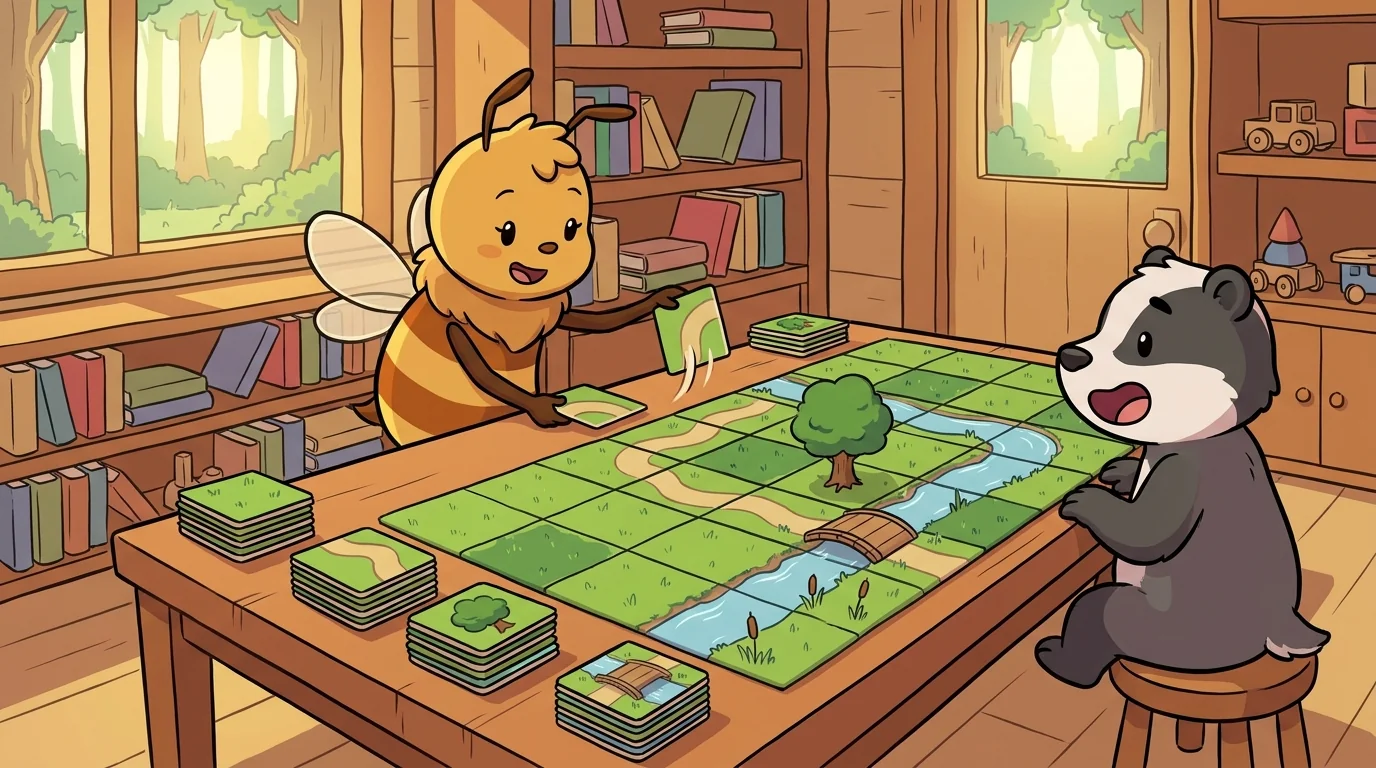
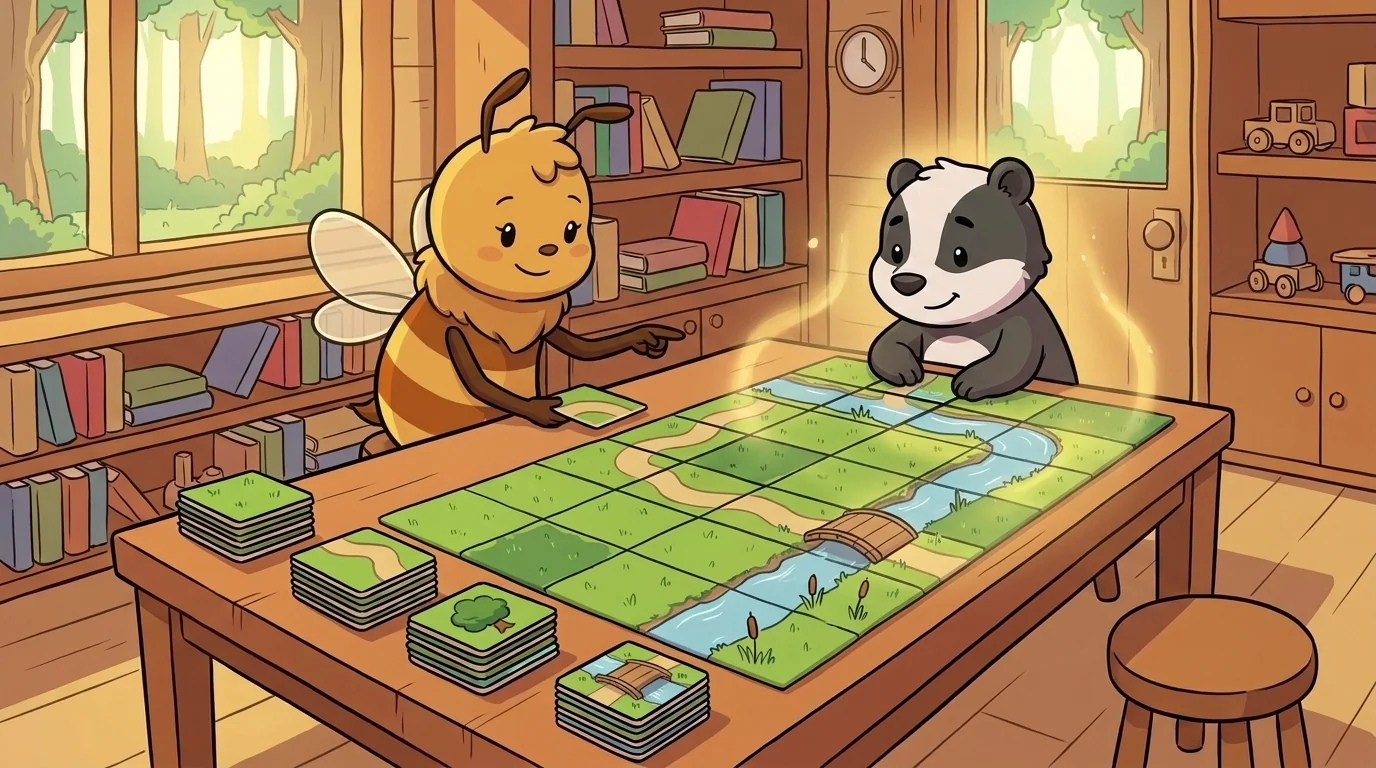
Grid worked the grid the way her grandmother had worked the comb — one cell at a time, snapping each square down until its edges vanished into the ones beside it. She was a honeycomb-bee-tween, amber and soft black, and her workshop table was ruled into a faint checkerboard of empty squares. She laid a card of green grass into the top-left cell. Then another beside it. Then a card of dirt path, angled just so, and the path continued into the next square without a seam. Grass, grass, path, grass — her small hands moved fast, and a meadow crept across the table where a moment ago there had been nothing but ruled lines.
"There," she hummed, stepping back. A forest edge had grown out of maybe a dozen little cards, each one used again and again. She turned one grass card face-up so you could see it was ordinary, plain, unremarkable — and then pointed at the meadow it had built forty times over. That was the whole trick, and she never got tired of watching someone's eyes widen when they noticed.
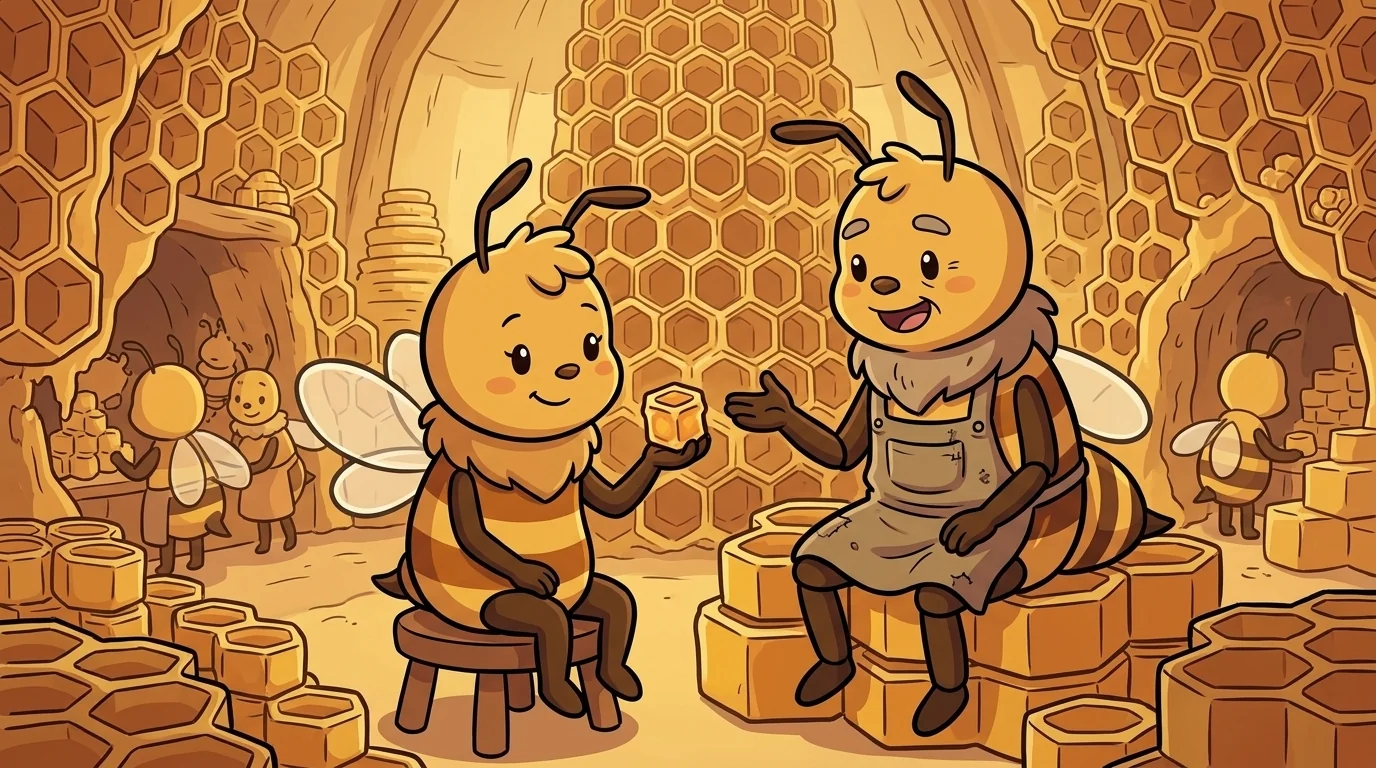
The workshop was quiet in the mornings, and the mornings were when Grid remembered the hive.
She had grown up inside walls the family built by hand — not painted, not sculpted, but tiled, hexagon fitted against hexagon until a wall became a room and a room became a home. Her grandmother, old Comb, would hand her a single fresh cell of wax and say, "Look at it. Just this one. Now imagine ten thousand of it." And young Grid could never imagine ten thousand of anything. It was too big. Her chest would go tight the way it did before a test she hadn't studied for.
So Comb showed her instead. She set one hexagon down. Then fitted a second to its edge, so the two shared a wall and wasted nothing. Then a third. "You don't build ten thousand," Comb said. "You build one, well. Then you reuse it." By the third cell Grid could see the fourth already, and the tenth, and somewhere far ahead the whole warm curving wall of the storeroom. The tightness in her chest loosened into something else — a hum, low and steady, that felt like the wall was building itself and only needed her hands to keep up.
That hum never left her. Years later, when she first saw a game map — a forest, a river, a winding road, all of it stretching further than any single artist could ever draw by hand — she did not feel overwhelmed. She looked closer. And she saw the seams. She saw where the same patch of grass repeated, where the same stretch of water tiled across the shallows. The map wasn't drawn. It was built, the way the hive was built. And Grid laughed out loud in the middle of the arcade, because she already knew how.
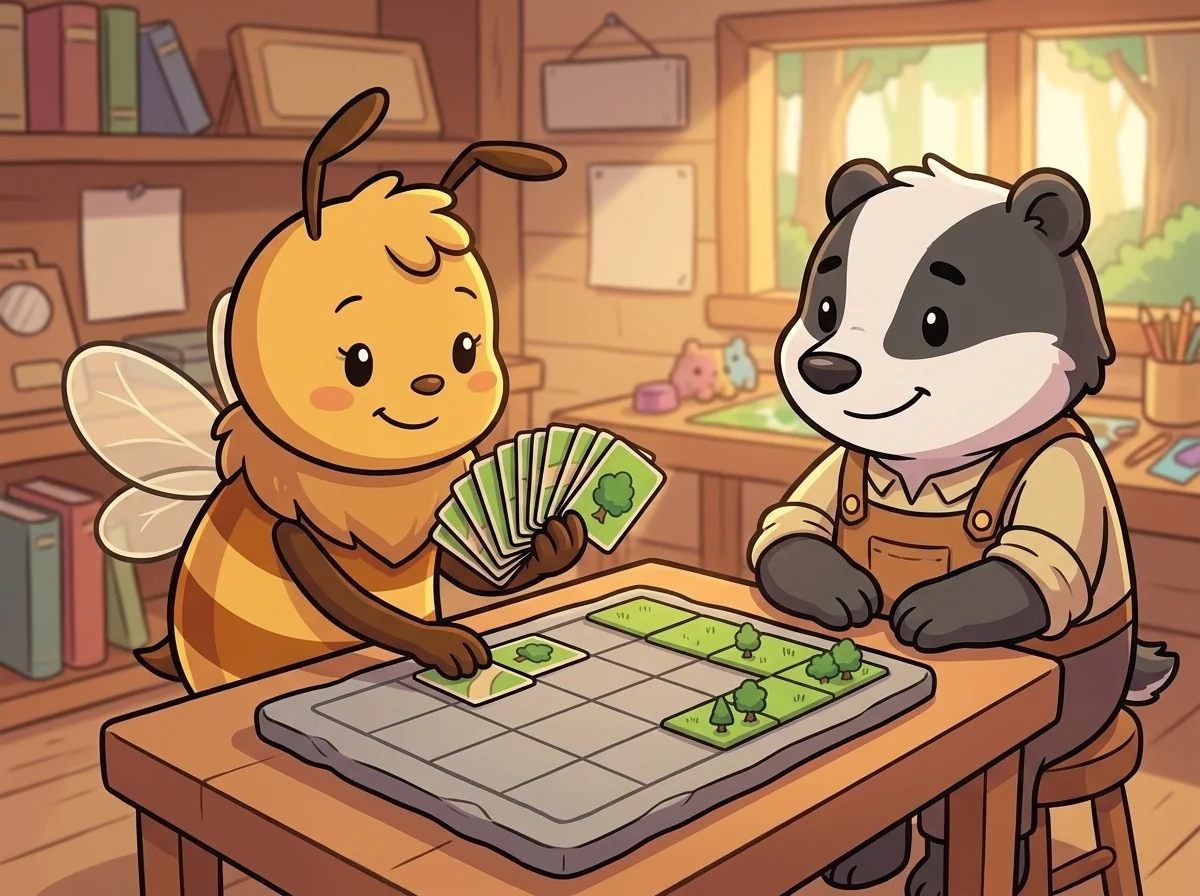
She came to PixelForge with nothing but her deck of tile-cards and the hum in her veins.
Palette, the academy's founder, watched from a stool in the corner of the entry hall — she watched everyone, they said, before she said a word. Grid didn't ask permission. She found an empty ruled board on the demonstration table, knelt, and began.
She had thirty-two cards. She laid grass across the low ground, snapped a river through the middle so its banks met the grass without a line, bridged the river with a single card, ran a path off the bridge, and lined the far ridge with trees. When the water at one edge looked too samey she swapped in a rippled variant, and a duller grass tile here and there so the meadow didn't gleam like a checkerboard. A whole valley — a river, a crossing, a road home — grew under her hands in the time it took Palette to finish her tea.
Palette set the cup down. She looked at the valley, then at the thirty-two cards, then at Grid. "How many pictures did you draw," she asked, "to make all that?"
"None," Grid said. "I drew thirty-two. I used them a few hundred times."
Palette's slow smile spread like fresh paint. She pulled a spare stool to the demonstration table and pushed it toward the girl. That was all. Grid had her workshop.
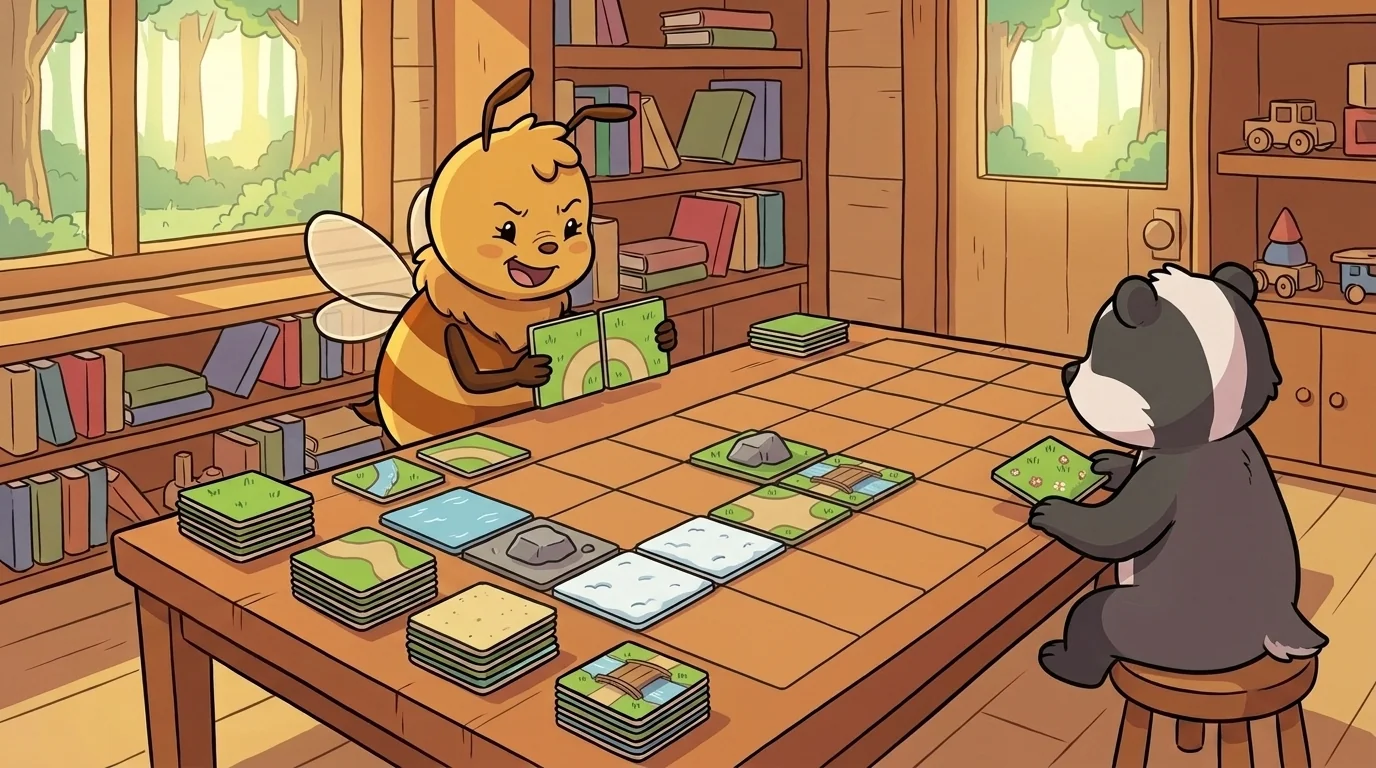
Students found their way to her table because the valley kept appearing there, always different, always from the same little deck.
"But it repeats," a boy named Sol complained one afternoon, arms folded. "Won't everyone see the same grass over and over? Won't it look cheap?"
Grid didn't argue. She handed him three grass cards. "Lay them," she said. He did — three identical squares in a row, and yes, they looked like wallpaper, obviously copied. "Now." She swapped the middle one for a variant, a shade brighter, freckled with tiny yellow flecks. Then she tucked a fallen-leaf card into the corner of the third. Sol tilted his head. The row didn't read as repeated anymore. It read as a field.
"Same amount of squares," Grid said. "You just gave the eye somewhere to rest that isn't the copy." She called that little rule breaking the sameness — enough variety to hide the reuse, never so much that you were back to drawing everything by hand.
Then she reached across and set a water card where his path had been. "Try to walk there," she told him.
"I can't. It's water."
"Right. So your grass isn't only pretty — it's a floor. Your water isn't only blue — it's a wall." She tapped each in turn. "Every square you place tells the game two things at once: what the player sees, and what the player can do. A tile is a picture and a rule, snapped into the same little box."
Sol laid the next stretch himself — grass to walk on, a river to block, a bridge to cross, a variant leaf so it didn't feel copied. It came out looking like somewhere real. He grinned before he could stop himself.
"See?" Grid said softly. "You didn't draw a world. You composed one."
When the others had gone, Sol lingered at the edge of the table, looking at his own small valley.
"When I started," he said, "the whole map felt too big. Like I'd never get to the end of it."
Grid nodded. She remembered a single wax cell in her grandmother's hand, and ten thousand more she couldn't picture. "It always feels too big at the start," she said. "That's the part nobody warns you about. Then you build one good tile — just one — and set it down, and set it down again, and the bigness stops being a wall." She slid a fresh grass card across to him. "It turns into a hum. Like the map's already there, waiting, and your hands are only catching up to it."
Sol held the card a moment. Then he set it in the empty corner of his board, and the valley reached one square wider, and something in his shoulders let go.
Grid felt it too — that quiet, satisfied hum she'd carried since the hive, the one that came whenever small pieces clicked into something far bigger than themselves. She let it settle in her chest and didn't say another word. She just watched him build.
The PixelForge ensemble
Grid is part of PixelForge's distributed-narrative cast. Each character embodies a different curricular primitive; together they teach the full subject.
-

Speck
The single pixel — the atomic unit of pixel art; every image is a grid of these
-

Shade
The palette ramp — a small set of colors arranged from darkest to lightest (the foundation of pixel-art shading and form)
-
Tween
The in-between frame — the animation frame that sits between two keyframes, giving motion its smoothness
-

Banner
The impact pose — the heroic / dramatic silhouette that reads instantly at thumbnail size (the principle that good character art is recognizable from its outline alone)
-
Stipple
Dithering — scattering two colors in a checker pattern so your eye blends them into a third; how pixel artists fake a smooth gradient with a tiny palette
-

Feather
Anti-aliasing — tucking a few in-between pixels along a jagged edge so a curve reads smooth instead of like a staircase
-
Sheen
Light source and form shading — choosing where the light comes from, then placing highlights and shadows so a flat shape turns round
-
Rim
Selective outlining — drawing the edge only where a sprite would get lost, so it pops from the background without looking boxed-in
-

Cycle
Color-cycling animation — making water and fire flow by shifting which colors sit in the palette slots, without moving a single pixel
-

The Sprite
A finished character sprite coming to life — how placed pixels, a color ramp, chosen light, a clean outline, and smoothed edges layer together into one whole little hero