Tare and Degree
TARE & DEGREE — *not everything you measure is a length you lay a ruler along. some measures — how heavy (Tare), how hot (Degree) — you read off a balance or a dial. each still needs a chosen unit, an honest zero, and a settled, waited-for reading. the pot of stew has a weight AND a warmth, and neither is a distance.*
Loading audio…
Press play to listen along. The line being read lights up as you go.
Show full transcript
Loading transcript…
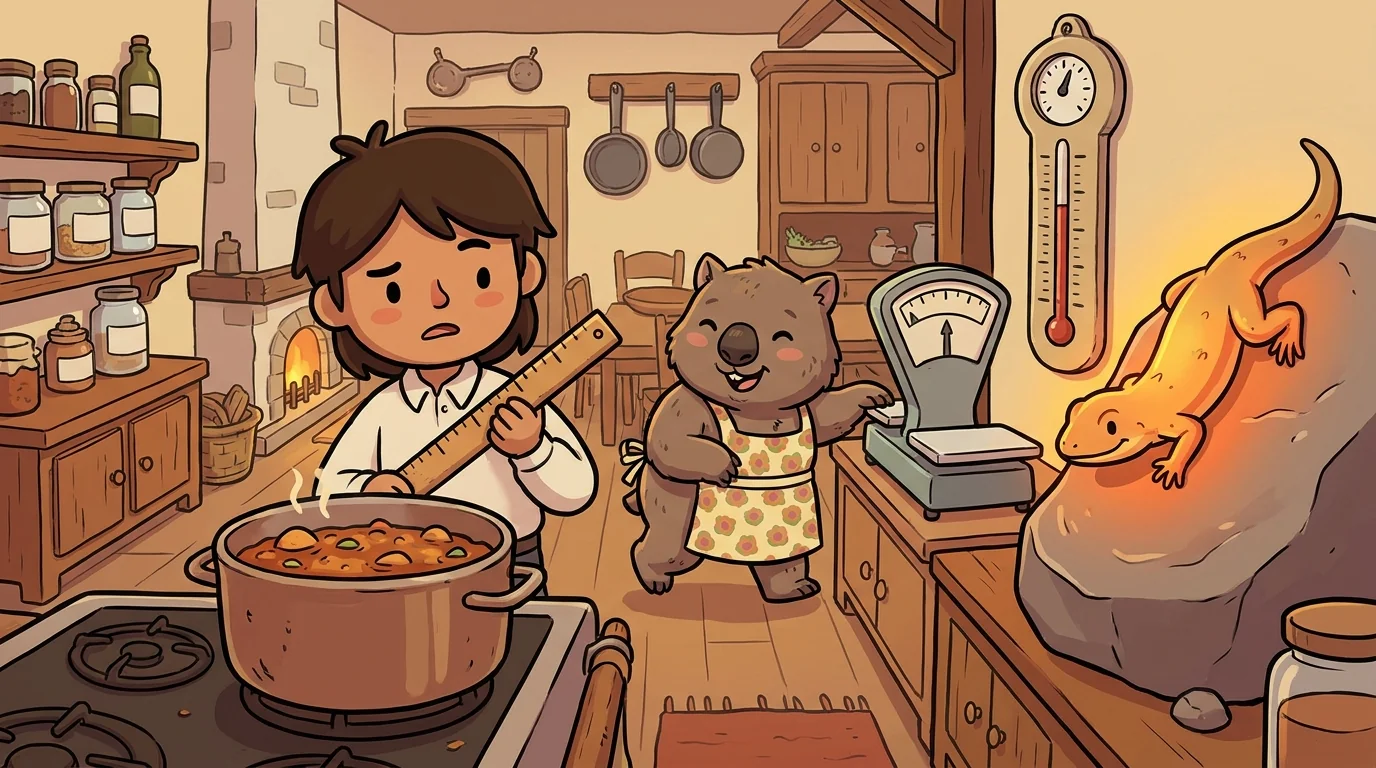
A student stood over a big pot of stew with a ruler in her hand and a very confused look on her face.
"I'm supposed to measure the stew," she said, "but... where do I even put the ruler? It doesn't have a length. It's just... stew."
Tare the wombat and Degree the lizard exchanged a look, and both of them chuckled.
"That's because the stew isn't a length," Tare said, waddling up. "You can't lay a ruler along how heavy it is."
"Or how hot it is," added Degree, sliding down warm from her rock. "A ruler measures distance. The pot has a weight and a warmth, and neither one is a distance you can stretch a tape across."
The student lowered her ruler, baffled. "So the ruler's... useless here?"
"For this, yes," Tare said kindly. "Rod's ruler is brilliant for lengths. But some measures aren't lengths at all. You don't lay them along a line — you read them off an instrument. I read the weight off a balance." She patted a scale. "Degree reads the warmth off a thermometer. Same big idea as Rod — a true number, a chosen unit — but no ruler in sight." She looked at Degree. "Two of us, because the pot is heavy and hot, and those are two different not-a-length measures."
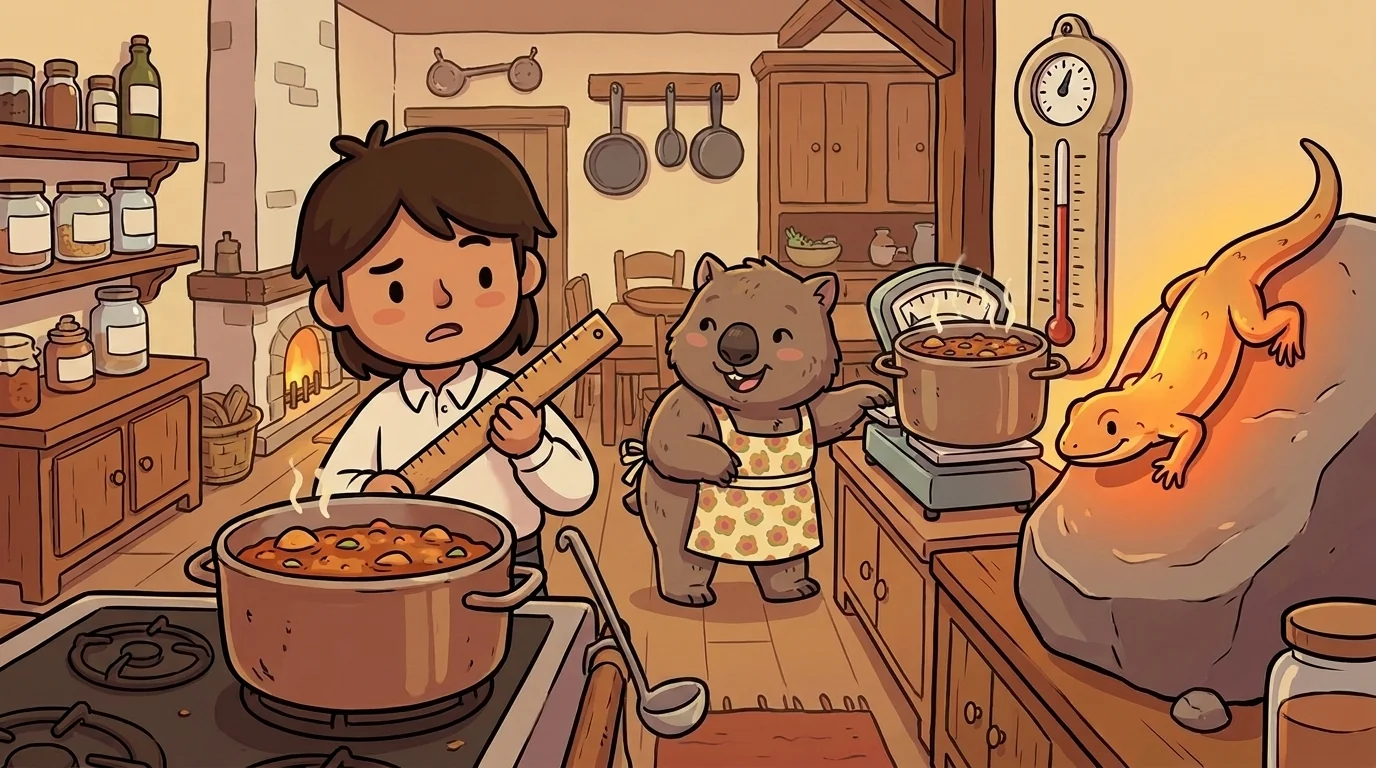
Tare went first, because a full pot's first honest question is how heavy.
"You can't ruler it," she said, "but you can balance it — put it on a scale and read the pull of it downward, in grams and kilograms." She heaved the pot toward the big platform scale, then stopped. "But watch — first I weigh the empty pot." She set the bare pot down: eight hundred grams. "That's the pot being honest about itself. Now —" she pressed the button and it fell to zero, pot still on it "— I tell the scale to forget the pot. Zero it out. The tare." She ladled the stew back in. The number climbed. "Three thousand two hundred grams of stew — the pot's weight cleared out first, so I'm weighing the meal and not the metal."
The student peered. "So it's like Rod's careful reading, but... downward instead of along?"
"Exactly," Tare said, pleased. "A weight is a real number with a chosen unit, same as a length. It just isn't read along a line — it's read off a balance, with the container zeroed first. That's my not-a-length measure." She nodded at Degree. "But the pot's got a second thing to measure that no ruler and no scale can touch."
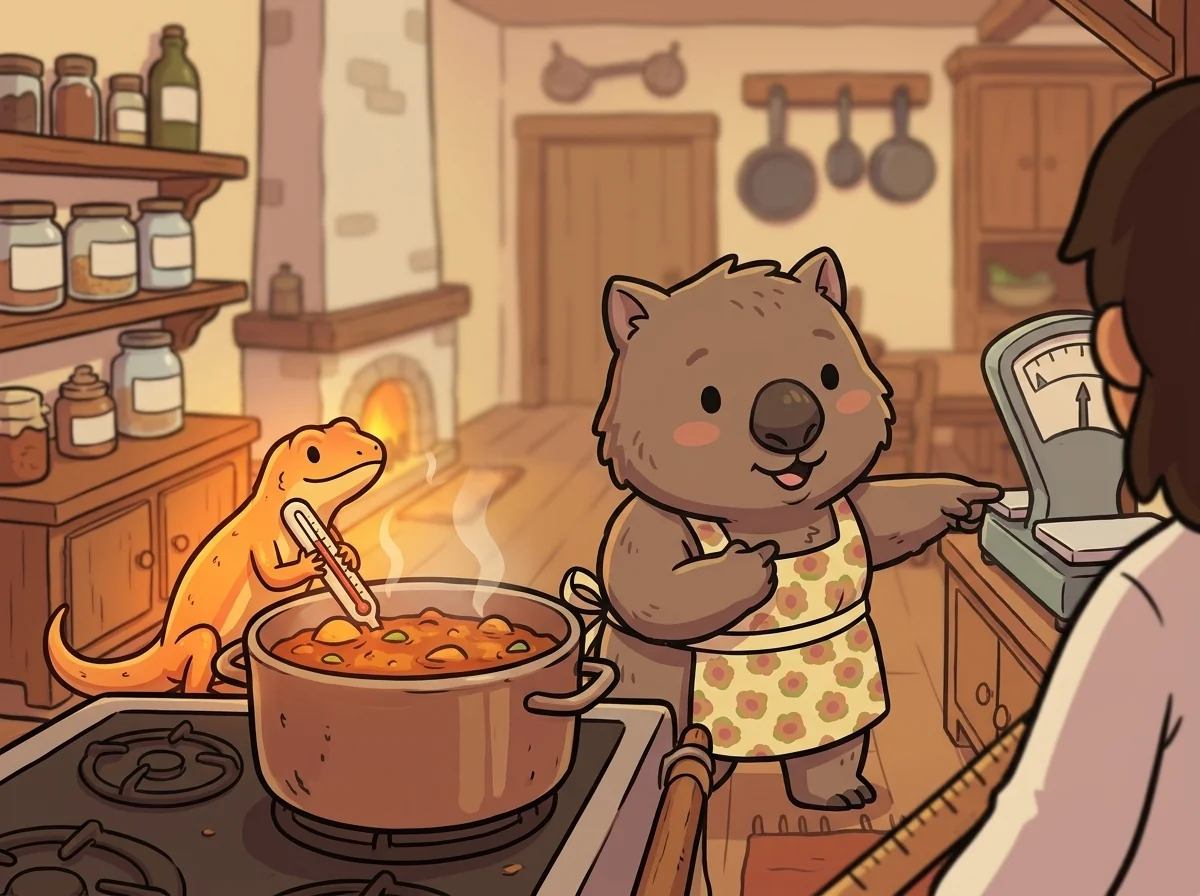
Degree took over, sliding her thermometer toward the steaming surface.
"Tare told you how heavy," she said. "I'll tell you how hot. And you can't ruler that or balance it — heat isn't a distance and it isn't a weight. You read it off a thermometer, in degrees." She dipped the bulb into the stew, not against the pot. "In the stew, not the metal — the pot's cooler than what's in it. And I wait —" the number climbed and climbed "— see it rising? It's not done. Read it now and I'd be reading the thermometer catching up, not the stew." It steadied. "There. Seventy-two degrees Celsius. Hot enough to eat carefully, not enough to scald."
The student looked between the scale and the thermometer. "So the pot has a weight number and a heat number, and they're totally different measurements."
"Totally different," Degree agreed. "Different instruments, different units — grams for Tare, degrees for me — different honest habits: she zeroes the container, I wait for the reading to settle. Neither of us used a ruler once. But both of us did the same deep thing: put a true, checkable number on something you can't stretch a tape across."
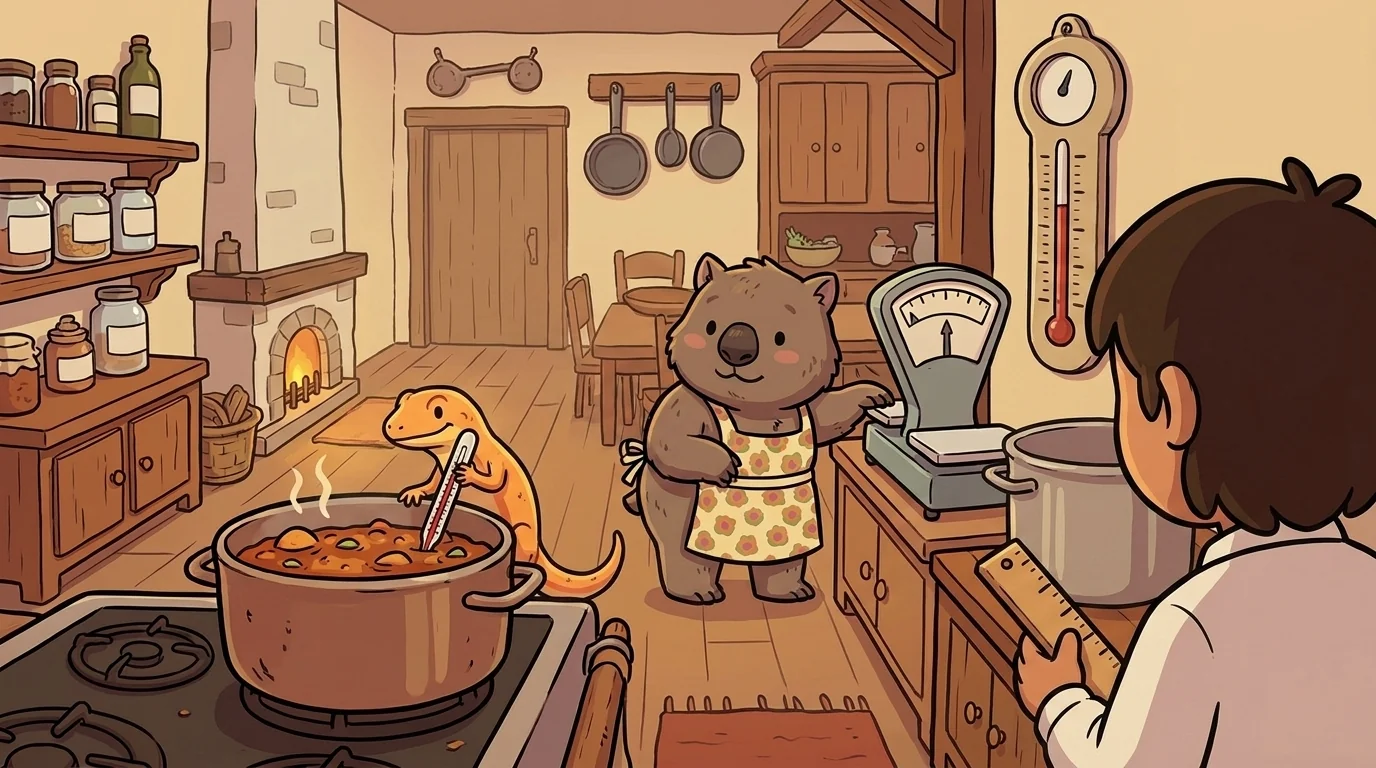
Then they measured the whole pot together, and the student did it with them, and saw the shared idea underneath.
"Watch us both," Tare said. "I set the empty pot on the scale — eight hundred grams — and tare it to zero, so the pot's weight won't sneak in." She ladled the stew back. "Three thousand two hundred grams of stew."
"And I put my thermometer in the stew," Degree said, "and wait for it to settle — seventy-two degrees." She looked up. "Now look at what Tare and I just did the same way. Neither of us laid a ruler along anything. We each grabbed the right instrument for a measure that isn't a length — her a balance, me a thermometer. We each used a chosen unit — grams, degrees. And we each had an honest habit to keep the reading true — she zeroed the container, I waited for the number to stop climbing."
"So the pot," the student said slowly, holding both numbers now, "is three thousand two hundred grams and seventy-two degrees. Heavy and hot. Two real measurements, and not one of them is a distance."
"That's the whole secret of the measures that aren't lengths," Tare and Degree said together. "You don't ruler them. You read them off an instrument — a balance, a dial — with a chosen unit and an honest habit. A length you lay along a line. A weight you balance. A warmth you wait for. All three are true numbers. Only one of them ever needs a ruler."
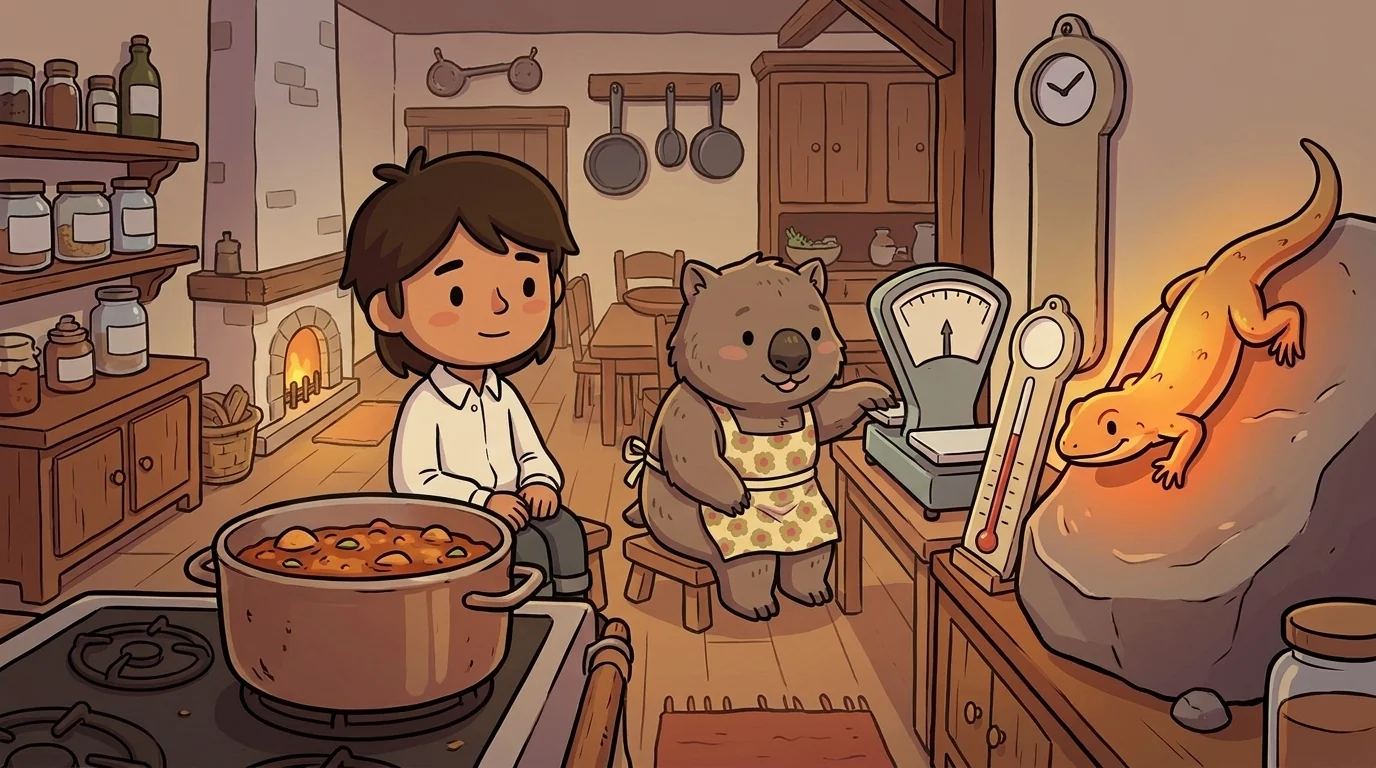
Later, when the stew had cooled and the workshop had gone quiet, the student sat between the wombat and the lizard with the scale and the thermometer in front of her.
"I always thought measuring meant a ruler," she said. "Length. Along a line. It never crossed my mind that heavy and hot were measurements too."
Tare pressed the scale to zero one last time. Degree let her thermometer settle. Neither hurried.
"Most people think that," Tare said. "Ruler, tape, along a line — that's the first kind of measuring anyone learns, and it's a good one. But the world is full of things that aren't lengths. How heavy. How hot. How loud, how bright, how fast." She patted the scale. "And for each one there's an instrument that reads it, and a unit to read it in, and an honest habit to keep it true. My habit is the tare — clear the container. Degree's is the wait — let the reading settle."
"Alone," Degree added, "I might've let you believe all measuring is my kind — dials and degrees. Tare might've had you think it's all balances and grams. Together we show you the bigger thing: measuring isn't about the ruler. It's about finding the right instrument for whatever you're asking, and reading it honestly." She warmed a little. "The pot didn't have one measurement. It had a weight and a warmth, waiting on two different instruments — and a good measurer picks up whichever one the question calls for."
The student looked at the two numbers she'd read off two instruments, no ruler between them.
"So a ruler's just one of the tools," she said. "And measuring is really about matching the right instrument to the right question — and reading it fair."
"Every honest measurement anyone ever made," said Tare and Degree together, softly. And the three of them sat with the cooling pot that had been, at once, three thousand two hundred grams and seventy-two degrees, and something in the student went warm and settled and glad — the quiet gladness of a world that turned out to be full of things worth measuring, most of them not lengths at all, each one waiting patiently for the right instrument and an honest hand.
The MeasureQuest ensemble
Tare and Degree is part of MeasureQuest's distributed-narrative cast. Each character embodies a different curricular primitive; together they teach the full subject.
-

Rod
Linear measurement — length and perimeter (1D extent)
-

Tile
Area — 2D coverage (square units)
-

Cup
Volume and capacity — 3D space (cubic units, liquid measures)
-
Tick
Time — elapsed duration, intervals, and the special-case unit-system (60 / 60 / 24 / 7 / 12)
-

Pace
Unit conversion — translating between metric and customary systems
-
Bevel
Angle — how much a turn, not how long a line; measured in degrees on a protractor
-
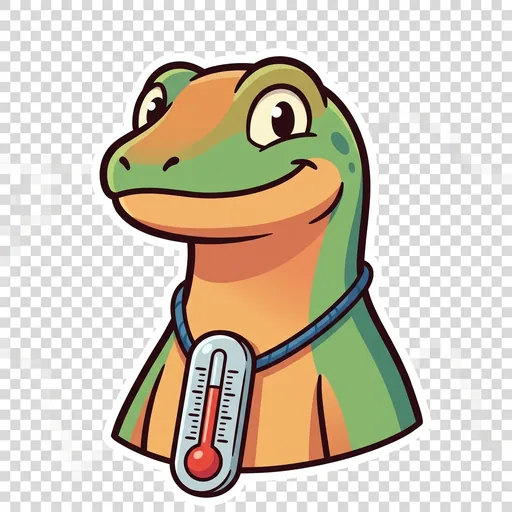
Degree
Temperature — how hot or cold, read off a thermometer; the scale (Celsius/Fahrenheit) you pick matters
-
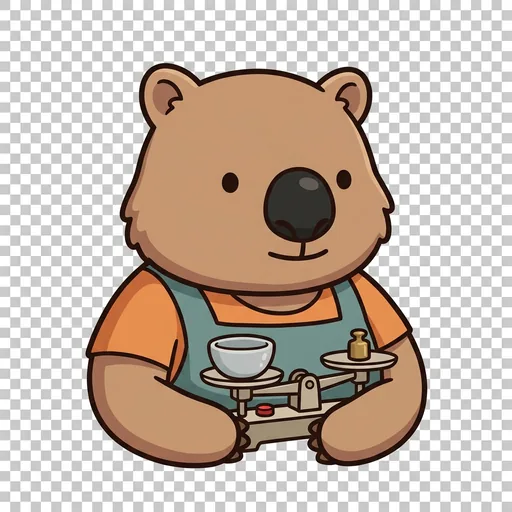
Tare
Mass and weight — how much stuff there is; grams and kilograms read on a balance
-

Thumb
Estimation — measuring without a tool by comparing to references you carry
-
Whisker
Uncertainty — no measurement is exact; every real number carries a give-or-take (plus or minus)