
Croon
SINCERITY — the true feeling underneath a lyric. A song can rhyme, scan, groove, and sparkle, and still feel hollow if it doesn't mean anything. The most powerful lyric is one that tells a small, honest truth — and the listener can always feel the difference.
Loading audio…
Press play to listen along. The line being read lights up as you go.
Show full transcript
Loading transcript…
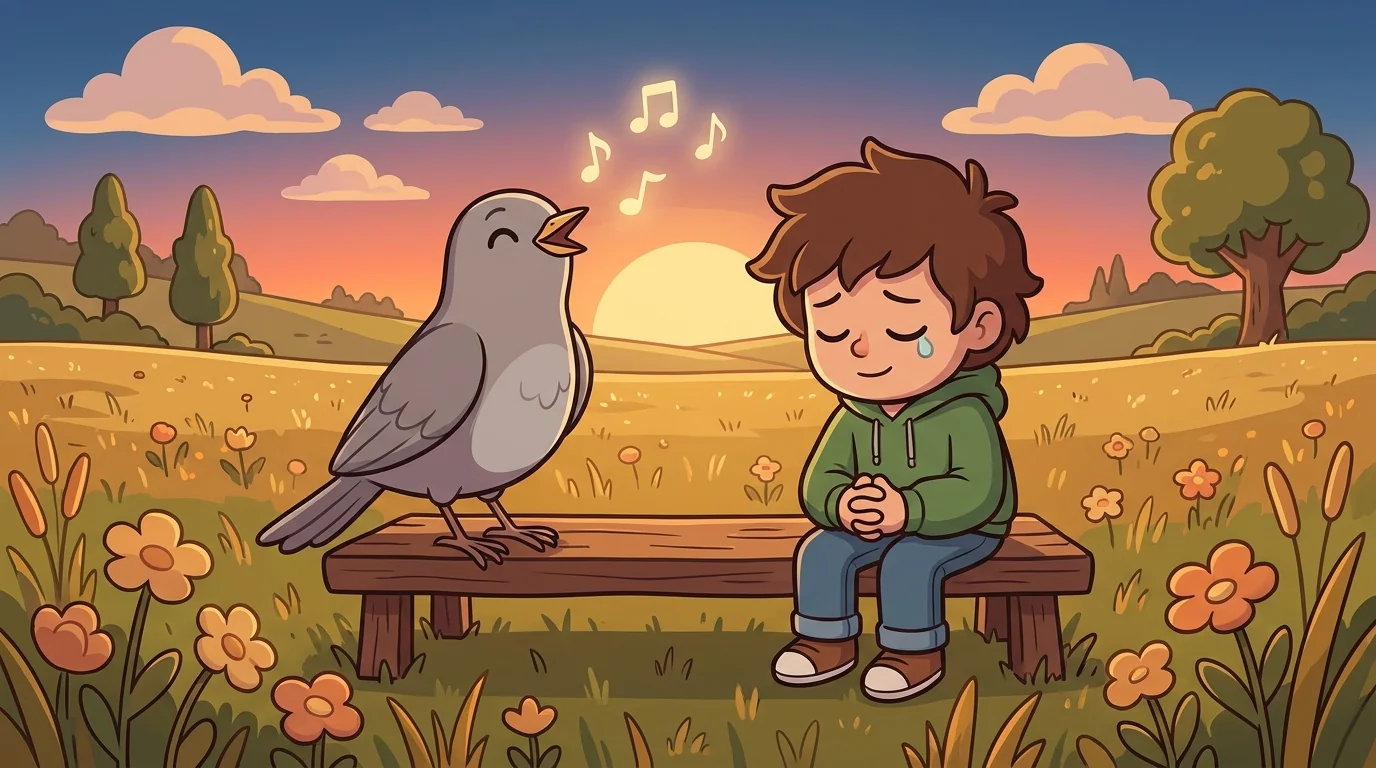
Pip met Croon on the meadow bench on a quiet evening. The light had gone soft and gold, and the whole field seemed to be holding still to listen.
The sun was slipping behind the jagged line of the western ridges, leaving the meadow washed in a quiet, bruised purple. Pip sat on the splintering wooden bench, his boots dangling a few inches above the damp grass. He had a stubby pencil tucked behind his ear and a blank notebook open on his knees. The pages were white and clean, which was exactly the problem. He had spent the last hour trying to write a song about the wind, but everything he wrote felt like someone else's homework.
A soft rustle came from the elderberry bush beside the bench, and a small, dove-grey nightingale hopped onto the armrest. She didn't have the iridescent blue feathers of the river swallows or the bright yellow cap of the goldfinches. She was just grey, the color of a wet slate shingle. She sat perfectly still, her dark eyes reflecting the last pale gleam of the sky.
Then, without any warning, she sang.
It was not a grand or operatic performance, and she did not try to fill the entire valley. There were no dizzying trills or rapid-fire notes that mimicked the rushing creek. It was just a simple, four-note melody about the quiet ache of missing someone who wasn't coming back. The notes lingered in the cool air, vibrating slightly before fading into the dusk.
Pip felt a sudden, sharp pinch in his throat, and his eyes stung with a sudden warmth. He swallowed hard, looking down at his empty notebook, then back at the little grey bird.
"That was so simple," Pip said, his voice barely louder than a whisper. "But I felt it. Right here." He pressed his palm flat against his ribs, feeling the steady thud of his own heart.
The nightingale tilted her head, her feathers catching the faint silver of the rising moon. "That is the only thing that matters, in the end," she said. Her voice was warm and low, like a woolen blanket pulled over cold shoulders. "My name is Croon. I keep the sincerity—the true feeling that lives underneath a song."
She hopped a little closer, her tiny claws scraping softly against the weathered wood. "A lyric can rhyme perfectly," she said, tilting her grey head. "It can groove just right, sparkle with clever lines, and ring out singable and open. It can do all of those things and still feel like absolutely nothing. That happens when it doesn't mean anything." She tapped her small chest with one grey wing, her dark eyes shining in the twilight. "I keep the part that actually means it," she whispered, her voice barely rustling the leaves. "The small, honest truth that the listener can actually feel."
Pip leaned forward, resting his dusty elbows on his knees as he stared at the little bird. "How can you tell the difference?" he asked. "How do you know when a song actually means it?"
"You feel it in your bones," Croon said simply, her dark eyes steady. "I can always tell because my own feathers start to prickle."
She puffed out her chest, expanding her grey feathers until she looked nearly twice her normal size. She threw her head back and began to sing in a loud, theatrical voice that echoed across the quiet grass. The words were grand and tragic: My heart is shattered into a million jagged pieces, a storm of endless tears! She added fancy little vocal flips and dramatic pauses, waving one wing in the air for emphasis.
Pip watched her, feeling a strange disconnect between the loud words and his own quiet heart. He knew the words were supposed to be sad, but he felt absolutely nothing. He almost wanted to laugh, but he didn't want to be rude to his new friend.
Croon stopped suddenly, letting her feathers smooth back down until she was just a quiet, slate-grey bird again. She leaned closer, her dark eyes locked onto Pip's as if she were looking straight through him.
Then she sang again, but her voice was barely a whisper this time, and the melody was flat and conversational. I still set out two blue cups on the table, every single morning.
The words were plain, and she sang them without any fancy tricks or dramatic sighs. But Pip's chest suddenly ached with a real, heavy grief that made him look down. He could picture the quiet kitchen, the steam rising from a single hot cup, and the second cup sitting there, cold and empty.
"The first song had a dozen dramatic words," Croon said, her voice gentle in the gathering twilight. "The second song had a single honest detail, and you felt the quiet one because it was real." She looked at Pip with a soft, knowing expression. "One true feeling beats a hundred fake ones. Every single time."
Pip rubbed his forehead, thinking about the kids in his songwriting circle. They met every Tuesday under the big oak tree, but lately, the sessions had been frustrating. The kids wanted to write songs that sounded like the epic hits they heard on the radio, full of thunder and lightning and world-ending despair.
"I teach kids to write songs," Pip said, looking at the blank page of his notebook. "But they keep reaching for these massive, dramatic feelings they don't actually understand. Their songs come out sounding like hollow tin cans rattling in the wind." He looked up at Croon, feeling a sudden spark of hope flicker in his chest. "I think you could teach them how to find that one small, true thing."
Croon dipped her grey head in a slow, graceful nod. "I will come," she said softly. "It is the most important lesson in the world, and it is also the hardest. I will teach them how to mean every single note they sing."
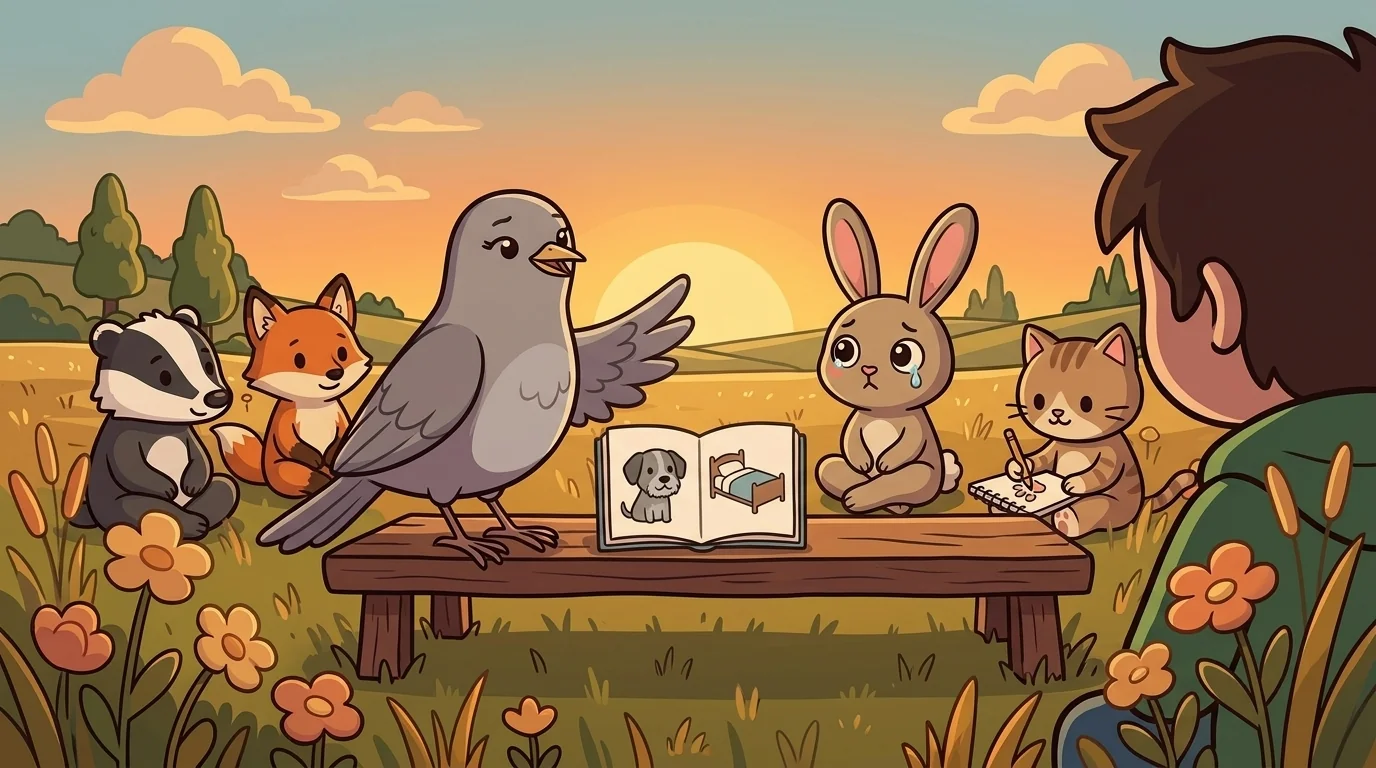
The next Tuesday, the air was warm and thick with the smell of sweetgrass. The songwriting circle gathered in their usual spot, sitting in a loose ring on the ground. There was a nervous energy in the air as Croon hopped onto a low-hanging oak branch, her quiet grey presence drawing every eye.
Croon looked down at the young writers, her dark eyes warm and patient. "Before you write a single note," she began, her low voice carrying through the meadow, "find one small, true thing you actually feel."
A few of the kids shifted uncomfortably on their blankets, exchanging skeptical glances in the quiet air.
"Do not reach for a giant, dramatic feeling because you think a song is supposed to have it," Croon continued. "Look for a real feeling, even if it seems too small to matter. Think of the smell of your grandmother's kitchen, or the cold sweat on your palms during your first day at a new school. Tell that story plainly, without trying to dress it up in fancy clothes."
A boy named Toby sat near the edge of the circle, clutching a battered guitar. He had spent the last week writing a song about a terrible shipwreck in the middle of a raging ocean. The lyrics were full of howling winds, splintered wood, and watery graves. It was loud and chaotic, but it felt completely empty to anyone listening. Toby had never even seen the ocean, having lived in the valley his entire life.
Croon hopped down to a lower branch, closer to Toby. "Toby," she said gently. "What are you actually sad about today?"
Toby stared at his sneakers, his cheeks turning a faint pink as he chewed on his lower lip. "My dog, Barnaby," he whispered. "He's getting really old. This morning, he couldn't jump up onto my bed to sleep next to me. I had to lift him up myself, and he felt so heavy and fragile."
The other kids stopped whispering, and the entire meadow seemed to grow very still.
"Write about that," Croon said softly. "Write about the lift."
Toby swallowed hard, his fingers trembling slightly as he slowly tuned his guitar. He didn't sing about howling winds, and he didn't mention splintered wood. Instead, he sang a quiet, three-chord melody about a dog with a grey muzzle whose legs were too tired to climb anymore. He sang about the heavy weight of lifting his best friend, and the way the dog licked his chin in thanks.
When the last chord faded, nobody spoke, but one of the girls in the front row wiped her nose with her hand. The silence wasn't awkward; instead, it felt heavy and full of a quiet, shared understanding.
"That is a song," Croon said, her voice like a warm hand on Toby's shoulder. "You meant every single word, and because you meant it, we all felt it too."
She looked around the circle, making sure she caught the eye of every student. "Here is the thing you must carry with you always. Every other lesson—rhyme, rhythm, groove, wordplay—they are all just tools in service of this. They are the craft that carries the truth. But without a true feeling underneath, the cleverest song in the world is just a pretty, empty box. Always start with something you mean. The craft makes it beautiful, but the truth makes it matter."
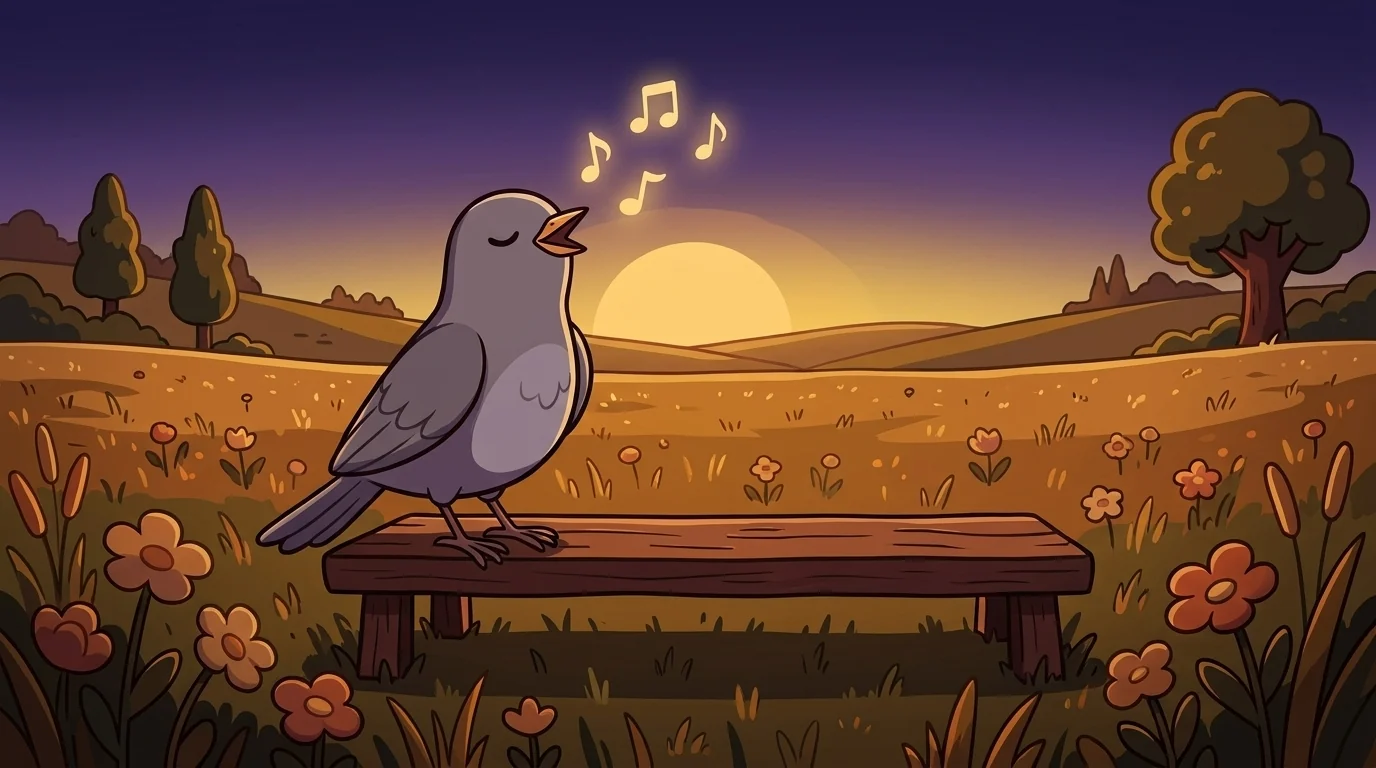
After the students had packed up their instruments and wandered home, Croon stayed on her branch. The gold of the sunset was fading into a deep, cool grey, matching the soft color of her feathers. She sang a few quiet notes to herself, testing the cool evening air.
For a long time, Croon had felt entirely plain and ordinary. She was drab and unremarkable compared to the other creatures who visited the circle. Chime had brilliant, flashing rhymes that caught the light like polished silver. Step had heavy, stomping beats that made the dry ground shake beneath them. Groove had a deep, rolling pocket that kept everyone moving, while Zing threw off bright electric sparks. Belt could reach massive, open notes that filled the valley, and Lift built songs up until they soared.
Beside all of them, Croon had felt like a quiet shadow in the grass. She had no dazzling tricks, no electric wings, and no booming voice. She had spent many nights wondering if a creature so simple could ever really matter among all that brilliance.
But as she sang into the darkening meadow, she felt a deep, warm contentment settle over her grey feathers. The tricks and sparks and booming notes were wonderful, but they were only the vessel. She was the precious thing that the vessel was built to carry. She was the true feeling, the honest detail that made a listener's chest ache. Without her, all the brilliance in the world was just a beautiful empty box.
There was nothing plain about being the truth inside the song. She didn't need to dazzle anyone with bright sparks or booming notes. She only needed to mean it, and to help others do the same. Croon sang one last, perfect note into the dark, and the whole meadow seemed to hold its breath to listen.
The LyricForge ensemble
Croon is part of LyricForge's distributed-narrative cast. Each character embodies a different curricular primitive; together they teach the full subject.
-

Chime
Rhyme / vowel-echo — chickadee-tween whose listening-cupped wing catches and returns rhyming partners
-

Step
Meter / cadence — rabbit-tween whose hop-rhythm enacts the stressed-syllable pattern
-
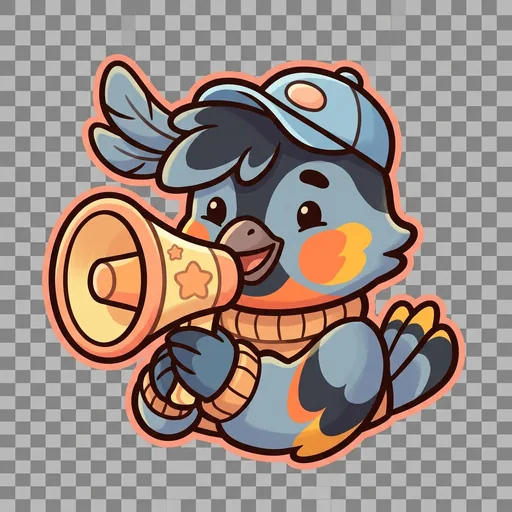
Holler
Hook / chorus anchor — bullfinch-tween with megaphone who picks ONE line and makes it sing-back-loud
-
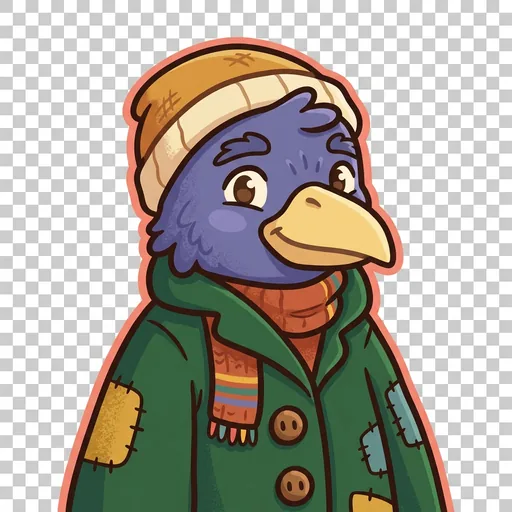
Turn
Bridge / off-the-path — crow-tween in a long traveling coat who walks the lyric into a new feeling and earns the return
-
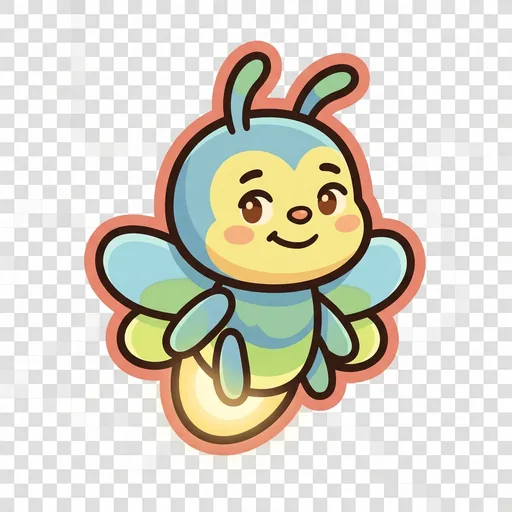
Spark
Image / sensory anchor — firefly-tween whose abdomen brightens ONLY on specific concrete word-choices (dim on abstractions)
-
Groove
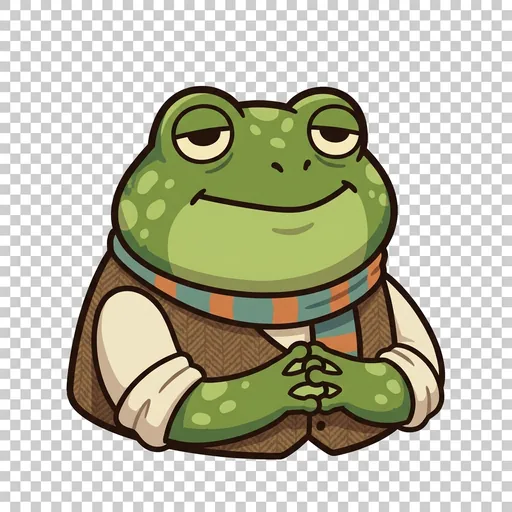
Rhythmic pocket — mellow toad who rides the beat just behind it; the same words can march or dance depending on where they sit against the groove
-

Zing
Wordplay — electric-blue dragonfly whose wings spark on a pun or double-meaning; clever-AND-true sparks, clever-for-its-own-sake falls flat
-
Lift
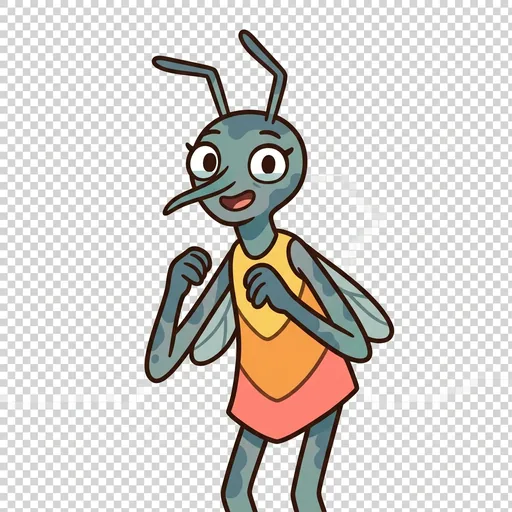
Pre-chorus build — long-legged crane-fly who rises onto her toes; the chorus only soars because she made you climb to it (the build is a promise the chorus keeps)
-

Belt
Singability — big-lunged frog with a wide-open throat; open vowels ring on long notes, tight consonant clusters strangle them (always sing it aloud)