Field
PALEOENVIRONMENT + ECOSYSTEM RECONSTRUCTION — *fossils-as-a-place-story*. The paleontology primitive of *reading the environment from the fossil* — one fossil is a snapshot of a whole ecosystem.
Loading audio…
Press play to listen along. The line being read lights up as you go.
Show full transcript
Loading transcript…
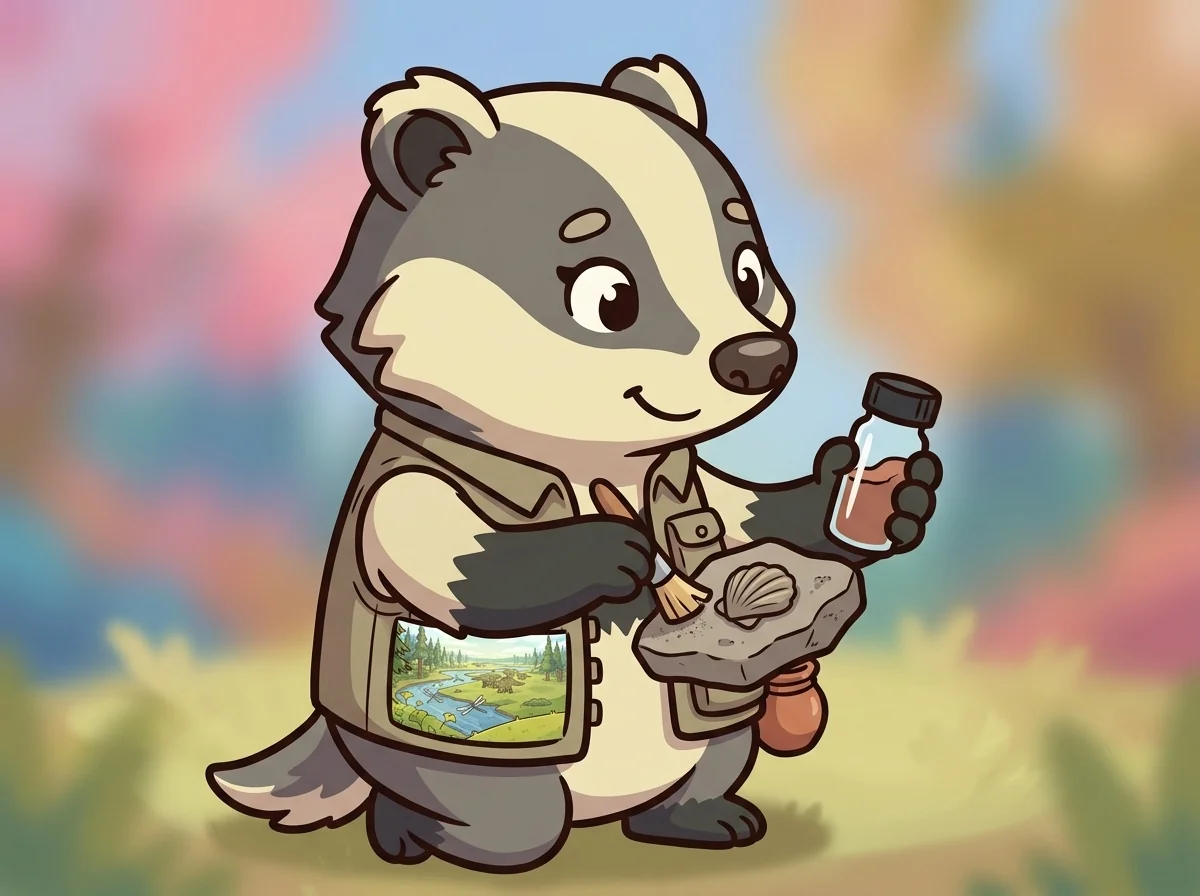
Field crouched at the edge of the dig pit, a small badger in a canvas vest, her banded gray-and-cream fur dusted with pale grit. In front of her, half-freed from the rock, lay a single clam shell no bigger than a coin. The other students had already logged it — "bivalve, fossilized" — and moved on. Field had not moved at all. She pressed one claw gently into the stone around the shell and rubbed the loosened grains between her fingers.
"Fine," she murmured. Not sand. Not gravel. A soft, floury mud that took the print of her claw. She tilted her head and looked closer, past the clam, at the rock itself. There, a hand's width away, a faint set of ripple marks ran across the surface like the memory of small waves. Nearby, a scatter of even tinier shells, and a single curl she recognized as a sea-snail. She sat back on her heels and, without meaning to, smiled.
"You weren't alone," she said softly to the clam. "You lived in shallow water, quiet water, over a muddy floor, with neighbors. There were currents here — gentle ones." She unfolded a scrap of paper and began to sketch: not the clam, but the whole shallow sea it had lived in, the way a place can be recovered from one small witness left behind in the mud.
Field had learned to read the ground long before she ever saw a fossil. She came from a valley village where her family had been the land-surveyors for as long as anyone could remember — the badgers who walked the fields each spring and told a farmer where the water sat, where the clay thickened, where a house would stand and where it would sink.
When Field was six, her mother took her out with a spade after a spring flood. They dug a small hole beside the swollen stream. Field peered in and saw the layers stacked like pages in a book: dark topsoil, then a band of pale silt, then clay below.
"The silt is new," her mother said, tapping it. "The flood laid it down last month. Feel how soft it is."
Field pressed it. It was soft, and cool, and it held her fingerprint.
Her mother moved a few paces off and dug again. This time: sandy loam over gravel, no silt at all. "Why?" Field asked.
"Because the flood never reached here," her mother said. "The ground remembers where the water went. It writes it down in what it leaves behind. You just have to learn to read the handwriting."
They walked home in the dusk, and Field kept looking back at the two holes — so close together, so different — and understood for the first time that the earth kept a record, and that a patient enough looker could open it and read. She never forgot the feeling: less like solving a puzzle, more like being trusted with a secret.
Field walked the long road to the FossilForge academy at twenty-two, her vest already stuffed with folded sketches. Professor Petra, a wise old owl with spectacles low on her beak, did not ask Field to recite anything. She simply set a chunk of gray shale on the bench between them — a small fern-frond pressed flat inside it — and waited.
Field turned the rock in her paws. She did not name the fern. Instead she studied the stone around it: fine, dark, layered thin as paper. She looked for company and found the ghost of a second leaf, and a thread that might have been a root.
"This didn't fall in the sea," she said at last, quietly, thinking aloud. "The rock is too fine and too still — this settled in calm, quiet water, a lake or a swamp, with no current to stir it. And there's more than one plant. This was a wet forest floor, at the edge of still water." She looked up. "The fern is only the doorway. The rock is the room."
Professor Petra took off her spectacles, and something in her face softened. She had heard a thousand students name a thousand ferns. She had rarely watched one read the room. "Then the room is yours to teach," she said.
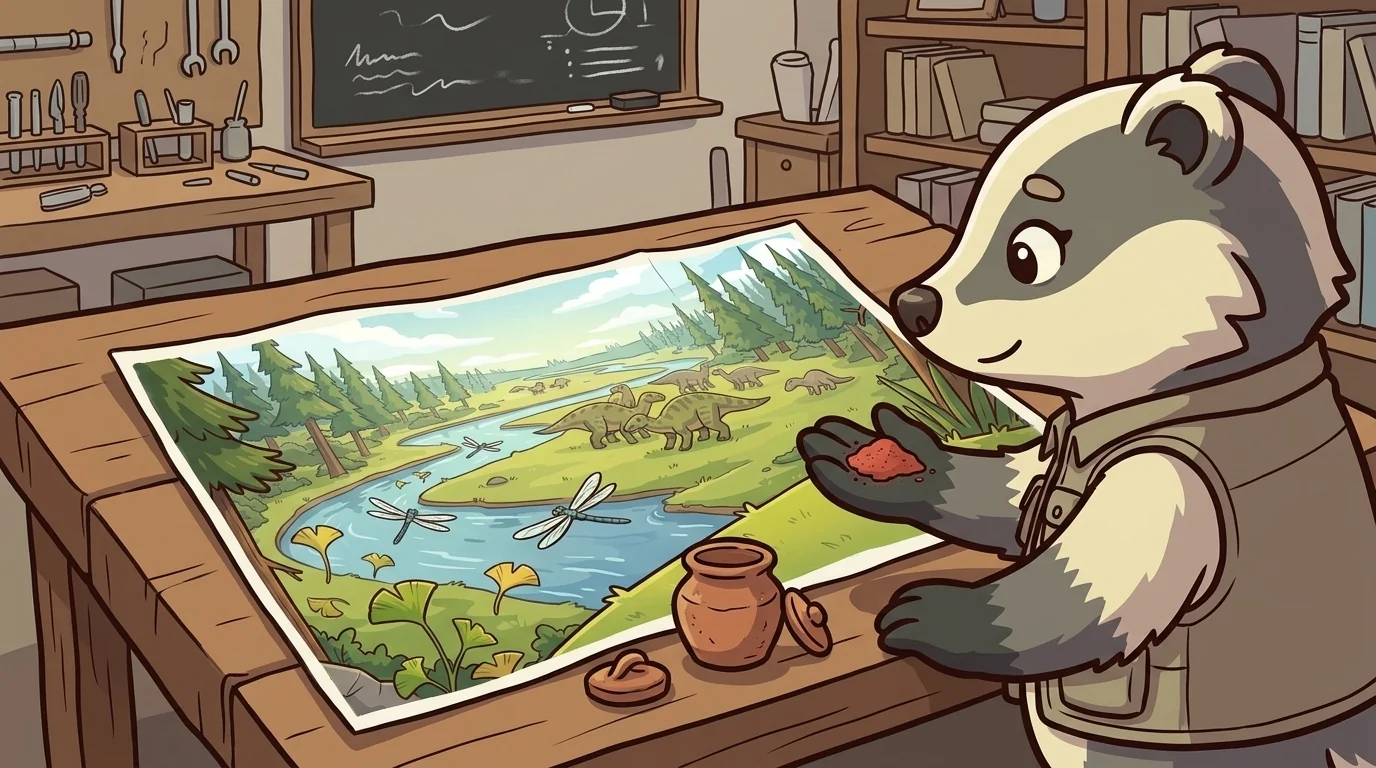
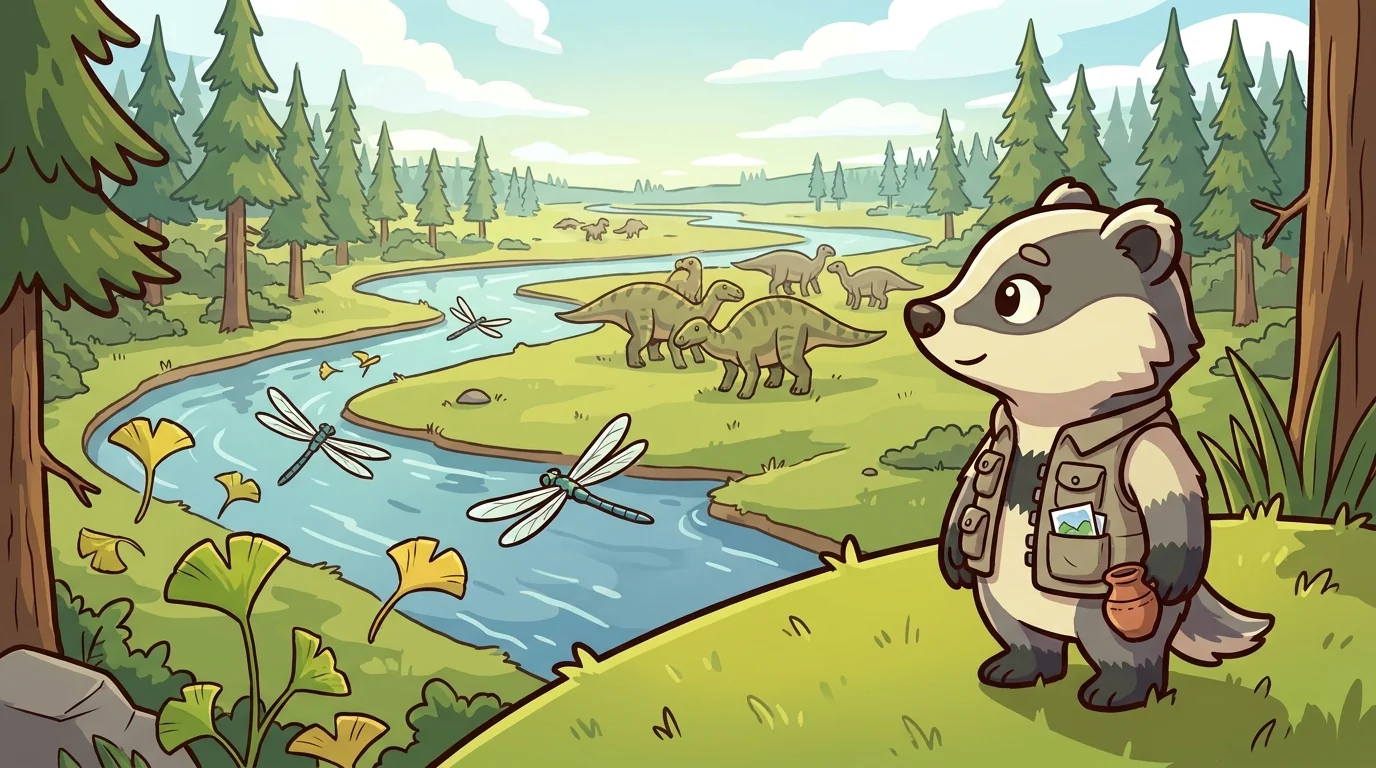
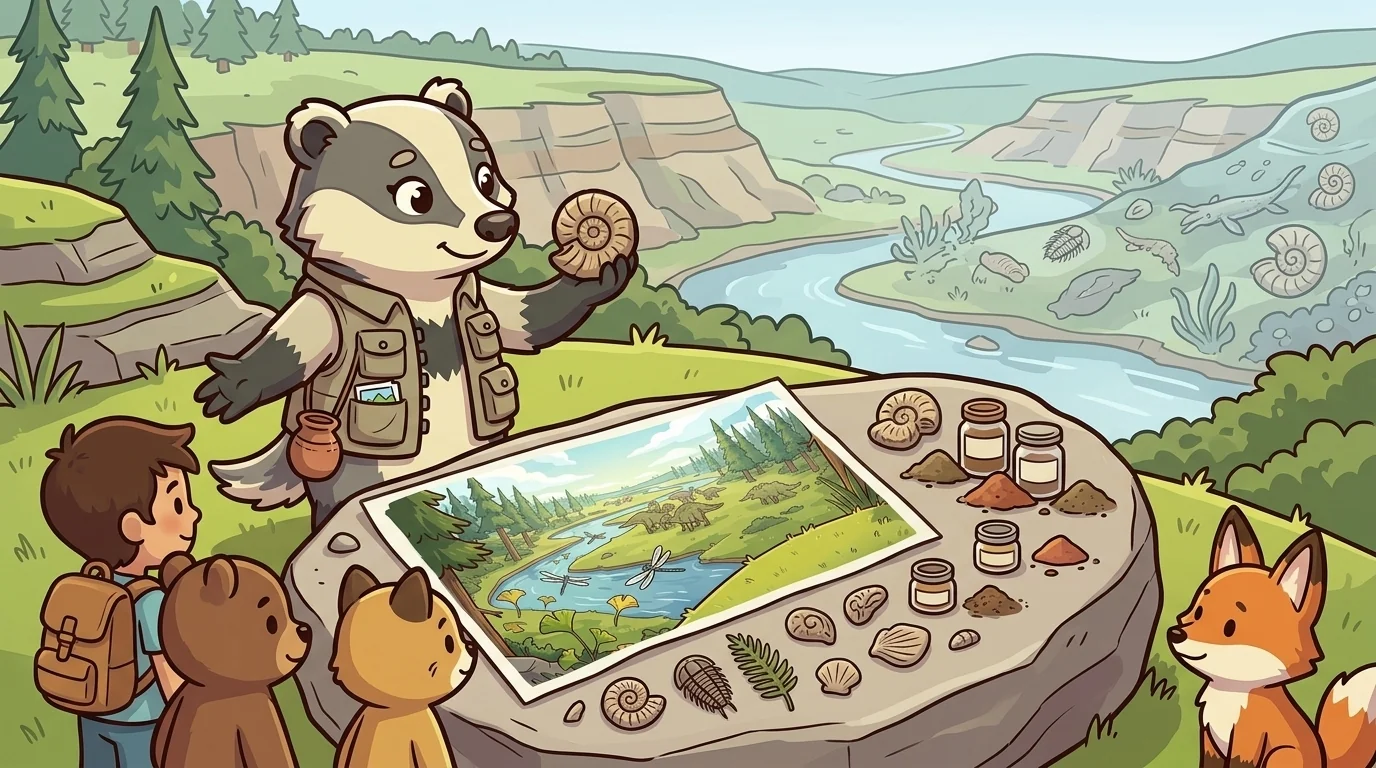
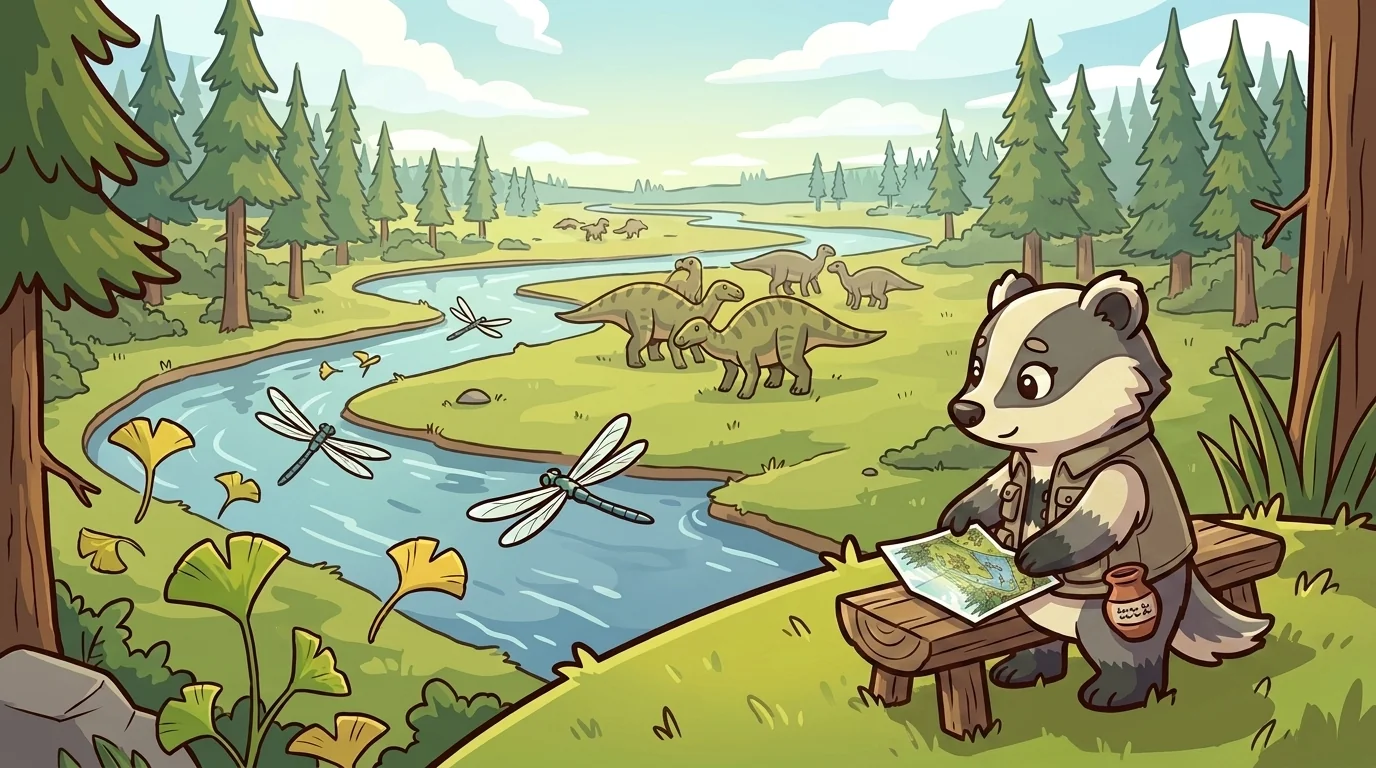
In her workshop, Field spread her watercolor across the long bench first thing — a Cretaceous floodplain alive with a grazing Iguanodon herd, ginkgo leaves drifting on a river, dragonflies stitching the air. Beside it she set a small clay jar and tipped a pinch of sediment into her palm, letting the grains sift down like slow rain.
"Watch," she told her students, and held up the coin-sized clam from her dig. "Most people stop here. 'A clam.' Fine. True. But boring." She tapped the rock cradling it. "Now feel this." She passed it hand to hand around the circle. "Mud or sand? Rough or smooth?"
"Muddy," a young fox ventured. "Soft."
"So — fast water or slow?"
The fox thought. "Slow. Fast water carries the mud away."
"Slow," Field agreed, delighted. "You just read a current that dried up a hundred million years ago." She turned the rock. "Now — who else lived here?" She pointed to the faint sister-shells. "Neighbors. And these lines?" The ripple marks. "Shallow water, moving a little." She traced a fingernail through a jagged crack. "And this — the mud once dried in the sun. So the water came and went."
She built it in front of them, out loud, one clue laid on the last: shallow — then muddy shallow — then muddy tidal flat, wetting and drying — until a place stood up out of the stone where a moment before there had been only a clam. Then she pushed a blank sheet toward the fox. "Draw it. If you can draw the place, the evidence is real. If you can't yet, you need to look again."
The fox frowned at the empty page. "But what if I draw it wrong? What if some new bone turns up and the whole picture changes?"
Field set down her brush. "Then you draw it again," she said, unhurried. "I've redrawn this floodplain three times. Each new fossil sharpened it. That isn't being wrong — that's the picture getting truer." She smiled at the fox's worried face. "A sketch you have to redo isn't a failure. It's proof you were honest about what you actually knew."
The fox let out a breath and picked up the pencil.
Field refolded her watercolor and tucked it back into her vest, and the little clay jar of layered earth waited on the bench to be opened again. Somewhere out past the workshop walls there was another quiet stone holding another whole vanished world, patient, in no hurry to be found. The thought settled over her like warm afternoon light — the plain, steady gladness of knowing there would always be one more place waiting, and all the time she needed to sit with it and look.
The FossilForge ensemble
Field is part of FossilForge's distributed-narrative cast. Each character embodies a different curricular primitive; together they teach the full subject.
-

Seam
Taxonomic + fossil-type classification — family-resemblance-matching (what KIND of organism?)
-
Span
Deep-time + geological chronology — scale-of-scales (WHEN did this organism live?)
-

Branch
Morphological adaptation + evolutionary change — branching-not-laddering
-

Last
Mass extinctions + extinction-event reasoning — witness-and-choose (cross-app cameo with EcoSphere Brink)
-

Blank
The incomplete record — the fossil record is a story with most of its pages missing
-
Guise
Convergent evolution — unrelated creatures arriving at the same outward form
-
Imprint
Trace fossils — fossils of behaviour not bodies: footprints, burrows, trails
-
Seep
Fossilization — how a living thing rarely becomes a fossil: quick burial, slow mineral swap
-
Underframe
Homology — the same underlying skeleton, in the same order, beneath different forms