
Clang
ONOMATOPOEIA — a word that sounds like the noise it names. Buzz. Splash. Crash. Hiss. When you say the word, your mouth makes a little echo of the real sound, so the reader almost hears it.
Loading audio…
Press play to listen along. The line being read lights up as you go.
Show full transcript
Loading transcript…

The old clock tower smelled of damp soot and ancient iron as Trope’s detective cast huddled under the archway, shivering in the gray fog. They heard Clang long before they saw him, because a rhythmic rattling echoed from around the corner like a loose copper pot rolling down a hill. With a cheerful clink, clank, chime, a small, round creature hopped into the courtyard. He was made entirely of dented copper, with green patina dusting his seams like moss. Every time his feet hit the wet stones, his hollow belly rang like a miniature church bell.
"Who goes there?" called Toby, a detective who always carried a yellow pencil behind his ear, while the creature chimed back in a bright, metallic voice.
"I go here!" the creature cried. He hopped directly into a deep puddle, sending up a wide fan of dirty water that did not just look wet. When Clang opened his mouth, the sound of the water seemed to live right inside his words.
"Splash!" he cried, and the word itself sounded like boots hitting a deep puddle.
"I am Clang," he said, giving a happy little bounce that made his ribs ring as he explained his special collection of sound-words. "I keep the ones that sound exactly like the noise they name."
The detectives crowded closer, their notebooks fluttering in the damp breeze as Maya leaned down to inspect his dented copper skin.
"Your words sound exactly like the things they mean," she whispered, and Clang gave a happy little ring that vibrated through his entire body.
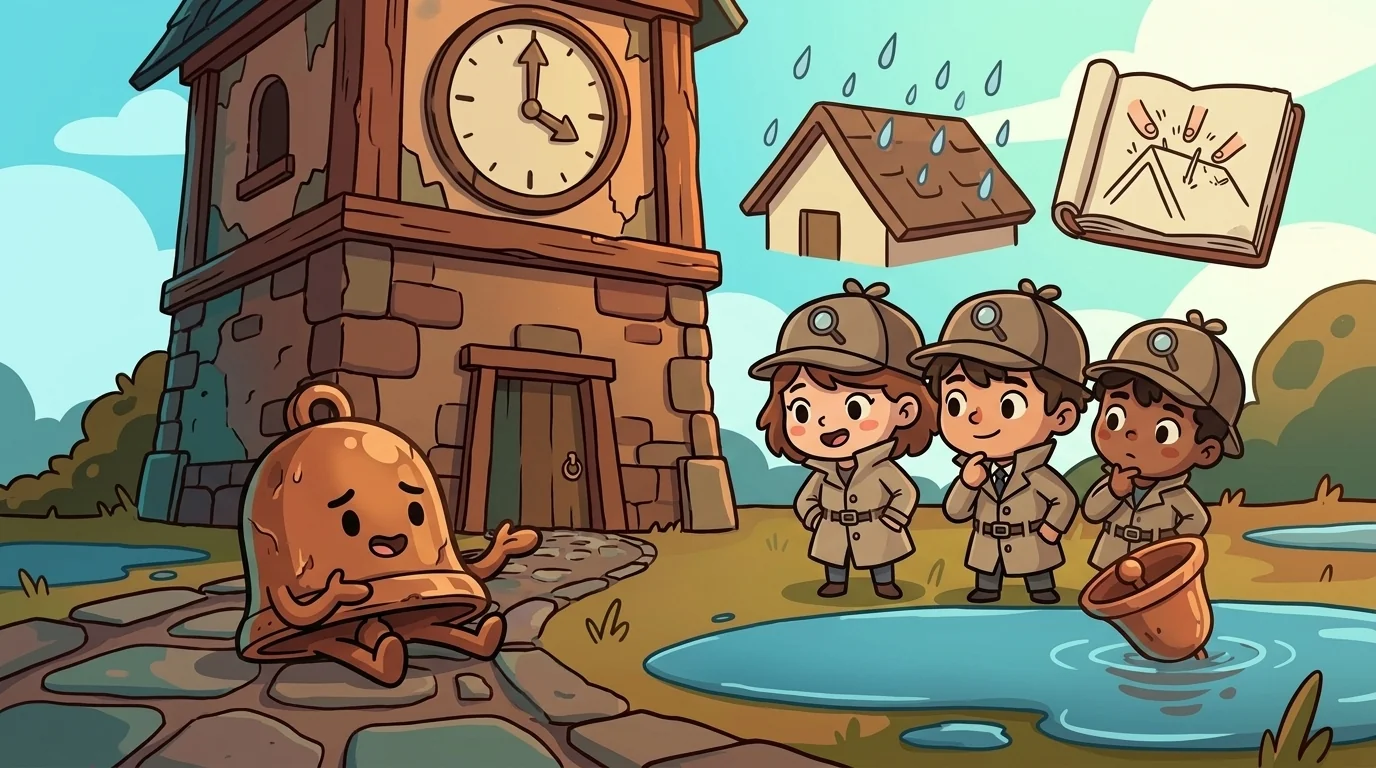
"That is my whole trick!" Clang said, his body vibrating with a warm hum. "Say the word for thunder and feel how it rumbles in your throat," Clang suggested, and they tried murmuring rumble into the cold air. "Now say the word for a snake's warning and feel it hiss between your teeth," Clang urged.
They hissed together, creating a soft chorus that sounded like dry leaves scraping across the stones, and Clang nodded his copper head. "The word is a little echo of the real sound that brings the physical world right onto the page."
Trope stepped forward, his long coat swirling around his ankles as he suggested showing them how it works in a proper sentence. Clang cleared his throat, which sounded like someone shaking a box of brass tacks, before speaking a flat, silent line.
"The rain fell on the roof."
Nothing happened, and the detectives just stood there under the archway, picturing a gray sky and wet wooden shingles. Then Clang took a deep breath, his copper chest expanding, and spoke the sentence again with a sound-word slid into the middle.
"The rain went pitter-patter on the roof."
Suddenly, they didn't just picture the rain, because they could hear the tiny, sharp tapping of water on a tin sheet. The sentence was no longer just telling them about the weather; it was letting them actually experience the storm.
"That is the magic," Clang rang softly, his voice dropping to a gentle chime that echoed off the damp stone walls. "A sound-word puts the noise right inside the sentence so the reader doesn't just picture it. They almost hear the noise, because the word does the listening for them."

Maya’s eyes went wide as she scribbled in her notebook, realizing that the word was like a tiny recording of the real sound.
"Exactly!" Clang chimed, his body ringing with delight.
Just then, a dry rattling sound echoed from the dark mouth of the clock tower as Chain slithered out into the courtyard. His heavy iron links clinked together in a slow, rhythmic pattern that contrasted with Clang's bright ring. He was a long, silver creature made of connected metal loops, and his dry voice sounded like sandpaper on rough wood.
"I heard a racket," Chain said, looking at the kids. "Are we talking about sound again?"
"We are!" Clang bounced, his copper body ringing in harmony with Chain's iron clink as they stood together on the wet stones. "We were just explaining how words can carry real noises to the reader."
Chain curled himself into a neat spiral on the wet stones and looked up at the young detectives with his dark, metallic eyes. "Clang and I are cousins in a way, because both of us care about how words sound. I repeat the first sounds of words to make a musical pattern, like a song without any instruments," Chain explained.
"Like slippery, slithering snakes," Maya suggested, remembering how they had caught him in the library last week.
"Precisely," Chain rustled, his links sliding over each other. "But Clang here takes the whole sound and stuffs it inside a single word. He doesn't need a long pattern of letters, because he just needs a single hiss to make his point."
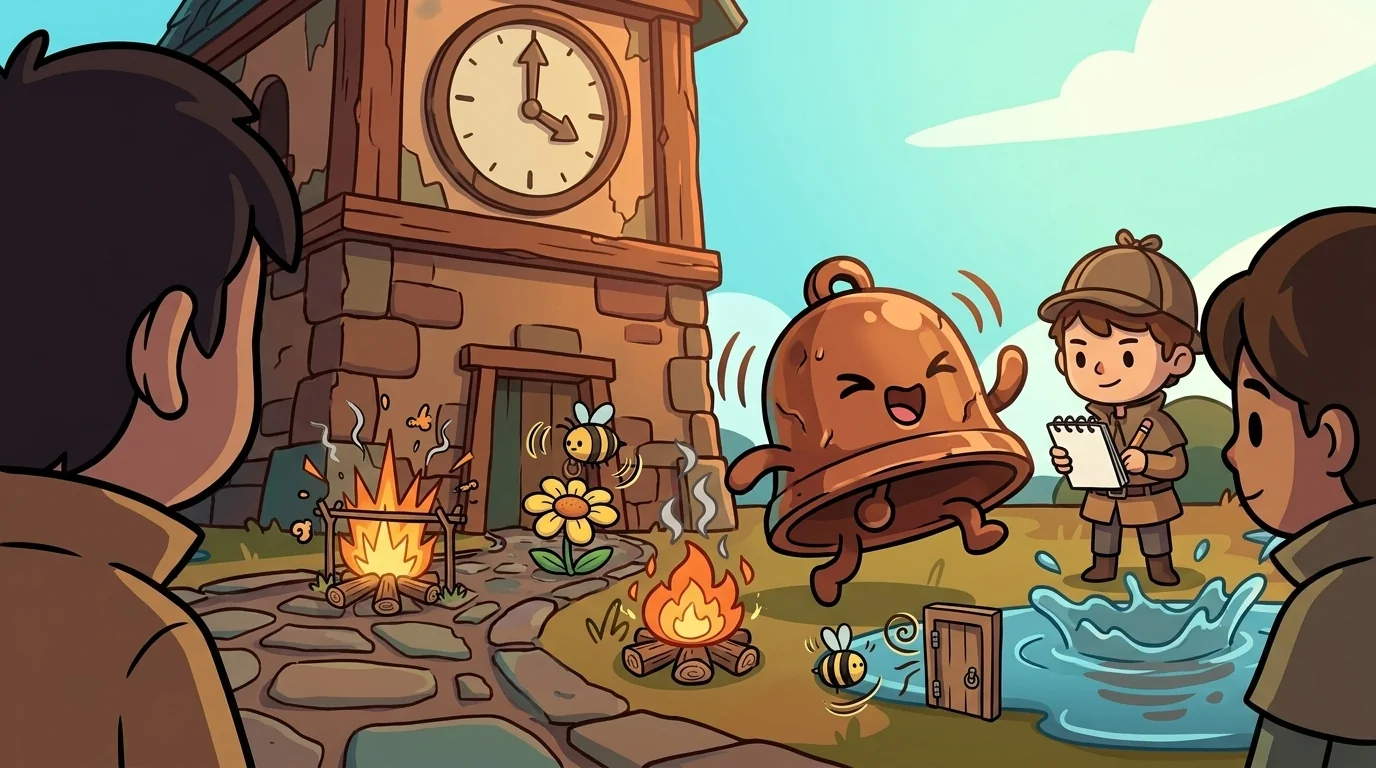
The two metal creatures stood side by side, a noisy, happy pair of friends who showed how different sounds could work together.
Trope turned to the young detectives, his eyes shining with purpose as he introduced their new copper companion. "These young word-detectives are learning the figures of speech, but their sentences are still too quiet. They write flat, silent lines that sleep on the page, and I think you could teach them to put a sound inside their words."
Clang rang all over with joy, his body vibrating so hard he blurred into a copper streak against the gray stone walls. "Oh, yes!" he cried. "I will teach them to write words you can actually hear!"
So Clang joined the detective cast, and the courtyard became a much noisier place as they practiced their new writing skills.
When Trope teaches onomatopoeia, Clang always takes the lead, ringing and chiming to make sure everyone is paying attention.
"Find the noise in your scene," he tells the detectives as they sit with their notebooks under the dripping trees. "Is something buzzing, crashing, or whispering? Then reach for the word that sounds exactly like that noise. Say it out loud to yourself, and if your mouth makes a little echo of the real sound, you have found it."
Toby sat on a wooden crate, staring miserably at his damp paper where he had written that the fire was loud. It was a flat, silent sentence that did not warm anyone up or paint a picture in the mind. Clang hopped over and peered at the page, his polished copper face reflecting the dark smudge of the pencil lead.
"What kind of loud is it?" Clang asked gently, his voice ringing like a small dinner bell. "Close your eyes and listen to the little stove over there in the corner," Clang suggested.

Toby closed his eyes and listened to the wood burning inside the heavy iron grate. He heard the sharp snaps of dry pine and the soft, boiling hiss of sap escaping from the bark. He opened his eyes, crossed out the word loud, and wrote that the fire crackled and popped. Suddenly, the sentence came alive with heat and sound, making the cold courtyard feel a little more comfortable.
"You didn't just tell us it was loud," Clang said, ringing with approval as he hopped on the stone. "You let us hear the crackle, and that is the real difference between telling and showing."
"And here is the clue to remember because we are detectives after all," Clang added, leaning in close to Toby. "A sound-word is easy to spot if you read your sentence aloud and listen to your own voice. Listen for the word where your mouth has to make the actual noise to say it. Buzz buzzes, hiss hisses, and boom booms because the word and the sound are the exact same thing. That is how you catch one in the wild."
After the lesson ended, the detectives packed up their damp notebooks and headed home through the darkening streets. Clang sat alone on the cold stone steps of the clock tower, watching the fog roll in. Above him, the giant brass gears of the clock began to turn with a heavy, metallic groan. The great bell chimed the hour, sending deep, booming waves of sound rolling through the thick fog.
Clang’s small copper body vibrated in perfect harmony with the giant bell, ringing softly along with the heavy brass. For a long time, Clang had felt a little silly compared to the other figures of speech. He was just a creature of noises, all clangs and buzzes and splashes, while they seemed so clever and deep. Metaphor could turn a dark room into a wild forest, and Clang had wondered if his sound-words were just a shallow trick.
But ringing gently along with the tower bells, Clang understood his gift much more warmly than before. Sound-words were not shallow at all, because they did something no other figure could manage. They reached past a reader's eyes and touched their ears, putting a real noise into a silent line of print. It was a little piece of the actual world, captured in a sound you could say with your own mouth.
There was a simple, joyful magic in that, and a warm hum of contentment spread through his copper body. He was not silly, and he knew he had a vital place in the stories they would write.
"I'm the one who lets a reader hear," he whispered, chiming softly as the last echo faded. He was glad to be a word you could actually listen to.
The FigureForge ensemble
Clang is part of FigureForge's distributed-narrative cast. Each character embodies a different curricular primitive; together they teach the full subject.
-

Ferry
Metaphor — 'X IS Y' direct comparison; carries meaning across
-

Ripple
Simile — 'X is LIKE Y' softer comparison
-

Knot
Idiom — fixed expressions whose meaning isn't literal
-

Twin
Analogy — extended comparison / X:Y::A:B parallel mapping
-

Hum
Personification — non-human takes on human qualities
-

Mask
Hyperbole + understatement + irony cluster — say one thing, mean another
-

Chain
Alliteration — living-chain creature whose links lock when words share a first sound (big blue balloon); a little is catchy, too much is a tongue-knot
-

Token
Symbolism — quiet creature with a many-pocketed cloak of small objects that stand for big ideas (a dove = peace); shows the meaning instead of saying it
-

Twain
Oxymoron — two-toned creature (one half warm, one half cool) who places two opposite words side by side (bittersweet); the clash says something truer than either alone