
Niche
ECOLOGICAL ROLE — *every species has a job, and the ecosystem holds together by the jobs fitting together.* The ecology primitive of *what-an-organism-does in the system.*
Loading audio…
Press play to listen along. The line being read lights up as you go.
Show full transcript
Loading transcript…
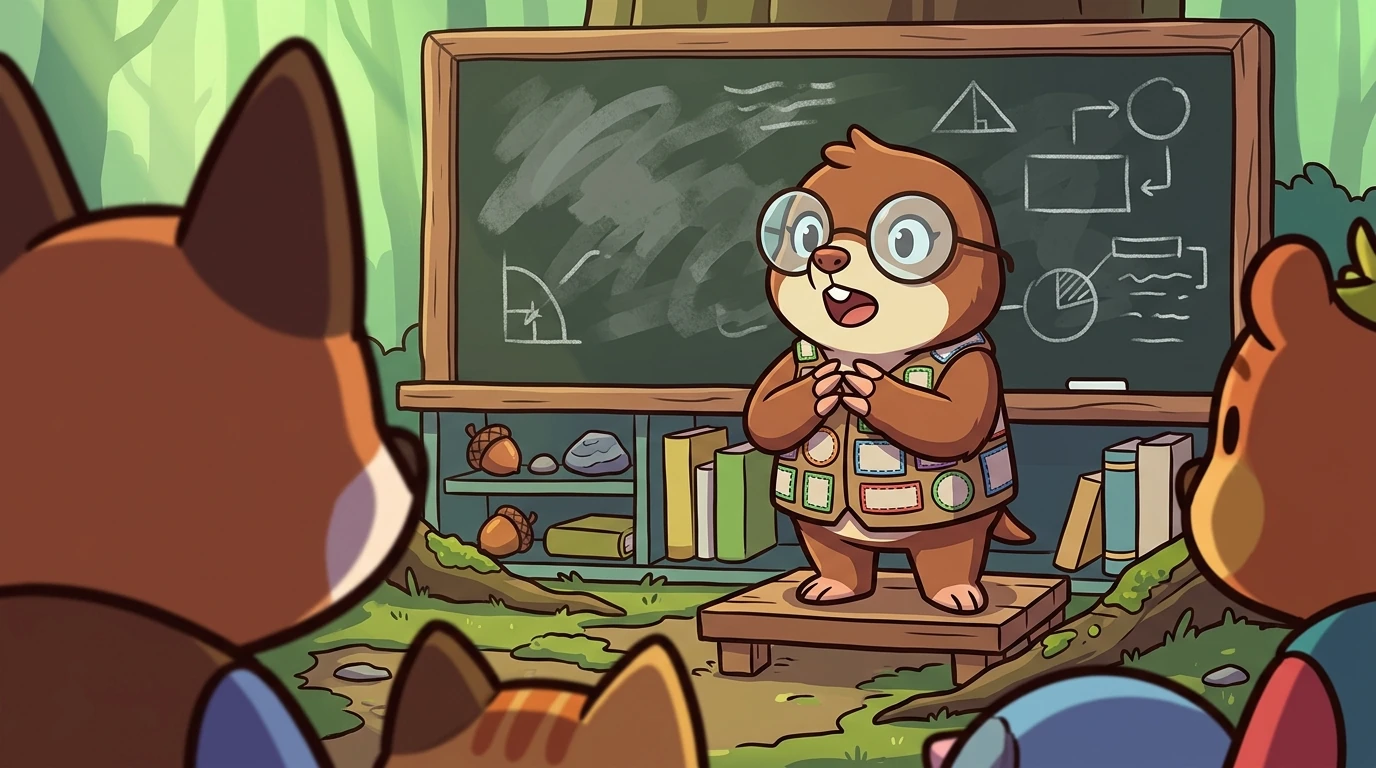
Niche stood at the edge of the pond, peering over her chunky round spectacles at a beaver hauling a branch. Her warm-brown mole-fur was neatly brushed, and her patchwork vest — crowded with tiny embroidered job-labels — caught the morning light. As the beaver wedged the branch into its dam, she tapped one label on her chest. Then another. Then a third. Under her breath she named what she saw: builder of the dam, maker of the wetland, thinner of the crowding trees, food for the things that hunt at dusk. One animal, four jobs, and behind each job a whole tangle of other lives leaning on it. She smiled and made a small mark in her notebook. This was the thing she could never stop doing — watching a creature and counting the quiet work it did that nobody had bothered to notice.
She had learned to count that way in her family's village, where the moles kept the job-board. Every season her grandmother chalked up who did what — the rope-maker, the well-digger, the soup-cook, the lamp-tender, the road-mender — so that nobody's work went unseen.
The winter Niche was six, the old bee-keeper died, and the board went quiet where her name had been. Niche watched, over the next months, the small holes open up: no one to tend the hives, then fewer bees, then thinner fruit at harvest, then the jam-maker with nothing to boil. "See?" her grandmother said, chalk in paw. "One name comes off the board and the hole travels. Every job holds up jobs you cannot see from where you stand." Niche never forgot it. A village did not hold together because of its most admired citizen. It held together because the work fit together, and every worker — even the ones no one praised — was plugged into the whole.
She was twenty-two when she walked to the EcoSphere academy, her vest freshly labeled. Terra, the founder, pointed at a slug crossing the garden path and asked her, dryly, what it was good for.
Niche knelt, watched the slug a moment, and answered by doing. She turned over a nearby leaf, showed him the half-eaten litter beneath, and traced where the broken-down leaves fed the soil that fed the roots that fed the garden he was standing in. "It is doing three jobs I can see and probably two I can't," she said, tapping labels as she went. "You do not have to find it charming. The soil does not check whether you find it charming." Terra looked at the slug, then at the crowded vest, then at the mole who had answered a sneer with a leaf. He said nothing more; there was nothing left to prove.
Her first workshop began with the vest held open. "Pick any creature," she told the room. A boy said "eagle," expecting something grand. Niche nodded and started tapping. "Hunter, yes. Also a spreader of bones and nutrients where it feeds. Also a thing that keeps the rabbits from stripping a hillside bare. Also, when it dies, food for a hundred smaller lives." She looked up. "Never stop at the first job. The first job is the one that got the creature famous. The real answer is the list."
Then she introduced the sea otter, and her voice went careful. "Some workers hold up the whole floor. The otter eats sea urchins. Take the otters away and the urchins boom and shave the kelp forest down to bare rock — every fish, every crab, gone with it." She pressed a label near her collar. "A worker like that, whose leaving collapses everything, we watch most closely of all."
A girl objected. "But some animals are just extra, right? If two do the same thing—" Niche brightened. "Ah — then losing one is survivable, because another fills in. That's a mercy. But sometimes only one creature does a certain job, and then losing it is losing the job forever. The skill is knowing which is which." She showed them how two similar birds could share a tree by working slightly different branches — small differences in the work that let them both belong instead of fight.
"Here is the one thing to carry out the door," she finished. "The slug is not the panda. Nobody is putting the slug on a poster. But both are holding up their corner of the world, and the world does not run on posters." She caught a student wrinkling his nose at the slug and shook her head, gently. "Feeling it's gross isn't a mistake. That's just the poster-thinking leaking in. Beat it by finding the jobs you hadn't noticed — there are always more."
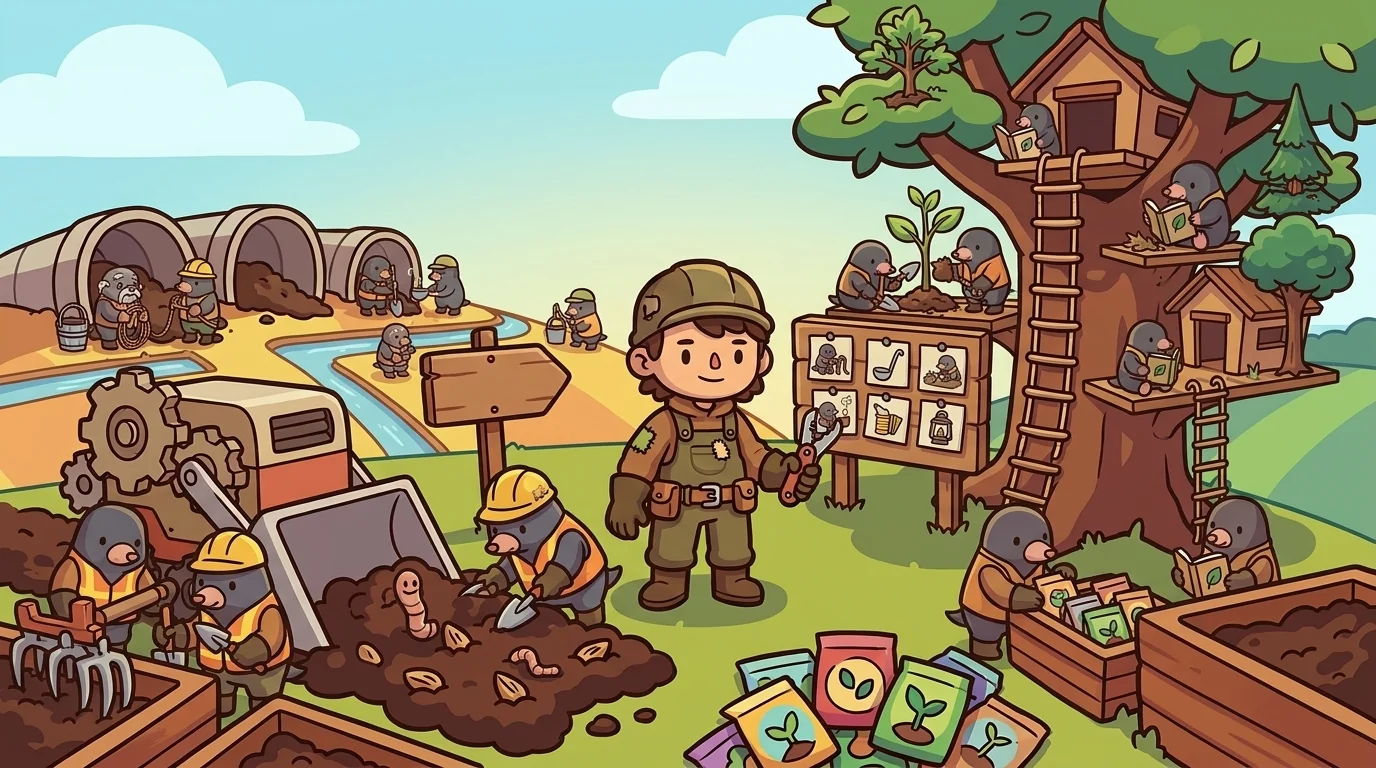
After class, a quiet girl lingered, the kind who never got picked first for anything. "The animals nobody notices," she said slowly. "The ones doing the quiet jobs."
"Those are the ones holding the floor up," Niche said softly. She watched the girl turn that over — watched her glance down at her own hands as if wondering what quiet, unnoticed work of her own might be holding up something larger. "Overlooked isn't the same as unneeded," Niche added. "Never has been." The girl looked up, and something warm and steadying moved across her face, a small unclenching, as though a label she'd been missing had finally been tapped onto her own chest. Niche closed her vest gently, glad all the way down. The next creature was already waiting to have its quiet work seen.
The EcoSphere ensemble
Niche is part of EcoSphere's distributed-narrative cast. Each character embodies a different curricular primitive; together they teach the full subject.
-

Chain
Food chain / trophic flow (energy moving up levels)
-
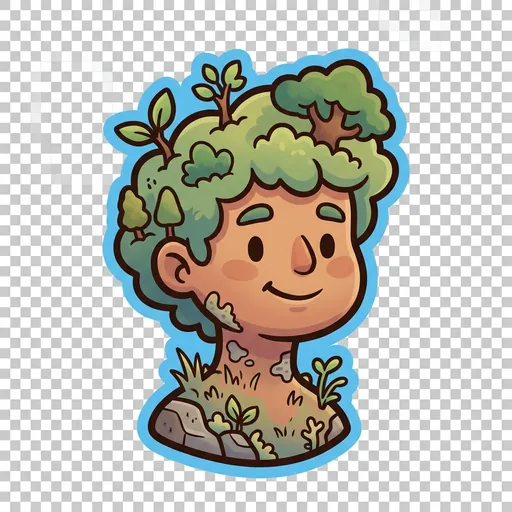
Phase
Succession / ecosystem change over time (primary, secondary, climax)
-

Crown
Canopy / trophic-pyramid structure (top vs. base)
-
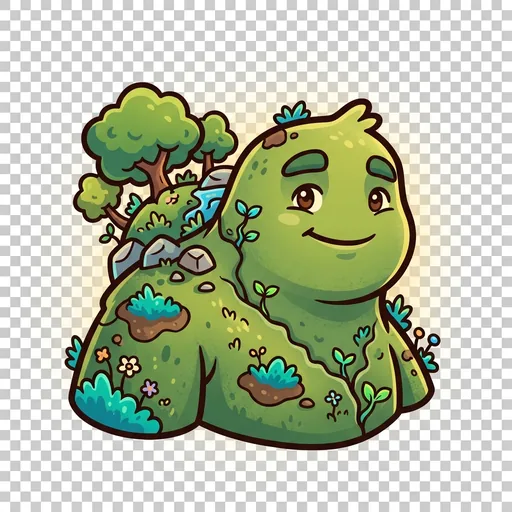
Brink
Tipping points / ecosystem thresholds / resilience-or-collapse
-

Cinder
Carbon cycle — the same carbon moves round and round: air to plant to animal to air
-

Lodge
Keystone species — one species that holds a whole ecosystem together; remove it and the web unravels
-

Mulch
Decomposition — what dies doesn't leave; it is broken down and handed back to the living
-

Rill
Water cycle — the same water goes round forever: sea to sky to rain to stream to sea
-
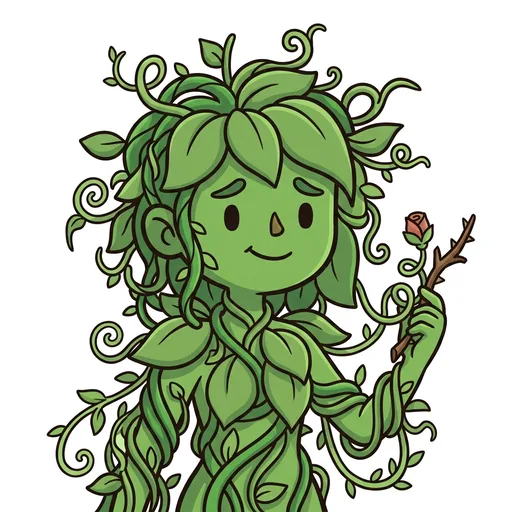
Sprawl
Invasive species — a species carried somewhere new, where nothing holds it back