Press
MIDNIGHT ZONE — *1000–4000m. pitch black. crushing pressure. cold. and life still thrives.*
Loading audio…
Press play to listen along. The line being read lights up as you go.
Show full transcript
Loading transcript…
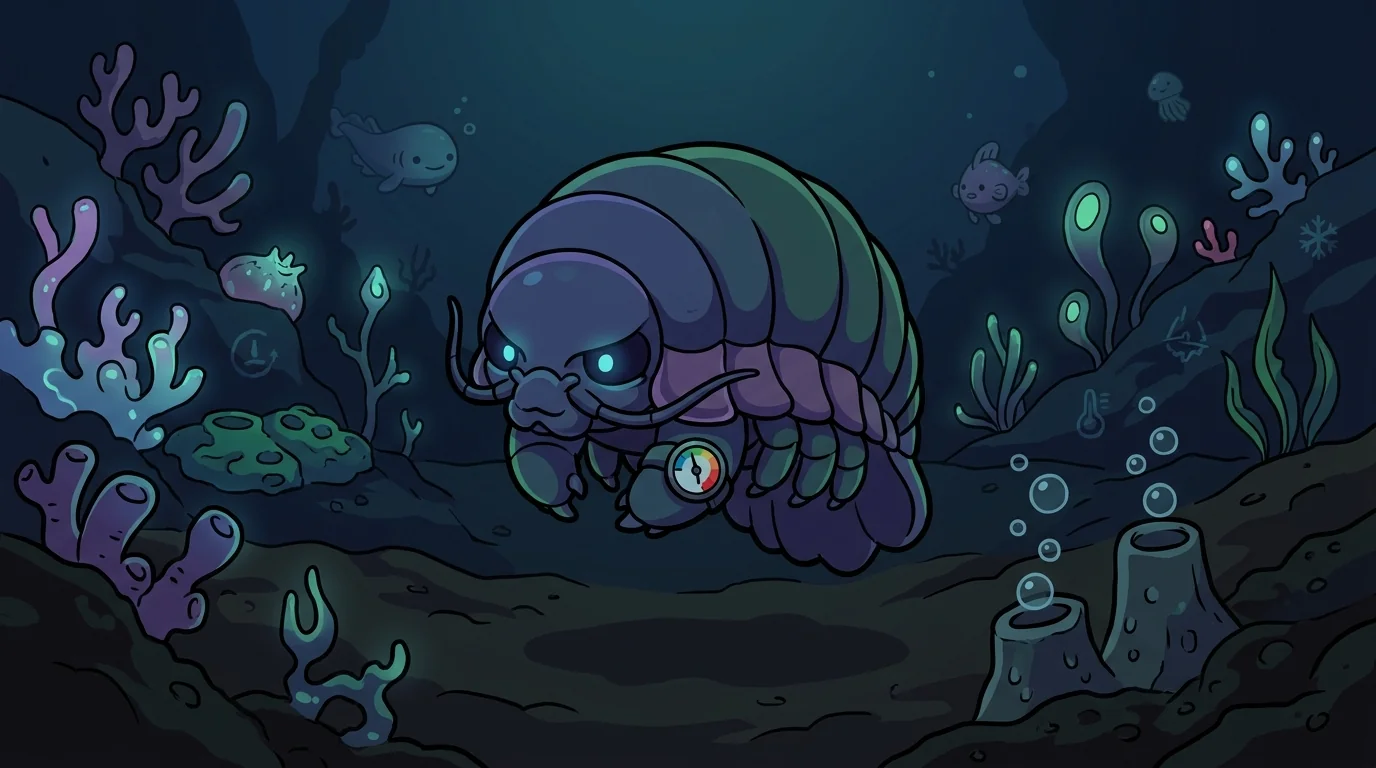
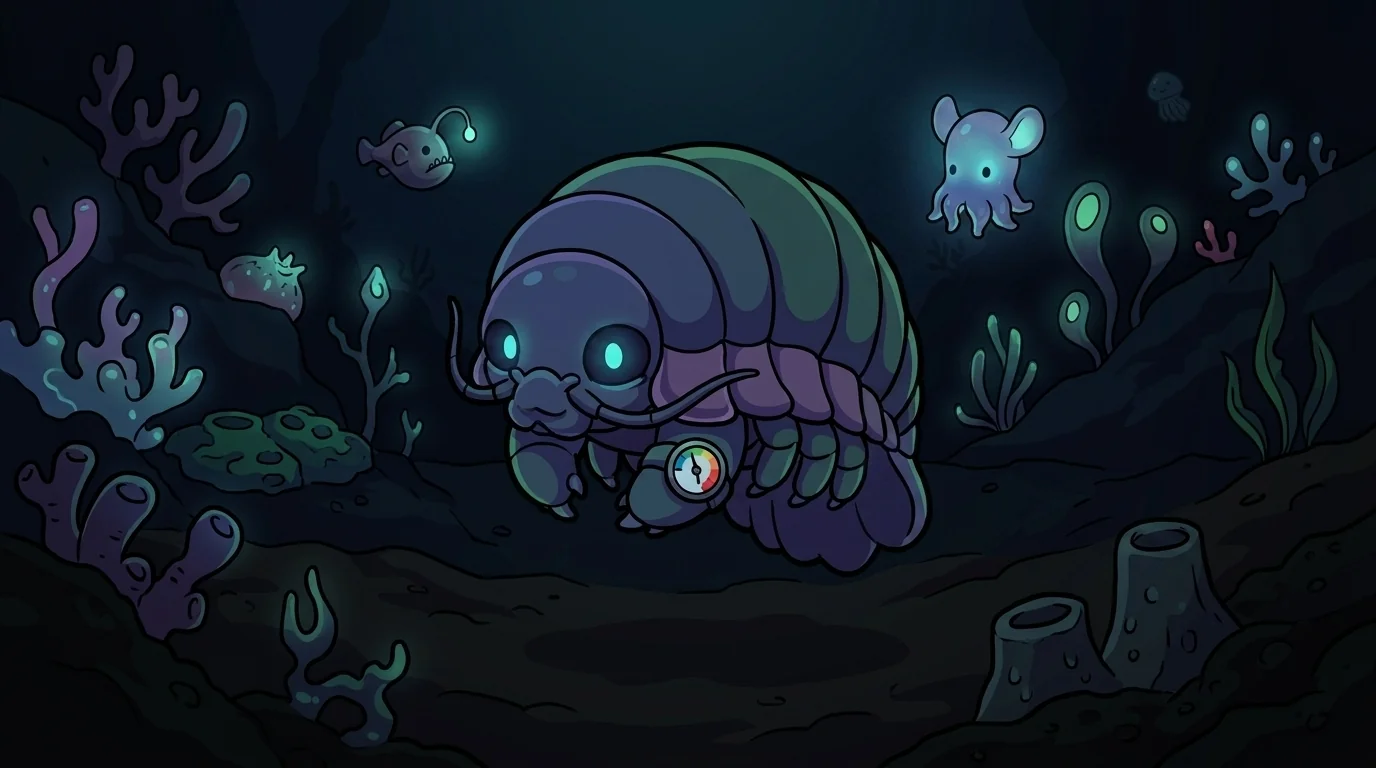
Three thousand meters down, in a blackness so total it pressed against the eyes like felt, Press drifted between two ridges of cold rock and did the thing she did best: nothing dramatic at all. She was a giant-isopod-tween, low and rounded, soft as a smooth deep-violet-and-cream stone, and she let herself sink the last few meters without a flicker of worry. On the strap at her wrist a small pressure-gauge glowed. Its needle sat past a hundred atmospheres — the weight of a small car resting on every square inch of her — and she never once glanced at it to check she was alright. She knew she was alright. A comb jelly pulsed past, trailing rainbow light along its ribs, and Press turned to watch it the way a surface child might watch a firefly on a warm night. "Everyone thinks this place would crush them flat," she murmured to no one, tapping the gauge fondly. "And it would. It just doesn't crush me." She kept drifting, at home in the crushing quiet, gathering the marine snow that sifted down from far above like the slowest, gentlest weather in the world.
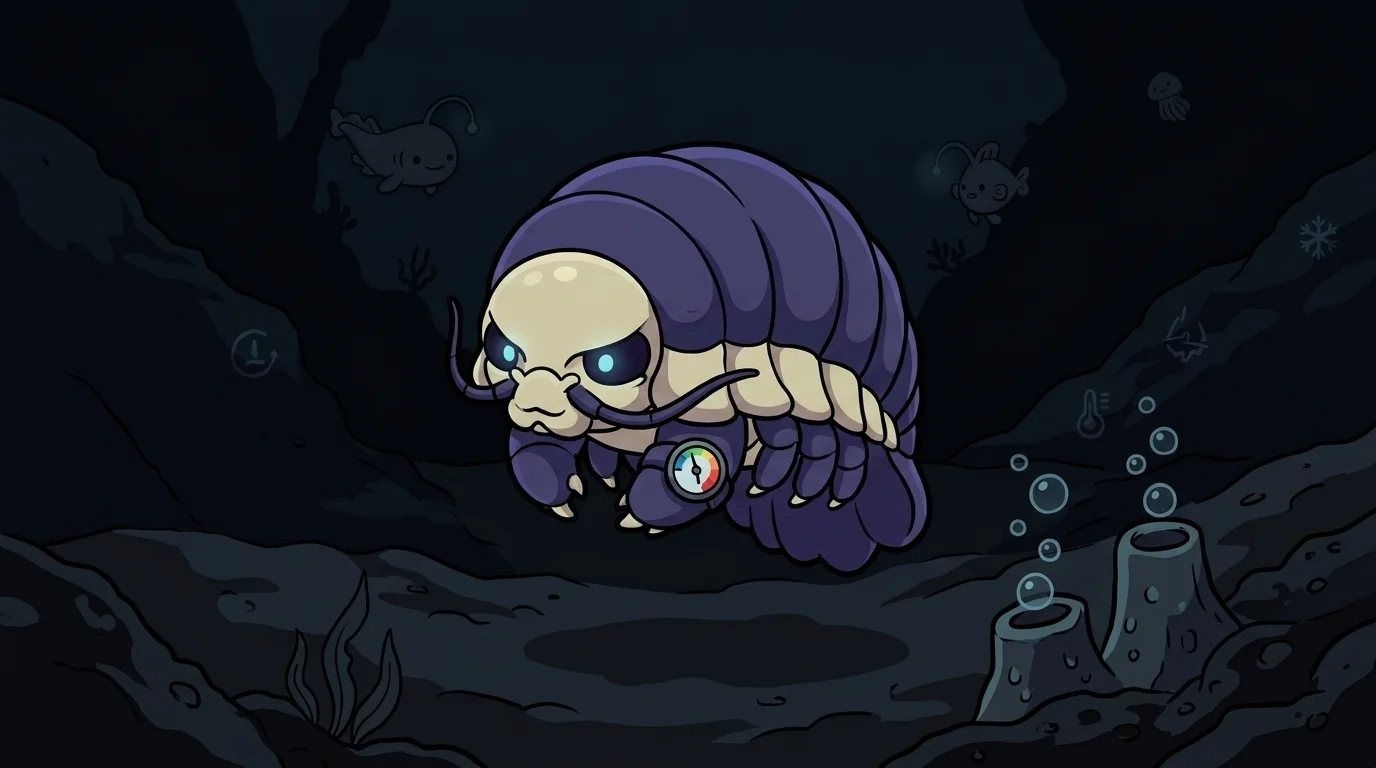
Press had learned the truth of the deep when she was very small, on the day her cousin got scared.
They were both isopod-hatchlings then, poking along the abyssal plain where their family had scavenged for generations. A research submersible had come drifting down out of the dark, all lights and whirring propellers, and inside it a surface-diver pressed her palm to the glass and stared out at the two of them with an expression Press had never seen before. Wide eyes. A mouth open in something like fear.
"She's frightened of us," her cousin whispered, backing under a rock. "Are we monsters?"
Press didn't back away. She crept closer to the glass instead, close enough to see the diver's gauges spinning wild, the frost creeping across the seals, the way the whole machine strained and creaked against a pressure that was, to Press, simply the ordinary weight of home. The diver couldn't last five minutes down here without a steel shell around her. Press had been born into it.
"She's not scared because we're monsters," Press said slowly, understanding it as she spoke. "She's scared because she can't live here. And we can. That's the whole difference." She watched the submersible rise back toward the far-off light, and something settled in her chest — a quiet, sturdy certainty. What looked extreme to a visitor was only home to a resident. She never forgot it. She wore a pressure-gauge from that day on, not to warn her of danger, but to remind her, every time she glanced down, exactly how much weight she carried without effort — and how much wonder that ought to be, instead of fear.
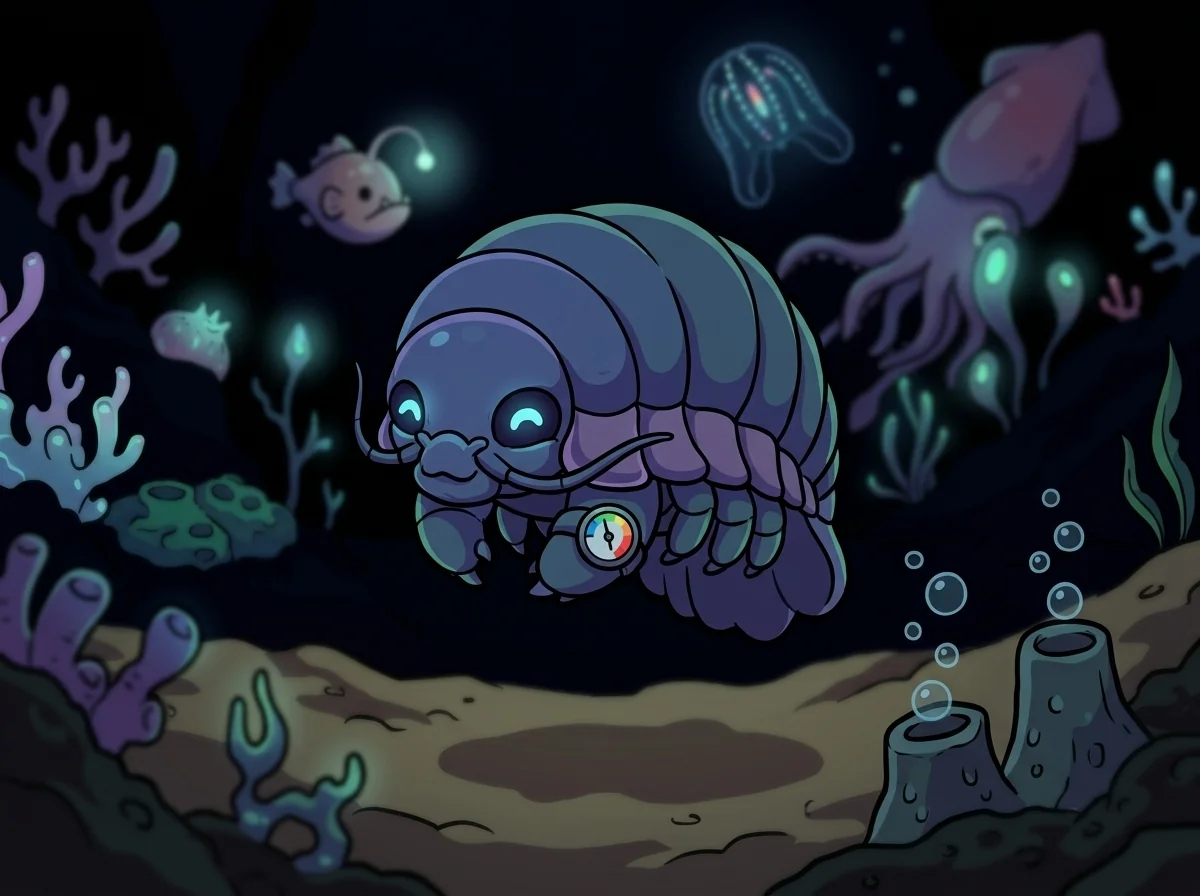
When she was twelve, Press made the long swim up-slope to DepthQuest village, and Marlin, the old mentor, met her at the edge of the light with a single question. "What is the midnight zone?"
Other candidates, she'd heard, answered by shivering — by calling it crushing, lightless, hostile, a place where nothing should live. Press did the opposite. She simply hovered there in front of him, perfectly relaxed a thousand meters below where any surface creature could survive, and let her stillness answer first.
"One thousand to four thousand meters," she said. "Pitch black. Cold as ice. Pressure like a hundred elephants." Then she smiled, unbothered. "And absolutely packed with life. Giant squid. Anglerfish. Vampire squid. Every one of them built exactly for it." She lifted her glowing gauge so he could read the needle pinned past a hundred atmospheres. "I'm not describing a nightmare, Marlin. I'm describing my street."
Marlin looked at the needle. He looked at how calmly she held herself in the dark. He didn't need her to recite anything more. "Then teach it that way," he said, and waved her through the gate.
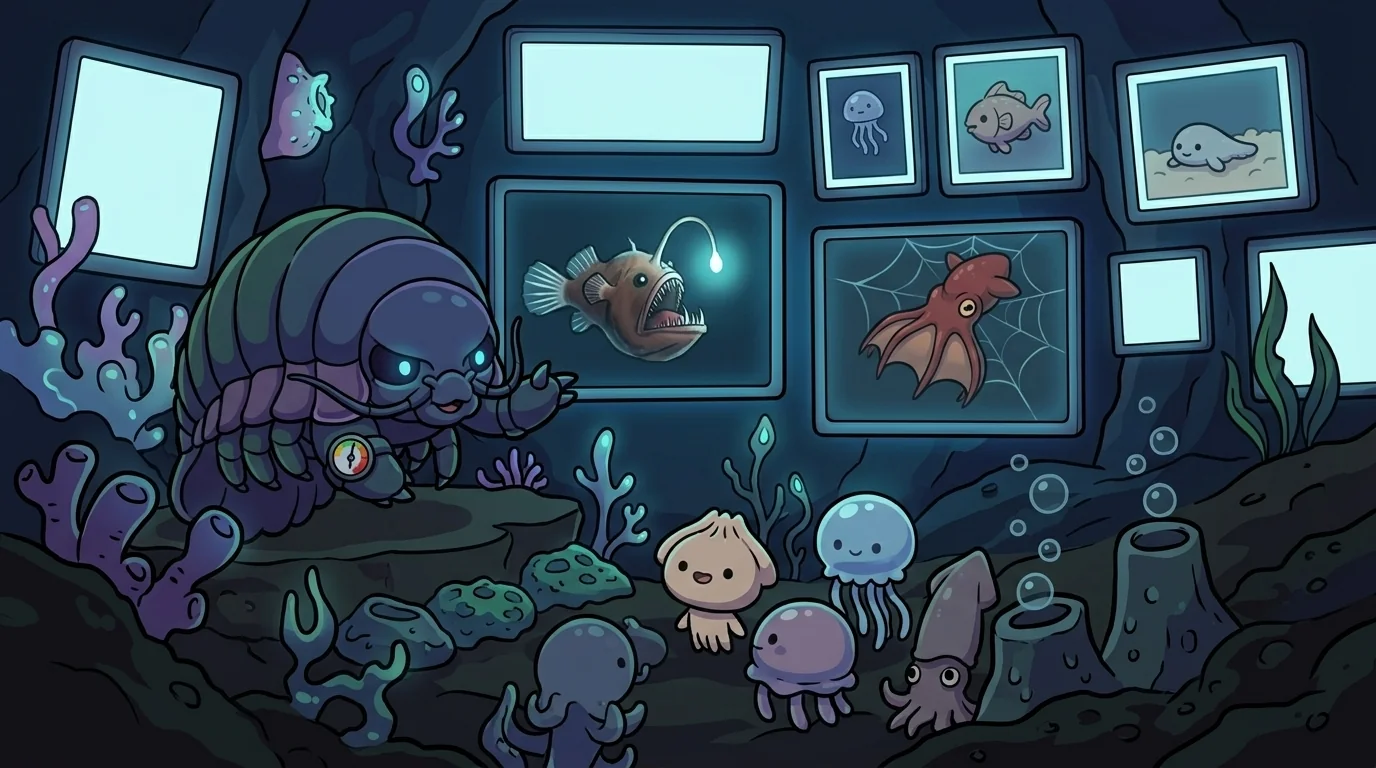
Press's workshop had no lecterns, only a wide dark tank and a wall of slow-motion footage. When new students arrived — usually clutching each other, spooked by the black water — she'd dim the lights further, not brighter, and let a female anglerfish swim into view, its little lure glowing.
"Watch what she does with the dark," Press said quietly. A hush fell. The anglerfish flicked her light; a shrimp drifted toward it; she struck. "She's not haunting anyone. She's fishing. Down here there's no sun to see by, so she grew her own lamp. That's not scary. That's clever." She let a girl in the front reach a fin toward the glass. "Now — how does she not get squashed? Feel your own body. You've got air spaces inside you, right? Lungs. Down here those would collapse." She swiped to a jellyfish, then a squid, soft and boneless. "So her kind gave up hard shells and air pockets entirely. Soft bodies don't crush — there's nothing hollow to cave in. And inside her cells, tiny helper molecules called piezolytes prop everything open so the machinery keeps running under all that weight."
She let a vampire squid unfurl its dark webbed arms across the screen, and a boy flinched. Press just chuckled. "Everybody flinches at this one. But he doesn't drink blood — he eats the marine snow that falls from above. Vegetarian, basically." She turned back to the class, her voice dropping to the register of a shared secret. "And the cold? Watch how slowly they all move. They barely burn any energy. Their enzymes — the little tools inside their cells — work best when it's near-freezing. Some even carry antifreeze in their blood, like a car in winter. Nothing down here is fighting its world. Every single one of them fits it."
The girl in the front row stayed behind after the others drifted out. "Press," she asked, "they still look so strange, though. Doesn't that mean something's wrong with them?"
Press settled beside her in the dark, letting the anglerfish's lure drift and glow between them. "Strange," she said gently, "just means built for somewhere you've never been. If you'd grown up in crushing pressure and total night, you'd look strange to a surface fish too. You'd probably have a lamp on your head and think it was the most normal thing in the world." The girl laughed, a small startled sound.
"They're the same kind of marvel as a giraffe," Press went on, watching the lure sway. "A giraffe just evolved for tall trees. These evolved for the deep dark. Same wonder — different address." She rested a fin lightly on the glass, and for a moment neither of them spoke. Out past the light, the marine snow kept falling, slow and endless and calm.
And sitting there in the quiet dark that terrified everyone else, Press felt what she always felt down here — not brave, not frightened, just held. Steady. Utterly, warmly at home. "That feeling," she said softly, "the one where somewhere everyone calls scary feels like the safest place in the world — hold onto it. It means you've stopped seeing monsters. It means you've started seeing neighbors."
The DepthQuest ensemble
Press is part of DepthQuest's distributed-narrative cast. Each character embodies a different curricular primitive; together they teach the full subject.
-

Reef
Sunlit zone — coral + photosynthesis-zone biodiversity
-

Drift
Twilight zone — bioluminescent + migratory species
-

Smoke
Abyss zone — hydrothermal vents + chemosynthesis
-

Trench
Hadal zone — deepest trenches + extreme-adaptation
-

Cling
Intertidal zone — the strip of shore underwater at high tide and open air at low; life that clings between the tides
-

Drizzle
Marine snow — the constant gentle fall of food from the sunlit top to the dark deep (the biological pump)
-

Gyre
Ocean currents — the great moving conveyor carrying water, heat, and life in slow giant loops
-

Neap
Tides — the moon and sun pull the whole ocean; twice a day the sea rises and falls
-

Sonar
Sound in the sea — light dies fast underwater but sound travels far; send a click and read the echo