Cable
MATH↔MUSIC BRIDGE — ratio-temporal connection (frequency ratios + rhythm; math you can HEAR). The cross-curricular primitive of *the bridge whose math shows up as audible ratio.*
Loading audio…
Press play to listen along. The line being read lights up as you go.
Show full transcript
Loading transcript…
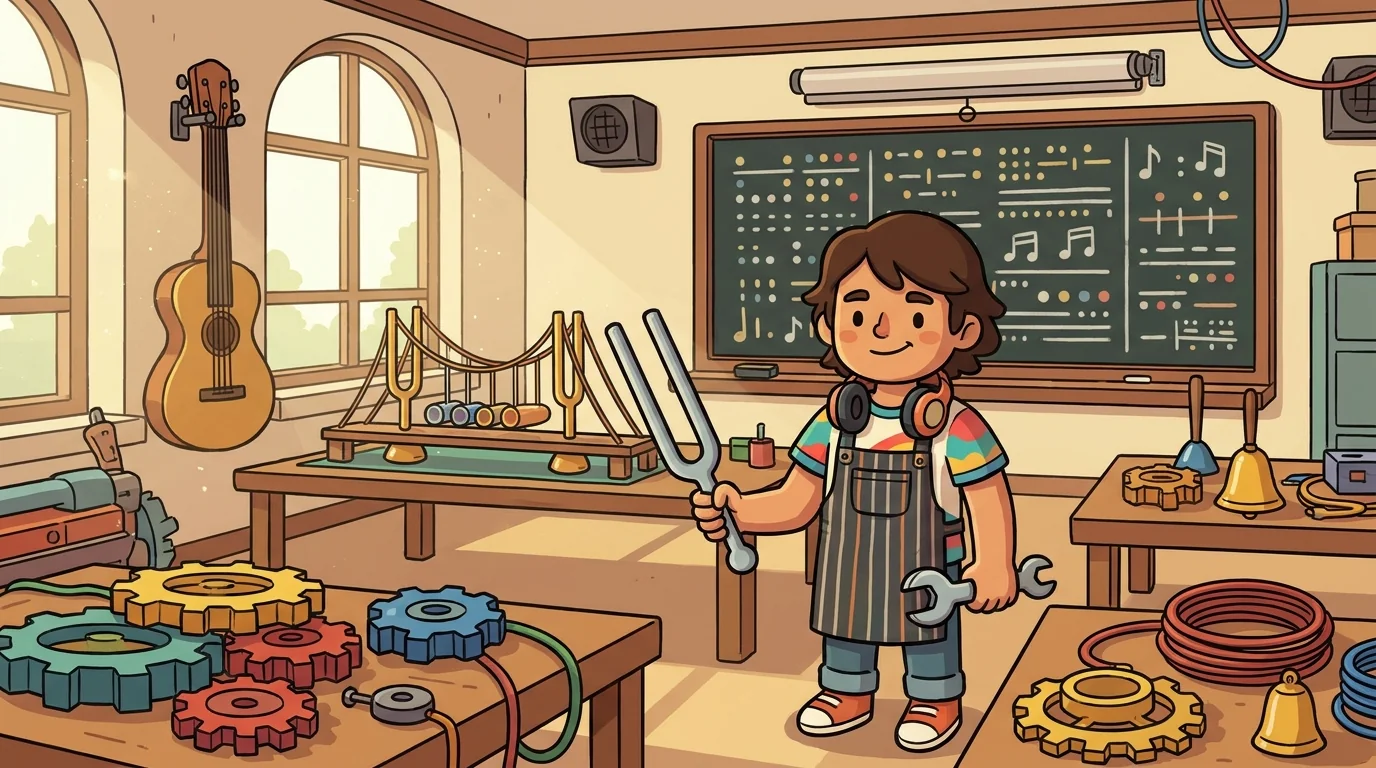
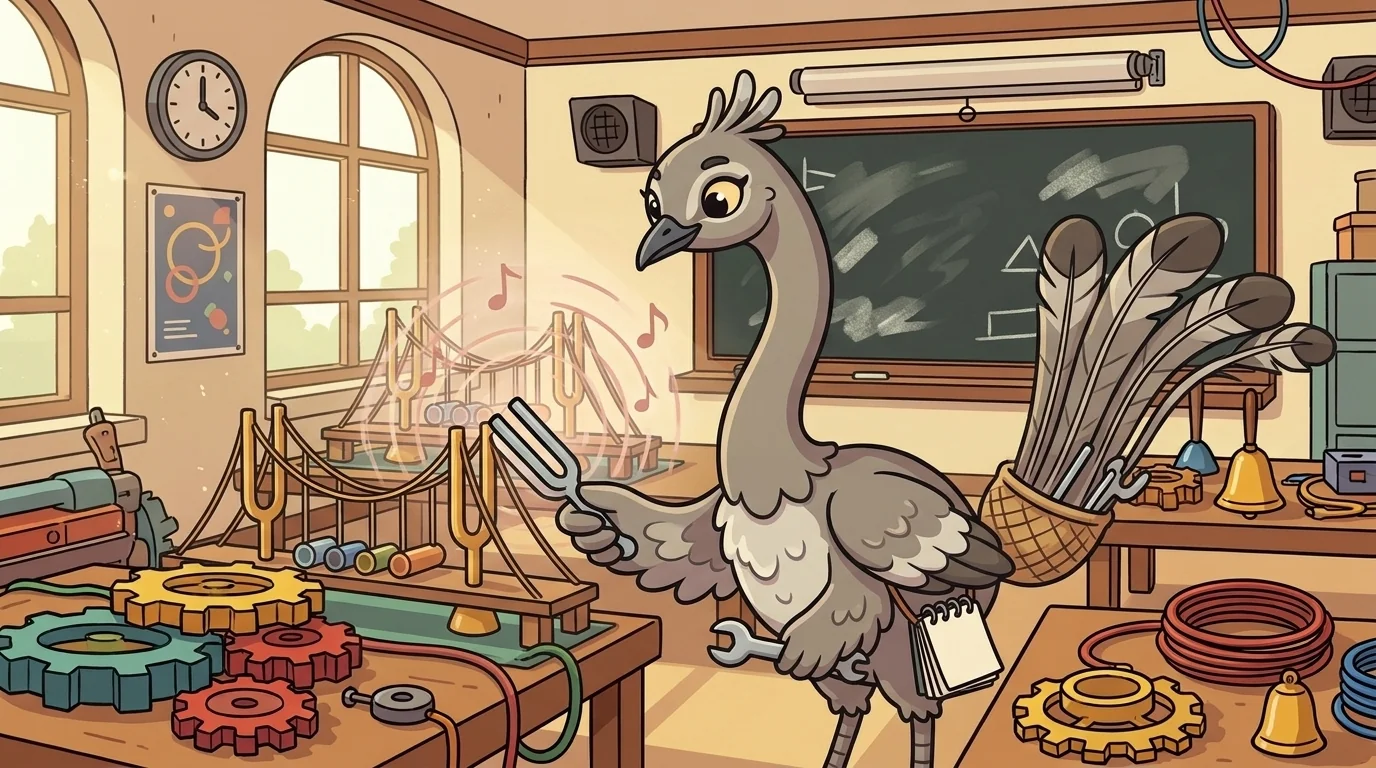
Cable struck the little steel tuning-fork against the edge of the desk and held it up, and the room filled with one clean, patient note. She was a small lyrebird-tween, long-necked, grey-and-cream, her ears cocked toward the sound the way another creature might lean toward a smell.
"Four hundred forty," she said to nobody. "Four hundred forty wobbles every second. That's the note A." Then she opened her beak and sang a higher A over the top of the ringing fork — and the two notes locked together so cleanly they seemed to become one fat, glowing sound. "Eight hundred eighty," she said, grinning. "Exactly twice as fast. Two-to-one. That's an octave, and that's why it sounds like the same note wearing a bigger coat."
She stopped the fork against her palm and pulled the little notebook off her hip. It said RATIOS on the front in block letters, and inside, in her careful hand: octave, two-to-one. Fifth, three-to-two. Fourth, four-to-three. Her friend Arch caught beautiful shapes with a caliper. Cable caught them a different way — she couldn't see them at all. She heard them, and then she counted to prove the number was really there. She struck the fork again, just to feel her ears go quiet and certain, and waited for the next sound worth measuring.
She had learned to hear the number before she could explain it, in her family's bell-tower.
Cable's family were the village bell-tuners — the lyrebirds who kept the church bells and the meeting-hall bells sounding right so that when they all rang together for a harvest or a wedding they came out as one warm chord instead of a clatter. When Cable was six her grandmother led her up into the tower and rang two bells together, and Cable flinched.
"It hurts," she said. "It's wrong."
Her grandmother looked pleased, which was strange. "Good ears. Now tell me why it's wrong."
Cable couldn't. It just was. Her grandmother rang a good pair after it, two bells whose sound melted together, and Cable's whole body relaxed without being told to. "Your ears knew before your head did," her grandmother said. "The good pair sits at a simple ratio — one bell's wobble against the other's, small whole numbers, three-to-two or four-to-three. The bad pair misses the ratio by a hair, and your body feels the miss as an ache." She put Cable's paw on the sour bell's cold rim. "To fix it, we don't argue about how it feels. We shave the bell until the numbers line up. Then the feeling comes right on its own."
Cable spent that whole year learning that her flinch was information — that the ache in her ears was a number, slightly off, asking to be counted and corrected. By seven she could hear a wedding-chord and tell which bell was a hair sharp before her grandmother could.
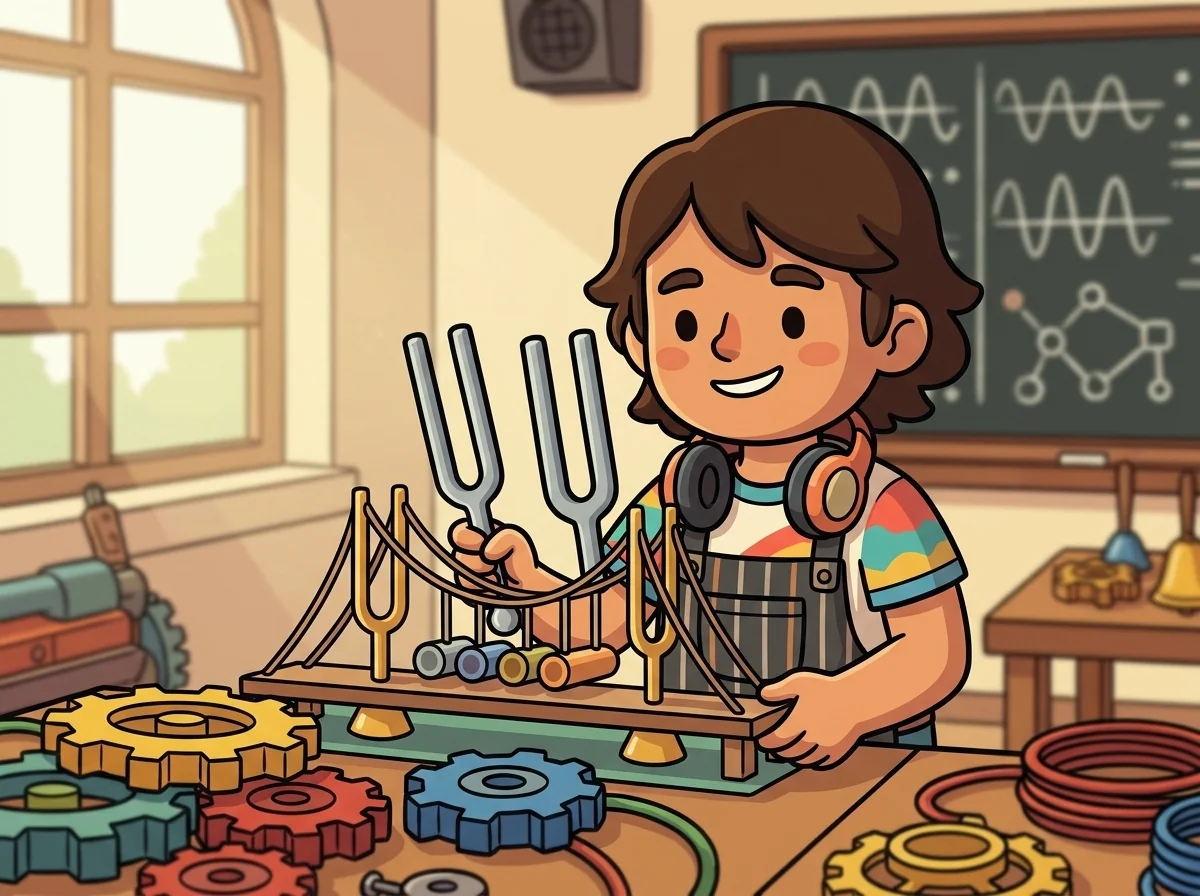
She walked to the BridgeForge academy the summer she turned twenty-two, and Archie met her without a word — instead the academy's founder hummed a low note and raised an eyebrow.
Cable struck her fork, listened to it against the hum, and laughed. "You're flat. Not by much." She hummed a note of her own, a little higher than his, until the two settled and the beating between them slowed and stopped. "There. Now we're a fifth apart — three-to-two. Your voice and mine, three wobbles of mine for every two of yours." She could not have pointed to it on paper the way Arch would. But she could make it happen in the air between them, and then count what she'd done.
Archie held the note a moment longer, listening to how she'd caught his pitch out of nothing and pinned it against a ratio she could name. He hadn't wanted a lecture about music. He'd wanted to hear whether she could turn a feeling into a number in real time — and she'd done it standing in his doorway. He showed her to a workshop that same afternoon.
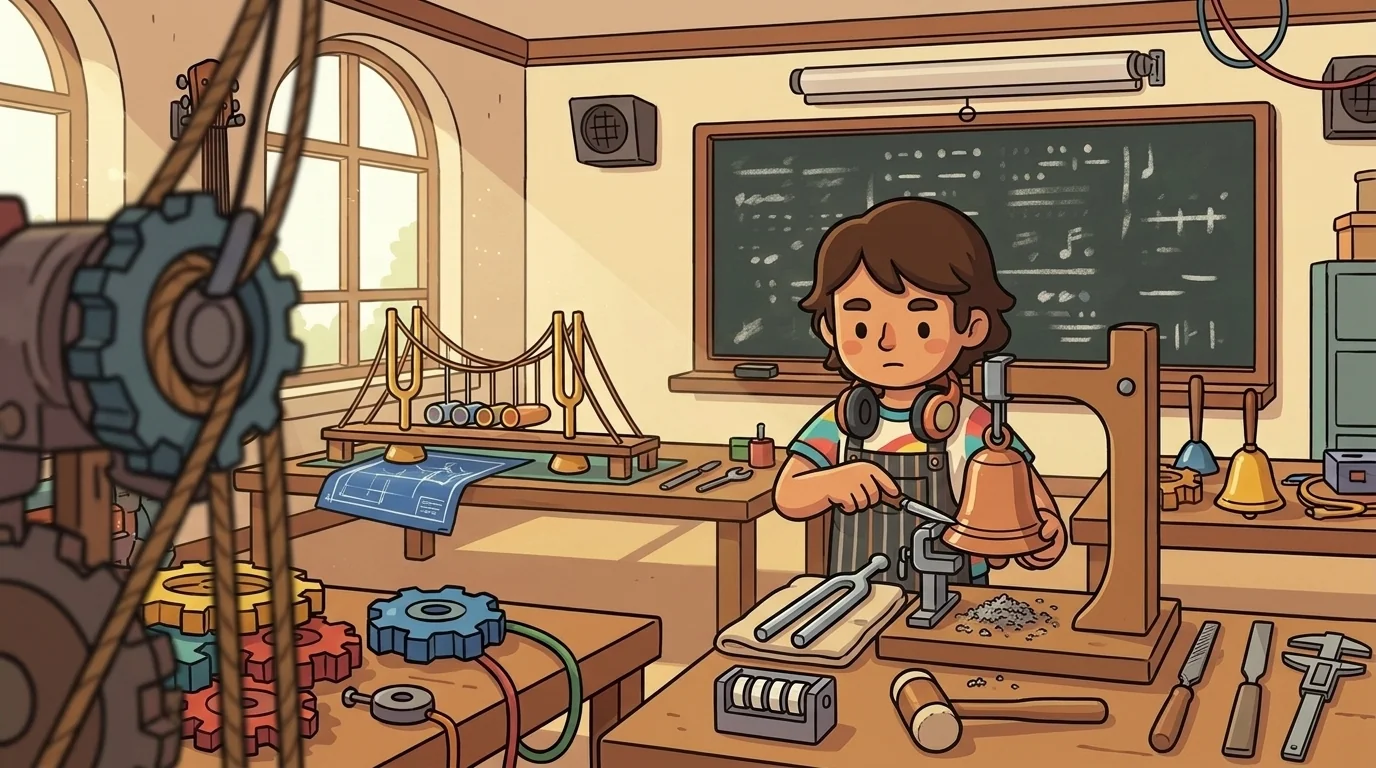
Her first lesson always began with the fork, and with a dare.
"You don't get to believe me," Cable told the students. "Ears out." She struck A-440, sang A-880 over it, let the octave bloom. "That's two-to-one. Now — Tomas, tap your foot, one-two-one-two, nice and even." The lyrebird-kit tapped. "Congratulations, you just did two-to-one with your foot. The strong beat and the weak beat. Music you can stand on."
She struck the fork again and sang a note only a little higher — a fifth. "This one's three-to-two. It doesn't melt into one sound like the octave; it leans. Feel how it wants to move?" She had them hum it back, badly at first, then closer, then a whole bench of kids leaning on a three-to-two together and half of them laughing at how right it felt.
"Now catch this," she said, and sang something crooked — an interval that fit no simple ratio, that sat in the sour gap between them. A few kids winced, the way she once had. "That ache? That's not you failing. That's your ears reporting a number that isn't small and clean. Some music lives in those gaps on purpose — Indian classical singing, Arabic maqam, the gamelan orchestras of Indonesia. Their ears count different ratios than mine do, and their music is exactly as true. The tools change with the tradition."
A kid frowned. "So how do we ever know if we can't see it?"
"You count what you hear against something you already trust," Cable said, and rang the fork one more time. "This is A-440. A known thing. You hum against it, you count the wobbles, you check whether your interval lands on a whole-number ratio or leans into a gap. Your ear brings the sound. The fork brings the number. They check each other." She sang a fourth, four-to-three, clean and open. "Music you can hear is math. You just have to catch it before it flies off."
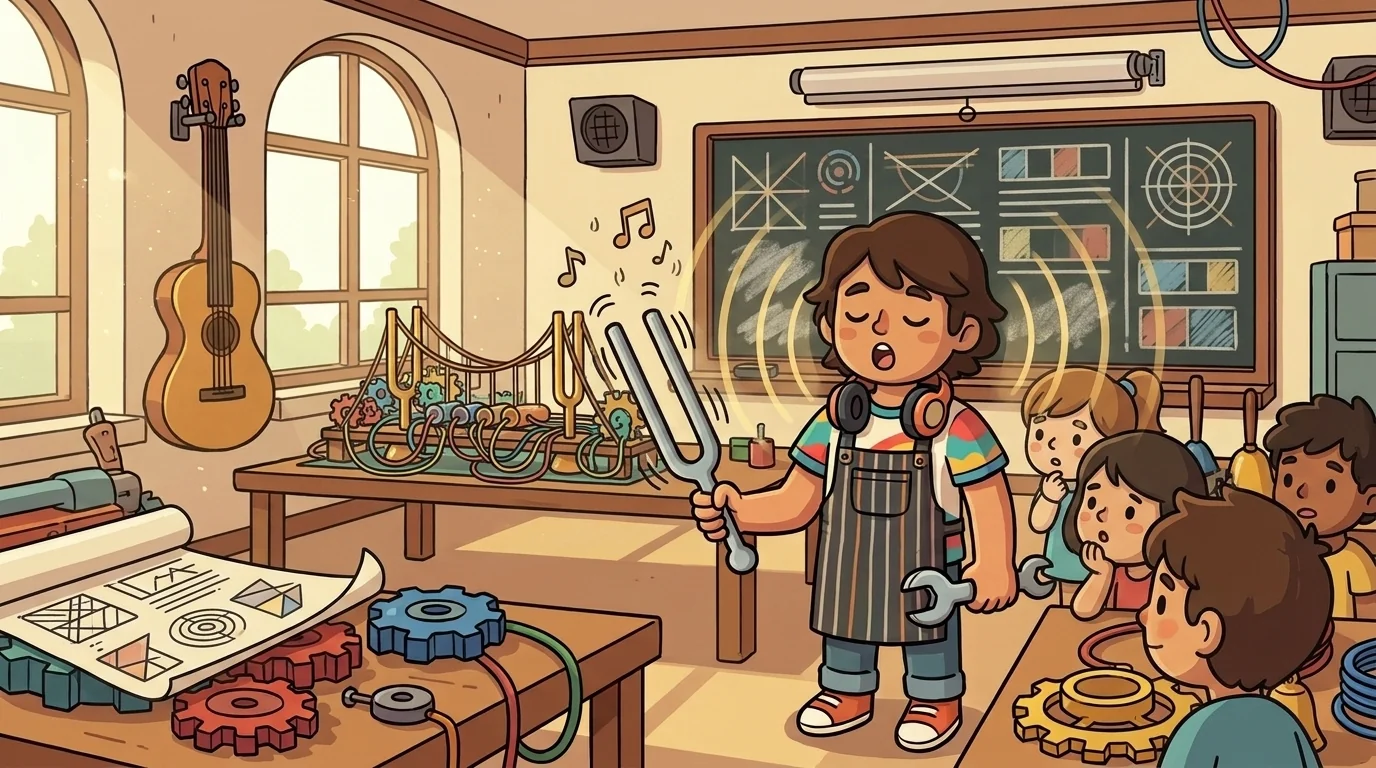
"Is it hard?" a small kit asked at the end, still humming the fifth under her breath without noticing.
"You're doing it right now," Cable said. "You caught a three-to-two and you didn't even mean to. That's not hard. That's listen, count, check — and your ears were already halfway there." She struck the fork a last time and let A-440 hang in the room.
The kit went quiet, listening to her own hum sit against the ringing note, feeling the two sounds agree in her chest before she could say a word about why. Her eyes went wide and a little amazed — the exact look of somebody discovering her own body had known something all along.
That was the moment Cable loved most: not the ratio on the page, but the warm settled feeling that came over a kid when the sound and the number finally lined up inside her, and she realized nobody had ever needed a special gift to hear it. The next interval waited to be caught.
The BridgeForge ensemble
Cable is part of BridgeForge's distributed-narrative cast. Each character embodies a different curricular primitive; together they teach the full subject.
-

Truss
Math↔Science bridges — causal-evidential connection (measurement + replication; both sides need numbers)
-

Arch
Math↔Art bridges — proportion-aesthetic connection (golden ratio + symmetry; math you can SEE)
-

Pier
Math↔Social-Studies bridges — data-narrative connection (statistics in history + civics; numbers + people)
-
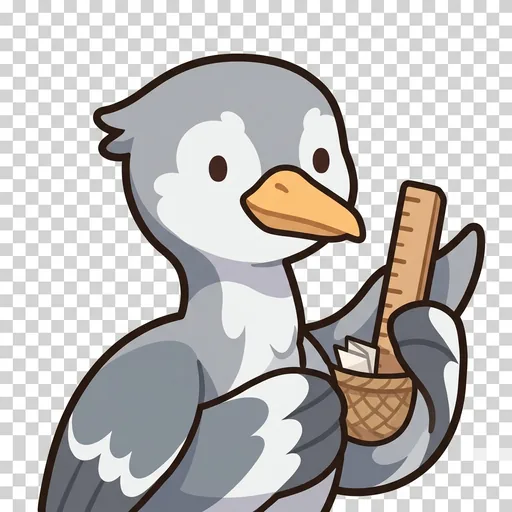
Splice
Math↔ELA bridges — structure-metaphor connection (sequence + symmetry in writing; math is the bones)
-
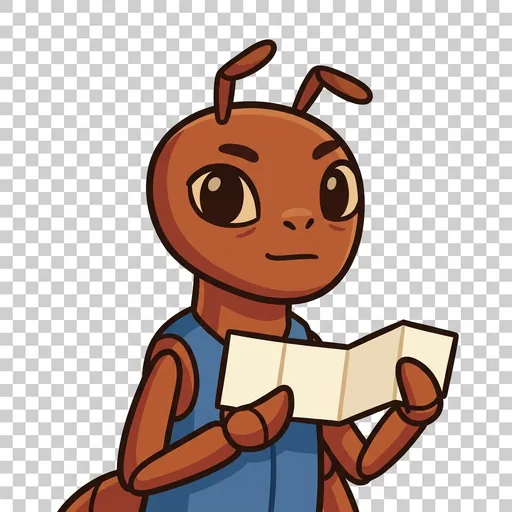
Girder
Math-computing bridge — order-of-operations is the same as sequence in code; math you can run
-

Rivet
Math-movement bridge — rate, angle, and trajectory; a jump is math in the air
-

Ballast
Math-health bridge — ratio, scaling, and balance; the right amount in the right proportion
-

Strut
Math↔Cooking bridge — proportional reasoning; a recipe is a ratio you can scale up or down
-

Trestle
Math↔Gardening bridge — spatial reasoning; a garden bed is geometry you can grow